
News
Drug War: NDLEA ‘ll deploy personnel in 774 LGAs in 2024 – Marwa


Drug War: NDLEA ‘ll deploy personnel in 774 LGAs in 2024 – Marwa
. Katsina Gov. Radda seeks partnership with Agency
By: Michael Mike
Personnel of the National Drug Law Enforcement Agency (NDLEA) are to be deployed in all 774 local government areas of the country.
The Chairman/Chief Executive Officer of Brig. Gen. Buba Marwa (Retd) of the agency who said the deployment would be made sometimes in 2024, revealed that the was part of efforts to strengthen the war against substance abuse and illicit drug trafficking especially in local communities.
He stated this while responding to request for partnership and deployment of more NDLEA officers in all parts of Katsina State by the state governor, Dr. Dikko Umaru Radda to tame the problem of drug abuse and insecurity.
Marwa said with the agency’s staff strength expected to rise to 15,000 by the end of the year, the next “development is to deploy in the LGAs. We currently have zonal commands, state commands, and area commands. We want to go to the LGAs for the offensive action and the advocacy work. We would need more support to succeed. I appreciate the work of the Katsina governor as the challenges are numerous in governing the state. But if insecurity is a problem and is fueled by drugs, I believe we have to collectively take it out of the security equation.”
He commended Governor Radda for his efforts to surmount the various challenges faced and enhance the socio-economic development of the state.
He noted that: “The drug menace is a huge issue and has destroyed the lives of our youths and communities. It is the public enemy number one, and especially the criminal aspect of it. 99% of the criminals must first have access to drugs and be under the influence to perpetrate some of their acts. That is why the NDLEA under the collective support of the directorates and the management has put all efforts towards operation ‘offensive action.’ This involves going out to seize all drugs cultivated, imported or on the verge of being exported out of the country.
“Over 6,668 tons of illicit substances have been seized in two years, and we assure that we will continue relentlessly until the streets are clean of drugs. This is the drug supply reduction aspect, where we arrest the perpetrators of the act, and over 36,096 suspects have been arrested and more than 6,043 already prosecuted and convicted within this period.”
He said the other side of the fight is drug demand reduction, which focuses on prevention, treatment and aftercare of drug dependent persons. “The preventive measure faces those who have not started or are about starting drug use. They are targeted through advocacy and sensitisation across all levels. It is for this reason we structured the WADA initiative from the National to LGA levels. We appeal to the government to have a state drug control committee of which the NDLEA will be the secretary and the chairperson would be the First Lady of the state. The first ladies are in the strategic position, because they are the mothers and have the best interest of the government at heart.”
Speaking earlier, Governor Radda said he was at the agency as part of his government’s efforts to solve the problem of insecurity facing the state.
He said. “It is no longer news that the problem of insecurity has been ongoing for years and insecurity is one of the major issues confronting Katsina state. We receive unpleasant news almost on a daily basis on what has been the issues disturbing the state for a long time. We have taken some needful steps, we set up a Katsina community watch corps with locals to complement the efforts of the conventional security agencies but that is not enough. We decided to reach out to the NDLEA under the leadership of the Chairman/Chief Executive to combine our efforts and synergise to mitigate the effect of insecurity in the state. We must get to the root of the problem, and the root of the problem is drug abuse by the teeming youths in the state. We know that these inhumane acts cannot be committed without the influence of drugs.
“This synergy is important and I recognize that the NDLEA has been making a lot of efforts in supporting the government. But we still need more support from the Chairman/Chief Executive to stop the movement of drugs and ensure the arrest and prosecution of dealers in the state. We are appealing for better partnership and synergy to reduce the abuse of drugs, the activities of banditry and trafficking in the state. We hope the partnership will go a long way in alleviating the issues of the state and improving the economy. Once insecurity is reduced, economic activities will be conducted better. I appeal to the NDLEA for this support, and on behalf of the Katsina state government, we appreciate the NDLEA for the work you are doing. We hope this visit enhances a better working relationship between the NDLEA and the state.”
Drug War: NDLEA ‘ll deploy personnel in 774 LGAs in 2024 – Marwa


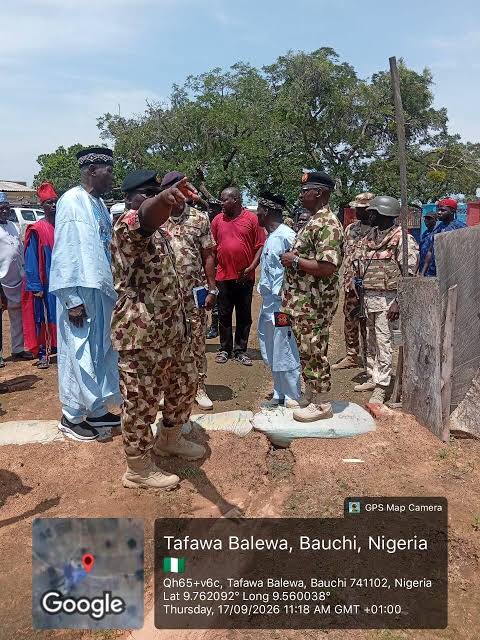
Army committee inspects sites for new 237 Tank Battalion in Bauchi
By Zagazola Makama
A high-level military committee has inspected proposed locations for the establishment of the newly formed 237 Tank Battalion in Tafawa Balewa Local Government Area of Bauchi State.
The inspection was conducted on Sept. 17, 2026, by a committee led by the Commander, 33 Artillery Brigade, Brig.-Gen. S.S. Shehu.
The delegation included the Bauchi State Commissioner for Lands, the Chief Security Adviser to the Bauchi State Government and the Chairman of Tafawa Balewa Local Government Area, among other officials.
On arrival at the headquarters of Sector 8, Sub-Sector 82, Operation ENDURING PEACE, in Tafawa Balewa, the delegation was received by the Sub-Sector Commander, Maj. F. Ogunleke.
Ogunleke subsequently led the committee on an inspection of selected temporary facilities being considered to accommodate the battalion.
Among the facilities inspected were the ATBU Annex and the Government Girls Secondary School, Tafawa Balewa.
The committee also assessed two locations being considered for the permanent establishment of the battalion one in Tafawa Balewa and another in Murno, Boto District of the local government area.
The inspection ended at about 1:30 p.m., after which the committee proceeded to Toro for further engagements as part of the ongoing process for establishing the battalion.
The development is part of efforts to identify suitable facilities and locations for the operational deployment and long-term accommodation of the newly established military formation.
Army committee inspects sites for new 237 Tank Battalion in Bauchi

DSS re-arraigns five suspected Ansaru members over Oyo school kidnapping
By Zagazola Makama
The Department of State Services (DSS) has re-arraigned five men accused of involvement in the May 15 kidnapping of pupils and teachers in Oriire Local Government Area of Oyo State, as well as the subsequent killing of two of the victims.
The defendants were brought before the Federal High Court sitting in Abuja on a seven-count charge bordering on their alleged involvement in the activities of Jama’atu Ansarul Muslimina Fi Biladis Sudan, commonly known as Ansaru.
The five suspects pleaded not guilty to all seven counts when the charges were read to them.
Following their pleas, the Director of Public Prosecutions of the Federation, Rotimi Oyedepo, SAN, who led the DSS legal team, urged the court to fix an early date for the commencement of trial in accordance with the provisions of the Administration of Criminal Justice Act, 2015.
Oyedepo also asked the court to protect the identities of prosecution witnesses expected to testify during the trial.
He specifically requested that the names of the witnesses be shielded and that they be allowed to give evidence while wearing masks, citing the need to safeguard them from possible threats.
The defence counsel, Bala Dakum, did not object to the applications.
Justice Salim Ibrahim subsequently granted the requests of the prosecution and ordered that the witnesses’ identities be protected in accordance with the court’s directives.
The judge adjourned the case until Oct. 18, 2026, for further proceedings.
He also ordered that the five defendants remain in the custody of the DSS pending the continuation of the case.
The prosecution alleges that the suspects were connected to the kidnapping operation in Oriire, during which pupils and teachers were abducted, with two of the victims later killed.
The case is expected to provide further details of the alleged roles of the defendants and their links, if established in court, to the Ansaru terrorist network.
DSS re-arraigns five suspected Ansaru members over Oyo school kidnapping

SMEDAN, Korea, UNDP Break Ground on $12m Abuja Entrepreneurship Centre
By: Michael Mike
The Federal Government has unveiled a new US$12 million entrepreneurship and innovation centre in Abuja as part of efforts to strengthen the pipeline from skills development and job creation to enterprise growth, innovation and investment for young Nigerians.
The Abuja Centre for Entrepreneurship (ACE), funded by the Republic of Korea through the Korea International Cooperation Agency (KOICA), is being developed by the Small and Medium Enterprises Development Agency of Nigeria (SMEDAN) in partnership with the United Nations Development Programme (UNDP).
The groundbreaking ceremony was held on Thursday at SMEDAN’s Idu Industrial Development Centre in Abuja, marking the transition of the project from planning and preparation to physical construction.
Speaking at the ceremony on behalf of Vice President Kashim Shettima, the Deputy Chief of Staff to the President, Senator Ibrahim Hassan Hadejia, said the Centre should be viewed not merely as a building but as part of a wider national ecosystem connecting skills, employment, entrepreneurship, innovation and enterprise growth.
He said the objective of government interventions should go beyond training Nigerians to creating pathways through which skills translate into jobs, jobs into enterprises and enterprises into broader economic growth.
“The objective cannot simply be to train more people. We must create pathways through which skills lead to jobs, jobs lead to enterprise, and enterprise drives economic growth,” Hadejia said.
He said ACE was coming at a critical time, noting that Nigeria’s youthful population represented a major economic asset if matched with the skills, infrastructure, finance, opportunities and markets required for productive participation in the economy.
According to him, the Centre has the potential to serve entrepreneurs and MSMEs across the Federal Capital Territory and the wider Northern region by connecting them with universities, financial institutions, technology companies, incubators, development partners and the private sector.
Hadejia also linked ACE to other government-backed interventions, including the Skills and Industry Alignment Roundtables, the Nigeria Jubilee Fellows Programme (NJFP), Expanded MSME Clinics and the Investment in Digital and Creative Enterprises (iDICE) initiative.
He said the programmes addressed different components of the same national challenge of building a workforce and enterprise ecosystem capable of supporting sustainable economic growth.
“Skills. Jobs. Enterprise. Innovation. Growth. And this is where the Abuja Centre for Entrepreneurship fits,” he said.
The Deputy Chief of Staff urged the project partners to begin building the pipeline of entrepreneurs and businesses that would occupy the facility even before construction is completed.
“By the time this facility is completed, we should not be starting from zero. We should already have entrepreneurs ready for incubation, businesses ready to scale, institutional partners ready to collaborate and pathways to finance and markets ready to support viable enterprises,” he said.
He added that the success of ACE should ultimately be measured by the entrepreneurs emerging from the facility, businesses expanding, innovations reaching the market, jobs created and opportunities opened to young Nigerians, women, persons with disabilities and other underserved groups.
Earlier, SMEDAN Director-General and Chief Executive Officer, Charles Odii, said the project was guided by the agency’s GROW Nigerian Strategy, which places skills development, access to finance and markets, and productive infrastructure at the centre of enterprise development.
“We have made skills development, access to finance and markets, and productive infrastructure central to fulfilling our mandate to build the enterprises that will carry this economy forward,” Odii said.
He said ACE would provide entrepreneurs with access to workspaces and specialist facilities that many would struggle to provide independently, adding that the partnership with KOICA and UNDP would strengthen SMEDAN’s capacity to deliver enterprise support at scale.
UNDP Resident Representative in Nigeria, Elsie Attafuah, said the Centre would help translate Nigeria’s demographic potential into sustainable businesses and decent jobs.
Attafuah noted that more than 75 million Nigerians are aged between 15 and 35, but said young people and MSMEs continue to face barriers including limited access to finance, digital infrastructure, business support and appropriate innovation spaces.
She said UNDP’s involvement in ACE was about more than supporting a physical facility, but about working with Nigerian institutions to create an environment where people could turn their capabilities and ideas into productive opportunities.
She recalled that UNDP had in 2024 supported the solarisation of SMEDAN’s Common Facility Centre at Idu through a 120 KVA solar-powered mini-grid, describing it as a practical investment in productive infrastructure.
Country Director of KOICA Nigeria, Kim Eunsub, said the project represented a further investment in Nigeria’s innovation, entrepreneurship and MSME ecosystem and reflected Korea’s commitment to science, technology and innovation-led development.
“The Abuja Centre for Entrepreneurship is a concrete expression of the strong and growing partnership between Korea and Nigeria,” Eunsub said.
He said KOICA hoped the Centre would provide an environment where the creativity and entrepreneurial potential of young Nigerians could be transformed into innovation, businesses and employment opportunities.
ACE is expected to support 500 prospective young Nigerian entrepreneurs and 400 start-ups in sectors including FinTech, EdTech, HealthTech and AgriTech, as well as MSMEs from Abuja and surrounding cities, with wider indirect benefits across Nigeria.
The facility will include time-share offices, hot-desking areas, meeting rooms, training facilities and incubation spaces.
Its design incorporates accessibility for persons with disabilities and older persons, alongside gender-responsive features, including provision for crèche facilities.
The building will also incorporate green design principles, including renewable energy, low embodied-carbon technologies and locally sourced bio-renewable materials.
Beyond the physical infrastructure, the partners plan to develop an entrepreneurship ecosystem around ACE involving incubators, universities, financial institutions, private-sector organisations and entrepreneur networks.
A planned ACE Incubation Pipeline will enable partner incubators and universities to run affiliated programmes during construction and contribute to the Centre’s first intake when it becomes operational.
The Centre is also expected to connect entrepreneurs with government and private-sector institutions working in areas such as business registration, digital innovation, skills development, investment, export promotion, finance and enterprise support.
The project brings together SMEDAN’s institutional mandate and reach within Nigeria’s MSME ecosystem, KOICA’s development cooperation and investment capacity, and UNDP’s technical and development implementation expertise.
Hadejia said the broader Nigeria-UNDP partnership had already demonstrated the value of creating practical pathways for young Nigerians into the world of work through programmes such as NJFP, while cooperation was also expanding into innovation and digital capability.
He cited the planned national rollout of University Innovation Pods as another effort to strengthen infrastructure for innovation and digital skills.
He said ACE would provide an additional link by creating a platform where skills, ideas and innovation could be converted into viable enterprises.
The project contributes to Sustainable Development Goals 4, 8, 9 and 17 and supports Nigeria’s MSME and start-up policy frameworks as well as the UN Sustainable Development Cooperation Framework 2023–2027.
The groundbreaking ceremony brought together senior government officials, development partners, private-sector representatives, financial institutions, innovation hubs, universities, entrepreneurs, and representatives of women and persons with disabilities.
With construction now commencing, SMEDAN, KOICA and UNDP are expected to focus on developing the partnerships, programmes and entrepreneur pipeline required to ensure that the Centre becomes operational as an active platform for innovation, enterprise development, investment and job creation.
SMEDAN, Korea, UNDP Break Ground on $12m Abuja Entrepreneurship Centre

Farmer injured in alleged attack by herders in Bokkos

Army committee inspects sites for new 237 Tank Battalion in Bauchi

DSS re-arraigns five suspected Ansaru members over Oyo school kidnapping

Roger Federer’s Shock as DNA Results Reveal Myla and Charlene Are Not His Biological Children

THE PLIGHT OF FARIDA

FAILED COUP IN BURKINA FASO: HOW TRAORÉ NARROWLY ESCAPED ASSASSINATION PLOT AMID FOREIGN INTERFERENCE CLAIMS
-
 News3 years ago
Roger Federer’s Shock as DNA Results Reveal Myla and Charlene Are Not His Biological Children
-
Opinions5 years ago
THE PLIGHT OF FARIDA
-
 News1 year ago
FAILED COUP IN BURKINA FASO: HOW TRAORÉ NARROWLY ESCAPED ASSASSINATION PLOT AMID FOREIGN INTERFERENCE CLAIMS
-

 News3 years ago
EYN: Rev. Billi, Distortion of History, and The Living Tamarind Tree
-
 Opinions5 years ago
POLICE CHARGE ROOMS, A MINTING PRESS
-

 ACADEMICS3 years ago
A History of Biu” (2015) and The Lingering Bura-Pabir Question (1)
-

 Columns3 years ago
Army University Biu: There is certain interest, but certainly not from Borno.
-

 Politics1 year ago
2027: Why Hon. Midala Balami Must Go, as Youths in Hawul and Asikira/Uba Federal Constituency Reject ₦500,000 as Sallah Gift
