
News
Deforestation: Tinubu Calls for Action to Strike a Balance between Forest Security and Sustainable Forest Management

Deforestation: Tinubu Calls for Action to Strike a Balance between Forest Security and Sustainable Forest Management
By: Michael Mike
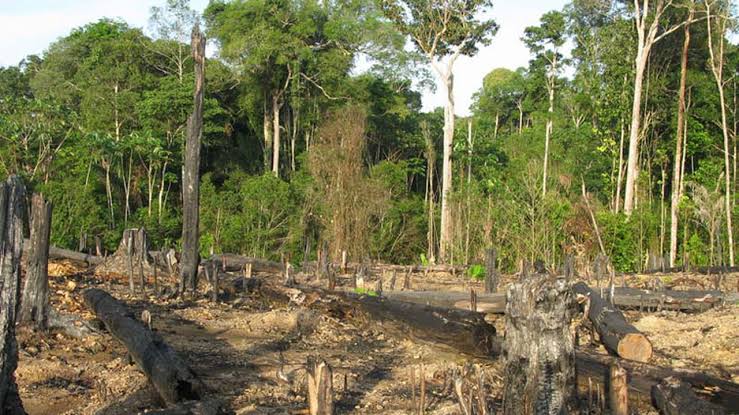
President Bola Tinubu has decried the growing deforestation in Africa which was largely due to subsistence and commercial agriculture, noting that there is urgent need for ambitious regional action to strike a balance between food security and sustainable forest management.
Speaking at the ongoing 1st International Conference on Afforestation and Reforestation holding in Brazzaville, Congo, President Tinubu who was represented by the Minister of Environment, Balarabe Lawal
said: “It gladdens my heart that the first ever International Conference on Afforestation and Reforestation is taking place right here in Africa where more than 15% percent of the world’s greenhouse gas emissions takes place. This historic gathering marks a significant milestone in our collective efforts to address one of the most pressing environmental challenges of our time. Forests, covers nearly 31% of the world’s land area and are crucial for maintaining ecological balance, preserving biodiversity and supporting the livelihoods to millions of people. However, deforestation and forest degradation continue to threaten these vital ecosystems, leading to severe consequences for our planet and future generations.”
Tinubu while quoting the Food and Agriculture Organisation of the United Nations (FAO) report that nearly 4 million hectares of African forests are being cut down each year, which is almost double the speed of the world’s deforestation average, noted that factors contributing to forest loss in the region include increasing population, indiscriminate land expansion for agriculture, rapid urbanisation, social needs and illegal logging.
He added that: “About 70% of deforestation in Africa is as a result of subsistence and commercial agriculture therefore, urgent ambitious regional action is needed to strike a balance between food security and sustainable forest management.”
He admitted that the choice of Congo for this conference was apt taking into consideration the contribution of Africa’s deforestation around the world. He said: “We are all here to remedy the situation by bringing together leading experts, policymakers, researchers and practitioners from around the globe to share knowledge, exchange ideas and foster collaborations. Our goal is to develop and implement innovative and scientific strategies for afforestation and reforestation which will in turn restore degraded lands, enhance biodiversity and mitigate the impacts of climate change.”
He stated that: “Regional and global cooperation like this is imperative and will foster development of appropriate regional transformative policy and legal frameworkcapable of mitigating the impacts of climate change. Through initiatives like this we will accomplish progressive adoption and implementation of climate smart agriculture practices that would assist in strikingbalance between food security and sustainable forest management.”
He disclosed that: “Nigeria has gone a long way and we are making progress in contributing to the reversal of forest cover loss through sustainable forest management and massive afforestation. As part of our determination to upscale forest financing and increase forest cover,”
He added that: @Government has recently approved the sum of 8.5 million US Dollars under the Presidential Initiative on Afforestation. These funds are mainly for the afforestation and restoration of degraded forests and other critical landscapes across the country. This is in addition to other similar programmes like the Great Green Wall Pan African Program and Agro-Climatic Resilience Semi-Arid Landscape (ACReSAL) being implemented resulting in the restoration of over 1.5 million hectares of degraded forests including establishment of over 1,428.9km Shelter belts covering 4,286 hectares, empowerment of more than 200,000 forest community members and creation of more than 3 million jobs for our youths.”
He said: “Relevant policy and legislative framework are being strengthened in response to the current and emerging circumstances we are faced with. We have recently placed an interim suspension on the export of wood-based products to enable adequate appraisal of the process and ultimately emplacement of a sustainable forest management trade complaint system without jeopardizing progress in the implementation of the UNSPF, NDC, and other global agreements.”
The President said: “Nigeria remains committed to global, regional and sub-regional consensus to promote and accelerate progress on sustainable forest management. This includes the COP27 Africa and Global Decade of Afforestation and Reforestation and COP26 Glasgow Leaders’ Declaration on Forests and Land Use as well as, other key outcomes of COP28.”
He said: “As parties to the globally agreed goals and targets on forests, biodiversity, climate change, and SDGs, we have no choice but to do all within our powers to accelerate transformative delivery of these goals within the set timelines. Restoration of our forest should not only be the responsibility of governments alone. It must be the collective effort of Government, Non-government organizations, corporate/private organizations, civil societies, and communities. We should all strive to achieve the common goal of increasing global forest cover.”
Deforestation: Tinubu Calls for Action to Strike a Balance between Forest Security and Sustainable Forest Management


Troops Arrest Suspected Military Impostor in Katsina
By Zagazola Makama
Troops of 17 Brigade have arrested a suspected military impostor during a fighting patrol in Malumfashi Local Government Area.
Security sources told Zagazola Makama that the suspect was apprehended at about 1:30 p.m. on July 4 by troops deployed at the Forward Operating Base (FOB) Malumfashi while conducting routine patrols within Malumfashi town.

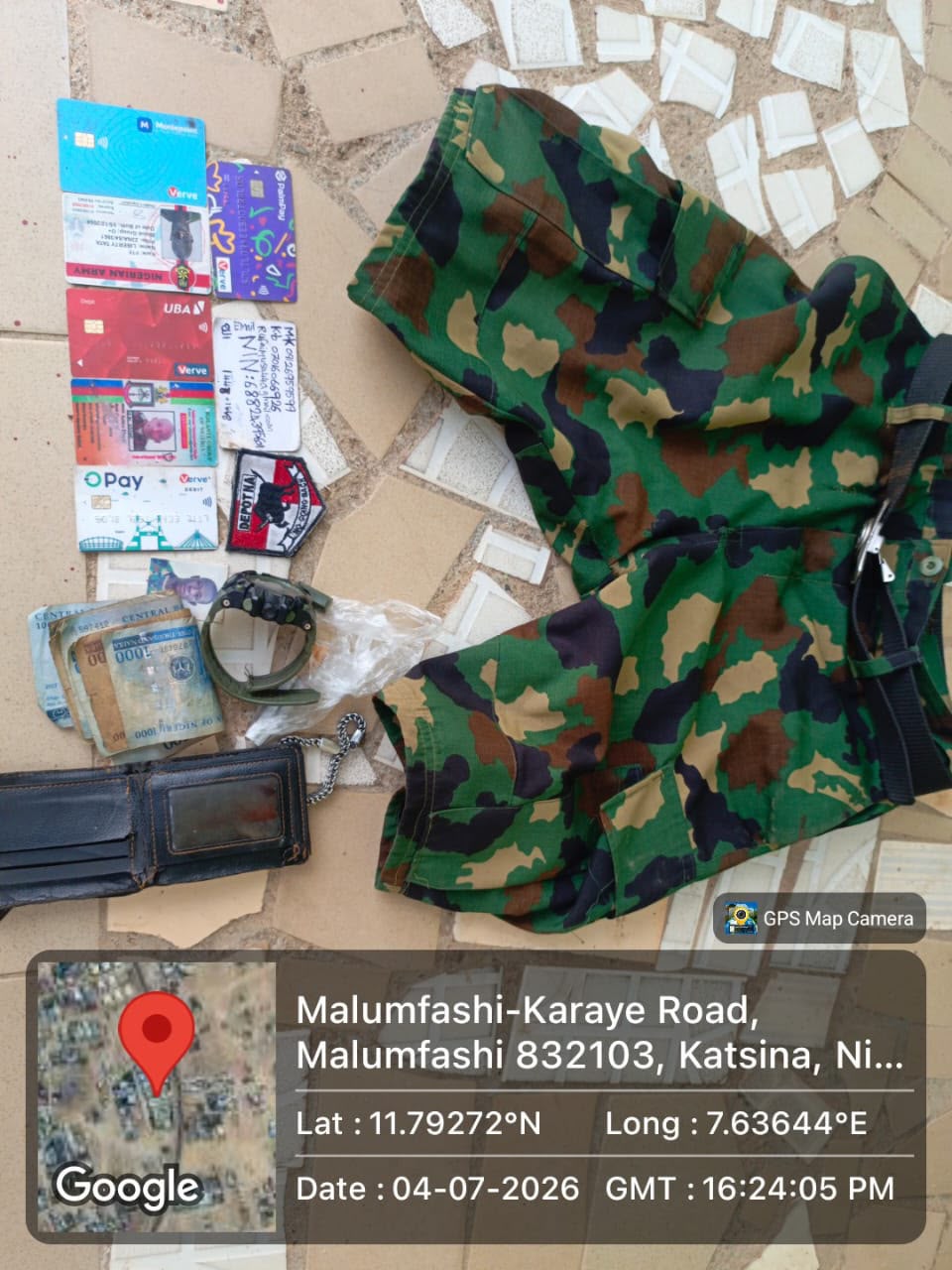
According to the sources, the suspect was intercepted while wearing a woodland camouflage three-quarter short, raising suspicion among the troops.
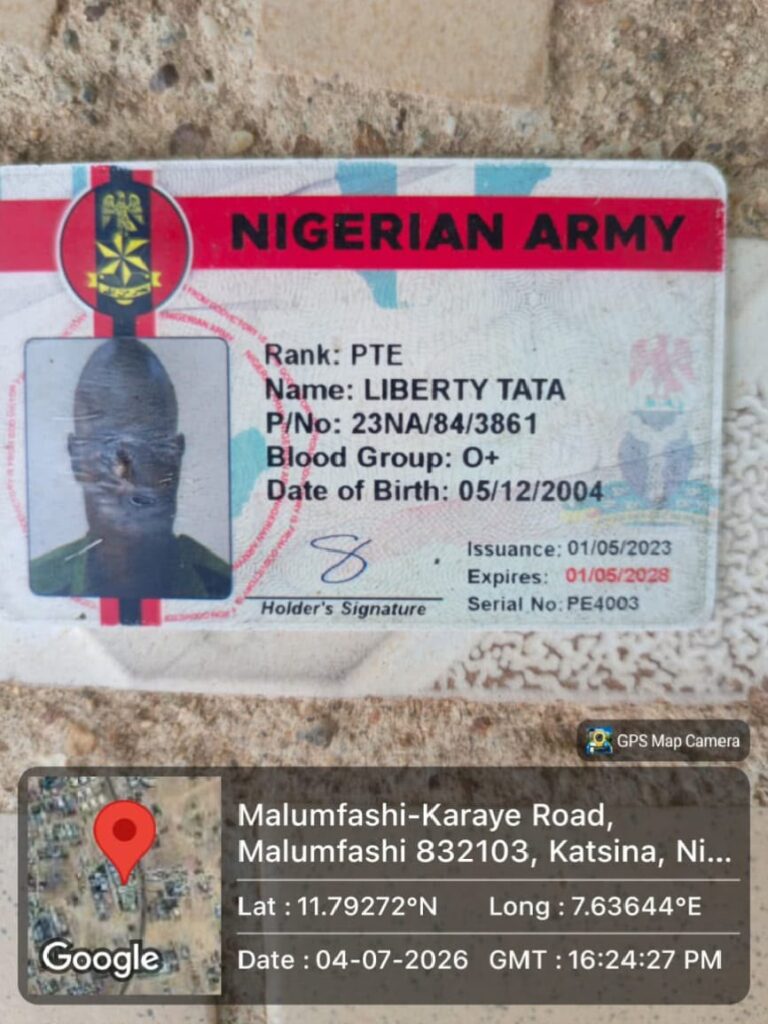
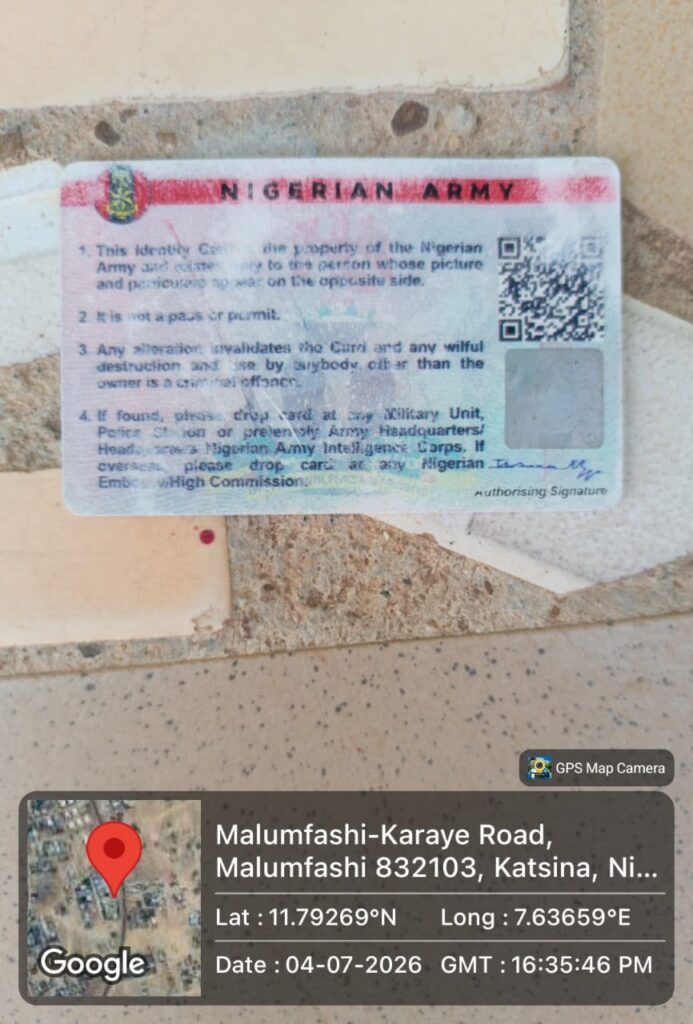
A search conducted on the suspect led to the recovery of a fake Nigerian Army identity card, four Automated Teller Machine (ATM) cards, one woodland camouflage three-quarter short, a wristwatch and the sum of ₦17,000.
The suspect and the recovered exhibits are currently in military custody pending further investigation.
Military sources said the arrest forms part of ongoing efforts to curb impersonation of security personnel and other criminal activities within the area.
Troops Arrest Suspected Military Impostor in Katsina
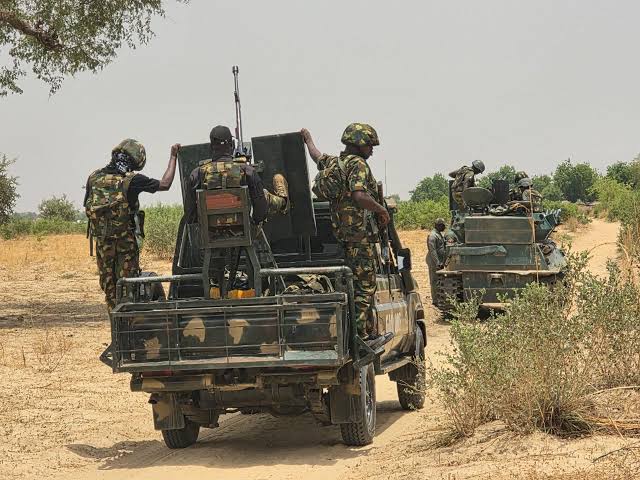
Troops Recover 50 Rustled Cattle, Repel Suspected Rustlers in Kaduna
By Zagazola Makama
Troops deployed at the Forward Operating Base (FOB) Kankomi have recovered 50 rustled cattle after repelling suspected cattle rustlers during an ambush operation in Chikun Local Government Area.
Security sources told Zagazola Makama that the troops responded to a distress call at about 9:55 a.m. on July 4 over the activities of suspected rustlers at Ungwan Gontu community.
According to the sources, the troops swiftly laid an ambush and made contact with the fleeing suspects, forcing them to abandon the stolen livestock and escape into the surrounding area.
During the operation, the troops recovered 50 rustled cattle, which were subsequently identified and handed over to their rightful owner.
Military sources said efforts are ongoing to track down the fleeing suspects as security operations continue to combat cattle rustling and other criminal activities across Kaduna State.
Troops Recover 50 Rustled Cattle, Repel Suspected Rustlers in Kaduna
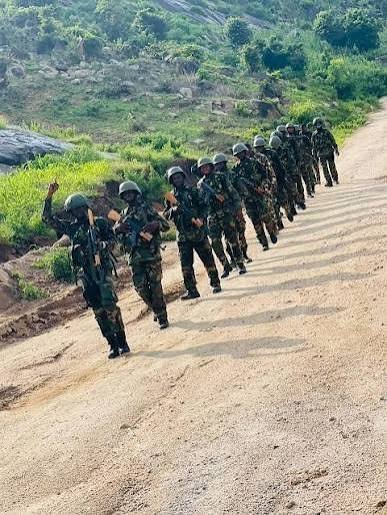
Troops Arrest Suspected Terrorist in Kogi, Suspect Confesses to Group Membership
By Zagazola Makama
Troops of 12 Brigade, in collaboration with Office of the National Security Adviser (ONSA) Hybrid Forces, have arrested a suspected terrorist during an operation in Lokoja Local Government Area.
Security sources told Zagazola Makama that the troops responded at about 1:00 p.m. on July 4 to reports of a confrontation between local residents and a suspected terrorist at a Ruga settlement behind Obajana community.
According to the sources, the troops swiftly intervened and arrested one suspect at the scene.
During preliminary interrogation, the suspect reportedly confessed to being a member of a terrorist group led by an individual identified as Haruna, which allegedly operates within the Okene general area.
The suspect is currently in military custody and is undergoing further investigation to establish the extent of his involvement and identify other members of the group.
Military sources said the arrest forms part of ongoing security operations aimed at dismantling terrorist and criminal networks across Kogi State.
Troops Arrest Suspected Terrorist in Kogi, Suspect Confesses to Group Membership

Troops Arrest Suspected Military Impostor in Katsina

Troops Recover 50 Rustled Cattle, Repel Suspected Rustlers in Kaduna

Troops Arrest Suspected Terrorist in Kogi, Suspect Confesses to Group Membership

Roger Federer’s Shock as DNA Results Reveal Myla and Charlene Are Not His Biological Children

THE PLIGHT OF FARIDA

FAILED COUP IN BURKINA FASO: HOW TRAORÉ NARROWLY ESCAPED ASSASSINATION PLOT AMID FOREIGN INTERFERENCE CLAIMS
-
 News2 years ago
Roger Federer’s Shock as DNA Results Reveal Myla and Charlene Are Not His Biological Children
-
Opinions4 years ago
THE PLIGHT OF FARIDA
-
 News1 year ago
FAILED COUP IN BURKINA FASO: HOW TRAORÉ NARROWLY ESCAPED ASSASSINATION PLOT AMID FOREIGN INTERFERENCE CLAIMS
-

 News2 years ago
EYN: Rev. Billi, Distortion of History, and The Living Tamarind Tree
-
 Opinions5 years ago
POLICE CHARGE ROOMS, A MINTING PRESS
-

 ACADEMICS2 years ago
A History of Biu” (2015) and The Lingering Bura-Pabir Question (1)
-

 Columns2 years ago
Army University Biu: There is certain interest, but certainly not from Borno.
-

 Politics1 year ago
2027: Why Hon. Midala Balami Must Go, as Youths in Hawul and Asikira/Uba Federal Constituency Reject ₦500,000 as Sallah Gift
