
News
Government at All Level in West Africa Need to Conscientiously Budget for Disaster- ECOWAS

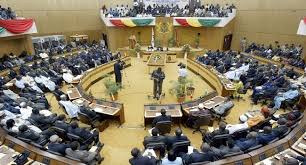
Government at All Level in West Africa Need to Conscientiously Budget for Disaster- ECOWAS
By: Michael Mike
Every level of government has been asked to conscientiously budget for disaster in order to checkmate its regular occurrence which recent research stating that it has left about 75 percent population of West Africa exposed and adversely impacted.
Speaking at the mid-term consultative meeting of the Regional Committee for Disaster Management in West Africa organised by the Economic Community of West African States (ECOWAS) Commission in Abuja on Tuesday, the Deputy Director Climate Change Department, National Disaster Management Organisation (NADMO), Ghana, Frank Nansam-Aggrey, said there is need for coordinated efforts to tackle disaster in West Africa.
He said: “Disaster issues have become very complex. Every now and then, we hear stories in West Africa about disaster that affects our population. Disasters have many exposed in the subregion, and according to research about 75 percent of our people are exposed to one form of disaster or the other. It is flooding, if it is not flooding then it is drought, if it is not drought it is conflict, so it has become imperative that the subcommittee looks at the issues of disaster very critically for our population is being affected every now and then.”
Nansam-Aggrey who acknowledged that ECOWAS is doing the best with its resources, said “but for financial constraints sometimes that do not make the bloc to meet up to the needs of its member countries.”
He however said: “The countries need to do more, disaster management is looked at as abstract issues, making budgeting to become somewhat of abstract. We need to go the extra mile to clearly and decisively budget for disaster issues so that it is not left to chance and as if it is futuristic.
“It is actually with us. We need to make more efforts from community level, district level to the national level, and all actors must be involved to channel all the resources we can gather to make sure we are all safe in the subregion.”
He said: “The time has come for us to begin to look at the West Africa regional preparedness against extreme disaster occurrences such as floods, fires and other disasters causing total havoc to human existence. Generally, disaster occurrences occasioned by natural and man-made hazard events have increased in the past three decades causing a lot of distress situations to over 75% of West Africa’s population.”
He lamented that: “As reported in the ECOWAS Policy for Disaster Risk Reduction document, large number of people and their livelihoods in West African countries are exposed and vulnerable to at least one hazard event which is further compounded by conflicts and diseases. In addition, in some instances, disasters have put development at risk and likewise, development decisions have led to increases in disaster risks.”
He however said: “In response to these scenarios and through the support of national governments and the ECOWAS Commission to some extent, member states are increasingly intensifying their interests and efforts in disaster risk reduction. In spite of these efforts, significant disaster events such as flooding, sea erosion, and drought keep escalating in severity and magnitude in the sub-region causing budget overruns for member states. As climate change factors continue to worsen extreme weather events, vulnerabilities of our people will equally increase leading to negative financial implications for member countries. This confirms the conclusion that the extent of vulnerability to hazards in the sub-region account for the level of disaster devastation being experienced annually by countries in the region amid inadequate public financing to maintain and enhance resilience or provide relief assistance for disaster victims.”
The Director General of the National Emergency Management Agency, Mrs. Zubaida Umar who was represented by the agency’s Director, Disaster Risk Reduction, Dr. Daniel Obot decried that “the West African subregion which is characterized by its diverse geography, population and cultures has a complex relationship with nature and human induced disasters.
“Over the years, the subregion has experienced series of disasters, crises and conflict that have posed serious threats to the human population, the environment, infrastructure and means of livelihood.”
He added that: “With this disaster scenario, the regional recovery roadmap, the regional resilience strategy, the roster of experts amongst others will have to be deployed for significant progress to be recorded in the management of disaster risk in West Africa in line with the ECOWAS goal of inclusive coordination and harmonization of disaster risk management efforts.”
On his part, the Head of ECOWAS Humanitarian Affairs and Disaster Management Division, Mohammed Ibrahim said: “In West Africa and the Sahel region, the magnitude of vulnerability and exposure to hazards and losses from disasters is expected to continue increasing over the next decade. Countries are particularly vulnerable to sudden onset events such as floods, alongside ongoing issues like land degradation, water scarcity, and coastal erosion, which have increased in occurrence and severity due to the adverse effects of climate change.”
He noted that: “Conflict remains primary driver of displacement, but climate change has significantly impacted migration decisions across West Africa over the last few decades. The overlap of conflict and climate disasters underscores the urgent need for comprehensive and coordinated responses to break the cycle of climate change and armed conflict and to increase humanitarian access and funding that supports resilience and adaptation to climate change.”
Government at All Level in West Africa Need to Conscientiously Budget for Disaster- ECOWAS


News
Two Notorious Terrorist Leaders Haruna Balatoni and Black Neutralised in Plateau Military Offensive Another Fatally Wounded as Six AK-47 Rifles Returned
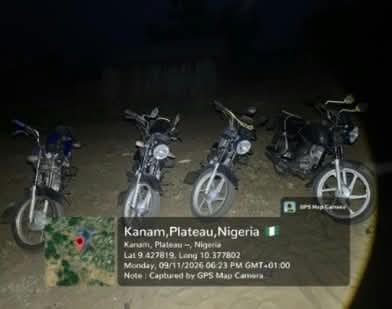
Two Notorious Terrorist Leaders Haruna Balatoni and Black Neutralised in Plateau Military Offensive Another Fatally Wounded as Six AK-47 Rifles Returned
By: Zagazola Makama
Troops of the Nigerian Army have recorded major breakthroughs in ongoing offensive operations against armed criminal networks in Plateau State, neutralising two notorious terrorist leaders, critically wounding another and recovering six AK-47 rifles previously seized from security forces.
The latest developments followed sustained military offensives at Dajin Madam in Wase Local Government Area of Plateau State on November 8, 2026.
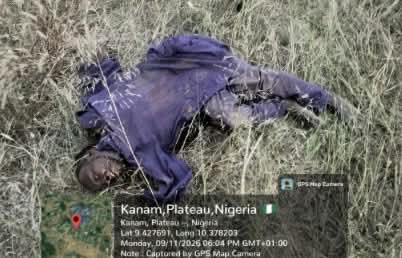
Security sources disclosed that HUMINT reports received at about 8:53 a.m. on November 9 indicated that the intensity of the military operation had resulted in the neutralisation of two suspected terrorist leaders identified as Haruna Balatoni and Black.
Another notorious figure, identified as Dogo Mai Kunkuru, was reportedly shot in the chest and left in a critical condition, with sources indicating that his chances of survival were slim.
In a significant development on November 10, the sustained military pressure reportedly compelled the terrorist network, through an intermediary identified as Ali-Kwara, to return six AK-47 rifles previously seized from security forces.
The recovered weapons are currently in military custody.
In a related operation, troops of 173 Battalion deployed at Mansur rescued a kidnapped mother and her daughter and recovered 39 cattle.
The developments represent a significant disruption of the criminal network’s leadership, weapons stockpile and capacity to sustain operations in the Wase axis.
The recovery of the six rifles is particularly important as it restores weapons previously lost to the criminal network and provides an opportunity for further intelligence exploitation.
The latest successes underscore the impact of sustained offensive pressure, intelligence-driven operations and military presence in dismantling armed groups operating across Plateau State.
The reported deaths of the terrorist leaders and the condition of Dogo Mai Kunkuru are based on preliminary HUMINT assessments and remain subject to independent military confirmation
Two Notorious Terrorist Leaders Haruna Balatoni and Black Neutralised in Plateau Military Offensive Another Fatally Wounded as Six AK-47 Rifles Returned
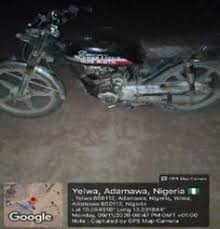
Troops Dislodge Terrorists from Hideouts in Taraba, Recover Five Motorcycles
By: Zagazola Makama
Troops of the Nigerian Army’s 114 Battalion (Reinforcement) have dislodged suspected terrorists from their hideouts during a fighting patrol in Karim Lamido Local Government Area of Taraba State.
The operation, conducted under Operation WHIRL STROKE (OPWS), commenced at about 7:30 a.m. on November 8, 2026, with troops advancing towards Komodoro village, where they made contact with suspected terrorists.
Security sources said the criminals fled upon sighting the advancing troops, prompting the patrol team to extend its operation to Mashigin Kirya village within the same local government area.
At Mashigin Kirya, the troops encountered suspected terrorists believed to have been hibernating in the general area and engaged them, forcing the armed elements to retreat.
The troops subsequently recovered five motorcycles suspected to have been used by the criminal group for mobility and logistics.
To further disrupt the fleeing terrorists, the troops conducted a fire mission using an 81mm mortar along their withdrawal route.
The operation was ongoing as troops sustained pressure on suspected criminal hideouts and movement corridors in the area.
The development point to the military’s determination to deny armed groups safe havens and restrict their freedom of movement across Taraba State.
Troops Dislodge Terrorists from Hideouts in Taraba, Recover Five Motorcycles
News
Two Fulani Herdsmen, 16 Cows Killed in Attack on Enugu Community as Joint Troops Launch Investigation
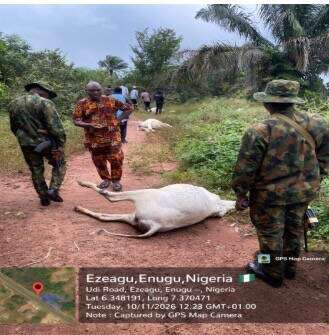
Two Fulani Herdsmen, 16 Cows Killed in Attack on Enugu Community as Joint Troops Launch Investigation
By: Zagazola Makama
Troops of the Nigerian Army, in collaboration with the Nigeria Police and Department of State Services (DSS), have launched an investigation into an attack on Fulani herdsmen in Obelagu Umuamba community, Ezeagu Local Government Area of Enugu State, which left two herders and 16 cattle dead.
The incident came to light at about 11:00 a.m. on November 10, 2026, when a joint patrol team comprising troops of the 82 Division Garrison and 103 Battalion (Reinforcement), alongside police and DSS operatives, visited the community to assess the cause and extent of damage from the recent attack by suspected hoodlums.
On arrival, the security team discovered that two Fulani herdsmen and 16 cows had been killed, while two other persons sustained injuries.
Following the discovery, the troops convened a joint peace and security meeting involving community leaders, representatives of the Fulani herders, neighbourhood watch groups and other key stakeholders.
During the meeting, security officials cautioned all parties against taking the law into their hands, warning that reprisals could escalate tensions and further threaten peaceful coexistence.
The troops subsequently recovered the corpses and handed them over to the police for further investigation.
Meanwhile, security agencies have commenced efforts to identify and apprehend those responsible for the attack, including suspected local collaborators.
The intervention is aimed at preventing retaliatory violence, restoring confidence among residents and ensuring that those responsible are brought to justice.
Authorities have urged both farming and herding communities to remain calm, cooperate with security agencies and pursue grievances through lawful channels.
Two Fulani Herdsmen, 16 Cows Killed in Attack on Enugu Community as Joint Troops Launch Investigation

Troops Intercept Abandoned Toyota Camry Loaded with 315 Sachets of Suspected Indian Hemp in Kaduna

NSCDC CG Reaffirms Personnel Welfare Priority, Pays N87.4m Insurance Benefits

How we arrested 4 suspected IPOB members who kidnapped, killed our operative –DSS witness

Roger Federer’s Shock as DNA Results Reveal Myla and Charlene Are Not His Biological Children

THE PLIGHT OF FARIDA

FAILED COUP IN BURKINA FASO: HOW TRAORÉ NARROWLY ESCAPED ASSASSINATION PLOT AMID FOREIGN INTERFERENCE CLAIMS
-
 News3 years ago
Roger Federer’s Shock as DNA Results Reveal Myla and Charlene Are Not His Biological Children
-
Opinions5 years ago
THE PLIGHT OF FARIDA
-
 News2 years ago
FAILED COUP IN BURKINA FASO: HOW TRAORÉ NARROWLY ESCAPED ASSASSINATION PLOT AMID FOREIGN INTERFERENCE CLAIMS
-
 Opinions5 years ago
POLICE CHARGE ROOMS, A MINTING PRESS
-

 News3 years ago
EYN: Rev. Billi, Distortion of History, and The Living Tamarind Tree
-

 ACADEMICS3 years ago
A History of Biu” (2015) and The Lingering Bura-Pabir Question (1)
-

 Columns3 years ago
Army University Biu: There is certain interest, but certainly not from Borno.
-

 Politics1 year ago
2027: Why Hon. Midala Balami Must Go, as Youths in Hawul and Asikira/Uba Federal Constituency Reject ₦500,000 as Sallah Gift
