
News
EXCLUSIVE: Boko Haram–ISWAP rivalry escalates into full-scale territorial war across island corridors


EXCLUSIVE: Boko Haram–ISWAP rivalry escalates into full-scale territorial war across island corridors
By: Zagazola Makama
The Lake Chad Basin is witnessing a dangerous escalation in insurgent-on-insurgent warfare, as a fresh wave of violent clashes between rival jihadist factions Boko Haram’s Jama’atu Ahlis Sunna Lidda’awati wal-Jihad (JAS) and the Islamic State West Africa Province (ISWAP) intensifies across strategic island strongholds and riverine settlement routes in Abadam and Kukawa Local Government Areas of Borno State.
Between 5 and 8 November 2025, Boko Haram’s Jama’atu Ahlis Sunna Lidda’awati wal-Jihad (JAS) launched a fierce coordinated assault on its rival faction, Islamic State West Africa Province (ISWAP), across a stretch of islands identified as Sahel 1, Dogon Chuku, Mangari, and linked riverine basins spanning Tumbun Gini – Tumbun Dalo – Tumbun Shanu – Mangari – Dumba in Abadam and Kukawa local government areas of Borno State.
The fighting was intense. The objective was clear. JAS wants to erase ISWAP. Sources revealed that JAS fighters, led by commanders Hassan Buduma and Mohd Hassan, mobilised multiple watercraft loaded with fighters and heavy weapons, moving in waves from Tumbun Gini through the upper river basin to Tumbun Dalo, Tumbun Shanu, Mangari, Dumba and surrounding islands, a chain of sandy enclaves where humanitarian presence is almost non-existent.
In a scene described as “an amphibious assault in insurgent style,” JAS fighters attacked ISWAP from the water, surprising them at dawn. “This is not a misunderstanding, this is a takeover,”said one intelligence source familiar with the region.
However, after days of sustained fighting,
ISWAP fighters were forced to abandon their river camps scrambling for their lives.
The number of casualties remains unknown, but ISR reportedly picked up heat signatures of several bodies floating and others buried in shallow sand pits.
Multiple sources also confirmed that JAS deployed several motorized watercraft in a multi-axis assault, overrunning ISWAP clusters and pushing surviving fighters off the island perimeter into mainland hideouts around Ali Jillimari, Metele, Kangarwa, and Gudumbali in North of Borno.
While both groups share an extremist ideology, the battle has nothing to do with religion. It is about power. Control of the Lake Chad islands means control of millions of naira collected through extortion of fishermen and traders, they will also take control of the Arms and fuel smuggling corridors through Niger, Chad and Cameroon. They will also have mobility advantage where the water channels provide a perfect cover from air surveillance.
ISWAP had dominated these islands since 2021, after the death of Boko Haram leader Abubakar Shekau. But water levels have receded this season, opening new land routes and exposing old fishing settlements.
At the core of this escalation is not ideology — but dominance. JAS, according to intelligence intercepts, has vowed to “totally eliminate ISWAP presence in the Lake Chad islands”, and seize ISWAP’s lucrative supply corridors interfacing Niger, Chad and Cameroon.
JAS reportedly plans to push further south toward ISWAP headquarters within Marte and Ngala LGAs, a strategic move that, if successful, would reverse ISWAP’s dominance for the first time since 2021. Once ISWAP regroups on the mainland, it will retaliate violently to reclaim the islands. The group has never allowed a territorial defeat to stand.
Zagazola report that the clashes represent a transition from sporadic skirmishes to a full territorial campaign. More ambushes, roadside bombs and abductions along access routes linking Metele, Kangarwa and the Maiduguri–Damasak MSR, should be anticipated.
The emerging trend suggests that both factions will now lunched retaliatory raids on each other’s strongholds, attack supply lines, including river transport. Communities in Kukawa and Abadam especially fishermen, transport boat operators, and seasonal farmers will bear the immediate consequences.
The Lake Chad Basin has always held strategic value a place where borders blur and armies struggle to manoeuvre. But this new insurgent rivalry marks a turning point. For the first time in years, Boko Haram and ISWAP are not just fighting the state. They are fighting over who gets to rule the shadows.
And somewhere in the middle caught between gunboats, ideology and hunger are the civilians of the Lake Chad islands, whose lives continue to be shaped by a war they did not choose and cannot escape.
Zagazola Makama is a Counter Insurgency Expert and Security Analyst in the Lake Chad Region.
EXCLUSIVE: Boko Haram–ISWAP rivalry escalates into full-scale territorial war across island corridors



Borno 2027: The General’s Charge and How Zulum Unleashes Borno’s Heavyweight Political Squad
By Abubakar M. Kareto
In Nigerian politics, elections are rarely won on auditorium stages; they are decided in the quiet corridors of rural wards and the long queues of remote polling units.
The formal inauguration of the Borno State All Progressives Congress (APC) Campaign Council at the Government House followed by a massive, open-air campaign flag-off at the Sports Centre in Maiduguri represents a calculated departure from routine rally-making toward micro-targeted grassroots mobilization.
By commanding party stalwarts to abandon executive comfort and embed themselves directly within their local communities, Governor Babagana Umara Zulum is deploying a bottom-up doctrine aimed at locking down political legitimacy where it matters most.
At the heart of this strategy is the critical task of maintaining party cohesion after intense internal primaries. Zulum’s explicit instruction for victorious candidates to reach out and heal rifts with aggrieved aspirants reflects a realistic understanding of political arithmetic: internal resentment erodes turnout faster than any opposition campaign. By coupling reconciliation with firm warnings against subversion, the leadership is attempting to forge an unbreakable front out of potentially volatile factions.
The sheer scale of political unity displayed in Maiduguri underscores the formidable nature of this campaign structure. Bringing together political titans including former Governors Senator Maina Ma’aji Lawan and Senator Ali Modu Sheriff, alongside APC Deputy National Chairman Ali Bukar Dalori and the state’s complete senatorial delegation demonstrates an unprecedented level of internal alignment.
This public display of solidarity among historical heavyweights signals organizational stability, minimizing space for opposition inroads while keeping rank-and-file members firmly aligned.
Beyond local dynamics, Borno State occupies a unique position on the national political chessboard as the home state of Vice President Senator Kashim Shettima. In this high-stakes arena, sheer victory is insufficient; the turnout margin itself serves as a barometer of political influence.
Delivering a massive vote tally is therefore both a local objective and a strategic demonstration of national strength, cementing the state’s leverage within the governing alliance.
To turn political influence into actual votes, the campaign relies heavily on record-based persuasion and visible governance dividends. By grounding the campaign pitch in key developmental gains achieved despite severe security challenges and highlighting major federal institutions acquired in Gwoza, Bama, and Azare canvassers are equipped with a tangible policy narrative. Framing voter turnout for President Bola Ahmed Tinubu, gubernatorial candidate Engr. Mustapha Gubio, and all legislative candidates as a direct return on investment gives party workers a clear, evidence-backed story for every doorstep across the state’s 27 local government areas.
A vital strength of this expanded outreach is the deliberate inclusion of women and youth as core engines of voter mobilization. The strong presence of the women’s delegation led by Borno First Lady Dr. Falmata Babagana Umara Zulum alongside the wife of the Deputy Governor and the wives of party candidates highlights an organized effort to engage families and community networks directly. Demanding structured participation across all demographics ensures that campaign directives actively translate into voter registration and turnout.
Deputy Governor Umar Usman Kadafur’s commitment to an issue-based, unit-by-unit campaign outlines the operational mechanics needed to execute this vision. Requiring regular field reports creates a system of measurable accountability across every precinct. In a vast state with complex logistics, such systematic tracking ensures that high-level strategy is actively carried out at every single polling station.
Lastly, the Maiduguri launch demonstrates how strategic discipline, elite reconciliation, and precinct-level focus converge to shape electoral outcomes. In an increasingly competitive political landscape, the Borno APC has laid out a clear blueprint: harness the full weight of a unified leadership squad, but win the election one polling unit at a time.
About the Author
Abubakar M. Kareto is a Public Affairs Analyst and Communications Strategist focusing on governance, policies, economy, and institutional reforms across Nigeria and Africa. He can be reached on X @amkareto and via email at amkareto@gmail.com.
Borno 2027: The General’s Charge and How Zulum Unleashes Borno’s Heavyweight Political Squad
News
Two Notorious Terrorist Leaders Haruna Balatoni and Black Neutralised in Plateau Military Offensive Another Fatally Wounded as Six AK-47 Rifles Returned
Two Notorious Terrorist Leaders Haruna Balatoni and Black Neutralised in Plateau Military Offensive Another Fatally Wounded as Six AK-47 Rifles Returned
By: Zagazola Makama
Troops of the Nigerian Army have recorded major breakthroughs in ongoing offensive operations against armed criminal networks in Plateau State, neutralising two notorious terrorist leaders, critically wounding another and recovering six AK-47 rifles previously seized from security forces.
The latest developments followed sustained military offensives at Dajin Madam in Wase Local Government Area of Plateau State on November 8, 2026.
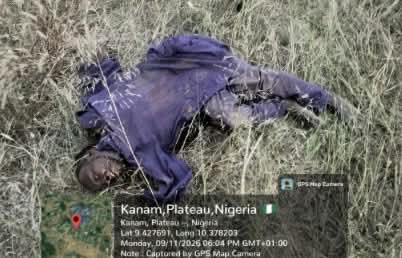
Security sources disclosed that HUMINT reports received at about 8:53 a.m. on November 9 indicated that the intensity of the military operation had resulted in the neutralisation of two suspected terrorist leaders identified as Haruna Balatoni and Black.
Another notorious figure, identified as Dogo Mai Kunkuru, was reportedly shot in the chest and left in a critical condition, with sources indicating that his chances of survival were slim.
In a significant development on November 10, the sustained military pressure reportedly compelled the terrorist network, through an intermediary identified as Ali-Kwara, to return six AK-47 rifles previously seized from security forces.
The recovered weapons are currently in military custody.
In a related operation, troops of 173 Battalion deployed at Mansur rescued a kidnapped mother and her daughter and recovered 39 cattle.
The developments represent a significant disruption of the criminal network’s leadership, weapons stockpile and capacity to sustain operations in the Wase axis.
The recovery of the six rifles is particularly important as it restores weapons previously lost to the criminal network and provides an opportunity for further intelligence exploitation.
The latest successes underscore the impact of sustained offensive pressure, intelligence-driven operations and military presence in dismantling armed groups operating across Plateau State.
The reported deaths of the terrorist leaders and the condition of Dogo Mai Kunkuru are based on preliminary HUMINT assessments and remain subject to independent military confirmation
Two Notorious Terrorist Leaders Haruna Balatoni and Black Neutralised in Plateau Military Offensive Another Fatally Wounded as Six AK-47 Rifles Returned

Troops Dislodge Terrorists from Hideouts in Taraba, Recover Five Motorcycles
By: Zagazola Makama
Troops of the Nigerian Army’s 114 Battalion (Reinforcement) have dislodged suspected terrorists from their hideouts during a fighting patrol in Karim Lamido Local Government Area of Taraba State.
The operation, conducted under Operation WHIRL STROKE (OPWS), commenced at about 7:30 a.m. on November 8, 2026, with troops advancing towards Komodoro village, where they made contact with suspected terrorists.
Security sources said the criminals fled upon sighting the advancing troops, prompting the patrol team to extend its operation to Mashigin Kirya village within the same local government area.
At Mashigin Kirya, the troops encountered suspected terrorists believed to have been hibernating in the general area and engaged them, forcing the armed elements to retreat.
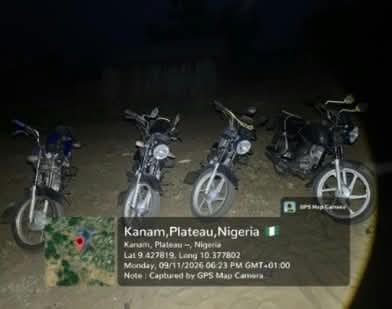
The troops subsequently recovered five motorcycles suspected to have been used by the criminal group for mobility and logistics.
To further disrupt the fleeing terrorists, the troops conducted a fire mission using an 81mm mortar along their withdrawal route.
The operation was ongoing as troops sustained pressure on suspected criminal hideouts and movement corridors in the area.
The development point to the military’s determination to deny armed groups safe havens and restrict their freedom of movement across Taraba State.
Troops Dislodge Terrorists from Hideouts in Taraba, Recover Five Motorcycles

Borno 2027: The General’s Charge and How Zulum Unleashes Borno’s Heavyweight Political Squad

Troops Intercept Abandoned Toyota Camry Loaded with 315 Sachets of Suspected Indian Hemp in Kaduna

NSCDC CG Reaffirms Personnel Welfare Priority, Pays N87.4m Insurance Benefits

Roger Federer’s Shock as DNA Results Reveal Myla and Charlene Are Not His Biological Children

THE PLIGHT OF FARIDA

FAILED COUP IN BURKINA FASO: HOW TRAORÉ NARROWLY ESCAPED ASSASSINATION PLOT AMID FOREIGN INTERFERENCE CLAIMS
-
 News3 years ago
Roger Federer’s Shock as DNA Results Reveal Myla and Charlene Are Not His Biological Children
-
Opinions5 years ago
THE PLIGHT OF FARIDA
-
 News2 years ago
FAILED COUP IN BURKINA FASO: HOW TRAORÉ NARROWLY ESCAPED ASSASSINATION PLOT AMID FOREIGN INTERFERENCE CLAIMS
-
 Opinions5 years ago
POLICE CHARGE ROOMS, A MINTING PRESS
-

 News3 years ago
EYN: Rev. Billi, Distortion of History, and The Living Tamarind Tree
-

 ACADEMICS3 years ago
A History of Biu” (2015) and The Lingering Bura-Pabir Question (1)
-

 Columns3 years ago
Army University Biu: There is certain interest, but certainly not from Borno.
-

 Politics1 year ago
2027: Why Hon. Midala Balami Must Go, as Youths in Hawul and Asikira/Uba Federal Constituency Reject ₦500,000 as Sallah Gift
