
News
EU Warns of Rising Foreign Information Manipulation

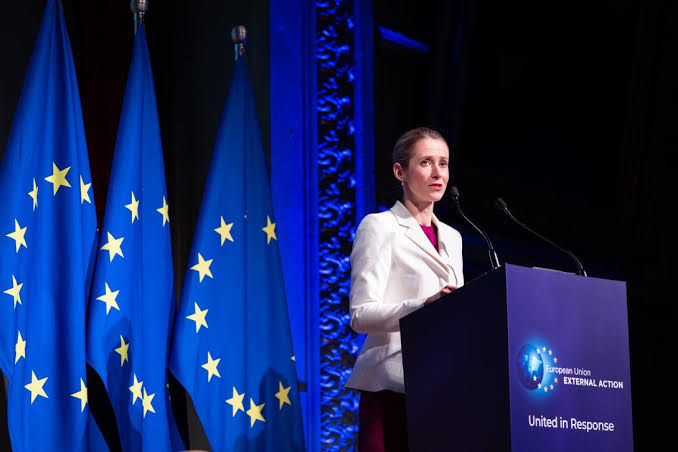
EU Warns of Rising Foreign Information Manipulation
By: Michael Mike
The European Union has warned that the surge in foreign information manipulation and disinformation poses a growing threat to Nigeria’s democracy, media integrity, and public trust.
The warning was issued on Monday in Abuja during a one-day capacity-building workshop on Foreign Information Manipulation and Interference (FIMI) organised for members of the Diplomatic Correspondents Association of Nigeria (DICAN).
Delivering the opening remarks, the EU Ambassador to Nigeria and ECOWAS, Gautier Mignot said false or misleading information—whether generated for political influence, commercial benefit, or malicious deception—has become one of the most destabilising forces shaping public discourse globally.
He added that the consequences are particularly severe when disinformation is deliberately designed to deceive and then disseminated to unsuspecting citizens.
He noted that the media remains a pillar of democratic society, and any erosion of its credibility directly threatens governance and social stability. “When people lose faith in such a critical institution, democracy is at risk, and society itself becomes gravely endangered,” he warned.
Mignot stressed that journalists sit at a high-risk intersection within the information chain because they decide what reaches the public. For this reason, he said, they often become primary targets of manipulation campaigns. Once the media is misled, he explained, the entire society becomes vulnerable to deception.
He highlighted the dual role that both journalists and diplomats share in preserving credibility. “If we want to remain reliable, we must ensure that the information we disseminate is accurate,” he added.
The envoy while stating that emerging technologies have made communication faster and more accessible, however warned that they have also created sophisticated tools capable of falsifying or recreating realities with ease.
He noted that deepfakes, doctored videos, manipulated images, and AI-generated content now circulate with a level of authenticity that makes them difficult to distinguish from legitimate information.
He referenced a 2024 report by the European Parliament showing that 85% of people globally are worried about disinformation’s impact on their societies, while 87% believe it has already distorted political life.
Mignot noted that Nigeria faces similar challenges. Citing a 2020 Centre for Democracy and Development report, he said disinformation in the country has grown to unprecedented levels, aggravating existing ethnic and religious divisions. With information now spreading rapidly across text, audio, memes, images, and videos, the nation’s traditional “rumour mill” has gained powerful new tools.
The EU outlined a range of interventions designed to strengthen media literacy and counter disinformation in Nigeria and across West Africa. These include monitoring disinformation campaigns, especially those targeting elections, and enhancing media literacy through nationwide training programmes.
Earlier this year, the EU facilitated fact-checking training for members of the Nigerian Guild of Editors in Lagos and continued to support Nigeria’s leading fact-checking platforms, including Dubawa. It has also sponsored Nigerian journalists to attend advanced trainings in Europe, including missions to conflict areas such as Ukraine.
Mignot reaffirmed the bloc’s commitment to partnering with civil society organisations, media institutions, and youth groups to reinforce public access to credible information.
Mignot revealed that revealed that members of DICAN were chosen for the workshop, as they play a crucial role in interpreting foreign information for domestic audiences. Their reporting on international affairs, including EU activities in Nigeria, places them at a critical junction between global narratives and national understanding.
He acknowledged DICAN’s demonstrated interest in combating disinformation, recalling the association’s earlier engagement with the Ministry of Foreign Affairs in July.
The EU cautioned that organised disinformation campaigns in West Africa—including those that glamorise anti-democratic actors—continue to erode peace and stability in the region. Nigeria, he said, must remain vigilant against efforts to distort public perception or undermine the credibility of democratic leadership.
The workshop aims to equip journalists with tools to recognise and counter foreign information manipulation, strengthen newsroom verification processes, and improve the resilience of the Nigerian media space.
EU Warns of Rising Foreign Information Manipulation



2027: ActionAid challenges INEC over voter register errors, result transparency
…Demands state-by-state disclosure of complaints, access to signed collation sheets
By: Michael Mike
ActionAid Nigeria has challenged the Independent National Electoral Commission (INEC) to account for errors in the voters’ register ahead of the 2027 general elections, demanding a state-by-state breakdown of complaints, corrections made and unresolved cases, as well as greater transparency in the collation and publication of election results.
The organisation said Nigerians deserved clear answers on how errors in the voters’ register would be addressed and how results recorded at polling units would be tracked through ward, local government and state collation stages to ensure that votes were not altered or lost in the process.
In a statement issued on Monday in Abuja, ActionAid Nigeria said INEC must explain how voters could inspect results at each stage of collation and identify discrepancies between polling-unit figures and results subsequently announced at higher levels.
The demand comes amid concerns over the commission’s readiness to make collated results publicly accessible through its Result Viewing Portal (IReV). INEC’s Director of Information and Communication Technology, Lawrence Bayode, reportedly said the commission had yet to build and test the system required to upload collated results to the portal, which currently displays polling-unit result sheets.
ActionAid said INEC must disclose where signed result sheets from subsequent collation stages would be published, how quickly they would be made available after announcement and what mechanisms citizens would have to report discrepancies.
“Nigerians should never have to beg to see how their votes were counted. They are entitled to an account of what happened to every vote,” the Country Director, Andrew Mamedu, said.
He said the availability of polling-unit results on IReV should be matched by public access to signed ward results to enable citizens verify whether figures from their polling units were accurately transferred during collation.
ActionAid also questioned INEC’s handling of discrepancies in the voters’ register, particularly following the commission’s acknowledgement of multiple registrations and reported removal of more than 1.6 million records.
With a comprehensive review of the register deferred until after the elections, the organisation demanded explanations on what INEC could still address within the statutory timelines, urging it to publish the number of complaints received, verified, corrected and outstanding in each state and the Federal Capital Territory.
It also called for a timeline for the next public update, warning that unresolved complaints could deepen public distrust in the electoral process before voting begins.
ActionAid said the presence of a deceased relative’s name on the register should be sufficient grounds for a family to request an investigation, but stressed that allegations of voting in the name of deceased persons required separate evidence.
It warned that duplicate and outdated records could distort registration figures and create misleading impressions about voter turnout, adding that failure to respond to complaints could fuel suspicion ahead of the polls.
The organisation further questioned the circumstances surrounding INEC’s decision to postpone a comprehensive review of the voters’ register until after the 2027 elections, asking what changed between its earlier commitment to clean up the register and the decision to defer the exercise.
ActionAid urged the commission to explain when the decision was taken and why it considered the review unnecessary before Nigerians cast their ballots.
Citing Section 19 of the Electoral Act 2026, the organisation said INEC should strengthen public awareness of the procedures for inspecting the register, filing claims and objections, reporting deceased relatives and seeking reinstatement where eligible voters were wrongly omitted.
It called for the use of local radio and community organisations to communicate the procedures in local languages, particularly to voters who may face difficulties accessing INEC offices.
Mamedu said voters displaced by conflict, persons with disabilities and those living far from commission offices should not lose their place on the register because they could not respond to complaints at short notice.
He urged INEC to guarantee affected voters access to their status, a fair hearing where their eligibility was challenged and decisions they could follow up on.
ActionAid Nigeria called on the commission to publish a clear timetable for reporting voter register complaints and establish a transparent framework for public access to signed collation sheets, insisting that Nigerians must know before election day where to obtain the records and which INEC office would be responsible for addressing discrepancies.
2027: ActionAid challenges INEC over voter register errors, result transparency
Troops Arrest Suspected Terrorist Collaborator in Monguno, Recover Phone, Cash
By: Zagazola Makama
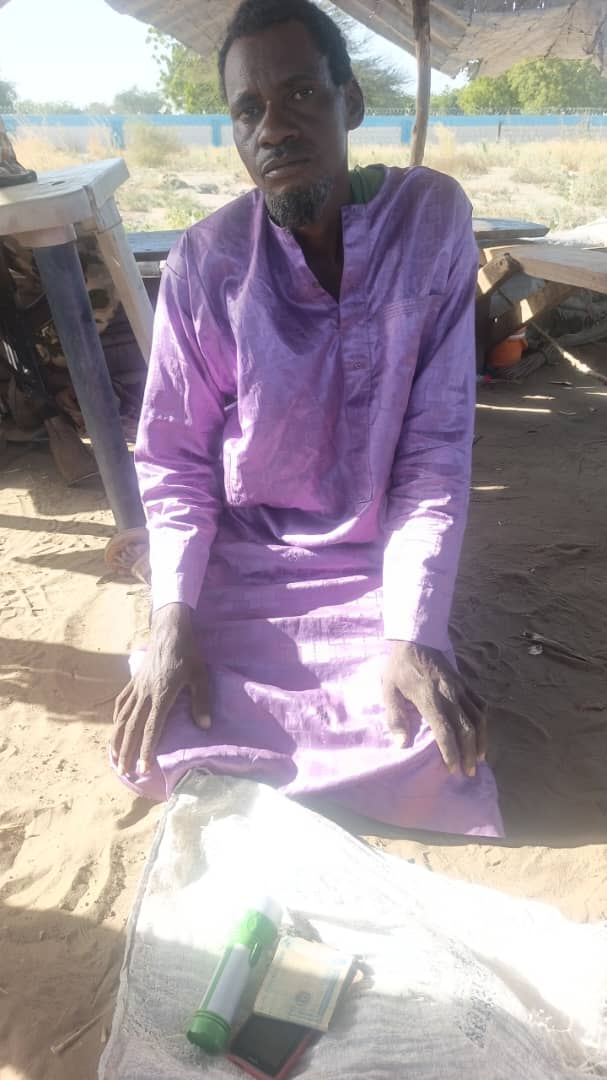
Troops of Sector 3, in collaboration with members of the Civilian Joint Task Force (CJTF), have arrested a suspected terrorist collaborator accused of facilitating the movement of recruits to terrorist elements in Borno State.
The suspect, identified as Abdulmuminu Adamu, 45, was arrested at about 3:00 p.m. on November 20 at Cross Motor Park in Monguno town, Monguno Local Government Area.
Security sources said the arrest followed intelligence received by troops at about 1:43 p.m. concerning alleged negotiations between Adamu and a suspected terrorist member, identified as Afo Asso.
The duo were reportedly planning to transport two individuals, comprising a female and a suspected new terrorist recruit, from Kekeno and Minatti communities in Monguno LGA to a designated location.
During interrogation, Adamu allegedly confessed that he had been tasked with conveying the two individuals to Karfe village in Kukawa LGA, where terrorist elements were expected to receive them.
Items recovered from the suspect included one mobile phone, a torchlight, a turban, a mirror and ₦7,400 in cash.
Troops Arrest Suspected Terrorist Collaborator in Monguno, Recover Phone, Cash
Troops Clear Suspected Militia Camp in Borno, Arrest Two Suspects, Recover Arrows, Ammunition
By: Zagazola Makama
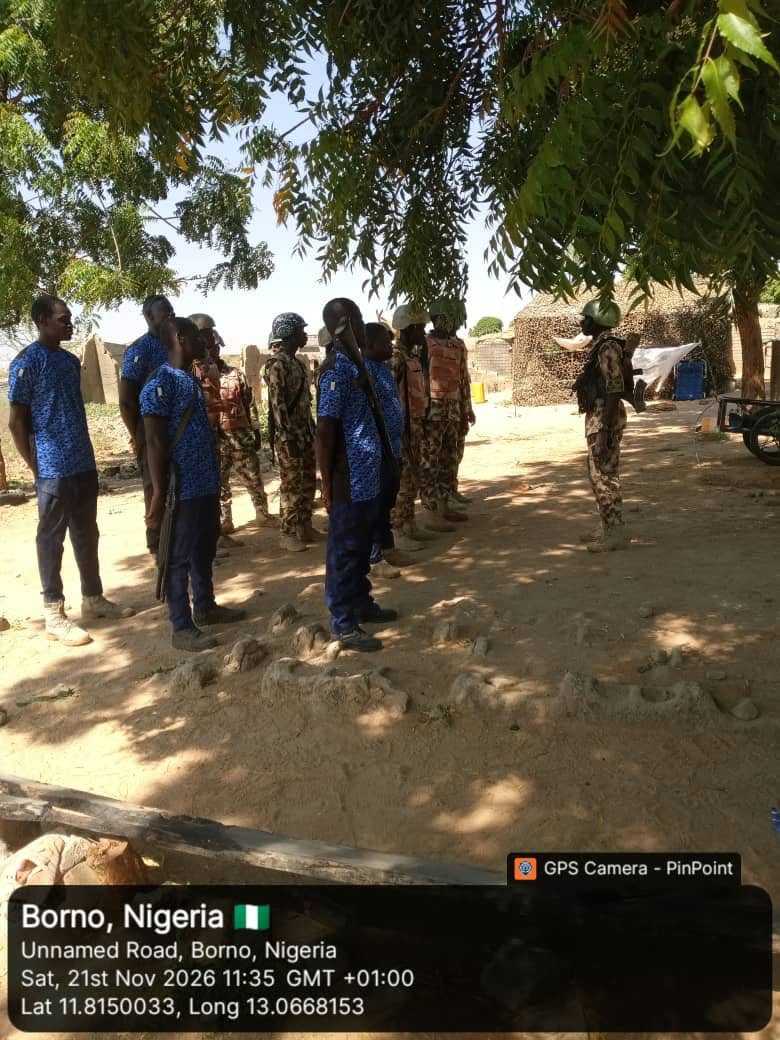
Troops of the 333 Artillery Regiment, in collaboration with members of the Civilian Joint Task Force (CJTF), have cleared a suspected militia camp at Katapilar village in Borno State and arrested two suspects during a clearance patrol.
The operation was conducted on November 21, following a patrol to Katapilar village, where troops cleared a suspected Fulani militia camp.
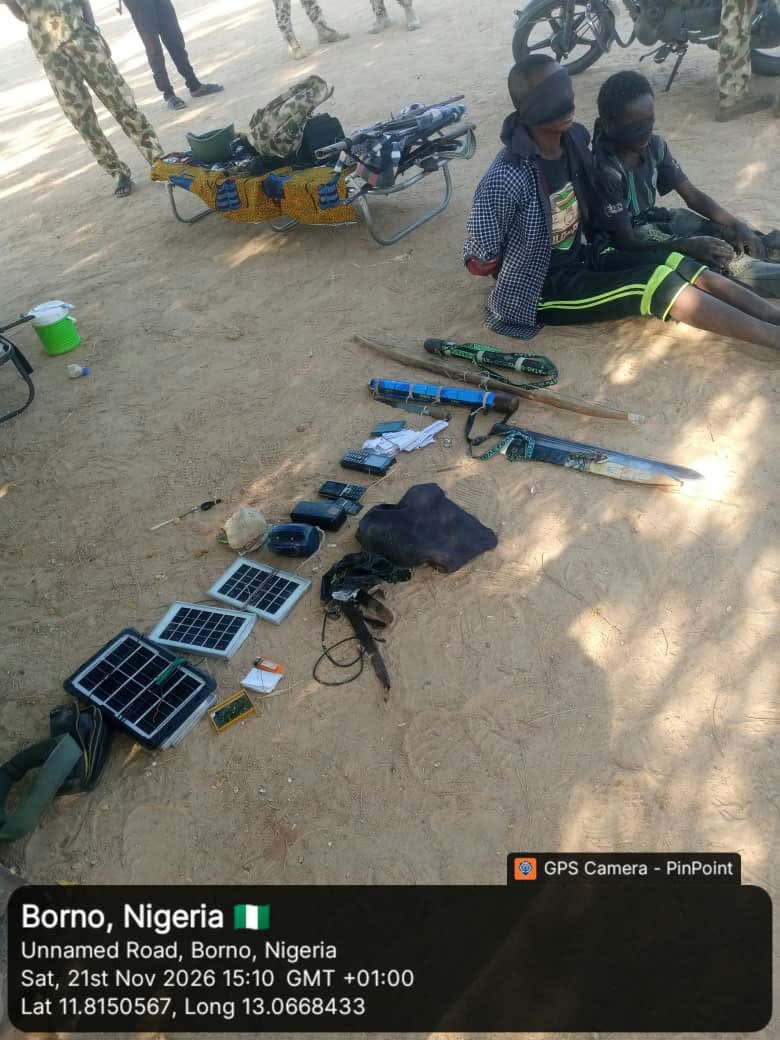
Items recovered from the location included one bow, 14 arrows, three rounds of 7.62mm special ammunition, two mobile phones, one cutlass and two mini solar panels.
The troops subsequently extended the operation to Duwairi village, where they arrested two suspects identified as Umaru Shehu, 32, from Gubio, and Ali Yahaya, 16, from Konduga.
Items recovered from the suspects included 16 arrows, one knife, an MP3 player, one power bank, four mini solar panels and ₦37,170 in cash.
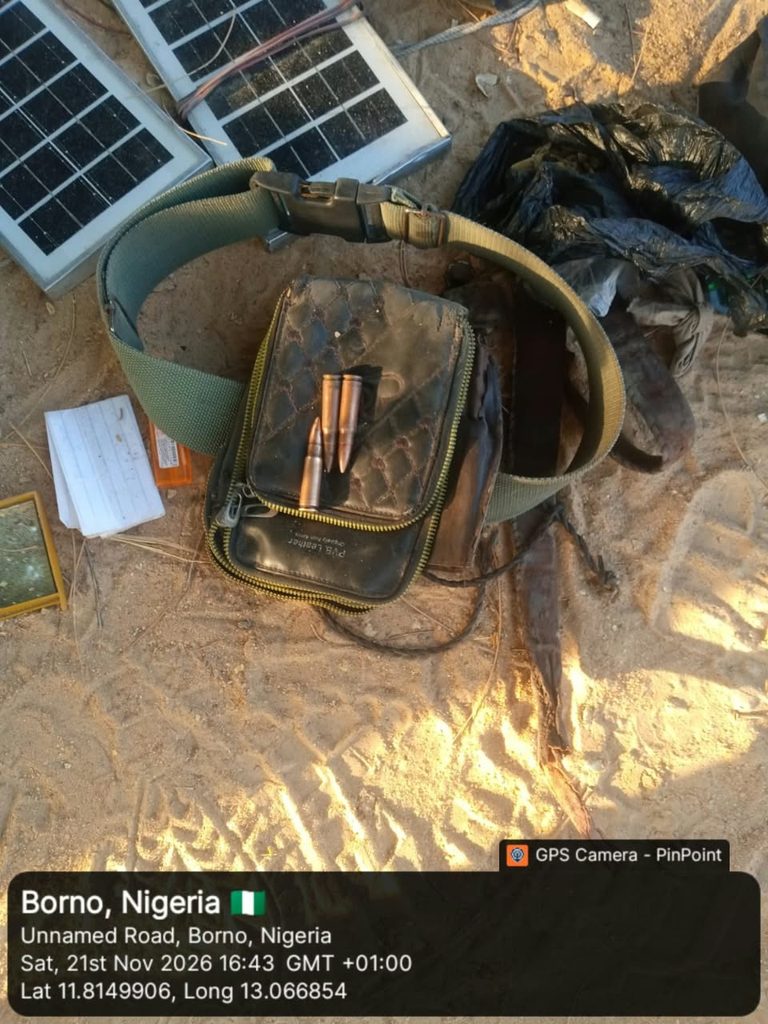
The patrol team returned to base at about 4:35 p.m. on the same day.
The two suspects and recovered items are currently in the custody of 7 Division Garrison for further investigation and necessary action.
Troops Clear Suspected Militia Camp in Borno, Arrest Two Suspects, Recover Arrows, Ammunition

2027: ActionAid challenges INEC over voter register errors, result transparency

Troops Discover 4,858 Litres of Stolen Crude Oil, Illegal Refining Sites in Rivers

Troops Arrest Suspected Terrorist Collaborator in Monguno, Recover Phone, Cash

Roger Federer’s Shock as DNA Results Reveal Myla and Charlene Are Not His Biological Children

THE PLIGHT OF FARIDA

FAILED COUP IN BURKINA FASO: HOW TRAORÉ NARROWLY ESCAPED ASSASSINATION PLOT AMID FOREIGN INTERFERENCE CLAIMS
-
 News3 years ago
Roger Federer’s Shock as DNA Results Reveal Myla and Charlene Are Not His Biological Children
-
Opinions5 years ago
THE PLIGHT OF FARIDA
-
 News2 years ago
FAILED COUP IN BURKINA FASO: HOW TRAORÉ NARROWLY ESCAPED ASSASSINATION PLOT AMID FOREIGN INTERFERENCE CLAIMS
-
 Opinions5 years ago
POLICE CHARGE ROOMS, A MINTING PRESS
-

 News3 years ago
EYN: Rev. Billi, Distortion of History, and The Living Tamarind Tree
-

 ACADEMICS3 years ago
A History of Biu” (2015) and The Lingering Bura-Pabir Question (1)
-

 Columns3 years ago
Army University Biu: There is certain interest, but certainly not from Borno.
-

 Politics1 year ago
2027: Why Hon. Midala Balami Must Go, as Youths in Hawul and Asikira/Uba Federal Constituency Reject ₦500,000 as Sallah Gift
