
News
Benue Takes Decisive Step to Strengthen Climate Governance Framework


Benue Takes Decisive Step to Strengthen Climate Governance Framework
Benue State has taken a decisive step to strengthen its climate governance framework, signalling a renewed commitment to addressing the growing environmental challenges facing the state.
The state government has identified prioritizing stronger institutional capacity and legislative leadership as key drivers for building long-term climate resilience.
At the one-day training on climate change, themed “Strengthening Legislative Leadership for Developing Climate Change Resilience and Carbon Budgeting in Benue State,” top government officials, members of the 10th State House of Assembly, and international development partners gathered in Abuja to deepen climate awareness and equip lawmakers with the tools to drive effective policies.
The training emphasized the critical role of informed legislation in institutionalizing carbon budgeting, promoting sustainable development, and safeguarding Benue’s future against escalating climate threats.
In his keynote address, the Executive Governor of Benue State, His Excellency Rev. Fr. Dr. Hyacinth Iormem Alia, represented by his Secretary, Dr. Emmanuel Chenge, raised concern over the increasing exposure of the state to climate-related disasters, noting that frequent flooding, erratic rainfall, rising temperatures and biodiversity loss now threaten agriculture, infrastructure and rural livelihoods.
He said: “Benue State, known as the Food Basket of the Nation, bears a disproportionate vulnerability to climate change.
“We have witnessed increasing frequency of floods in Makurdi, Agatu, Guma, Logo, Katsina-Ala and other riverine LGAs; erratic rainfall affecting crop yield; rising temperatures impacting water security and the health of our people; as well as degradation of forest landscapes and biodiversity.”
Chenge added that the effects of climate change are already eroding the state’s economic foundations, insisting that: “When climate disasters strike, it is our farmers, our women, our youth and our rural communities who suffer the most.
“Our food production systems are exposed, our infrastructure is weakened and our social stability is endangered. We cannot afford to treat this as a distant problem—its impacts are already at our doorstep.”
He called for urgent legislative action, emphasizing that the House of Assembly holds the power to set the pace for the state’s climate transition stating that “Climate governance begins with strong laws, effective oversight and a clear budgeting framework, you as lawmakers, have the power to strengthen the Benue State Climate Change Law so it evolves with global best practices, you can institutionalize carbon budgeting systems, legislate climate-smart land use and demand accountability from MDAs. With your leadership, we can turn challenges into opportunities for green development.”
He further stressed that climate resilience must be mainstreamed into all sectors. “Every ministry must begin to think climate. Every local government must plan with climate in mind, and every future development blueprint must place environmental sustainability at its core, out survival as a people depends on the decisions we make today.” He noted .
The country Director of International Alert Nigeria, Kingsley Udo, highlighted the need for unified climate leadership, describing the gathering as a strong demonstration of the state’s readiness to confront climate-related risks.
He said: “I am delighted to see such a rich gathering of stakeholders committed to strengthening climate governance in Benue State, your presence reflects a shared commitment to ensuring that our institutions, communities and governance structures work together in confronting the realities of climate change.”
He emphasized that climate change is fast becoming a major driver of conflict if left unaddressed.
He noted that “In Benue, Nigeria’s food basket, erratic rainfall, flooding, prolonged dry seasons and land degradation are contributing not only to environmental stress but also to heightened competition over land, water and livelihoods.”
He explained that: “Climate pressure, if unmanaged, becomes a conflict trigger, that is why proactive climate governance is no longer optional; it is essential for long-term peace.”
Udo also highlighted International Alert’s decades-long work in peacebuilding and governance reform.
“International Alert has worked for over 30 years globally and nearly two decades in Nigeria helping communities find peaceful solutions to conflict, we have partnered with governments, civil society and security agencies to develop responsive policies and strengthen institutional capacity. Our commitment to Benue is rooted in our belief that peace and climate security must go hand in hand.” He said .
He called on lawmakers to take a central role in implementing the Climate Change Act noting that: “As lawmakers, your leadership is indispensable,The Act will remain a document unless you translate it into real, actionable and well-resourced policies. Your oversight, your budgeting decisions and your engagement with your constituencies determine how far Benue will go in building resilience.”
Udo added further that the state cannot wait for disasters before taking action.
“We must move from reaction to prevention, the time for hesitation is over , the climate is changing faster than our systems are adapting,this meeting marks an important step toward bridging that gap.”he said .
The Director General, Benue State Council On Climate Change (BSCCC), Aondofa Mailumo identified the climate situation in Benue as severe and escalating. Shifting rainfall patterns, flooding, rising temperatures, erosion, declining soil fertility and the struggle of farmers signal that the state is approaching a dangerous threshold. The food system—not just the environment—is under threat. This urgency forms the foundation for why legislative action, financing and coordinated climate governance are essential.
He said: “Benue State, the food basket of the nation, is increasingly confronted with environmental realities that threaten the economic lifeline of its people. Farmers are struggling, food production is declining, and our communities are facing heightened vulnerability. These growing impacts highlight the urgent need for climate action.”
The DG emphasized that no climate initiative policy, plan, or strategy,can succeed without the backing of the State Assembly. Laws must create structure, continuity, accountability and enforcement without legislation, climate plans remain intentions; with legislation, they become enforceable frameworks capable of driving real change.
He further noted that the key legislative responsibilities include providing legal backing for the Climate Change Law and its Action Plan, institutionalizing carbon budgeting across government operations, mandating climate risk assessments for public projects, ensuring consistent climate reporting by MDAs, and approving sustainable budgetary provisions for adaptation and mitigation initiatives.
He said: “Without supportive legislation, climate policies remain aspirations. With strong laws, they become instruments for real transformation. The Legislature has the power to institutionalize carbon budgeting, mandate climate risk assessments, and safeguard the climate agenda of Benue State.”
He revealed that the major barrier to climate action is inadequate financing , current budget allocations are intermittent and insufficient, while the scale of climate threats demands sustained, predictable funding.
The DG stressed that Benue must diversify its financing sources to include domestic, international, private sector and community-level channels. This blended finance model is essential for moving from planning to implementation.
“Climate action requires huge financial resources that government alone cannot shoulder, to move from planning to implementation, we must expand our financing landscape tapping into domestic, international, private-sector and community-level climate finance,” he said.
Beyond challenges, the DG said climate change must be used as an opportunity for transformation, noting that with effective mitigation and adaptation strategies, Benue can strengthen agriculture, promote green innovation, create jobs and build long-term resilience Climate action, therefore, is not only defensive but also developmental.
“Mitigation and adaptation represent an opportunity to reduce climate risks, drive sustainable development, protect livelihoods, and promote green innovation in Benue State. This is our chance to build a resilient future,” he said.
Participants agreed that the state legislature must anchor climate governance by enacting responsive laws, mandating climate risk assessments and ensuring transparent use of climate funds.
The meeting concluded with a collective commitment from government leaders, lawmakers and development partners to prioritize climate action as a central pillar of Benue’s long-term development strategy. Stakeholders emphasized that while technical solutions are essential, they must be complemented by strong political will, effective legislation and continuous capacity building with strengthened legislative leadership and continued collaboration with partners such as International Alert, Benue State appears poised to chart a more resilient, climate-responsive and sustainable path for its citizens.
Benue Takes Decisive Step to Strengthen Climate Governance Framework


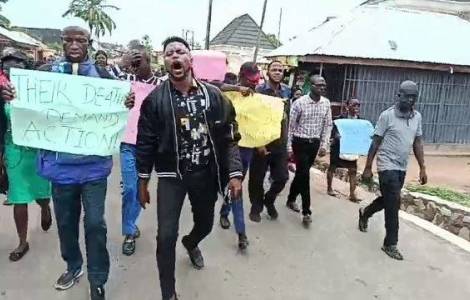
SOJA Condemns Alleged Abduction of Teachers, Students in Oyo, Demands Urgent Rescue Efforts
By: Michael Mike
A human rights organisation, Speak Out for Justice Advocacy Ltd./Gte. (SOJA), has condemned the reported abduction of teachers and students in Oriire Local Government Area of Oyo State, describing the incident and the alleged killing of a teacher, Mr. Michael Oyedokun, as “a case too many.”
In a statement issued on Thursday, the group expressed deep concern over reports that armed attackers abducted teachers and students from schools within the council area around May 15, 2026, while Mr. Oyedokun, a Mathematics teacher at Community High School, Ahoro-Esiele, was reportedly killed during the incident.
The organisation said several victims were still believed to be in captivity awaiting rescue.
SOJA, led by its Founder and Executive Director, Hameed Ajibola Jimoh, commiserated with the affected families and communities, warning that repeated attacks on schools and civilians across parts of the country were becoming alarming.
According to the advocacy group, the incident, if confirmed, raises serious constitutional and human rights concerns under both Nigerian law and international treaties to which Nigeria is a signatory.
Citing Section 14(2)(b) of the 1999 Constitution, SOJA stressed that “the security and welfare of the people shall be the primary purpose of government,” while Sections 33, 34 and 35 guarantee the rights to life, dignity and personal liberty.
The group also referenced Nigeria’s obligations under several international and regional legal frameworks, including the United Nations-backed International Covenant on Civil and Political Rights (ICCPR), the Convention on the Rights of the Child (CRC), the African Charter on Human and Peoples’ Rights (ACHPR), and the African Charter on the Rights and Welfare of the Child (ACRWC).
SOJA argued that the obligations imposed by these instruments go beyond symbolic commitments, requiring authorities to take practical and preventive steps to protect lives, especially those of vulnerable groups such as school children and teachers.
“The implication of these obligations in the present circumstances is that government responsibility extends beyond merely reacting after tragic events occur,” the statement said.
The organisation acknowledged reports that security agencies had intensified rescue operations and investigations, but maintained that recurring attacks on schools demanded more decisive and proactive measures.
“This is a case too many,” the statement added.
SOJA therefore called for the immediate intensification of lawful rescue efforts for those still in captivity, a thorough investigation into the incident, prosecution of perpetrators, strengthened security around schools and vulnerable communities, and adequate support for affected victims and families.
The group further urged the government to undertake a comprehensive review of strategies aimed at preventing future attacks on educational institutions.
“Teachers should not become targets. Schools should not become zones of fear. Children should not bear the burden of insecurity,” the organisation stated.
SOJA Condemns Alleged Abduction of Teachers, Students in Oyo, Demands Urgent Rescue Efforts

Troops recover suspected stolen motorcycle in Plateau
By: Zagazola Makama
Troops of Sector 6, Operation Enduring Peace have recovered a suspected stolen motorcycle following a pursuit of suspected motorcycle snatchers in Riyom Local Government Area of Plateau.
Security sources disclosed that the incident occurred at about 6:30 p.m. on May 21 along the Bachi-Banghai road after troops received reports on the activities of suspected motorcycle snatchers in the area.
The sources said the troops immediately mobilised and pursued the suspects, who abandoned the motorcycle and fled upon sighting the security personnel.
According to the sources, the recovered motorcycle has been secured, while efforts were ongoing to identify the rightful owner and apprehend the fleeing suspects.
The military said the operation formed part of sustained efforts to combat criminal activities and enhance security across Plateau.
Troops recover suspected stolen motorcycle in Plateau

Troops launch rescue operation after abduction in Plateau
By: Zagazola Makama
Troops of Sector 1, Operation Enduring Peace have launched a rescue operation following the abduction of a resident in Bassa Local Government Area of Plateau.
Security sources disclosed that the incident occurred at about 11:00 p.m. on May 21 when gunmen reportedly abducted Mr Eze Emeka from his residence at Agingi village.
The sources said troops swiftly responded to the distress report and commenced rescue operations in collaboration with other security agencies.
According to the sources, efforts were ongoing to track down the kidnappers and secure the safe release of the victim.
The military assured residents that security forces were intensifying operations to curb criminal activities in the area.
Troops launch rescue operation after abduction in Plateau

Hidden Wounds Across Borders: Thousands of Women in Nigeria, Somalia Suffer in Silence as Obstetric Fistula Crisis Deepens

AU’s Sudan Dilemma: Balancing Anti-Coup Norms with Diplomatic Pragmatism

SOJA Condemns Alleged Abduction of Teachers, Students in Oyo, Demands Urgent Rescue Efforts

Roger Federer’s Shock as DNA Results Reveal Myla and Charlene Are Not His Biological Children

THE PLIGHT OF FARIDA

FAILED COUP IN BURKINA FASO: HOW TRAORÉ NARROWLY ESCAPED ASSASSINATION PLOT AMID FOREIGN INTERFERENCE CLAIMS
-
 News2 years ago
Roger Federer’s Shock as DNA Results Reveal Myla and Charlene Are Not His Biological Children
-
Opinions4 years ago
THE PLIGHT OF FARIDA
-
 News1 year ago
FAILED COUP IN BURKINA FASO: HOW TRAORÉ NARROWLY ESCAPED ASSASSINATION PLOT AMID FOREIGN INTERFERENCE CLAIMS
-

 News2 years ago
EYN: Rev. Billi, Distortion of History, and The Living Tamarind Tree
-
 Opinions4 years ago
POLICE CHARGE ROOMS, A MINTING PRESS
-

 ACADEMICS2 years ago
A History of Biu” (2015) and The Lingering Bura-Pabir Question (1)
-

 Columns2 years ago
Army University Biu: There is certain interest, but certainly not from Borno.
-

 Opinions2 years ago
Tinubu,Shettima: The epidemic of economic, insecurity in Nigeria
