
Uncategorized
NHRC Raises Alarm Over Rising Human Rights Violations, Records 659,617 Complaints in Q1 2026

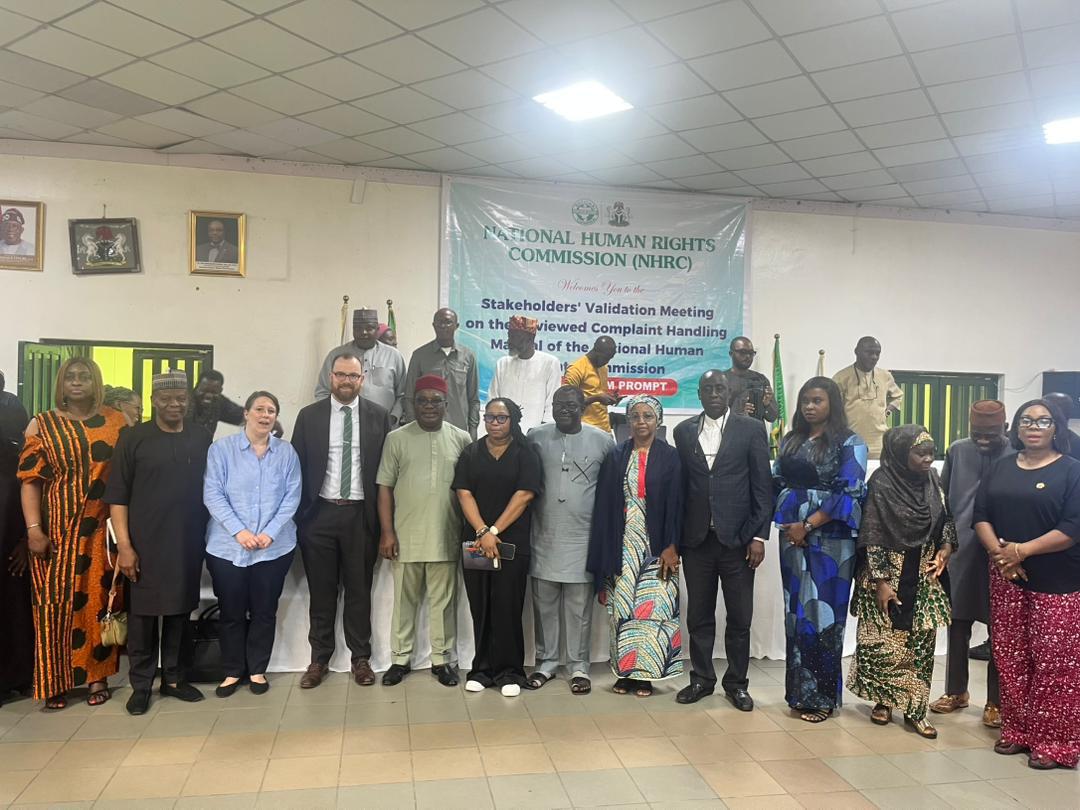
NHRC Raises Alarm Over Rising Human Rights Violations, Records 659,617 Complaints in Q1 2026
By: Michael Mike
The National Human Rights Commission (NHRC) has raised fresh concerns over a worsening human rights and security situation in Nigeria, disclosing that it received 659,617 complaints and recorded 992 killings in the first quarter of 2026, amid rising cases of discrimination, insecurity, and abuse across the country.
Presenting the January–March 2026 Human Rights Situation Dashboard in Abuja, the Senior Adviser to the Commission, Hilary Ogbona, said the data reflected both an escalation in violations and improved public reporting, warning that the trends point to deepening national challenges in governance, security, and social protection.
Ogbona explained that complaints increased consistently across the quarter, with 180,341 cases in January, 223,144 in February, and 256,132 in March, adding that the dominant category of complaints remained freedom from discrimination, followed closely by cases linked to law enforcement misconduct and violations of human dignity.
“For the months of January to March 2026, we recorded 659,617 human rights complaints in the Commission.”
He said the Commission’s Human Rights Observatory also captured incidents beyond formal petitions, revealing widespread insecurity-related abuses, including killings, abductions, communal violence, and sexual and gender-based violence across multiple states.
According to him, mass killings peaked in February 2026, making it the deadliest month of the quarter, driven largely by insurgent attacks, banditry operations, communal clashes, and mob violence in several regions.
“Mass killings across Nigeria reached an all-time high, especially in the month of February.”
The report showed that the North-Central zone recorded the highest number of complaints, followed by the North-West and North-East, with Abuja (FCT), Benue, Niger, Plateau, and Kaduna among the most affected states. Ogbona noted that reporting structures in the FCT also contributed to its high ranking due to combined data from multiple NHRC offices.
The adviser further highlighted growing concerns over gender-based violence and violations against children, including sexual assault, abandonment, trafficking risks, and denial of access to care. He described the situation as a “serious protection crisis,” especially for vulnerable populations.
“We have seen an upsurge in gender-based violence and discrimination.”
He also disclosed that child rights violations remained widespread, with child abandonment emerging as the most frequent category, alongside rising incidents of exploitation and domestic abuse. In addition, mob justice and “home action killings” were identified as increasing contributors to overall fatalities.
The NHRC report further indicated that out of the 992 killings recorded, a significant proportion were attributed to bandit groups, Boko Haram insurgents, and unknown gunmen, while others stemmed from communal clashes, cult-related violence, and mob actions. Road and boat accidents were separately recorded at 197 deaths and not included in the main security tally.
Justice sector institutions and partners at the event commended the NHRC for strengthening transparency through its dashboard system.
A representative of the Police Service Commission, Barista Dada, described the dashboard as a critical accountability mechanism for monitoring police conduct and enforcing discipline within the Nigeria Police Force.
“The dashboard has become an official platform upon which human rights compliance in Nigeria can be assessed monthly, quarterly.”
He added that findings from the NHRC reports are increasingly being used to validate allegations of misconduct and guide disciplinary action against officers.
Similarly, Barista Bamidele, speaking on behalf of the Director-General of the Legal Aid Council of Nigeria, said the dashboard exposed systemic weaknesses in Nigeria’s justice system, particularly delays in investigations and trials.
“The incessant abuse of human rights and systemic delays in handling of investigations, criminal trials, ineffective administration creates justice gaps.”
He stressed that the Legal Aid Council views the initiative as essential for improving access to justice and supporting victims of human rights violations across the country.
The Executive Secretary of the NHRC, Dr. Tony Ojukwu, said the dashboard has continued to receive international recognition, including presentations at the United Nations in Geneva, where it was highlighted as an innovative model for human rights monitoring.
“I was recently honoured to speak on the Dashboard at the United Nations in Geneva, reflecting global recognition of our efforts.”
He added that the Commission is working to sustain the dashboard beyond donor support, describing it as a permanent tool for accountability, transparency, and policy guidance.
The NHRC warned that the first quarter 2026 figures underscore urgent national challenges requiring coordinated action across all levels of government. It called for stronger institutional accountability, improved security responses, and deeper collaboration with civil society, development partners, and the media to curb rising human rights violations and restore public confidence in governance and justice systems.
NHRC Raises Alarm Over Rising Human Rights Violations, Records 659,617 Complaints in Q1 2026


WHEN TERRORISTS MOCK THE STATE
By Sa’adiyyah Adebisi Hassan
A retired Major General is kidnapped and dies in captivity. Soldiers are ambushed and killed in Kaduna. Troops are attacked in Borno. Farmers are slaughtered in Zamfara. Villages continue to live under the shadow of fear. Families sell their property to pay ransom. Children grow up knowing the sound of gunfire better than the sound of peace. Yet the Nigerian state continues to behave as though these are isolated incidents instead of symptoms of a national security emergency.
At what point do we stop pretending?
At what point do we stop calling this “security challenges” and start admitting that armed criminal groups have become bold enough to openly challenge the authority of the Nigerian state?
Because that is exactly what is happening.
The death of Major General Abubakar Rabe in captivity should have shaken every office in Abuja. This was not an ordinary citizen hidden away in a remote village. This was a retired General, a man who spent years serving the nation. If criminals can abduct and hold a retired General until he dies in captivity, what message does that send to the ordinary teacher, farmer, trader, student, doctor or civil servant?
The message is simple and frightening: nobody feels untouchable anymore.
And that is why public frustration is boiling over.
The most dangerous thing happening in Nigeria is not just that terrorists and bandits are killing people. The most dangerous thing is that they increasingly appear unafraid of the consequences. Fear is supposed to flow in one direction, from criminals toward the state. In Nigeria, that equation appears dangerously reversed. Citizens fear criminals. Criminals seem less fearful of the state.
That should terrify every serious leader.
And then there is another question that many Nigerians are asking, even if officials do not like hearing it.
How can violent criminal networks continue to communicate, negotiate ransoms, circulate videos, move money and maintain support structures without creating intelligence opportunities?
✅Modern criminality leaves footprints.
✅Phones leave footprints.
✅SIM cards leave footprints.
✅Financial transactions leave footprints.
✅Internet activity leaves footprints.
✅Movement leaves footprints.
✅Communication leaves footprints.
✅Nothing simply appears from thin air.
Which is why many Nigerians become angry when they see stories of suspected bandits or criminal sympathizers flaunting wealth online, building audiences, distributing money or creating influence networks while communities they helped terrorize are burying their dead.
Every person is entitled to due process and evidence matters. But any serious country would investigate suspicious financial ecosystems around violent criminal networks aggressively and relentlessly.
Because terrorism is not sustained by bullets alone.
✅It is sustained by money.
✅It is sustained by logistics.
✅It is sustained by information.
✅It is sustained by collaborators.
✅It is sustained by people willing to normalize evil because there is money attached to it.
✅No terrorist organization survives in complete isolation.
✅Someone supplies information.
✅Someone moves money.
✅Someone facilitates communication.
✅Someone benefits.
That is why successful counterterrorism operations across the world do not focus only on gunmen in forests. They focus on the entire ecosystem that keeps the violence alive.
Nigeria’s problem is that it often appears to be chasing the symptoms while the disease continues growing.
A kidnapping gang should not only be viewed as armed men carrying rifles.
It should be viewed as a network.
A terror cell should not only be viewed as fighters.
It should be viewed as financiers, recruiters, propagandists, informants, transporters, suppliers and digital facilitators.
Destroy the network and the gunmen become isolated.
Ignore the network and new gunmen appear.
That is the lesson serious countries learned long ago.
The second lesson is even more important: intelligence wins wars before soldiers do.
A nation of over two hundred million people should not be relying primarily on reaction. It should be relying on anticipation.
The future of security is intelligence fusion.
✅Telecom intelligence.
✅Financial intelligence.
✅Cyber intelligence.
✅Human intelligence.
✅Border intelligence.
✅Geospatial intelligence.
All operating from one integrated national threat platform.
Not twenty agencies protecting twenty databases while criminals exploit the gaps.
The truth is that Nigeria does not have a shortage of brave soldiers. It does not have a shortage of brave police officers. It does not have a shortage of brave intelligence personnel.
What it appears to suffer from is a shortage of speed, integration, accountability and coordination.
And criminals thrive inside those gaps.
That is why every major attack must trigger a hard question: what information existed before the attack, who had it, what was done with it and why did prevention fail?
Those questions are not anti-government.
Those questions are pro-accountability.
Because the purpose of security is not explaining attacks after they happen.
The purpose of security is preventing them from happening in the first place.
The greatest tragedy in all of this is that Nigerians are gradually becoming emotionally exhausted. Every day brings another headline. Another abduction. Another ambush. Another funeral. Another community attacked. Another family destroyed.
No country should normalize that.
No society should accept that.
No government should become comfortable with that.
The death of Major General Abubakar Rabe, the killing of soldiers, the slaughter of farmers and the endless stream of kidnappings are not separate stories. They are warnings. Warnings that criminals are testing the limits of state authority every single day.
The question now is whether the state intends to reclaim that authority decisively, intelligently and relentlessly or continue issuing statements while citizens continue counting the dead.
Because a nation is not judged by the speeches of its leaders.
It is judged by whether its people can live without fear.
And right now, too many Nigerians are afraid.
WHEN TERRORISTS MOCK THE STATE
Gov Mbah Lauds DSS, Army, Others as He Inspects Arms Cache Seized From ESN Terrorists
*Thanks President Tinubu for Supporting States To Fight Insecurity
By: Michael Mike
Governor Peter Mbah of Enugu State on Friday commended the Department of State Services (DSS), the Nigerian Army, and the Nigeria Police for their commitment to securing Nigeria and the Southeast geopolitical zone in particular.
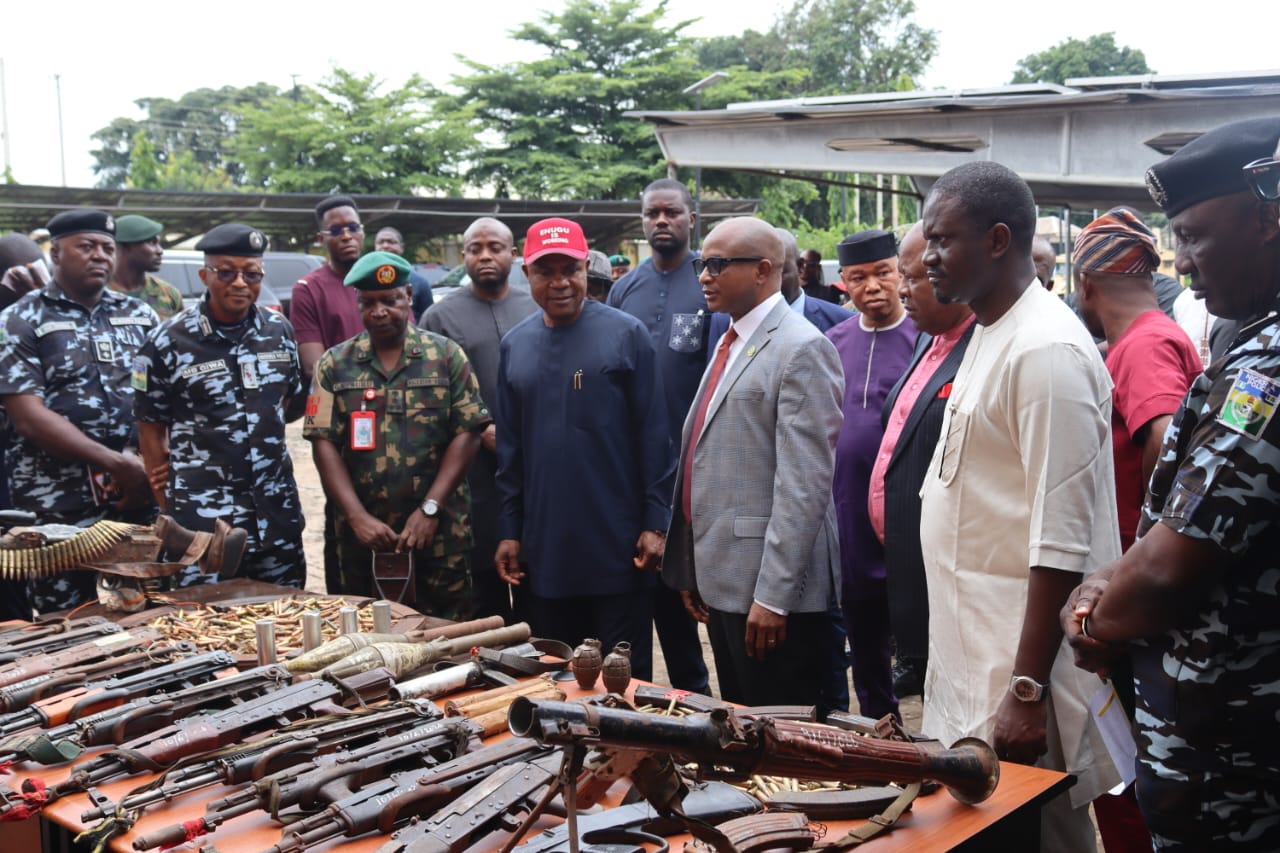
The Governor gave the commendation shortly after visiting the State’s DSS headquarters where he inspected a cache of arms and ammunition recovered on Tuesday from commanders of the outlawed Eastern Security Network (ESN) in the State.
During the raid on ESN armoury, DSS operatives, backed by troops of the 82 Division of the Nigerian Army, recovered a large cache of high-calibre arms and ammunition.
Governor Mbah inspected some of the recovered weapons, including
a rocket launcher, two RPG (rocket propelled grenades) warheads, three RPG chargers, 11 AK-47 rifles, and over 610 rounds of NATO 7.62×39 mm ammunition, and National Youth Service Corps (NYSC) uniforms and lanyards.
Accompanied by the Division’s Garrison Commander, Brig. Gen Abubakar Suru, State Commissioner of Police, Bitrus Giwa, and other government officials, Mbah praised the hard work and collaboration among security agencies in the country.
According to the governor, but for the diligence and intelligence of the DSS and sister security agencies, , the recovered arms and ammunition would have been used by the ESN terrorists to wreck havoc across the South and paint a false picture that insecurity has taken over Nigeria.
Governor Mbah called on Nigerians to, irrespective of their political and religious affiliations, support efforts by President Bola Tinubu to tackle insecurity.
He thanked President Tinubu for supporting states to tackle insecurity, saying the President’s effort is the reason for the successes being recorded by security agencies across the states.
Security sources disclosed that the raid on the ESN armoury came on the heels of intelligence gathered from some arrested ESN members, that the terrorist organization was planning to unleash terror on Enugu and other Southeast States, and create panic and the false impression that bandits have invaded the region.
The Enugu recovery came two days before the Federal High Court in Abuja sentenced five members of a band of notorious bandits each to 25 years in prison for assisting the gunmen who, on November 21, 2025, attacked and abducted students and staff of St. Mary’s Catholic School in Papiri, Niger State.
The five convicts were arrested by DSS operatives in separate operations last week.
Gov Mbah Lauds DSS, Army, Others as He Inspects Arms Cache Seized From ESN Terrorists
Uncategorized
Army Distributes Fertiliser to Farmers in Jigawa Under Civil-Military Cooperation Programme
Army Distributes Fertiliser to Farmers in Jigawa Under Civil-Military Cooperation Programme
By: Zagazola Makama
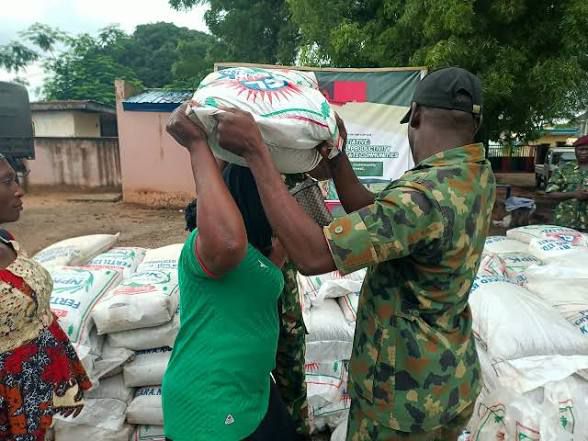
The Nigerian Army has distributed 40 bags of fertiliser to selected farmers in Jigawa State as part of its Civil-Military Cooperation (CIMIC) activities aimed at supporting local communities and enhancing agricultural productivity.
Security sources reliably informed that the distribution exercise was carried out on Thursday at Dahuwa Primary School in Chamo District of Dutse Local Government Area.
According to the sources, the Commander of the 26 Armoured Brigade, Brig.-Gen. O.I. Odigie, represented the Chief of Army Staff (COAS) during the event.
The fertiliser was distributed to selected farmers drawn from communities within the brigade’s area of responsibility as part of efforts to strengthen relations between the military and host communities while supporting food production.
The sources said the initiative forms part of the Nigerian Army’s broader commitment to community development and socio-economic support programmes across the country.
The event was conducted peacefully and without any security incident.
Army Distributes Fertiliser to Farmers in Jigawa Under Civil-Military Cooperation Programme

Kashim Shettima: Of Betrayal, Power, and Survival.

ELECTIONS CAN WAIT: SAVING NIGERIA FROM COLLAPSE MUST COME FIRST

FACT CHECK: No School Attack, No Student Abduction in Kautikari — What Really Happened During the ISWAP Raid

Roger Federer’s Shock as DNA Results Reveal Myla and Charlene Are Not His Biological Children

THE PLIGHT OF FARIDA

FAILED COUP IN BURKINA FASO: HOW TRAORÉ NARROWLY ESCAPED ASSASSINATION PLOT AMID FOREIGN INTERFERENCE CLAIMS
-
 News2 years ago
Roger Federer’s Shock as DNA Results Reveal Myla and Charlene Are Not His Biological Children
-
Opinions4 years ago
THE PLIGHT OF FARIDA
-
 News1 year ago
FAILED COUP IN BURKINA FASO: HOW TRAORÉ NARROWLY ESCAPED ASSASSINATION PLOT AMID FOREIGN INTERFERENCE CLAIMS
-

 News2 years ago
EYN: Rev. Billi, Distortion of History, and The Living Tamarind Tree
-
 Opinions4 years ago
POLICE CHARGE ROOMS, A MINTING PRESS
-

 ACADEMICS2 years ago
A History of Biu” (2015) and The Lingering Bura-Pabir Question (1)
-

 Columns2 years ago
Army University Biu: There is certain interest, but certainly not from Borno.
-

 Politics1 year ago
2027: Why Hon. Midala Balami Must Go, as Youths in Hawul and Asikira/Uba Federal Constituency Reject ₦500,000 as Sallah Gift
