
News
Digital Violence: NHRC, NBA Women Forum Mobilise Against Online Attacks on Women Lawyers

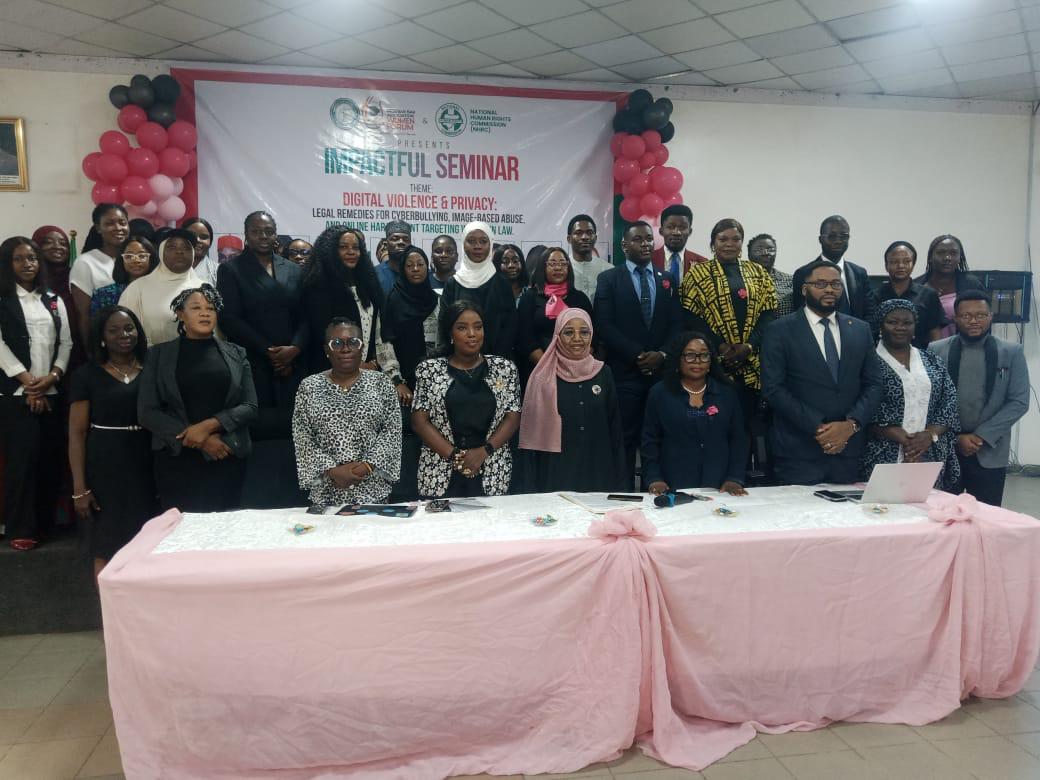
Digital Violence: NHRC, NBA Women Forum Mobilise Against Online Attacks on Women Lawyers
By: Michael Mike
The National Human Rights Commission (NHRC) and the Nigerian Bar Association Women Forum (NBAWF) have launched a renewed institutional push to confront the growing wave of digital violence against women in the legal profession, warning that online abuse is increasingly being used to intimidate, silence and undermine women’s participation in public life.
The two organisations, at a high-level seminar in Abuja on Monday, called for greater awareness of legal remedies, improved reporting mechanisms, stronger institutional collaboration and enhanced digital security to protect women lawyers, judges, academics, law students and other women in the justice sector from technology-facilitated abuse.
The seminar, organised around the theme, “Digital Violence and Privacy: Legal Remedies for Cyberbullying, Image-Based Abuse and Online Harassment Targeting Women in Law,” brought together legal practitioners, judicial officers, human rights advocates and digital rights experts to examine the growing threats posed by the misuse of technology.
The development comes against the backdrop of the increasing use of social media and other digital platforms as tools for professional engagement, public advocacy and civic participation. However, the same platforms have also created new avenues for cyberbullying, cyberstalking, identity theft, doxxing, online intimidation, non-consensual sharing of intimate images and coordinated attacks against women.
Opening the seminar on behalf of the Executive Secretary of the NHRC, Chief Tony Ojukwu, the Commission’s Director of Legal Services, Hajiya Rabi A. Anwar, said technological advancement had transformed communication and professional practice but had also created new frontiers for human rights violations.
She said women in the legal profession were increasingly exposed to digital attacks capable of damaging their reputation, compromising their privacy and threatening their personal and professional security.
According to her, the abuses were not simply the unpleasant consequences of modern technology but serious violations of fundamental rights to dignity, privacy, equality and freedom from discrimination.
She warned that the consequences extended beyond individual victims, as persistent online harassment could intimidate women into silence and discourage them from seeking leadership positions, participating in public debates or maintaining a visible professional presence.
“Digital violence can silence women, restrict their participation in public life and undermine their professional advancement,” she said.
Anwar said the NHRC’s mandate to protect and promote human rights covered both physical and digital spaces, stressing that the emerging nature of online abuse required institutions to adapt their strategies and strengthen cooperation.
She identified the Cybercrimes (Prohibition, Prevention, etc.) Act, the Violence Against Persons (Prohibition) Act, the Nigeria Data Protection Act, 2023, and constitutional protections for fundamental rights as some of the legal instruments available to victims of digital violence.
However, she said the principal challenge was increasingly becoming the lack of awareness among victims and the public about the remedies available to them.
“Many victims do not know where to report, how to preserve digital evidence or which institution has the responsibility to intervene,” she said.
She explained that the seminar was therefore designed to move beyond theoretical discussions by providing participants with practical knowledge on litigation and other remedies, preservation of digital evidence, content takedown and de-indexing procedures, data protection complaints, cybersecurity and strategic advocacy.
She urged participants to use the knowledge acquired to protect themselves, assist victims and contribute to the development of a stronger national response to digital violence.
The NHRC further pledged to sustain its partnership with the NBA Women Forum and work towards translating the recommendations of the seminar into concrete policy initiatives and institutional action.
In her remarks, the National Chairperson of the NBA Women Forum, Mrs Agnes Fache-Omoya, described digital violence as a serious human rights and professional challenge that could affect virtually every aspect of a woman’s life.
She said the growing visibility of women lawyers online, while creating opportunities for professional engagement and public advocacy, had also exposed them to increased risks of cyberbullying, online intimidation, identity theft, image-based abuse and other forms of technology-enabled gender violence.
Omoya said the legal profession could not claim to be advancing gender equality while women lawyers were forced to choose between professional visibility and personal safety.
“No female lawyer should have to choose between professional visibility and personal security,” she said.
She reaffirmed the commitment of the NBA Women Forum to ensuring that women in the legal profession could practise and participate in public life with confidence, dignity and freedom from harassment both online and offline.
According to her, the partnership with the NHRC was particularly significant because the protection of women in the digital space required more than individual vigilance.
“It requires strong institutions, effective laws, accessible remedies and a professional community that refuses to normalise abuse,” she said.
She urged participants to promote responsible digital conduct, ethical online engagement and stronger solidarity within the legal profession.
Experts at the seminar examined the legal and institutional responses available to victims of cyberbullying, online harassment, image-based abuse and privacy violations. Discussions also focused on cybersecurity, responsible digital citizenship, evidence preservation and the need for victims to report abuses rather than suffer in silence.
The event ended with calls for sustained public education, improved institutional response mechanisms and more effective enforcement of existing laws.
Participants stressed that as Nigeria’s legal profession and public institutions continue to embrace digital technology, the protection of women online must become an integral part of the country’s broader human rights, gender equality and justice agenda.
The consensus was that digital spaces must not become new arenas for discrimination and intimidation, but platforms where women can participate freely, safely and equally in professional and public life.
Digital Violence: NHRC, NBA Women Forum Mobilise Against Online Attacks on Women Lawyers



Gombe govt, UNICEF launch project to tackle malnutrition
The Gombe State government in collaboration with the United Nations Children’s Fund, UNICEF has launched the Latter-Day Saints (LDSC)-Supported Project to tackle malnutrition through sustained investment in the first 1000 days of life.
The project tagged “Preventing Malnutrition in the First 1000 Days of Life” is to be implemented across Gombe State for a year.
Inaugurating the project in Gombe on Monday, Dr Abdulrahman Shuaibu, the Executive Secretary of the Gombe State Primary Health Care Department Agency said that the initiative was key to improving the health of children in the state.
Shuaibu said that the impact of malnutrition on children was severe, affecting the mental and overall development of the children, hence urged collective action to tackle the menace.
Stating that the statistics for Nigeria and Gombe State were not looking good, the Executive Secretary stressed the need to strengthen the fight against malnutrition through sustained investment and collaborations.
He advocated the need for antenatal care, safe delivery, exclusive breastfeeding, complementary and supplementary feeding as part of preventive measures that should be embraced by residents of the state.
Shuaibu highlighted efforts by the state government in collaboration with critical stakeholders to tackle the menace.
On her part, the Chief of UNICEF, Bauchi Field Office, Dr Nuzhat Rafique said that the one-year project was to support malnourished children to improve their nutritional status and to strengthen support for children during their first 1000 days.
Rafique decried the high number of children who were suffering malnutrition and the need for more investments in the first 1000 days of life to prevent malnutrition and ensure that children grow well to contribute to societal development.
“Today represents another important milestone in our collective commitment to ensuring that every mother and every child in Gombe State have the opportunity not only to survive but to thrive.
“The first 1,000 days of life — from conception until a child’s second birthday — represent the most critical period for brain development, physical growth, immunity and lifelong health.
“Investments made during this window yield some of the highest returns in human capital development and are fundamental to achieving sustainable development,” she said.
The Chief also lamented that the situation of hygiene and open defecation was very common, stressing that the nutritional status and availability of diverse food everyday in appropriate quality and quantity was unavailable.
“We need a very strong system to prevent malnutrition and promote healthy growth of the children and this grant is going to support that.”
Rafique said that the state needed a system strengthening approach and a good evidence based planning to tackle malnutrition amongst children in the state, stressing the importance of data-driven planning in all LGAs.
She called for a change in the community behaviour that often led children into malnutrition which she said wasn’t supposed to be.
“These children shouldn’t go into malnutrition in the first place because when they do, they lose a part of their I.Q, energy and potential to grow and be productive for the society.
“Once a child grows malnourished, everything they lose, even when they are treated at high cost, still we are at loss.
“As a nation we will be at a loss in future with more children malnourished although they are recovered,” she said.
The UNICEF Chief appealed to the media to help effect the needed behaviour change amongst communities to build a culture of prevention rather than treatment.
Rafique commended the Gombe State government for its continued investment and commitment to improving the wellbeing of children and women in the state which she said was evident in its sustained collaboration with UNICEF and other partners in the efforts to advance child rights.
Ms Philomena Irene, a Nutrition Specialist with UNICEF Nigeria’s Bauchi Field Office, highlighted the importance of the first 1000 days of a child, saying that the period was key to brain development.
Irene said investing in such a period was the most effective, high-impact strategy to break the cycle of malnutrition, poverty and inequality.
Breaking down the 1000 days, she said that the period comprised 270 days of pregnancy, 180 days of infancy, 550 days of toddler.
She called on stakeholders in the state to invest in the first 1,000 days to reduce child malnutrition and mortality while improving education, productivity and economic growth in the future.
Gombe govt, UNICEF launch project to tackle malnutrition

Ex-CDS Petinrin Lauds DSS On Oriire Rescue
*Says Intelligence Key To All Operations
By: Our Reporter
A former Chief of Defence Staff, Air Chief Marshal Oluseyi Petinrin, has praised the Department of State Services (DSS) for the recent rescue of 46 kidnapped pupils and teachers of a school in Oriire, Oyo State.
He described intelligence as key to all military operations, saying the intelligence supplied by the DSS greatly helped in the rescue operation.
In a statement he personally signed, Petinrin, a retired Four-star General, said he found the silence of the secret police before, during and after the rescue, impressive.
“While the side players were being eulogised and the main DSS actors responsible for the release were being ignored, the DSS kept silent,” noted the retired military officer.
He continued, “Students of military operations, including its planning and execution, know that intelligence is the grandfather of most successful operations. But it is a fact that is not immediately obvious to many members of the public and even to some that have spent years in the military establishments.”
He noted, “The Oriire kidnap victims’ release was already being credited to the military until one of the released victims told the true story.
“They were released by the kidnappers, and no kinetic action was involved in that release. The kidnappers even told their victims why they were being released: members of the kidnappers’ families had been arrested and their videos were sent to the kidnappers,” he stated.
The former Defence Chief noted that the ability of the DSS to identify relatives of the kidnappers and to use such intelligence to turn the tide against the abductors, led to the success of the operation.
Petinrin, who also served as Chief of the Air Staff, said he was particularly impressed by the conduct of the DSS after the operation was considered by many as a huge success.
“That is the way of solid intelligence professionals. They keep mum after doing the job that leads to the success of operations and will not raise a whimper even when the wrong people are being credited for the job. I must say it again: intelligence is the grandfather of military operations,” he declared.
Ex-CDS Petinrin Lauds DSS On Oriire Rescue

DSS Set To Appeal Life Sentence On Ansaru Terror Commanders
*Seeks Maximum Penalty On Behalf of Murdered Oriire Teachers
By: Michael Mike
The Department of State Services (DSS) is set to appeal Monday’s life sentence handed two top commanders of the Ansaru Terror organization by a Federal High Court, Abuja.
Justice Emeka Nwite had, shortly after Mahmud Usman, a.k.a Abu Bara’a/Abbas/Mukhtar, the self-styled Emir of Ansaru; and Abubakar Abba, a.k.a Mahmud al-Nigeri/Malam Mamuda, pleaded guilty to all the 32-count charges against them, sentence both men to life imprisonment.
However, a top official of the Service, said they considered the life sentence as too light a punishment for the crimes allegedly committed by the Ansaru commanders.
The official said the Service found it curious that, both convicts were on the verge of pleading guilty to the charges, but changed their minds shortly after some persons believed to be members of the same Ansaru organization kidnapped pupils and teachers in Oriire, Oyo State.
“For the nearly 60 days the kidnappers held on to the pupils and teachers of Oriire, the Ansaru commanders in our custody changed. One of the top conditions the abductors gave was the unconditional release of these same Ansaru commanders in exchange for the Oriire kidnap victims,” he said.
“From ‘not guilty plea,’ the two men at the penultimate court session, said they were undecided on what plea to take. Justice Nwite even had to hand them an ultimatum to make up their minds on or before Monday’s sitting. After the Oriire rescue, they came to court to plead guilty to all the charges,” he added.
According to the top official, allowing the two terror commanders walk away with life sentences would not serve the cause of justice for the two Oriire teachers beheaded by their abductors.
“The reason the terrorists beheaded the two Oriire teachers was to put pressure on government to release these two Ansaru commanders. It, therefore, wouldn’t be fair to see two men beheaded and their families are made to live with the losses without adequately bringing the culpits to book,” he declared.
DSS Set To Appeal Life Sentence On Ansaru Terror Commanders

Gombe govt, UNICEF launch project to tackle malnutrition

Ex-CDS Petinrin Lauds DSS On Oriire Rescue

DSS Set To Appeal Life Sentence On Ansaru Terror Commanders

Roger Federer’s Shock as DNA Results Reveal Myla and Charlene Are Not His Biological Children

THE PLIGHT OF FARIDA

FAILED COUP IN BURKINA FASO: HOW TRAORÉ NARROWLY ESCAPED ASSASSINATION PLOT AMID FOREIGN INTERFERENCE CLAIMS
-
 News2 years ago
Roger Federer’s Shock as DNA Results Reveal Myla and Charlene Are Not His Biological Children
-
Opinions4 years ago
THE PLIGHT OF FARIDA
-
 News1 year ago
FAILED COUP IN BURKINA FASO: HOW TRAORÉ NARROWLY ESCAPED ASSASSINATION PLOT AMID FOREIGN INTERFERENCE CLAIMS
-

 News2 years ago
EYN: Rev. Billi, Distortion of History, and The Living Tamarind Tree
-
 Opinions5 years ago
POLICE CHARGE ROOMS, A MINTING PRESS
-

 ACADEMICS2 years ago
A History of Biu” (2015) and The Lingering Bura-Pabir Question (1)
-

 Columns2 years ago
Army University Biu: There is certain interest, but certainly not from Borno.
-

 Politics1 year ago
2027: Why Hon. Midala Balami Must Go, as Youths in Hawul and Asikira/Uba Federal Constituency Reject ₦500,000 as Sallah Gift
