
Education
Nigeria’s Education Crisis Now About System Capacity, Not School Enrolment – Report


Nigeria’s Education Crisis Now About System Capacity, Not School Enrolment – Report
By: Michael Mike
Nigeria’s education challenge has shifted from getting children into school to building an education system capable of delivering quality learning, according to a new policy report by the Athena Centre for Policy and Leadership.
The report, Nigeria’s Education Capacity Crisis: Closing the Gap Between Enrolment Growth and System Capacity, authored by Professor Temitayo Shenkoya and Anita Olatunde, argued that while the country has made remarkable progress in expanding access to education, inadequate investment in classrooms, teachers, infrastructure and governance has left the system overwhelmed and unable to translate rising enrolment into improved learning outcomes.
The publication, released on Wednesday in Abuja, described the situation as a structural capacity crisis rather than a temporary funding challenge, warning that without far-reaching institutional reforms, Nigeria risks undermining its human capital development and long-term economic competitiveness.
According to the report, 40.1 million pupils and students were enrolled in Nigeria’s public basic and secondary education system during the 2024/2025 academic session across 107,042 public schools.
However, the rapid increase in enrolment has far outpaced investments needed to sustain quality education.
The report revealed that an average classroom accommodates about 60 students, while roughly 66 students share a single toilet, highlighting severe overcrowding and poor sanitation in many public schools.
It also noted that Nigeria devoted only 0.3 per cent of its Gross Domestic Product (GDP) to public education in 2025, a figure significantly lower than allocations recorded in several comparable African countries.
The authors argued that the country’s education system is constrained less by enrolment than by weak governance structures, fragmented planning, inadequate teacher deployment, poor instructional quality, weak institutional coordination and limited use of education data for policy decisions.
“Nigeria’s education challenge is no longer defined solely by access; it is increasingly one of system capacity,” the report stated.
Rather than focusing exclusively on expanding school access, the report urged governments at all levels to prioritise strengthening institutional capacity, improving accountability mechanisms and adopting evidence-based planning to enhance learning outcomes.
Central to its recommendations is the development and effective deployment of the Digital Nigeria Education Management Information System (DNEMIS), which it said should serve as the backbone for planning, monitoring and evaluating education performance nationwide.
Among other recommendations, the report called for the establishment of integrated State Education Management Information Systems linked to the national platform, sustained multi-year investments in classrooms, teachers and digital infrastructure, evidence-based teacher deployment, improved instructional quality and stronger school leadership.
It also advocated annual infrastructure and learning-performance scorecards to monitor progress, targeted interventions for vulnerable learners and improved coordination among the Federal Ministry of Education, state governments, State Universal Basic Education Boards (SUBEBs), Teaching Service Commissions (TESCOMs) and Local Government Education Authorities.
The report stressed that future education spending should be guided by verified data and measurable learning outcomes rather than enrolment figures alone.
Drawing lessons from Botswana, South Africa and Namibia, the authors argued that countries achieving better educational outcomes have done so by building institutions capable of continuous planning, performance monitoring and accountability.
According to the report, the true measure of success should no longer be the number of children enrolled in school or classrooms constructed, but the ability of governments to use reliable evidence to improve teaching quality, strengthen school leadership and ensure meaningful learning for every child.
The publication concluded that addressing Nigeria’s education capacity deficit is not only an education sector priority but also a national development imperative with direct implications for economic growth, workforce productivity and global competitiveness.
Nigeria’s Education Crisis Now About System Capacity, Not School Enrolment – Report



Education
Drama at Ogun Student Election as Umpire Allegedly Swallows Ballot Papers, Police Intervene

Drama at Ogun Student Election as Umpire Allegedly Swallows Ballot Papers, Police Intervene
By Zagazola Makama
Drama unfolded during the Joint Campus Ogun State Council election held at the Nigeria Labour Congress (NLC) Secretariat in Leme, Abeokuta, after an electoral umpire allegedly swallowed some ballot papers during vote counting.
Police sources said the election, which commenced at about 8:00 a.m., was briefly delayed following a two-hour recess to resolve disputes over the number of accredited institutions.
The sources disclosed that stakeholders later reached a consensus recognising 13 institutions, after which the election proceeded.
According to the sources, tension escalated during the counting of votes when one of the electoral umpires, whose identity is yet to be confirmed, allegedly chewed some ballot papers as participants demanded the announcement of results.
They added that the umpire later fainted, prompting the Divisional Police Officer (DPO) to evacuate him in a Department of State Services (DSS) vehicle for safety and urgent medical attention.
The sources further said the Chairman of the electoral commission, identified as Sileola, was also escorted to safety in a police SWAT vehicle.
They noted that three persons who attempted to cause a breakdown of law and order were arrested, while aggrieved parties were advised to channel their grievances through the appropriate authorities.
The sources said the situation was brought under control, with calm restored at the venue, while further developments are expected.
Drama at Ogun Student Election as Umpire Allegedly Swallows Ballot Papers, Police Intervene
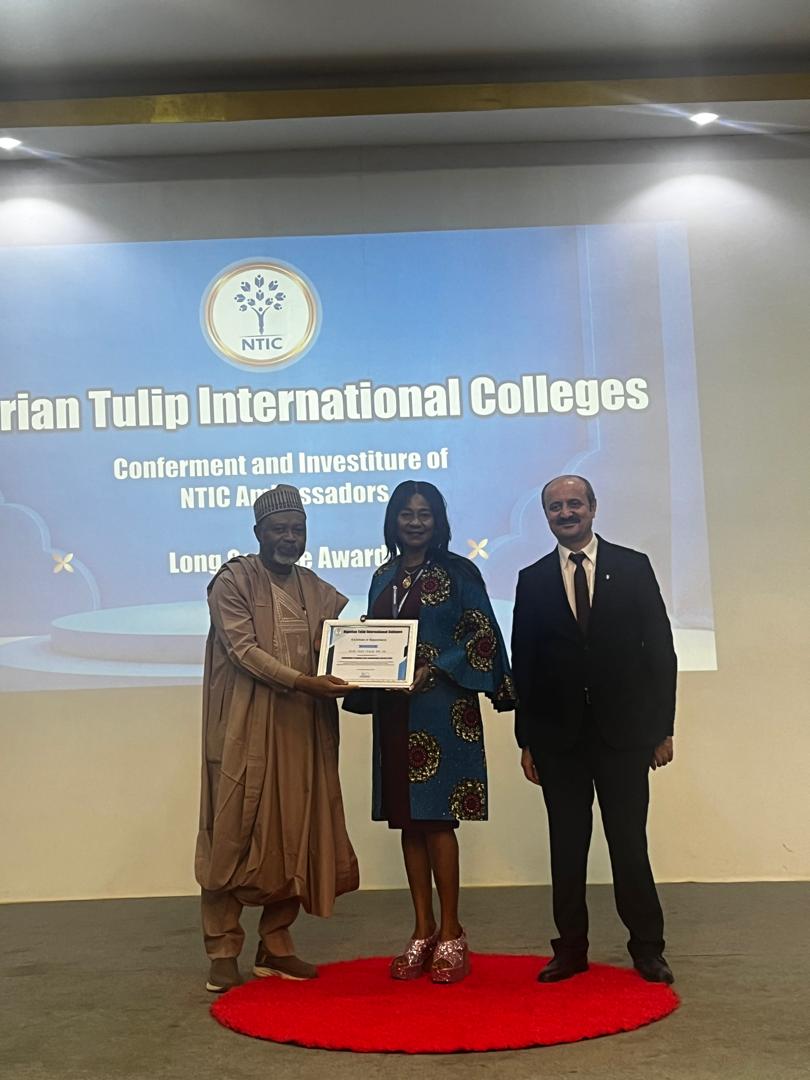
NTIC Names Mary Onyali School’s Ambassador
By: Michael Mike
A former Nigerian sprinter, Mary Onyali has been made the Ambassador of the Nigerian Tulip International Colleges (NTIC).
Also name an ambassador is a retired Air Force officer, Air Commodore Darlington Abdullahi (rtd) at a ceremony where 61 staff of the school were honoured for their long service.
The 61 awardees were so honoured for dedicating more than 15 years of service to the development of the institution. Many of them, who were issued appointment letters over 15 years ago, have risen through various administrative and academic cadres in different capacities within the school.
The management of NTIC organised the landmark historical event to celebrate the long-serving staff and formally confer ambassadorial honours on the two distinguished Nigerians.
Nigerian Tulip International Colleges (NTIC) is a well-established network of international schools recognised for its strong commitment to character education, academic excellence, and holistic student development. Located in Lagos, Yobe, Kano, Kaduna, and Abuja, NTIC offers both the Nigerian national curriculum and the Cambridge International Curriculum, supported by robust foundation programmes that ensure strong academic grounding across all levels.
Over the past 28 years, the institution has built a solid legacy rooted in quality, discipline, and innovation, consistently recording outstanding national and international achievements in academics and competitive platforms.
NTIC places high value on staff well-being and health, acknowledging the central role of human capital in educational quality, while continuously integrating cutting-edge technology and online learning platforms to enrich teaching and learning.
Speaking at the event, the Managing Director of NTIC, Dr. Fevzullah Bilgin, stated that Air Commodore Darlington Abdullahi (rtd) and Mrs. Mary Onyali were chosen as NTIC Ambassadors due to their contributions to national development.
“Their achievements will serve as inspiration for our students to become individuals of great impact in their various endeavours and to always strive to be the best version of themselves,” he said.
Bilgin further noted that the long-serving staff members have demonstrated commitment and loyalty to the institution.
“These staff members, who were given appointment letters more than 15 years ago, have risen through various administrative cadres and have proven their dedication to the development of NTIC and the provision of world-class education,” he added.
He described the award ceremony as a recognition of their meritorious service and unwavering commitment since joining the institution.
The awardees cut across academic and non-academic staff, from junior to senior management levels. They received appreciation gifts ranging from a 13th-month salary bonus to electronic items and home appliances in recognition of their dedication and selfless service.
Bilgin emphasised that NTIC provides opportunities for growth and development, noting that the career progression of long-serving staff is evidence of the institution’s supportive system.
Similarly, the Human Resource Manager, Dr. Muazu Omeji, who has spent 21 years at NTIC, said he joined the school as a Mathematics teacher and rose through various positions. He described NTIC as more than a workplace, calling it “a place of growth.”
Other staff members shared similar testimonies. Mrs. Njepuome Margaret-Chris described her 22-year journey at NTIC as eye-opening and transformative. Mr. Ugoala Uchenna Joseph said the institution has been a platform for growth since he joined 18 years ago.
Also, Abdusalam Adeyemi Ahmed stated that he began as a Biology teacher 17 years ago, later served in several administrative roles, became Principal of NTIC Kaduna, and currently serves as Head of Academics in Abuja. “NTIC is home away from home,” he said.
Mrs. Oluwatoyin Kolawole Okotie, a secretary at NTIC Abuja Coed, who has spent 17 years at the institution, described the administration as family-oriented, noting that this supportive environment has encouraged many staff members to remain with the school.
In their remarks, both ambassadors said they accepted the role because of NTIC’s dedication to student growth and staff well-being.
The event was attended by members of the NTIC Board, parents, delegates from the Ministry of Education, alumni, and other dignitaries.
In her acceptance speech, Mrs. Mary Onyali expressed excitement about her new role.
“I am super excited for so many reasons. I have always loved being around children. Throughout my life, I have tried to connect with them, make them feel comfortable, and share life lessons that have brought me this far,” she said.
She added that leaving a positive impact on young people is more valuable than financial reward.
“I love the fact that I have left a positive impact in their lives and would love to see them flourish because human capital is more valuable than any amount of money,” she stated.
On her plans as ambassador, Onyali said she intends to promote higher enrolment and create positive awareness about the school.
She addressed misconceptions about the institution, stating that NTIC is neither exclusive nor limited to any religion.
“It is a multinational, multicultural, and multi-religious school. Our role as ambassadors is to educate the public and promote the positive values of the school,” she said.
She pledged to use her network and influence to promote NTIC and strengthen its public image globally.”
NTIC Names Mary Onyali School’s Ambassador

Kashere Varsity gets new VC
The Governing Council of the Federal University Kashere (FUK) has appointed Professor Muhammad Ja’afaru as the new Vice-Chancellor of the university.
The announcement was made on Tuesday by the Pro-Chancellor and Chairman of Council FUK Professor Williams Aderounmu, after a competitive selection process.
Speaking after the appointment, Professor Aderounmu said the selection followed clear rules.
He explained that only professors with at least seven years’ experience were allowed to apply.
He said candidates were judged based on their experience, academic work, service to the community and how well they performed during the interview. Special attention was also given to their ability to raise funds for the university through international grants, endowment funds, consultancy services and other income-generating activities.
The Pro-Chancellor noted that government funding alone is not enough, so the university needs leaders who can help find additional sources of money.
He confirmed that Professor Ja’afaru performed better than the other candidates, but did not share the exact scores.
He added that 20 well-qualified professors were interviewed for the position and that all of them were capable of becoming vice-chancellors.
Professor Ja’afaru is an experienced lecturer and university administrator who has worked for many years at Modibbo Adama University (MAU), Yola. Before this appointment, he was the Deputy Vice-Chancellor (Administration), where he handled the day-to-day administrative affairs of the university.
The Governing Council of the Federal University Kashere (FUK) has appointed Professor Muhammad Ja’afaru as the new Vice-Chancellor of the university.
The announcement was made on Tuesday by the Pro-Chancellor and Chairman of Council FUK Professor Williams Aderounmu, after a competitive selection process.
Speaking after the appointment, Professor Aderounmu said the selection followed clear rules.
He explained that only professors with at least seven years’ experience were allowed to apply.
He said candidates were judged based on their experience, academic work, service to the community and how well they performed during the interview. Special attention was also given to their ability to raise funds for the university through international grants, endowment funds, consultancy services and other income-generating activities.
The Pro-Chancellor noted that government funding alone is not enough, so the university needs leaders who can help find additional sources of money.
He confirmed that Professor Ja’afaru performed better than the other candidates, but did not share the exact scores.
He added that 20 well-qualified professors were interviewed for the position and that all of them were capable of becoming vice-chancellors.
Professor Ja’afaru is an experienced lecturer and university administrator who has worked for many years at Modibbo Adama University (MAU), Yola. Before this appointment, he was the Deputy Vice-Chancellor (Administration), where he handled the day-to-day administrative affairs of the university.
Kashere Varsity gets new VC

NHRC Flags Implementation Gaps, Moves to Reset Human Rights Strategy

Resetting Power Sector: FG Rules Out Tariff Hike, Targets Stronger Grid and Universal Metering

NUJ Honour Validates Security-Media Partnership, Says DSS DG

Roger Federer’s Shock as DNA Results Reveal Myla and Charlene Are Not His Biological Children

THE PLIGHT OF FARIDA

FAILED COUP IN BURKINA FASO: HOW TRAORÉ NARROWLY ESCAPED ASSASSINATION PLOT AMID FOREIGN INTERFERENCE CLAIMS
-
 News2 years ago
Roger Federer’s Shock as DNA Results Reveal Myla and Charlene Are Not His Biological Children
-
Opinions4 years ago
THE PLIGHT OF FARIDA
-
 News1 year ago
FAILED COUP IN BURKINA FASO: HOW TRAORÉ NARROWLY ESCAPED ASSASSINATION PLOT AMID FOREIGN INTERFERENCE CLAIMS
-

 News2 years ago
EYN: Rev. Billi, Distortion of History, and The Living Tamarind Tree
-
 Opinions5 years ago
POLICE CHARGE ROOMS, A MINTING PRESS
-

 ACADEMICS2 years ago
A History of Biu” (2015) and The Lingering Bura-Pabir Question (1)
-

 Columns2 years ago
Army University Biu: There is certain interest, but certainly not from Borno.
-

 Politics1 year ago
2027: Why Hon. Midala Balami Must Go, as Youths in Hawul and Asikira/Uba Federal Constituency Reject ₦500,000 as Sallah Gift
