Connect with us

News

Corps Members Urged To Sustain Courage Of Serving In Borno

Published

on

Corps Members Urged To Sustain Courage Of Serving In Borno

By: Melvin Ibe

The corps members serving their mandatory one-year national youth service in Borno have been urged to sustain their courage in carrying out their service in the state.

It could be recalled that for over 13 years following the decade-long Boko Haram insurgency in Borno, the National Youth Service Corps (NYSC) Orientation Camp was shut down, but with the emerging peace in the state, the Orientation Camp was recently reopened.

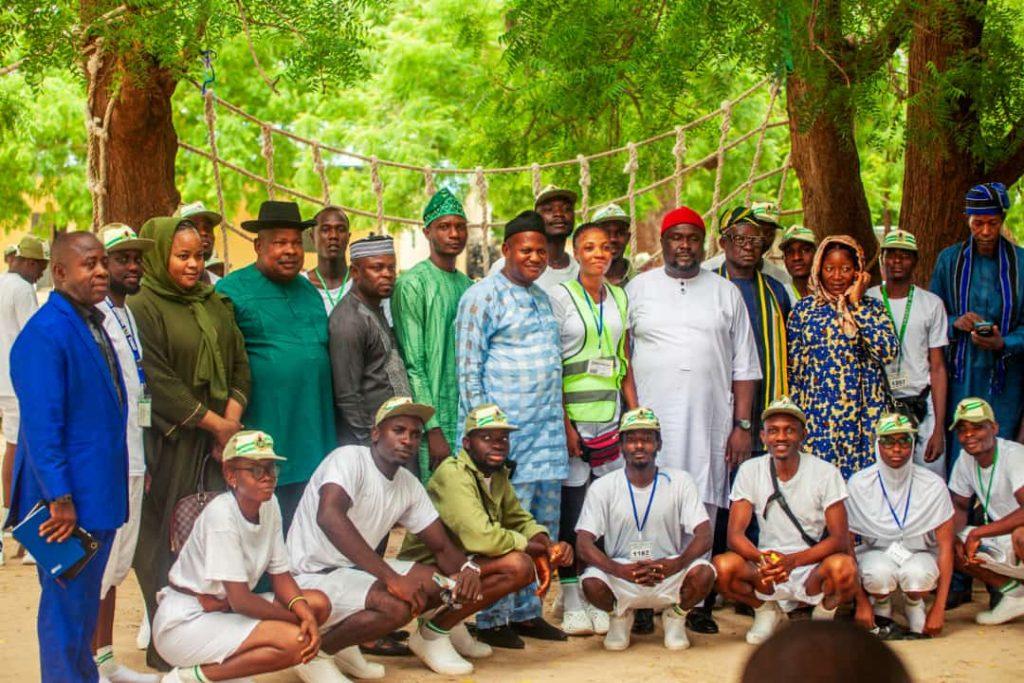
Speaking during their visit to the NYSC temporary orientation camp in Maiduguri, the Coordinator of Internal Diaspora Borno State Chapter, Chief Emmanuel Ugochukwu Egwudike (Go-Easy) , who led the leadership of the various non-indigenous tribes in the state to the camp, said their visit is part of their continuous effort and support to the state government, most importantly towards restoration of peace, hope, dignity, stability, and to boost the confidence of the newly arrived corps members.

Chief Egwudike assured the corps members that his members will do everything to give them maximum support and ensure that the service to their fatherland in the state ends remarkably well.
The Coordinator informed the corps members that the state government, under the leadership of Professor Babagana Umara Zulum, holds non-indigenes in the state in high esteem; hence, every December 25th, the Governor provides free transport to everyone who wishes to travel home to celebrate Christmas and the new year with loved ones.

We are here to welcome you as our brothers and sisters. Most of us have spent over 30 years in the state, and the majority of our successes and breakthroughs in life came from here. Our assurance to you is that you will never regret your decision to serve here.

The Governor has already given you a warm reception with gifts, and he has demonstrated that he is a detribalized Nigerian by assuring you of engagement in the services of the state. We are assuring you that many good things will come your way in the course of your stay in the state,” Egwudike said.

Further encouraging the corps members, the General Secretary of Internal Diasporans, Mr. Olusegun Asiwaju Alabi, who is from Oyo State, urged the corps members to see their postings to the state as a divine call destined by God.

He assured that the leadership of the association will, from time to time, visit the corps members to ensure their wellbeing and good condition of service.

The President of the Imo State Welfare Association, Chief Francis Meke, assured the corps members that none of them would regret their service in the state, noting that Borno, which is known as the home of peace, has raised many prominent Nigerians from other parts of the country.

In a similar vein, Chief Abraham Kanti, the President General of the TIV community in Borno State and an entrepreneur, urged the corps members to key into entrepreneurship, where opportunity abounds in the state, while Chief John Azimeye, the President General of the Niger-Delta community in the state, urged the corps members to take fear out of their minds and embrace the service.

Responding, Obani Prince Azubuike, the Ezendigbo of the Orientation Camp and a graduate of transport management technology at the Federal University of Technology Owerri (FUTO), said before coming to the state, he heard different negative stories, but on arrival at the camp, the reverse was the case.

He commended the state governor, Babagana Umara Zulum, for his benevolence to the corps members and the warm reception he gave them, and he promised to finish his service in the state.

Corps Members Urged To Sustain Courage Of Serving In Borno

Continue Reading
Click to comment

Leave a Reply

Your email address will not be published. Required fields are marked *

News

AFS ADVOCATES FOR GENDER PERSPECTIVES IN THE USE OF THE DEATH PENALTY IN NIGERIA

Published

on

AFS ADVOCATES FOR GENDER PERSPECTIVES IN THE USE OF THE DEATH PENALTY IN NIGERIA

By: Michael Mike

An international non-governmental organisation, Avocats Sans Frontieres (ASF) France has revealed that no fewer than 82 female Nigerians are currently on death row in various correctional centres across the country even as it advocated for gender perspective in application of death penalty.

The advocacy was made at the two-day workshop organised by ASF to champion the course of the female inmates who are on death row as the World Women’s Rights Organisation celebrates in Abuja the 16 Days Advocacy on Gender Based Violence.

At the workshop themed: “Capacity-building Session on Mainstreaming Gender Perspective in the Use of the Death Penalty” the Country Director, ASF France in Nigeria, Angela Uzoma-Iwuchukwu said the statistics showed that the situation in Nigeria is the highest in sub-Saharan Africa, with those on death row somehow neglected and forgotted.

Uzoma-Iwuchukwu further said: “We strongly believe that these women, who have often been neglected, forgotten, because they are behind bars and on death row need a voice, we have decided to raise their voices and their peculiar circumstances.

“And this is because there are gender issues around the application of the capital punishment. It is often projected as being neutral, but the death penalty is not neutral.

“There are gender biases all across the criminal justice system, starting from the point of arrest, conviction and even incarceration of women who are facing the death penalty,” she said.

She added that “a lot of these women are victims of domestic violence who often when they react and it leads to maybe homicide cases, the criminal justice system fails to recognise them as victims as they go through the justice system.”

She went on to say, what we see in practice in Nigeria is that women are subjected to further brutality and gender biases within the set-up.

She said: “And we argue that these women are in fact convicted and tried for more than their crimes.

“They are tried for more than the crimes that they have committed. They are tried for being women who dared to commit crimes.

“And this is the gender bias, some of the gender bias that we see. There are several other issues that pertain to women and we see that they are not in any way taken into account.

“Now a lot of these women, we see issues around poverty, cross-cutting issues around poverty and how this affects women.”

In the same vein, the Founder and Chief Facilitator, Edeika Trauma Care Centre and Equity Advocates, Mrs. Ene Ede, emphatically kicked against Death Penalty in all forms. She believed life is sacred.

She said: “Anything that has to do with taking life is of utmost important to God, to humanity, to nature and to our country because, it is about deflection of human resources, it is about grieving, it is about injustice because most of the time you find element of injustice embedded in this life sentencing. So it is very problematic. If we look at it with another eye, the better for us. It is not something we should be in hurry to do.

“Therefore, it will be better to abolish death penalty in Nigeria. That is not to say we want to encourage criminality, even with the law in place there is escalation of criminality. We need to look at the justice system again with human eye, with empathy, with patriotism, because it is citizens and human beings they are dealing with and not animals”

Ene said life is too delicate to be toy with, adding that we should look at the area of the law that makes us vulnerable, that the level of its vulnerabilities is too high.

AFS ADVOCATES FOR GENDER PERSPECTIVES IN THE USE OF THE DEATH PENALTY IN NIGERIA

Continue Reading

News

Inaugural MOFI Award to Promote Excellence in Corporate Governance- Takang

Published

on

Inaugural MOFI Award to Promote Excellence in Corporate Governance- Takang

By: Michael Mike

The maiden edition of the MOFI Excellence Awards to promote excellence in corporate governance and performance across Federal Government-owned and Linked Enterprises is scheduled for 2026.

The Managing Director of the Ministry of Finance Incorporated (MOFI), Dr Amstrong Takang, who announced this at the formal unveiling in Abuja on Wednesday, said the awards would deepen the culture of good corporate governance, transparency, and accountability in the public sector of the nation’s economy.

Takang said the awards initiative, which follows the MOFI Corporate Governance Scorecard launched early this year as a part of its ongoing reform agenda, would recognise outstanding performance as well as redefine governance as a strategic asset driving transparency, accountability, and long-term value creation in government-owned entities.

He noted that MOFI Corporate Governance Scorecard revolves around key pillars that reflect global best practices adapted to Nigeria’s context, including effectiveness and independence of boards; robust control and risk management environment; strategic alignment and performance management; quality and timeliness of financial reporting and disclosure; and emerging issues of environmental, social and governance (ESG) as well as innovation, stakeholder engagement and sustainability.

He stated that MOFI believes that no strong economy would emerge without strong institutions, adding that strengthening the backbone of public institutions, by incentivising them to adopt best practices, would strengthen the entire nation’s economic outlook.

He disclosed that in the run-up to the awards next year, the process would involve the submission of documentation and data by portfolio companies required for their performance scorecard assessments and review of established criteria by an independent consultant and other experts.

He said once the technical review is completed, the consolidated findings through an evidence-based process would be presented to an Awards Panel tasked with the responsibility of providing independent oversight, by reviewing score distributions, and confirming entities that meet the threshold for recognition in each category.

Takang said: “What the Excellence Awards is building is the combination of a national Corporate Governance Scorecard for SOEs (state-owned enterprises) and an independently adjudicated excellence awards programme to serve as a model for other jurisdictions and as a reference point for investors and partners looking for credible signals of reform.”

To select the entities qualified for the awards, an independent panel, made up of individual experts and representatives of institutions renowned for promoting good governance, was inaugurated on Wednesday.

Members include representatives of the Financial Reporting Council, the Society for Corporate Governance Nigeria, the Chartered Institute of Directors, Nigeria Exchange Group and the Chartered Risk Management Institute.

Inaugurating the panel, the Minister of Finance and the Coordinating Minister of the Economy, Wale Edun, charged its members to make the awards a model of transparency and impact, to help deepen the culture of good corporate governance, transparency and accountability.
The integrity of the awards, the Minister pointed out, was dependent on the integrity of members of the panel responsible for judging and selecting prospective honourees.

He said MOFI Awards, which is open to all government-owned portfolios companies under MOFI management, would ultimately become the standard for corporate governance, transparency, accountability and integrity in the country over time.

“Your roles are pivotal in overseeing a transparent and rigorous process by ensuring the highest standard of institutional performance. We want to see that companies are not only run efficiently, but run according to the rule of law, sanctity of contracts, and regulations, and that they are timely with their financial reporting. There must be an open and independent process that must be merit-based,” he said.

He said the MOFI Excellence Awards was conceived to promote corporate governance excellence, high institutional performance, and strategic alignment across MOFI’s portfolio of public enterprises to spotlight on those boards and management teams that exemplify transparency, accountability, and strong performance.

He revealed the intention of the government would be to recognise agencies and their leaders who demonstrate high standards of transparency, accountability, and performance in managing public assets.

Edun said: “By doing so, we send a clear message that good governance and results will be rewarded, and that every entity under MOFI should strive towards the highest ideals of service and stewardship.”

He described the initiative as part of MOFI’s core mandate as the asset manager for the Federal Government charged with the responsibility of ensuring that government investments and state-owned enterprises were managed prudently and professionally.

In his response after the inauguration, the Chairman of the panel, who is also the Chairman/CEO of the J. K. Randle Group, a chartered audit, finance, tax, and accounting advisory firm, Bashorun J. K. Randle, expressed appreciation to the government for the confidence reposed in its members to serve.

Randle, who is also the former Chief Executive and Chairman of KPMG Nigeria and former Chairman of KPMG Africa, said the panel would do a good job to justify the confidence.

He said the composition of the panel with persons and entities with diverse perspectives and reputations for integrity would ensure that its evaluations would be independent, credible, and beyond reproach.

The MOFI Excellence Awards, the Chairman explained, would recognise and celebrate state-owned enterprises that demonstrate outstanding corporate governance, prudent risk management, sound ESG practices, and overall operational excellence.

He added that entities that have shown significant improvement over time, by incentivising everyone to attain those standards, while highlighting gaps and providing support to strengthen them, would also be recognised and rewarded.

“We want to send a clear message across the public sector that transparency, accountability and performance will be noticed and rewarded. We also want to foster a healthy sense of competition and peer learning among our portfolio companies,” he said.

In another development, the Managing Director and CEO of the Ministry of Finance Incorporated (MOFI), Dr. Armstrong Takang, has dismissed the notion that the government should not be involved in the business of driving economic growth in the country.

He described this view as a fallacy, asserting that governments at all levels play a critical role in the development of any nation.

Takang highlighted that countries like China have proven that government intervention in the economy, alongside private sector participation, can lead to success. He emphasized that this is the kind of capitalism Nigeria should aim for.

He cited Singapore Airlines, which has been owned by a government agency similar to MOFI, as an example of a successful state-owned enterprise. The airline has remained a leader in global aviation for decades, showcasing the potential of government involvement in business.

“The government has a pivotal role to play because of its sovereign status and its ability to access resources that the private sector can’t,” Takang explained. “There are certain amounts of capital the government can mobilize where private companies simply don’t have access.”
 
He added that: “It’s a fallacy to suggest that only the private sector can grow businesses. At MOFI, we believe the government can leverage its sovereign status to drive business and create opportunities for the private sector, especially where they lack the necessary capital. The private sector still needs the government. And we believe state-owned enterprises have a significant role to play in the economy.”

Takang also discussed the MOFI Excellence Awards, which aim to foster a culture of governance, excellence, and performance in state-owned enterprises. The awards will serve as a tool to evaluate corporate governance, track contributions to GDP, job creation, and other economic sectors, and encourage these enterprises to prioritize impact and accountability.
 
“We want state-owned enterprises to perform at their best, and that’s why we introduced the MOFI Excellence Awards,” Takang said, adding. “The goal is to provide a framework for assessing these organizations and ensuring they contribute positively to the economy.”

He noted that some of MOFI’s portfolio businesses have already begun prioritizing dividend payments, signaling a shift toward better performance and accountability. 
 
“By institutionalizing these awards, we are creating a culture of excellence in corporate governance,” he added.

Inaugural MOFI Award to Promote Excellence in Corporate Governance- Takang

Continue Reading

News

ActionAid: 45% women in Nigeria experience cyberstalking

Published

on

ActionAid: 45% women in Nigeria experience cyberstalking

By: Michael Mike

ActionAid Nigeria has decried that 45 percent of women in Nigeria have experienced cyberstalking.

It further lamented that also 10.6 percent is said to have faced doxing, which is revealing a person’s private information online to expose them to harm.

UN Women, alongside members of the Development Partners Group on Gender (DPGG) including ActionAid Nigeria, Plan International Nigeria, GIZ, TETRATECH SPRING, and CARE International in collaboration with the Federal Ministry of Women Affairs, convened a landmark National Multi-Stakeholder Dialogue on Technology-Facilitated Gender-Based Violence (TF-GBV) in Abuja.

Held as a flagship event of the 2025 16 Days of Activism against Gender-Based Violence, the dialogue brought together a broad coalition of government institutions, development partners, technology companies, law enforcement agencies, civil society organisations, digital rights groups, and survivor advocates to address the rapidly growing threat of violence against women and girls in online and digital spaces.

Technology-facilitated GBV ranging from cyber-harassment, non-consensual image sharing, online stalking, digital blackmail, hate speech, and exploitation—continues to escalate in Nigeria, yet reporting pathways remain unclear, institutional mandates overlapping, and coordination across sectors insufficient to match the complexity of digital harms.

The Civil Society Organisation, ActionAid Nigeria also revealed that women and girls especially activists, journalists, politicians, and influencers are major victims of high levels of technology-facilitated gender based violence.

Niri Goyit, Women activist and Programme Manager for Women’s Rights, ActionAid Nigeria, reeled out the data on Friday in Abuja at a National Multi-Stakeholders Dialogue on Technology-Facilitated Gender Based Violence, which was part of the #16daysofactivism 2025.

Goyit in her technical presentation: an overview of TF-GBV trends in Nigeria, listed patriarchal norms, low digital literacy, weak enforcement of online harassment laws, platform moderation gaps, and rapid spread of smartphones/apps as some of the drivers of T-FGBV in the country.

She noted that: “In Nigeria, 45% of women have experienced cyberstalking, especially women in public roles, and 10.6% have faced doxing.”

She stated further that: “Nigeria’s internet adoption has grown faster than the safeguards needed to protect users. Survivors as young as fourteen now seek help. Women in public life face coordinated attacks and gendered misinformation.”

She noted that local data shows that many women have experienced cyberstalking or doxing while thousands of sextortion linked accounts were removed by platforms.

She added that: “In Nigeria, digital spaces mirror offline gender power structures Women and girls—especially activists, journalists, politicians, and influencers—face high levels of threats, coordinated harassment, image-based abuse, and doxing.”

She also stated that: “Women and girls across all ages are affected, but some groups face heightened vulnerability: dolescent girls (12–17) and young women (18–35) due to early, frequent social media use and limited control over privacy.

Other vulnerable groups are Women in public roles — journalists, activists, politicians, influencers.

The aim, according to the activist is to silence or discredit them.

On the impact of TF-GBV on victims, Goyit said it includes withdraw or self-censor, reducing women’s civic participation and economic opportunities.

“TFGBV affects survivors in several ways. Emotionally it causes fear, anxiety and trauma. Socially many withdraw from relationships or communities due to shame. Economically some lose jobs or avoid opportunities. Online threats also escalate into physical danger especially when private information is exposed,” she explained further.

She blamed systemic challenges for low implementation of the laws against TF-GBV, saying “Several challenges stand in the way. Laws have not kept pace with digital realities. Many officers do not have the skills to handle digital evidence. Society often dismisses online abuse as jokes. Platforms act slowly and case management systems are weak. These issues combined create major obstacles for survivors.”

Noting the challenges, the ActionAid officer urged for collaboration among all stakeholders.

She stressed that “No single institution can handle TFGBV alone. Government agencies must provide clear pathways for reporting and investigation. Law enforcement needs support from digital experts. SARCs must connect with cybercrime units. Civil society offers survivor centred approaches while technology companies must improve takedowns and cooperation. When all actors work together survivors are protected more effectively.”

She however said: “Nigeria does not need entirely new laws that will take years to pass. The country can update the laws it already has to match today’s digital realities. Real progress will come from collaboration, clarity and survivor centred systems. When institutions adapt and work together Nigeria can build a safer digital environment for all.”

In his goodwill Message, the Country Director, ActionAid Nigeria, Mr. Andrew Mamedu reiterated the commitment of AAN to ending all forms of GBV including TF-GBV.

He also called on all the stakeholders to join in preventing the menace.

Mamedu who was represented by Goyit said: “At ActionAid Nigeria, our commitment to ending all forms of GBV including TF-GBV—remains firm.

“We work in communities to challenge harmful norms, support survivors, strengthen access to justice, engage men and boys, and build the capacity of women-led organisations.

“We recognise both the opportunities and risks of digital platforms, and we remain committed to ensuring that technology empowers rather than harms women and girls.”

He therefore urged all partners—government, civil society, private sector, media, development partners, and community leaders—to renew their shared commitment to preventing and responding to all forms of GBV.

Special Adviser to the President on Women’s Health, Dr. Adanna Steinaker, representing the Minister of Women Affairs, Mrs. Imaan Sulaiman-Ibrahim noted that:

“As technology evolves, so must our responses. Technology should be a tool for empowerment, not a weapon of abuse. As a nation, we are committed to building systems that protect women and girls in every space—including the digital world. This dialogue moves us closer to a Nigeria where online safety, accountability, and justice are guaranteed for all.”

”Technology-facilitated violence is one of the fastest-growing threats to gender equality. On behalf of UN Women, I reaffirm our commitment to working with the Government of Nigeria and all partners to ensure that women and girls can participate in digital spaces without fear. This dialogue is a critical step toward a coordinated national response that protects rights, amplifies accountability, and builds a safer future for all.” UN Women Acting Deputy Country Representative – Ms. Patience Ekeoba who spoke on behalf of the Country Representative to Nigeria and ECOWAS.

ActionAid: 45% women in Nigeria experience cyberstalking

Continue Reading

Trending

Verified by MonsterInsights