
News
Cuban Government: US Military Deployment in the Caribbean Sea Threatens the Region Under Absurd Pretexts

Cuban Government: US Military Deployment in the Caribbean Sea Threatens the Region Under Absurd Pretexts
By: Michael Mike
The Cuban Government has rejected the current deployment of United States military forces in the Caribbean Sea, stating that this action represents a serious threat and an aggressive show of force against the sovereignty and self-determination of the peoples of Latin America and the Caribbean.
Cuba further said this action ignores the commitment of the 33 Member States of the Community of Latin American and Caribbean States when they proclaimed the region as a Zone of Peace.
A statement by the Cuban Ministry of Foreign Affairs made available at the weekend to our correspondent, said the US claims associating the legitimate government of Venezuela and its President Nicolas Maduro with criminal organisations involved in illegal drug trafficking is an absurd pretext that is unfounded.
It alleged that leaders in Washington are irresponsibly disregarding the assessment of their own Drug Enforcement Agency (DEA) that, in its report this year, does not mention the Venezuelan Government among the authors or enablers of drug trafficking operations threatening the United States territory.
The statement further read: “The Government of the United States resorts to lies once again to justify violence and plunder. They use them in the renewed implementation of the dominance scheme based on the Monroe Doctrine, key to their interventionism in the American continent.
“On the basis of similar fallacies, they have carried out ruthless aggressions resulting in considerable and protracted human costs. An example from recent decades was the charade about the alleged presence of weapons of mass destruction in Iraq. This pretext served to attack and invade a sovereign country, causing the death of hundreds of thousands of its citizens and the forced displacement of a similar figure.”
It alleged that: “The United States is the largest market of narcotic drugs in the region and possibly the world, according to the World Drug Report 2025, published by the United Nations Office on Drugs and Crime. This fact is well-known and the international community must denounce it. It is in the US where the largest networks are located, encouraging consumption, guaranteeing distribution, facilitating traffic, collection and accumulation of the large proceeds. Such networks launder the resulting drug money within the country’s own economy with relative impunity, without serious and effective efforts being made by the government to stop it.
“The immense proceeds from the illegal US market encourage the emergence and operation of drug trafficking networks in Latin America and the Caribbean. That country’s powerful arms industry and its uncontrolled privileges for commercialization feed the deadly power of the region’s criminal organisations. Neglect and failure to act on the root causes of the phenomenon within the United States will only intensify the regional impact of this scourge.
Cuba reiterated its firm commitment with the honest and effective fight against illegal trafficking in drugs, the defense of the national sovereignty and the promotion of peace and stability in Latin America and the Caribbean.
It also denounced in equally strong terms the use of irregular migration flows as an excuse to turn the waters of the Caribbean Sea into a war zone. No one with minimum common sense and honesty believe that the quantity of the troops, the combat materiel, naval forces, including nuclear submarines, and the firepower that the United States has sought to deploy in this peaceful area of the world, is the appropriate manner to fight organized crime, illicit drug trafficking or irregular migration flows, nor that such deployment is truly pursuing its stated goals.
The statement added that: “Cuba reiterates the call made by President Miguel Diaz-Canel Bermúdez, at the 13th Extraordinary Summit of ALBA-TCP, last 20 August, to firmly denounce the new imperialist shows of force.”
End


Troops rescue three abducted victims, recover ammunition in Borno
By: Zagazola Makama
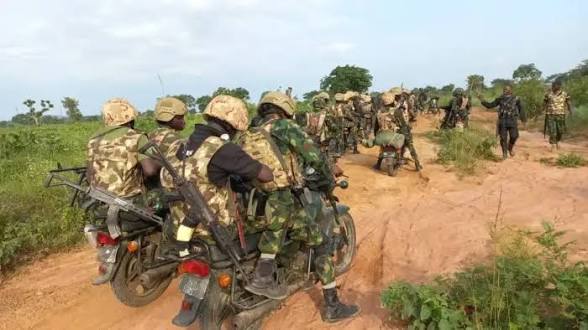
Troops of Operation Hadin Kai have rescued three abducted civilians and recovered ammunition during an operation in Bama Local Government Area of Borno State.
Security sources said the operation was carried out at about 10:00 a.m. on March 30 by troops of 202 Battalion in collaboration with volunteer forces at BOCOBS.
According to the sources, the troops responded to credible intelligence indicating that suspected members of the Islamic State West Africa Province and Boko Haram had abducted three locals in the area.
The sources said the troops made contact with the insurgents and successfully rescued all three victims during the operation.
Items recovered from the scene include one AK-47 rifle magazine loaded with 30 rounds of 7.62mm special ammunition.
The sources added that the rescued victims are safe, while troops have continued to dominate the general area to prevent further incidents.
They said the operation is part of sustained efforts to protect civilians and dismantle terrorist activities across the North-East theatre.
Troops rescue three abducted victims, recover ammunition in Borno
Troops repel terrorist attack in Yobe
By: Zagazola Makama
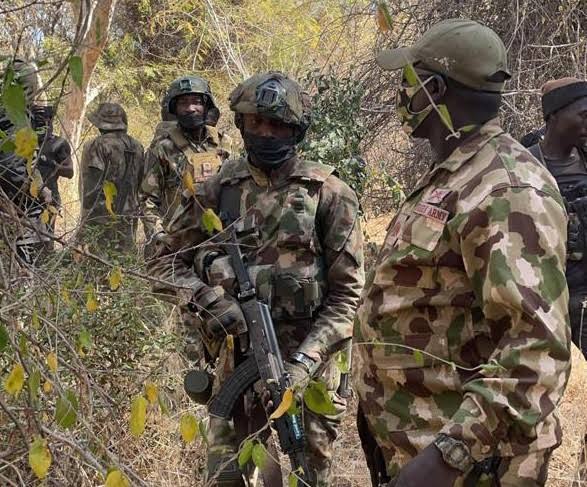
Troops of Operation Hadin Kai have repelled an attack by suspected members of the Islamic State West Africa Province and Boko Haram on a Forward Operating Base in Yunusari Local Government Area of Yobe State.
Security sources said the incident occurred at about 10:05 p.m. on March 30 at Forward Operating Base Bukarti.
According to the sources, the terrorists launched an attack on the troops’ position, prompting a fierce engagement during which the troops successfully repelled the assailants.
During the encounter, one soldier sustained injuries and has since been stabilised and is responding to treatment.
The sources added that the attackers carted away a gun truck mounted with a QJC gun, a Civilian Joint Task Force vehicle, two motorcycles, a PKT machine gun and a Baofeng radio.
They said troops have continued to maintain operational presence in the area, while efforts are ongoing to recover the stolen equipment and further degrade the capabilities of the insurgents.
Troops repel terrorist attack in Yobe
CJTF member accidentally shot by colleague in Borno
By: Zagazola Makama
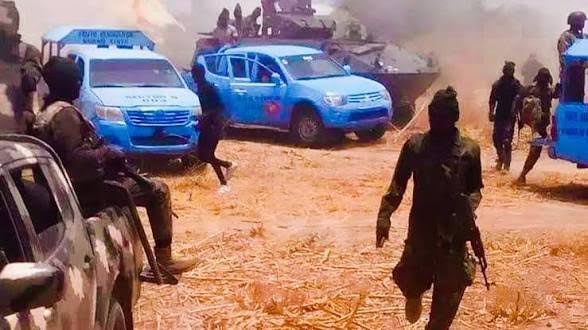
A member of the Civilian Joint Task Force (CJTF) has been injured in an accidental shooting incident in Biu Local Government Area of Borno State.
Security sources said the incident occurred at about 3:50 a.m. on March 31 at the location of 162 Amphibious Battalion in Mandara-Girau.
According to the sources, the CJTF member was on duty when he was mistakenly shot in the left leg by a colleague.
The victim was immediately evacuated to the battalion’s medical facility, where he is currently receiving treatment.
Sources said the injured personnel are responding to treatment, while further details surrounding the incident are being awaited.
CJTF member accidentally shot by colleague in Borno

Troops arrest two suspected terrorist collaborators in Pulka

Troops rescue three abducted victims, recover ammunition in Borno

Troops repel terrorist attack in Yobe

Roger Federer’s Shock as DNA Results Reveal Myla and Charlene Are Not His Biological Children

THE PLIGHT OF FARIDA

FAILED COUP IN BURKINA FASO: HOW TRAORÉ NARROWLY ESCAPED ASSASSINATION PLOT AMID FOREIGN INTERFERENCE CLAIMS
-
 News2 years ago
Roger Federer’s Shock as DNA Results Reveal Myla and Charlene Are Not His Biological Children
-
Opinions4 years ago
THE PLIGHT OF FARIDA
-
 News12 months ago
FAILED COUP IN BURKINA FASO: HOW TRAORÉ NARROWLY ESCAPED ASSASSINATION PLOT AMID FOREIGN INTERFERENCE CLAIMS
-

 News2 years ago
EYN: Rev. Billi, Distortion of History, and The Living Tamarind Tree
-
 Opinions4 years ago
POLICE CHARGE ROOMS, A MINTING PRESS
-

 ACADEMICS2 years ago
A History of Biu” (2015) and The Lingering Bura-Pabir Question (1)
-

 Columns2 years ago
Army University Biu: There is certain interest, but certainly not from Borno.
-

 Opinions2 years ago
Tinubu,Shettima: The epidemic of economic, insecurity in Nigeria
