
News
ECOWAS Should Partner AU, UN in Mediation with Niger, Burkina-Faso, Mali, Advises Stakeholders

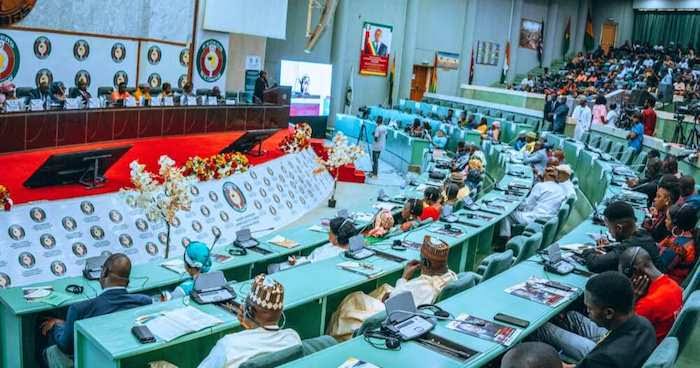
ECOWAS Should Partner AU, UN in Mediation with Niger, Burkina-Faso, Mali, Advises Stakeholders
By: Michael Mike
The Economic Community of West African States (ECOWAS) has been advised to partner with the African Union(AU), the United Nations (UN) and the Diaspora Community to intervene in the mediation process with the three Sahelian countries of Niger, Burkina-Faso and Mali in the ongoing plan of bringing them back into the regional bloc.
The call was made on Thursday in Abuja at a forum organised by the West Africa Democracy Solidarity Network (WADEMOS) and Centre for Democracy and Development (CDD) Ghana with the theme: “Strengthening Response to Democratic Recession in West Africa: The Role of the Diaspora Community.
In a communique issued at the end of the forum, the failure of ECOWAS in its recent mediation efforts with Niger, Mali, and Burkina Faso was recognized, and a call was made that the regional body should partner with the African Union, the United Nations and the Diaspora Community to intervene in the mediation process.
ECOWAS was urged to improve on its communication strategy and clearly communicate information to the citizens of the community, as the majority of citizens in the Alliance of Sahelian States (AES) are not aware of the implication of the exit from ECOWAS.
A request was made to ECOWAS to deploy an all-female delegation to mediate with the military leaders of Burkina Faso, Mali and Niger, bearing in mind that an all-men delegation has not worked in recent time.
The participants at the forum agreed to continue to support ECOWAS as an agent of integration of the peoples of the region, calling on the regional body to reinvent itself in promoting the ECOWAS of the People. Support the immediate constitution of ECOSOC which aims to promote the ECOWAS of the People.
The communique further read: “We reiterate our strong opposition to the overbearing colonial legacies and Foreign Information Manipulation and Interference (FIMI) in the domestic affairs and the peacefully established status of territories of the region.
“On the need for complementarity, we call for the full participation and involvement of the Diaspora Community, CSOs, and other critical stakeholders in decisions affecting the people of the region.
“Appeal to the military leaders of the Alliance of the Sahelian States to remain in the ECOWAS. while calling for the immediate restructuring of ECOWAS: ensuring checks and balances are effective. Condemn the structure where power is concentrated in the Heads of States over the ECOWAS Parliament and the Regional Court.
“Recommend a strong CSO and diaspora network to mobilize resources for advocacy and for the protection of human rights in the region and demand a more democratic region that is able to meet the needs of the people, we immediately call for immediate closure of the gap between the citizens and the leaders. We demand that ECOWAS be more responsible and more responsive to the needs of citizens.
“Call for the defense of human rights activists, especially women who face a double challenge as human rights defenders. In addition, women will be more vulnerable with the exit of the AES.
“Support calls for two-term limits for ECOWAS heads of state and government, while condemning all unconstitutional changes of government in the region, including changes to a country’s constitution to extend the tenure of presidents. Urge ECOWAS to openly condemn member states violating its Supplementary Protocol on Democracy and Good Governance.
“Urged ECOWAS to develop a mechanism of communicating early warnings/compliance/response to democratic recession in the region.
“Recommend unconventional ways e.g. DemoCratic (the arts) to advocate for good governance in the ECOWAS region.”
The participants are expressed worries that “the last two decades have seen manifestations of democratic backsliding that is escalating in all forms and scope and the decision of the military governments of Burkina Faso, Mali and Niger to withdraw from the ECOWAS bloc and the submission of a one-year formal notice of their withdrawal to the Commission, citing ECOWAS’s deviation from the ideals of its founding fathers and Pan-Africanism after nearly 50 years of existence.”
They lamented that the withdrawal of these states will threatens the continuation of several significant interventions, projects and programmes, including the Regional Food Security Reserve, which hosts stocks for about 52% of the regional stock; the Regional Support Programme for Pastoralism in the Sahel, financed by the World Bank to the tune of USD215 million for the three states; the Sahel Regional Irrigation Support Programme, financed by the World Bank, to the tune of USD103.43 million for the three states; the Regional Food System Resilience Support Program, funded by the World Bank, to the tune of USD230 million for the three states.
Other things to be adversely impacted include the ECOWAS Regional Electricity Market project, which links all member states to a regional electricity grid for improved access to electricity; the withdrawal could result in the halt or suspension of ECOWAS projects and programmes worth over US$500 million; Logistical hurdles for the West African Economic and Monetary Union (UEMOA) and its potential to weaken the long-term goal of establishing a single currency for all ECOWAS members; and a decline in foreign direct investment, negatively impacts on the private sector and women in the informal sector of the economy.
ECOWAS Should Partner AU, UN in Mediation with Niger, Burkina-Faso, Mali, Advises Stakeholders


News
ECOWAS@50: Liberian Students Honoured for Essays on Youth Entrepreneurship and Regional Integration
ECOWAS@50: Liberian Students Honoured for Essays on Youth Entrepreneurship and Regional Integration
By: Michael Mike
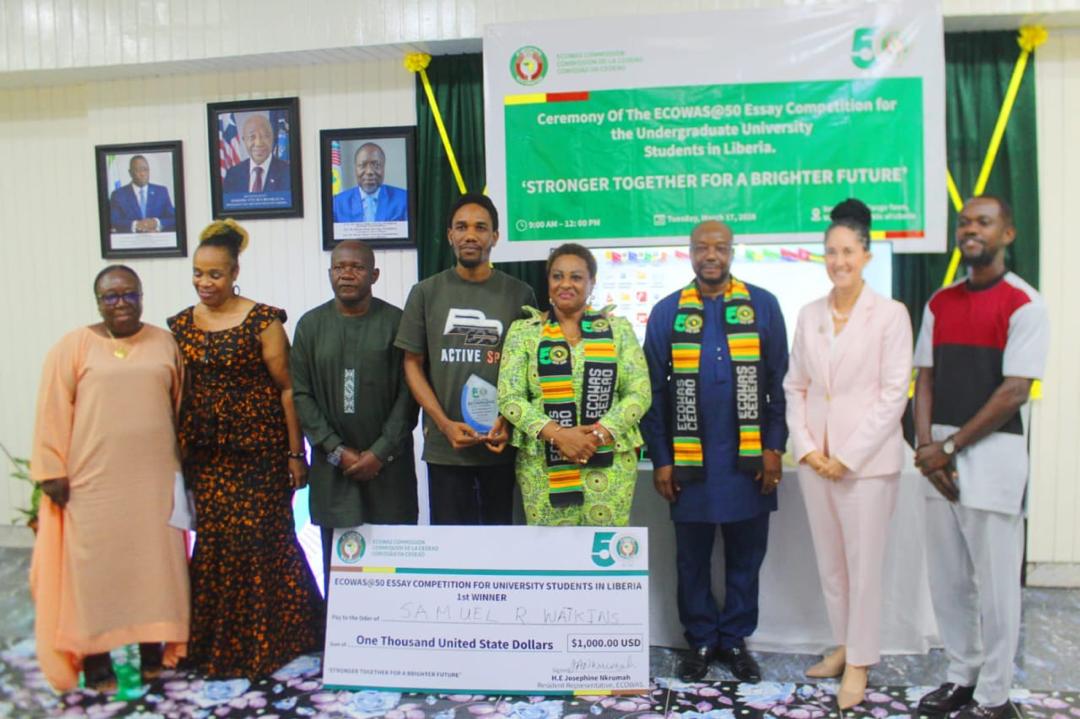
Students in Monrovia, Liberia, have been honoured for their contributions to a regional essay competition organised to commemorate the 50th anniversary of the Economic Community of West African States (ECOWAS).
The awards ceremony, organised by the Office of the ECOWAS Resident Representative in Liberia, celebrated outstanding undergraduate essays examining the role of young people in driving development and strengthening regional cooperation across West Africa.
Launched as part of the ECOWAS@50 anniversary activities, the competition invited university and college students to reflect on the theme, “Youth Entrepreneurship as a Catalyst for National Development and Regional Integration.” Organisers said the initiative was designed to stimulate intellectual engagement among young people and encourage them to think critically about their role in shaping the future of the region.
In total, 40 essays were submitted by students from tertiary institutions across Liberia, offering diverse perspectives on how youth-led enterprise could contribute to economic growth, job creation and deeper integration among West African nations.
At the ceremony, Samuel R. Watkins of the University of Liberia emerged as the overall winner, receiving a $1,000 prize for his submission. The second-place award went to Daniel Isaac-Sie Jr. of African Methodist Episcopal University, who received $700. Organisers announced that the two winning essays will also be published in national newspapers with online platforms to broaden public engagement with the ideas presented.
The event attracted a distinguished audience that included ambassadors of ECOWAS member states accredited to Liberia, university presidents, and representatives from the Ministry of Education of Liberia, the Ministry of Youth and Sports of Liberia, and the National Commission on Higher Education of Liberia.
Speaking at the ceremony, Josephine Nkrumah, ECOWAS Resident Representative in Liberia, commended the students for the depth of thought reflected in their essays and encouraged them to continue using writing as a platform for civic engagement and policy influence.
She emphasised that empowering young people to participate actively in national and regional development remains a key priority for ECOWAS, noting that youth voices are essential in shaping policies that drive economic transformation and social progress.
Nkrumah also urged participants who did not win to remain committed to intellectual pursuits, describing the competition as a learning experience that should inspire greater academic and creative efforts in the future.
The competition forms part of broader activities marking 50 years since the establishment of ECOWAS in 1975, as the regional bloc continues to promote economic cooperation, integration and shared prosperity among its member states. Organisers say initiatives that engage young people are critical to sustaining the vision of a more integrated and economically vibrant West Africa.
ECOWAS@50: Liberian Students Honoured for Essays on Youth Entrepreneurship and Regional Integration
Russia Hosts Classical Music Concert in Abuja to Revive Cultural Ties with Nigeria
By: Michael Mike
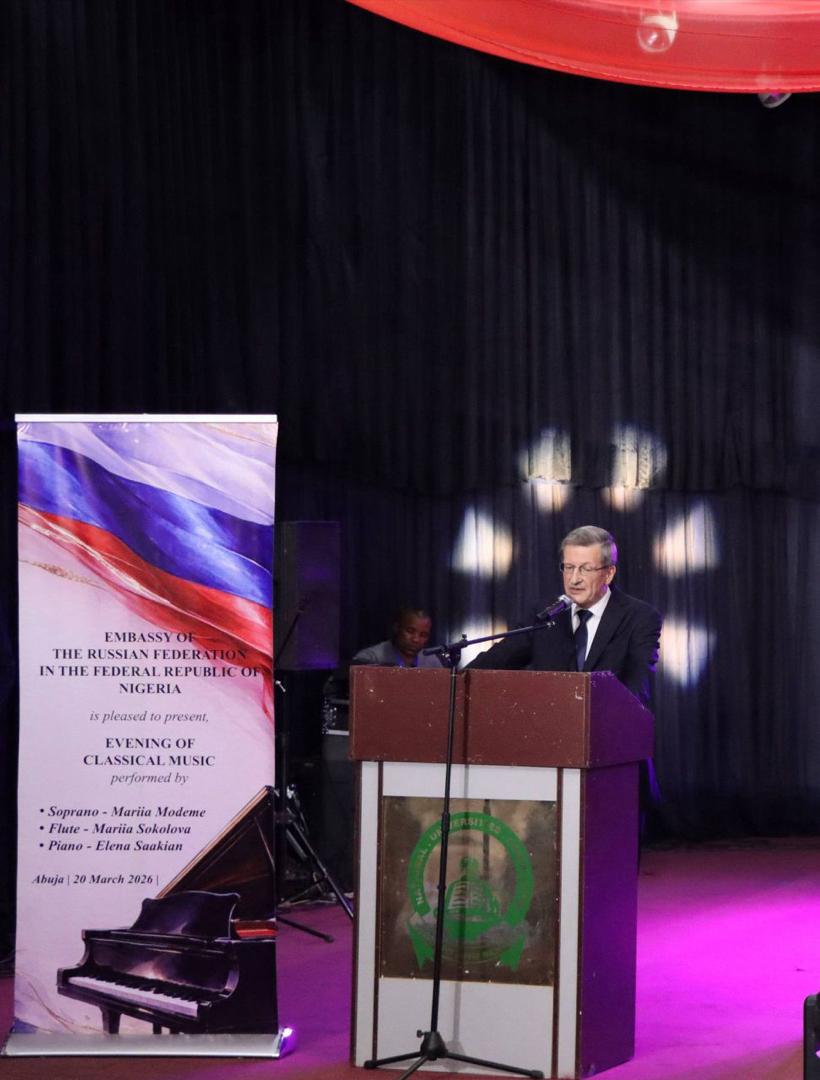
The Embassy of the Russian Federation in Nigeria has hosted a special classical music concert in Abuja, describing the event as a significant step toward strengthening cultural dialogue and people-to-people relations between Nigeria and Russia.
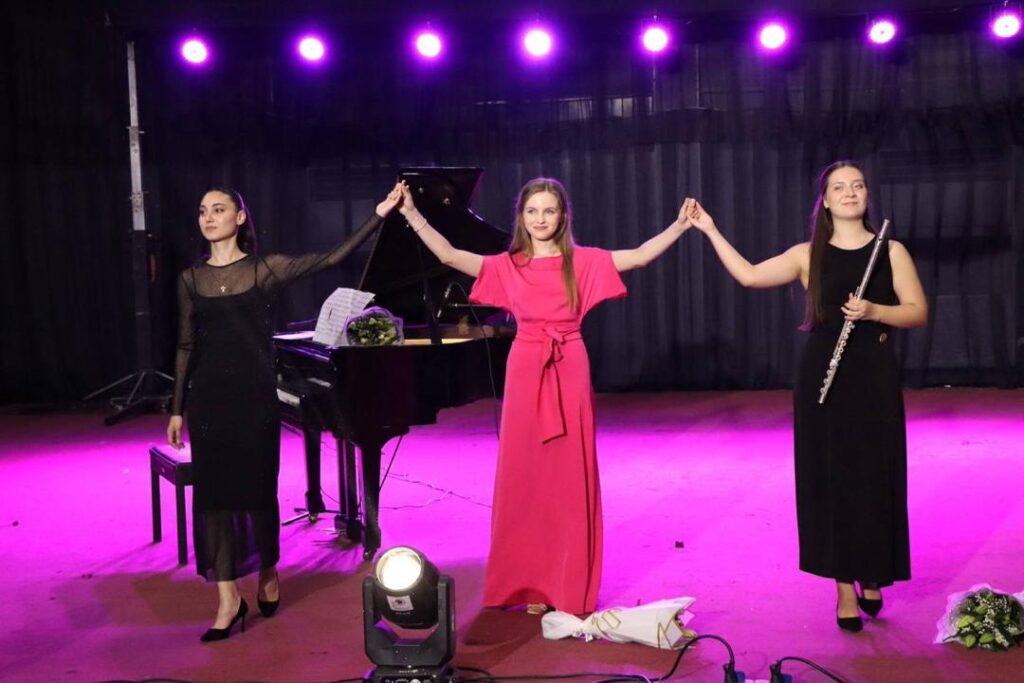
The event, which drew diplomats, cultural enthusiasts, academics and members of the public, featured performances by three talented young Russian musicians from the Tchaikovsky Moscow State Conservatory, one of Russia’s most prestigious music institutions.
Speaking at the event, the Russian Ambassador to Nigeria, Andrey Podelyshev noted that the concert was organized with the support of the Russkiy Mir Foundation and the Department for Multilateral Humanitarian Cooperation and Cultural Relations of the Ministry of Foreign Affairs of the Russian Federation.
According to him, the concert represents the first cultural event of its kind organized by the Russian Embassy in Nigeria in several years and marks an important effort to revive cultural engagement between the two nations.
“This evening is not simply a concert,” the envoy said. “It is an important step toward strengthening cultural dialogue between the Federal Republic of Nigeria and the Russian Federation. We hope it will mark the beginning of a new tradition that brings our peoples closer through the universal language of music.”
He expressed appreciation to several Nigerian institutions for supporting the initiative, including the National Universities Commission for providing the venue, as well as the Federal Ministry of Art, Culture, Tourism and Creative Economy and the Nigeria Immigration Service for their cooperation.
Special recognition was also given to Abba Music School for its role in coordinating the event and facilitating the participation of the visiting musicians.
The envoy said Russia also hopes to deepen cultural exchange by creating opportunities for Nigerian artists and creative groups to perform in Russia in the future, allowing Russian audiences to experience Nigeria’s rich cultural heritage.
“We look forward to the day when Nigerian creative groups will visit Russia, enabling our audiences to appreciate the depth, diversity and richness of Nigeria’s culture,” he said.
Guests at the concert were treated to a carefully curated repertoire of classical masterpieces drawn from Russian and global musical traditions, showcasing the technical brilliance and artistry of the visiting performers.
The evening also provided an opportunity for cultural interaction among diplomats, academics, students and music lovers, reinforcing the role of arts and culture in fostering international understanding.
The Russian envoy concluded his remarks by congratulating Muslims on the occasion of Eid al-Fitr and thanking guests for attending the event.
Observers noted that the concert reflects a renewed effort by Russia to use cultural diplomacy to deepen engagement with Nigeria, particularly in the areas of education, arts and cultural exchange.
Russia Hosts Classical Music Concert in Abuja to Revive Cultural Ties with Nigeria
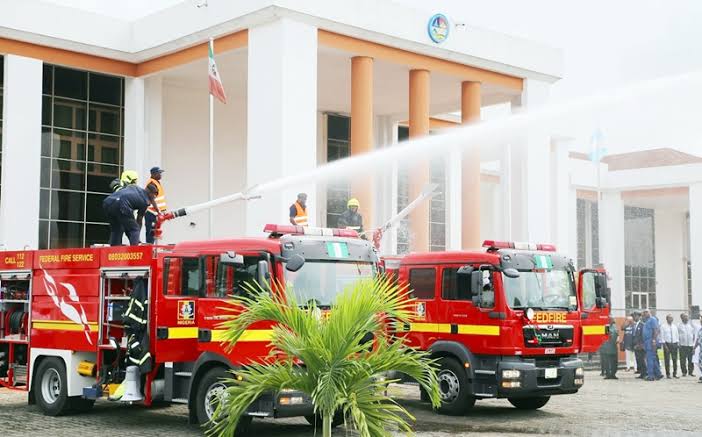
Fire destroys 10 shops in Gusau shopping complex
By: Zagazola Makama
A fire outbreak has destroyed ten shops at a shopping complex in Garejin Mai Lena area of Gusau Local Government Area, Zamfara State.
Sources said the incident occurred at about 2:00 a.m. on Thursday, causing extensive property losses valued at millions of naira.
The blaze was brought under control through a joint effort by security operatives and local residents who assisted in putting out the fire.
Authorities confirmed that no lives were lost and no injuries were reported during the incident.
The cause of the fire is currently under investigation as efforts continue to assess the full extent of the damage.
Fire destroys 10 shops in Gusau shopping complex

ECOWAS@50: Liberian Students Honoured for Essays on Youth Entrepreneurship and Regional Integration

ECOWAS Issues Biometric Identity Cards to Over 260 Women Traders at Senegal–Guinea-Bissau Border

ECOWAS, Energy China Explore Partnership to Strengthen West Africa’s Power Infrastructure

Roger Federer’s Shock as DNA Results Reveal Myla and Charlene Are Not His Biological Children

THE PLIGHT OF FARIDA

FAILED COUP IN BURKINA FASO: HOW TRAORÉ NARROWLY ESCAPED ASSASSINATION PLOT AMID FOREIGN INTERFERENCE CLAIMS
-
 News2 years ago
Roger Federer’s Shock as DNA Results Reveal Myla and Charlene Are Not His Biological Children
-
Opinions4 years ago
THE PLIGHT OF FARIDA
-
 News11 months ago
FAILED COUP IN BURKINA FASO: HOW TRAORÉ NARROWLY ESCAPED ASSASSINATION PLOT AMID FOREIGN INTERFERENCE CLAIMS
-

 News2 years ago
EYN: Rev. Billi, Distortion of History, and The Living Tamarind Tree
-
 Opinions4 years ago
POLICE CHARGE ROOMS, A MINTING PRESS
-

 ACADEMICS2 years ago
A History of Biu” (2015) and The Lingering Bura-Pabir Question (1)
-

 Columns2 years ago
Army University Biu: There is certain interest, but certainly not from Borno.
-

 Opinions2 years ago
Tinubu,Shettima: The epidemic of economic, insecurity in Nigeria
