
National News
EU Presents Final Report on Nigeria’s General Election

EU Presents Final Report on Nigeria’s General Election
By: Michael Mike
The European Union Election Observation Mission (EU EOM) has presented its final report on Nigeria’s general elections.
Bola Tinubu of the All Progressives Congress (APC) was declared the winner by the Independent National Electoral Commissioner (INEC) of the highly disputed presidential election held on February 25, 2023 with both defeated candidates of the Peoples Democratic Party (PDP) and the Labour Party (LP), Atiku Abubakar and Peter Obi heading to the Presidential Election Petition Tribunal to win back what they described as their “stolen mandate.”
Addressing a press briefing in Abuja, the Chief Observer, EU EOM, Barry Andrews, noted that his team carried out its work between 11 January and 11 April on the invitation of the INEC.
He added that a delegation of the European Parliament joined the EU EOM for the observation of the Presidential and National Assembly elections, and that the mission accredited a total of 110 observers from 25 EU Member States, as well as Norway, Switzerland, and Canada.
Andrews, also in its presentation, said that in the lead up to the 2023 general elections, Nigerian citizens demonstrated a clear commitment to the democratic process.
He however noted that “the election exposed enduring systemic weaknesses and therefore signal a need for further legal and operational reforms to enhance transparency, inclusiveness, and accountability.”
The EU EOM noted that shortcomings in law and electoral administration hindered the conduct of well-run and inclusive elections and damaged trust in INEC.
The EU EOM offered 23 recommendations for consideration by the Nigerian authorities that would contribute to improvement of future elections,
Andrews said: “We are particularly concerned about the need for reform in six areas which we have identified as priority recommendations, and we believe, if implemented, could contribute to improvements for the conduct of elections.”
The six priority recommendations point to the need to; remove ambiguities in the law; establish a publicly accountable selection process for INEC members; ensure real-time publication of and access to election results; provide greater protection for media practitioners; address discrimination against women in political life, and; impunity regarding electoral offenses.
He said: “Importantly, there is a need for political will to achieve improved democratic practices in Nigeria,” insisting that inclusive dialogue between all stakeholders on electoral reform remains crucial.
He noted that the European Union stands ready to support Nigerian stakeholders in the implementation of these recommendations.
Reacting, the National Commissioner and Chairman, Information and Voter Education Committee, Festus Okoye, who spoke to journalists after the presentation said significant improvements on the 2023 elections have been reported thus far by international observers.
He said: “We are going to harmonise all the reports by international observers that have been presented and we are going to look at the reports holistically.”
He added that: “From the report presented, the EU made mention of the fact that there have been significant improvements in our electoral process and there have been so many positives to this particular election.
“One of the positives is that we registered over 93 million Nigerians during this election. Not only that if you look at the reports submitted by international observers, in terms of voters accreditation, the BVAS performed optimally.”
Okoye however admitted that there were challenges, promising that recommendations from international observers will be worked on and implemented.
He said: “But there were also a few challenges and looking at those challenges, one must look at the context and the environment of the election.
“Insecurity was in some parts of the country which we cannot dispute. Secondly, violence was targeted towards our staff and some Nigerians. Fuel scarcity and naira re-design also were challenges.”
He however said: “Recommendations have been made on administrative and legal issues and we are going to harvest them and implement them.”
EU Presents Final Report on Nigeria’s General Election


Eid-el-Fitr: IPCR Urges Nigerians to Embrace Unity, Peaceful Coexistence
By: Michael Mike
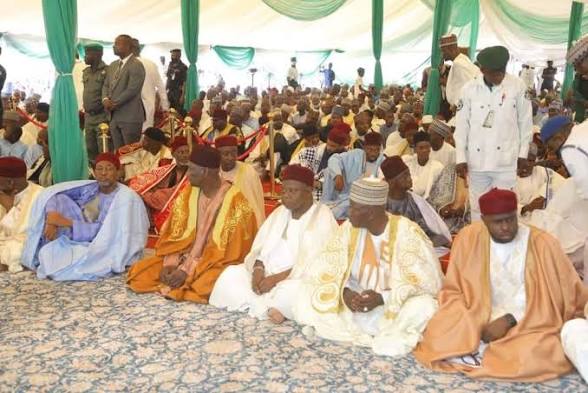
The Institute for Peace and Conflict Resolution (IPCR) has called on Nigerians to strengthen unity, tolerance and peaceful coexistence as Muslims across the country celebrate Eid-el-Fitr, marking the end of the holy month of Ramadan.
In a statement issued on Thursday in Abuja, the Director-General of the institute, Dr. Joseph Ochogwu, congratulated the Muslim Ummah in Nigeria and around the world on the successful completion of the Ramadan fast.
He said the occasion, which signifies the end of a period of fasting, reflection and spiritual devotion, provides an opportunity for citizens to renew their commitment to the values of peace, compassion and national unity.
Ochogwu urged Muslims to sustain the virtues cultivated during Ramadan—such as self-discipline, patience, charity and piety—beyond the festive period, stressing that such values are essential for building harmonious communities and strengthening the nation.
According to him, Nigerians must also rise above religious, ethnic and political differences and embrace mutual respect and peaceful coexistence as vital ingredients for national development.
“At a time when the country is confronted with complex challenges, unity of purpose and collective responsibility are crucial to overcoming divisions and building a more secure and prosperous nation,” he said.
The institute also expressed concern over recent security incidents in parts of the country, including the tragic bomb blast in Maiduguri, Borno State, which claimed several lives.
Ochogwu extended condolences to families of the victims, praying for the repose of the deceased and speedy recovery for those injured in the attack.
He reaffirmed the institute’s commitment to its mandate of promoting peacebuilding, conflict prevention and resolution across Nigeria, noting that IPCR would continue to work with government institutions, communities and other stakeholders to address the root causes of conflict.
The IPCR boss further urged citizens to remain vigilant, cooperate with security agencies and actively support peacebuilding initiatives in their communities.
“Peace is a shared responsibility, and every Nigerian has a role to play in safeguarding it,” he added.
Ochogwu also prayed that the Eid-el-Fitr celebration would usher in renewed hope, healing and unity for Nigeria while advancing peace, stability and national progress.
Eid-el-Fitr: IPCR Urges Nigerians to Embrace Unity, Peaceful Coexistence
National News
VP Shettima Visits Victims Of Multiple Explosions In Maiduguri, Assures Of FG’s Tough Response To Terrorism
VP Shettima Visits Victims Of Multiple Explosions In Maiduguri, Assures Of FG’s Tough Response To Terrorism
By: Our Reporter
The Vice President, Senator Kashim Shettima, has restated the Federal Government’s resolve to defeat terrorism, declaring that those behind recent attacks in the country will be decisively confronted.
He noted that beyond the presidential directive to security chiefs, the Federal Government was investing more in equipment and other logistics to boost the fight against terrorism across the country.
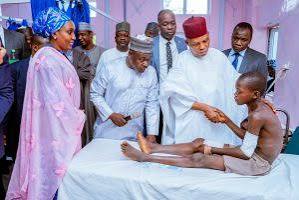
Senator Shettima spoke on Wednesday in Maiduguri when he visited victims of the bomb blast who are receiving treatment at the University of Maiduguri Teaching Hospital.
Condemning the gory multiple explosions in Maiduguri on Monday in which more than 100 people were affected by the incident, with over 20 confirmed dead, he described the perpetrators as barbaric, stressing that no cause justifies the killing of innocent people.
The Vice President said his visit was to sympathise with the injured and families affected by the tragedy, assuring of government’s support through the National Emergency Management Agency (NEMA), the North East Development Commission, and the Borno State Government.
The Vice President was accompanied by Borno State Deputy Governor Usman Kadafur; NEMA Director-General, Zubaida Umar; Chief Medical Director of the University of Maiduguri Teaching Hospital, Professor Ahmed Ahijo, and other top government officials.
VP Shettima Visits Victims Of Multiple Explosions In Maiduguri, Assures Of FG’s Tough Response To Terrorism

FG Declares Two-Day Public Holiday for Eid-ul-Fitr
By: Michael Mike
The Federal Government has declared Thursday, March 19 and Friday, March 20, 2026, as public holidays to mark this year’s Eid-ul-Fitr celebration.
The announcement was made by the Minister of Interior, Olubunmi Tunji-Ojo, who congratulated Muslim faithful across the country on the successful completion of the holy month of Ramadan.
In a statement issued on Tuesday by Permanent Secretary in the Ministry of Interior, Dr. Magdalene Ajani, on behalf of the Federal Government, the minister urged Muslims to uphold the core values of love, generosity, peace, tolerance, and sacrifice, which define the Ramadan period. He emphasized the need for Nigerians to reflect on these virtues beyond the fasting season as part of efforts to build a more harmonious society.
Tunji-Ojo also called on citizens, regardless of religious affiliation, to use the festive period to pray for national peace, unity, and sustained progress, noting that collective responsibility remains key to the country’s stability.
He further encouraged Nigerians to celebrate responsibly and extend kindness to the less privileged, in line with the spirit of the season.
The declaration underscores the government’s continued commitment to promoting unity and peaceful coexistence in the country, as millions of Muslims prepare to celebrate one of the most significant festivals in the Islamic calendar.
FG Declares Two-Day Public Holiday for Eid-ul-Fitr

Zulum Greets Muslim Ummah on Eid-El-Fitr

NUJ FCT Chair Grace Ike Inducted into NIPR, Vows Ethical Leadership in Public Communication

Zulum Reassures Borno Residents as Insecurity Resurges, Vows Decisive Action Against Insurgents

Roger Federer’s Shock as DNA Results Reveal Myla and Charlene Are Not His Biological Children

THE PLIGHT OF FARIDA

FAILED COUP IN BURKINA FASO: HOW TRAORÉ NARROWLY ESCAPED ASSASSINATION PLOT AMID FOREIGN INTERFERENCE CLAIMS
-
 News2 years ago
Roger Federer’s Shock as DNA Results Reveal Myla and Charlene Are Not His Biological Children
-
Opinions4 years ago
THE PLIGHT OF FARIDA
-
 News11 months ago
FAILED COUP IN BURKINA FASO: HOW TRAORÉ NARROWLY ESCAPED ASSASSINATION PLOT AMID FOREIGN INTERFERENCE CLAIMS
-

 News2 years ago
EYN: Rev. Billi, Distortion of History, and The Living Tamarind Tree
-
 Opinions4 years ago
POLICE CHARGE ROOMS, A MINTING PRESS
-

 ACADEMICS2 years ago
A History of Biu” (2015) and The Lingering Bura-Pabir Question (1)
-

 Columns2 years ago
Army University Biu: There is certain interest, but certainly not from Borno.
-

 Opinions2 years ago
Tinubu,Shettima: The epidemic of economic, insecurity in Nigeria
