
News
Fleeing bandits’ drug supplier ‘Gamboli’ arrested in Niger

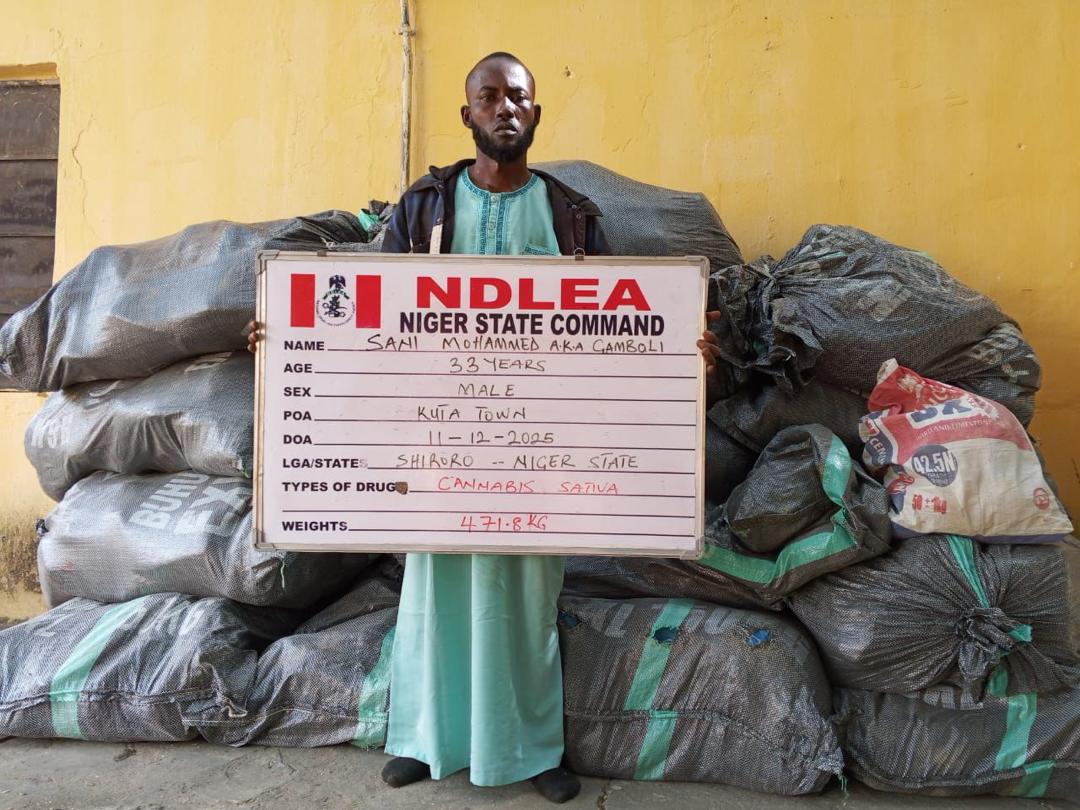
Fleeing bandits’ drug supplier ‘Gamboli’ arrested in Niger
. As NDLEA Mother and Child over 1,187 kilogrammes skunk seizure in Ondo
By: Michael Mike
Three weeks after escaping arrest at his home in Anguwan Makera, Kuta, Shiroro local government area of Niger state, a notorious supplier of illicit drugs to bandits operating in the area, 33-year-old Mohammed Sani (alias Gamboli) has been arrested by operatives of the National Drug Law Enforcement Agency (NDLEA) at his hideout.
Spokesman of anti-narcotics agency, Femi Babafemi, in a press statement on Sunday said the arrest of Gamboli followed credible intelligence about his illicit drug activities. He said NDLEA operatives had on 20th November 2025 raided his house at Anguwan Makera, Kuta, where they recovered 471.8 kilogrammes of skunk, a strain of cannabis. Though he escaped arrest during the raid and has since been in hiding, the manhunt for him eventually paid off last Thursday when NDLEA officers acting on processed intelligence traced and arrested him at one of his drug joints in Anguwan Fadama, Kuta.
Babafemi said intelligence reports had indicated that Gamboli is a major supplier of illicit drugs to bandits operating in Shiroro local government area.
The spokesman said NDLEA officers in Abia last Thursday raided a clandestine codeine syrup-manufacturing factory at Amapu Igbengwo village, Umuakpara, in Osisioma local government area of the state. During the operation, operatives recovered a total of 9,015 bottles of codeine syrup weighing 1,152.2 kilogrammes.
In Enugu state, operatives last Thursday arrested Ossai Emeka, 45, along Onitsha – Enugu Ezike road with 7.2 kilogrammes skunk, while Enoje Agada, 40, was nabbed along Enugu-Ezike -Ette road with 94.6 kilogrammes of same psychoactive substance.
A raid carried out by NDLEA operatives at a notorious drug joint known as “Beere the California” at Ido in Oyo state last Thursday led to the seizure of 3.4 kilogrammes skunk, 1.6 kilogrammes Colorado, a synthetic cannabis and 400 grammes of methamphetamine. Babafemi said the owner of the drug joint identified as “Idowu the killer” is currently at large while a suspect Ajibade Faruk was nabbed at the joint.
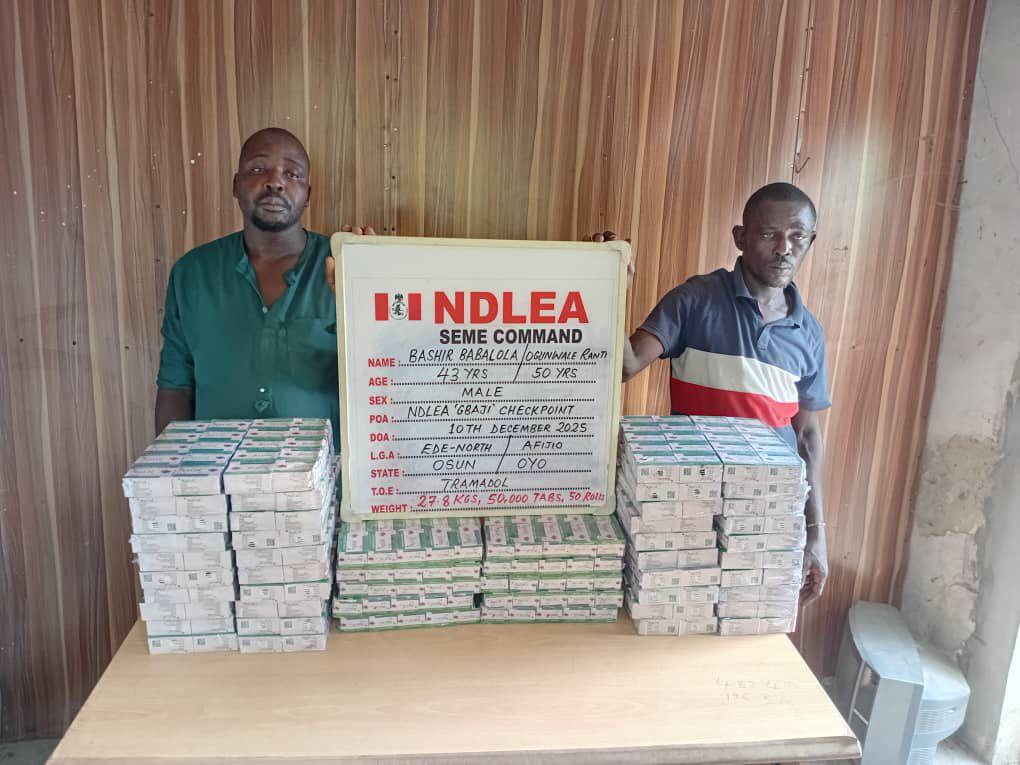
Another operation at Idi Oro, Elekuro, Ibadan last Friday led to the arrest of Olusanya Abosede, 35, and the seizure of 238.4 kilogrammes skunk, while the duo of Bashiru Babalola, 43, and Ogunwale Ranti, 50, were arrested last Wednesday at Gbaji checkpoint, Seme road Badagry, Lagos with 50,000 pills of tramadol 250mg,
NDLEA operatives in Ogun state arrested two suspects: Akinwale Makanjuola and Joseph Owolabi with 73 kilogrammes skunk at Iperu just as another suspect Wasiu Lateef was nabbed with 25 kilogrammes of same substance at Oke Agbede, Imeko area of the state last Tuesday. In Ondo state, NDLEA officers acting on credible intelligence last Monday raided a compound in Ogbese, Akure North local government area, where they arrested a 55-year-old woman Veronica Obi and her 29-year-old son Bright Obi, and recovered 1,187 kilogrammes of skunk and its seeds from them.
A suspect Ohiomah Igbafe, 44, was arrested during a raid operation at Uroe community, Owan East local government area of Edo state, where 461 kilogrammes skunk and its seeds were recovered last Tuesday.
In Gombe state, a suspect Muhammed Sani (alias Sha-Mu-Sha), 50, was arrested with 40,000 capsules of tramadol at Tunfure area, Gombe, while two other suspects: Muhammad Abdullahi (a.k.a Sakalala), 52, and Muhammed Hamza (a.k.a Mamman), 32, were nabbed at Ashaka Jalingo, with 56 kilogrammes skunk last Monday.
Babafemi said no fewer than 907 pills of tramadol, tapentadol, cocodamol, amitriptyline and bromazepam concealed in containers of local black soap, and designer wears, in six different consignments going to the US, Canada and Sweden were intercepted and seized by NDLEA operatives at two major courier companies in Lagos between Tuesday and Wednesday, last week.

At the Apapa seaport in Lagos, NDLEA officers on Saturday intercepted a consignment of 170,000 bottles of codeine syrup weighing 23,579 kilogrammes during a joint examination of a container with men of Customs Service and other security agencies.
He said in like manner, commands and formations of the agency across the country continued their War Against Drug Abuse, WADA, sensitization activities to schools, worship centres, work places and communities among others in the past week.
Meanwhile, the Chairman/Chief Executive Officer of NDLEA, Brig. Gen. Buba Marwa (rtd), while commending the officers and men of DOGI, Niger, Abia, Oyo, Enugu, Seme, Ogun, Ondo, Gombe, Apapa and Edo commands for the arrests, seizures and their dexterity, enjoined them and their colleagues across the country to continue with the ongoing balanced approach to the drug control efforts of the agency.
Fleeing bandits’ drug supplier ‘Gamboli’ arrested in Niger


Group demands zoning of Gombe Central Senatorial seat to Yamaltu/Deba
A sociocultural group under the auspices of Nyimatli Development Association (NDA) has demanded that the 2027 senatorial seat of Gombe Central be zoned to Yamaltu Deba Local Government Area of the State.
Speaking at a news conference on Monday in Gombe, Mr Emmanuel Usman, the secretary of the group in the company of other executive members said the demand was from the entire people of Yamaltu Deba LGA.
Usman said the demand was a necessary step for equity, unity, justice and inclusiveness.
He stated that since Gombe Central has two Local Government Areas of Akko and Yamaltu Deba and Akko has held the seat for 16 years, zoning it to Yamaltu Deba would ensure parity and correct the zoning imbalance.
“Akko has held the seat for too long and it is our turn to ensure equitable representation; this is the message from the Tera people and the people of Yamaltu Deba.
“The people of Yamaltu Deba LGA are concerned about the issue of representation at the National Assembly particularly at the Senate.
“Yamaltu Deba is in Gombe Central Senatorial District and the district is owned by Akko and Yamaltu Deba and by extension this seat should go round between the two LGAs in the zone.
“When we returned into the present democratic era, the first senator was from Akko who served for four years and then it returned to Yamaltu Deba, for another four years.
“Until it came to the time when Senator Danjuma Goje, from Akko became senator and he has served four consecutive terms that is for 16 years, without it being returned to Yamaltu Deba.
“We feel as a people if we own this seat collectively, equity and justice should have been the right thing and if Akko has enjoyed 16 years, it should now be returned to Yamaltu Deba,” he said.
Usman said that the people of Yamaltu Deba were already feeling maginalised not because the current senator Goje lacked competence or representation, but because they have been denied the right to represent the district.
He said the LGA has a lot of competent politicians and technocrats who could effectively represent the Senatorial District and fast track development.
Usman pleaded with Goje not to contest the 2027 senatorial seat but allow Yamaltu Deba in the spirit of “our unwritten consensus” for turn taking in representation.
“We have supported Goje, voted for him and given him the platform to lead, it is now time for him to return the favour and step aside for others from Yamaltu Deba to occupy the senate seat.”
He also appealed to Gov Inuwa Yahaya of Gombe State as the party leader of the All Progressives Congress (APC) in the state to listen to their plea towards ensuring fairness, inclusion and justice.
Group demands zoning of Gombe Central Senatorial seat to Yamaltu/Deba

Eight aspirants eye Governor Buni’s seat in Yobe
By: Yahaya Wakili
As 2027 general elections are approaching, over 8 aspirants from the three senatorial districts of Yobe state are jostling for the governorship ticket of the All Progressives Congress (APC) in the 2027 general elections.
Notably among them are the current Secretary to the Yobe State Government and the longest SSG in Northeastern Nigeria, Alhaji Baba Mallam Wali (BMW) mni; the former Senate President of the Federal Republic of Nigeria and the longest member at the National Assembly since 1999 up to date and the current Senator for the Yobe North Senatorial District, Senator Ahmed Ibrahim Lawan, GCON (SAIL), Sardaunan Bade; and Senator Mohammed Ibrahim Bomai (MIB), two-term Senator for the Yobe South Senatorial District and Madakin Fika Emirate Council.
Others notable among them include Senator Musa Mustapha (COOLERS), current Senator of the Yobe East Senatorial District; Engr. Abubakar D. Aliyu, former Deputy Governor of Yobe State and former Minister of Power and Jarman of the Pataskum Emirate Council; and Kashim Musa Tumsah, a lawyer and diplomat, and hosts of others. The All Progressives Congress (APC) has been ruling the state since the return of democracy in 1999 or since the creation of the state. Muhammad Abba, a political analyst in the state, revealed that we are advising the party stakeholders in the state that if they want the party to continue ruling the state, they should adopt the rotation or zoning formula so that every senatorial district will benefit from the governorship seat in the state.
Dr. Garba Adamu, also a political analyst in the state, said rotation or zoning is the best option for the APC in the state, adding that since the creation of the state, Zone A, or the Yobe East Senatorial District, for a long time has held the power or has produced the governor, and the Yobe South Senatorial District has produced only one governor, Mamman B. Ali, who spent only 18 months in office before he died. But in the Yobe North Senatorial District, Zone C, they never produce anything else, neither the governor nor the deputy; they never get the opportunity or the chance.
He added that, but this time around if the party wants to win the election easily without facing any challenges from the opposition party, they should reintroduce the zoning system because it will encourage the electorates to come out en masse to vote for the party, especially from Zone C, because they picked its son to be the party candidate. However, he said the best candidate from the zone, who would win the election 100%, is Alhaji Baba Mallam Wali (BMW), the current secretary to the state government; he has the capacity, and he has the experience to handle the affairs of the state because of his long experience in administration.
According to him, the election of Baba Mallam Wali as the fifth democratically elected governor of Yobe State will steady impactful walks through the corridors of power at both local and state levels. He is a man blessed with a character of humility, sympathy, and accessibility and a genius in letting go of what rightfully and lawfully belongs to him for peace to reign. However, BMW’s plan is to continue building on what they call the “Renewed Hope and Vision of Governor Mai Mala Buni and the legacy of His Excellency, Senator Ibrahim Geidam,” aimed at delivering a better life for residents of Yobe State.
“Baba Mallam Wali’s agenda is anchored on People-Oriented Development (POD), a strategy designed to ensure that government decisions directly continue to improve the daily lives of citizens. Alhaji Idris Musa, also a political analyst in the state, reiterates his call to the APC-led administration in Yobe State to adopt the rotation formula aimed to balance its political equations, adding that if care is not carefully taken in Yobe politics this time and if they fail to implement the zoning formula, they will face the consequences because likely the opposition party will win the election, because the two senatorial zones will react, especially Zone C and Zone B.
Zone C deserved to pick the governorship ticket of Yobe State in 2027, and if there is fairness, equity, and justice in the 2027 election, then from Zone C, the current Secretary to the State Government, Alhaji Baba Mallam Wali MNI, is capable and has the capacity to hold the ticket, and he will deliver, inshallah.
Eight aspirants eye Governor Buni’s seat in Yobe
Reprisal attack leaves two dead as plateau govt imposes curfew in Jos
By: Zagazola Makama
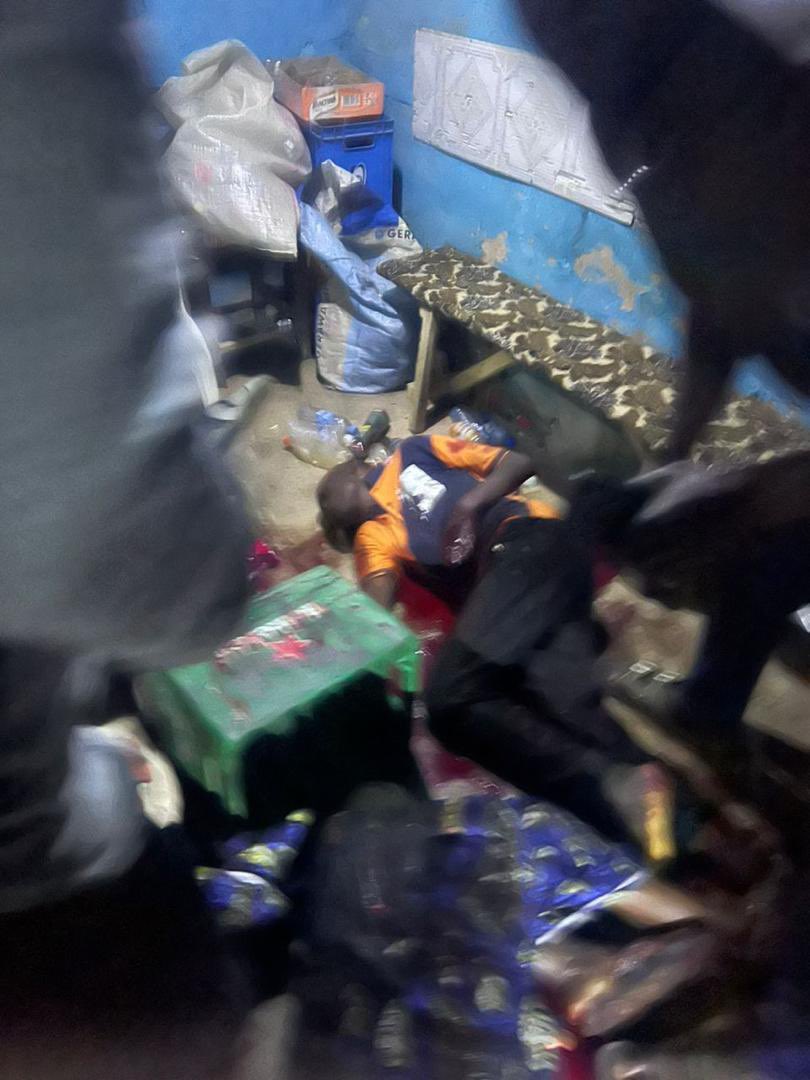
A reprisal attack has claimed the lives of two persons in Jos North Local Government Area of Plateau State, following an earlier shooting incident along the Jos–Bauchi highway.
A security source said the incident occurred on March 29 at Angwan Rukuba junction, where residents allegedly carried out retaliatory attacks on passersby after a morning assault by gunmen.
According to the source, the initial attack, which occurred at about 7:30 a.m., involved assailants who drove on a vehicle and opened fire on commuters, killing several persons and injuring others before fleeing the scene.
Security sources blamed the attack on cultist, while some blame it on the fulani bandits, sone said they are Boko Haram while some maintain that the attackers were some criminal elements because they fled in a vehicle.
Sources however said that in the aftermath of the shooting, some aggrieved residents reportedly attacked unsuspecting passersby on the highway, resulting in the death of two persons,” the source said.
He added that the situation created heightened tension in the area, with fears of further escalation.
The situation further compounded after a Foreigner went to the scene of the accident to demonstrate and threatened to President Bola Ahmed Tinubu, saying will regret what he was doing for not admitting Christian Genocide.
The Plateau State Government subsequently imposed an immediate 48-hour curfew to restore calm and prevent additional reprisal attacks.
The source said casualties from the incidents had been evacuated to the Jos University Teaching Hospital (JUTH), while security agencies had commenced investigations to identify and apprehend those responsible.
He noted that no arrests had been made as of the time of filing this report.
The source further stressed the need for sustained security presence and community engagement to de-escalate tensions and prevent a breakdown of law and order.
Security agencies have also intensified patrols and surveillance in the area, as efforts continue to restore normalcy and ensure the safety of residents.
Reprisal attack leaves two dead as plateau govt imposes curfew in Jos

Group demands zoning of Gombe Central Senatorial seat to Yamaltu/Deba

Eight aspirants eye Governor Buni’s seat in Yobe

Reprisal attack leaves two dead as plateau govt imposes curfew in Jos

Roger Federer’s Shock as DNA Results Reveal Myla and Charlene Are Not His Biological Children

THE PLIGHT OF FARIDA

FAILED COUP IN BURKINA FASO: HOW TRAORÉ NARROWLY ESCAPED ASSASSINATION PLOT AMID FOREIGN INTERFERENCE CLAIMS
-
 News2 years ago
Roger Federer’s Shock as DNA Results Reveal Myla and Charlene Are Not His Biological Children
-
Opinions4 years ago
THE PLIGHT OF FARIDA
-
 News11 months ago
FAILED COUP IN BURKINA FASO: HOW TRAORÉ NARROWLY ESCAPED ASSASSINATION PLOT AMID FOREIGN INTERFERENCE CLAIMS
-

 News2 years ago
EYN: Rev. Billi, Distortion of History, and The Living Tamarind Tree
-
 Opinions4 years ago
POLICE CHARGE ROOMS, A MINTING PRESS
-

 ACADEMICS2 years ago
A History of Biu” (2015) and The Lingering Bura-Pabir Question (1)
-

 Columns2 years ago
Army University Biu: There is certain interest, but certainly not from Borno.
-

 Opinions2 years ago
Tinubu,Shettima: The epidemic of economic, insecurity in Nigeria
