
News
Gombe: Jos DisCo condoles families of victims of electrocution

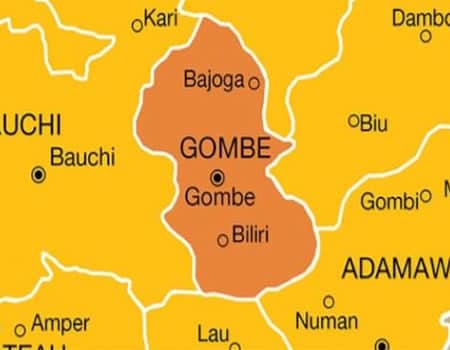
Gombe: Jos DisCo condoles families of victims of electrocution
The Management of Jos Electricity Distribution Company Plc, has commiserated with the families of those who died on Saturday from electrocution.
The commiseration is contained in a statement signed by Saratu Aliyu Dauda, the Ag. Head, Corporate Communications, JED and issued to journalists on Saturday.
The statement partly read: “the Management of Jos Electricity Distribution Plc is deeply saddened by the unfortunate incident that occurred at approximately 00:45 hours today, affecting customers connected to the Tudun Wada Pantami Distribution Transformer 2 in the Riyel community, Gombe.
“Preliminary investigations indicate that the incident was caused by a high-tension line snapping and making contact with low-tension lines, leading to a voltage supply outside permissible limits.
“We are closely monitoring the situation, particularly in light of the palpable tension within the affected community, and will continue to provide accurate updates as more facts emerge.”
Dauda stated that the company was already carrying out a thorough evaluation to determine the root causes of the incident, and subsequently ensure appropriate corrective and preventive measures would be implemented to avoid a recurrence.
“We extend our deepest sympathies to the families impacted by this tragic event. Our thoughts and prayers are with them during this difficult time.
“We also wish to express our sincere gratitude to the Traditional and Community Leaders in Riyel for their invaluable support in helping manage the aftermath of the incident.”
Gombe: Jos DisCo condoles families of victims of electrocution


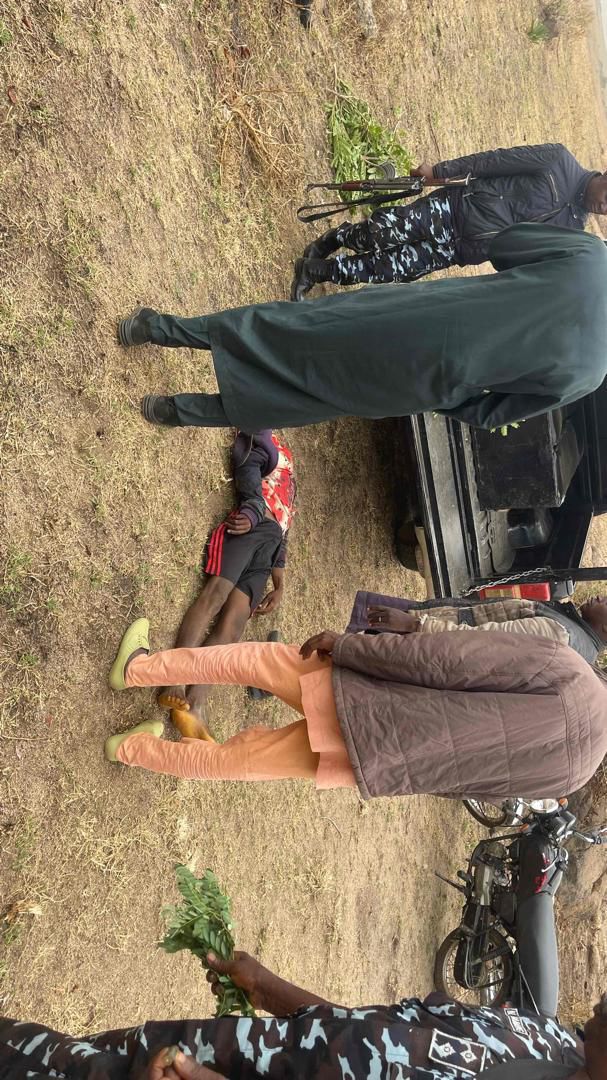
Why truth, not narratives, will end the killings in Plateau’s endless cycle of bloodshed
By Zagazola Makama
In Plateau State, the sound of gunfire is no longer shocking. It is expected. What follows each incident has also become predictable outrage, media attention, blames and accusations, as well as a rush to frame the tragedy within familiar narratives.
The latest reports of miners lynched by unknown gunmen have once again drawn national and international attention. Youth leaders, clerics, and advocacy groups are already describing the incident in sweeping terms, some branding it as genocide.
But beneath the headlines lies a more complicated and more troubling reality. Plateau is not witnessing isolated acts of violence. It is caught in a deeply entrenched cycle of reprisals, where attacks and counter-attacks have become the norm, and where truth is often buried beneath sentiment and selective narratives.
In the early hours of April 3, troops responded to a distress call from Sabongida village in Jos South Local Government Area. What they found was grim: the lifeless, beheaded body of a 30-year-old herder, identified as Shafiyu, lying in the bush. Security sources indicated that the killing was allegedly carried out by suspected Berom youths. Before the shock of that incident could settle, retaliation came swiftly.
Later that same day, armed men attacked an illegal mining site in Gyel village, Riyom Local Government Area. Three miners, including Samuel Davou, were killed in cold blood, while others fled for safety as troops moved in to secure the area. What might appear as separate incidents are, in reality, part of a continuous chain of violence, one feeding directly into the other.
Across Plateau, recent events reveal a troubling pattern that has defined the conflict for years.
On March 25, the body of Abdullahi Mohammed , a Fulani boy, was discovered in a shallow grave in Mangu Local Government Area, raising suspicions of targeted killing. On the same day in Riyom, irrigation farms belonging to several farmers were destroyed, by Fulani herdsmen, an act capable of provoking immediate retaliation.
Three days later, on March 28, gunmen assassinated Alhaji Bilyaminu Julde, a prominent Fulani community leader and Ardo of Gindiri, in Barkin Ladi. The attack, carried out at his residence, sent ignited tensions through the Fulani community and set off alarm bells across the state.
That same day, another flashpoint emerged in Riyom, where stray cattle destroyed farmlands in Tahoss village an incident that further strained relations between farmers and herders.
By April 2, violence had escalated again. In Bokkos Local Government Area, troops foiled an attack by suspected armed herders following a clash with vigilantes over grazing disputes. One vigilante sustained gunshot injuries.
Then came April 3, a day that encapsulated the crisis. Aside from the killing of the herder in Sabongida and the retaliatory attack on miners in Gyel, more killing were reported in Jos South.
On the same day, troops in Barkin Ladi recovered suspected rustled cattle reportedly taken by the Birom armed militia, while in Riyom, another Fulani youth was allegedly killed in an isolated attack. Each of these incidents is not just an entry in a security log. They are links in a chain, each one strengthening the justification for the next.
The Plateau conflict has increasingly been framed through singular lenses, often ethnic or religious. While these dimensions exist, they do not fully capture the complexity of what is happening on the ground. What emerges from security reports and field accounts is a cycle of reciprocal violence involving armed elements across communities. Fulani herders have been attacked and killed. Berom farmers and miners have also been targeted in deadly reprisals.
Yet, public discourse often pointing fongers only one side of the suffering.
This selective framing creates a dangerous distortion. It fuels anger, deepens divisions, and makes reconciliation even more difficult. More importantly, it prevents a clear understanding of the crisis one that is essential for any meaningful solution.
As observed by Simon Kolawole, the conflict has become a cycle of “attacks and counter-attacks, reprisals and counter-reprisals.”
In such an environment, violence becomes normalized. Communities begin to see retaliation not as a crime, but as justice.
Without accountability, peace remains elusive,”he said in his latest article, titled The Killing fields in plateau State.
In Plateau State, the search for peace has become a long, uncertain journey with no immediate destination in sight. Despite sustained military deployments and repeated calls for calm, deadly attacks continue to rage across communities, reinforcing a grim reality: this is a conflict deeply rooted in cycles of violence, mistrust, and silence.
For many residents, the first instinct after every attack is to look toward the government, Security forces and President Bola Ahmed Tinubu. Questions are asked why were the troops not there? Why was the intelligence not acted upon? Why are communities left exposed?
These concerns are valid. The primary responsibility of any government is the protection of lives and property. Yet, beneath these criticisms lies a difficult truth that is often left unspoken. In many cases, the same communities that demand protection are unwilling to confront the problem from within.
Across flashpoints in Riyom, Barkin Ladi, Bokkos, and Mangu, patterns have consistent which suggest that perpetrators of violence are not faceless outsiders operating in isolation. They are often known by name, by face, by affiliation. But they are rarely exposed. Instead, a culture of silence prevails. Fear, loyalty, and sometimes complicity prevent communities from identifying or handing over those responsible for attacks.
This silence creates a protective shield around perpetrators, allowing them to strike repeatedly without consequences. The result is a dangerous cycle: attacks occur, blame is assigned externally, and the real actors remain embedded within the communities.
There have been instances where youth leaders publicly blamed Fulani groups for atrocities even in cases where the victims themselves were Fulani. Such claims stretch logic and risk undermining credibility. The argument that a group would attack itself, rustle or poison its own livestock, and transport it into rival territory solely to assign blame raises fundamental questions.
While misinformation is a powerful tool in conflict, it cannot fully explain away patterns that are repeatedly documented by security agencies. These narratives, rather than promoting justice, deepen mistrust and inflame passions, making reconciliation more difficult.
This cycle has blurred the lines between victim and aggressor. Communities that mourn their dead today may be accused of launching attacks tomorrow. In such an environment, truth becomes contested, and justice becomes subjective. A herder is killed, reprisal follows.
Miners are attacked, revenge is planned.
Cattle are rustled, retaliation is inevitable. Each incident becomes both consequence and justification.
Intelligence gathering, the backbone of effective security operations depends heavily on local input. When communities withhold information, protect suspects, or distort facts, security agencies are left to operate in the dark.
This creates gaps that perpetrators exploit.
Blaming the government alone, without acknowledging this dynamic, presents an incomplete picture of the crisis.
Security forces have remained active, responding to distress calls, conducting patrols, and attempting to stabilize volatile areas. Yet, their presence has not been enough to stop the killings. The reality is that no amount of military deployment can fully secure a population that is unwilling to cooperate.
One of the most dangerous drivers of the conflict is impunity. For decades, perpetrators of violence in Plateau have rarely been brought to justice. Killings are recorded, condemned, and eventually forgotten until the next incident occurs.
Community, religious and youths leaders, who should serve as stabilizing forces, are increasingly unable to control armed youth groups. Such interventions are rare and often overshadowed by more powerful forces of anger and revenge. In many cases the leaders are the once directly fueling the crises and encouraging the youths to take up arms to carry out reprisals attacks.
The nature of the Plateau conflict makes it resistant to purely military solutions. This is not a conventional war with clear battle lines. It is a fragmented conflict driven by local grievances, economic competition, and historical mistrust.
Calls for heavy-handed interventions, including suggestions of foreign military involvement, fail to recognize this reality. Force alone cannot resolve a conflict that is rooted in social and communal dynamics.
If Plateau is to break free from this cycle, the first step must be honesty. The violence must be acknowledged for what it is a series of interconnected attacks involving multiple actors, not a one-sided campaign. Only then can meaningful solutions emerge.
This is not just a story of victims and aggressors. It is a story of a society caught in a loop of vengeance, where yesterday’s victim can become today’s perpetrator. Until the truth is confronted in its entirety without bias, without omission peace will remain elusive.
The government must move beyond reactive security measures and take decisive steps to address the root causes of the conflict. This includes ensuring accountability, strengthening intelligence capabilities, and facilitating genuine dialogue among communities.Equally important is the role of local leaders. They must rise above partisan interests and work actively to restrain their followers, promote peace, and reject all forms of violence regardless of who commits them.
Zagazola Makama is a Counter Insurgency Expert and Security Analyst in the Lake Chad Region
Why truth, not narratives, will end the killings in Plateau’s endless cycle of bloodshed
News
Military eliminate 50 bandits, kill Ado Allero’s son in Zamfara offensive in coordinated ground, air offensive
Military eliminate 50 bandits, kill Ado Allero’s son in Zamfara offensive in coordinated ground, air offensive
By: Zagazola Makama
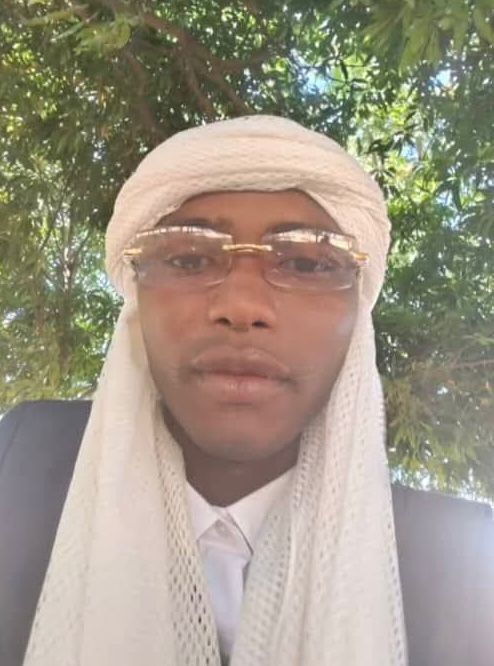
Troops of Operation FANSAN YANMA, in a coordinated ground and air offensive, have neutralised no fewer than 65 bandits, including a notorious kingpin, Kachalla Iliya Sarki, son of wanted bandit leader Ado Allero, during a major operation in Tsafe Local Government Area of Zamfara.
Credible security sources told Zagazola Makama that the operation, which took place at Munhaye village behind Kunchin Kalgo, dealt a devastating blow to the terrorists long associated with deadly attacks across Zamfara, Katsina and parts of Kano State.
The sources said the intense battle commenced at about 6:00 p.m. on Saturday and lasted for over seven hours, as troops engaged the bandits in a fierce exchange of fire, supported by precision airstrikes that decimated their positions.
According to the sources, the bandits kingpin Alhaji Ado Allero, had mobilised heavily armed fighters for the confrontation, deploying an estimated 300 motorcycles of fighters from Yan Wari axis in what appeared to be a coordinated attempt to repel advancing troops. Other fighters were deployed from the camp of Dankarami Gwaska and deployed as reinforcements against the troops.
“However, the superior firepower and tactical coordination of the troops overwhelmed the terrorists, leading to heavy casualties on their side,” one of the sources said.
Among those killed, the sources confirmed, were Kachalla Iliya Sarki, a key commander and operational leader within Ado Allero’s network, alongside other lieutenants identified as Dogo Sule and Iliya Mai Rasha.
“Iliya Mai Rasha was said to have taken over leadership responsibilities following the recent killing of another commander, Alti, last month,” the source added.
The sources further disclosed that seven vigilantes fighting alongside the troops paid the supreme price during the encounter.
In the aftermath of the operation, Ado Allero was said to have fled the area and is currently in hiding at Yankuzu twon, as troops continue pursuit operations to dismantle the remnants of his group.
Kachalla Iliya Sarki, described as one of the most vicious and feared bandit commanders in the North-West, had been linked to a series of deadly attacks, kidnappings and cattle rustling activities across Katsina and Zamfara States.
He was reportedly arrested in Katsina at some point during the administration of former Governor Aminu Bello Masari, but was later released following a dramatic incident in which his father allegedly orchestrated the abduction of senior police officers to force negotiations.
Security sources also revealed that the slain commander had, just four days prior to his death, travelled to Kano to rustle livestock, pointing to the trans-state operational reach of the criminal network.
His elimination marks a significant setback for banditry operations in the North-West, particularly in the tri-border region linking Zamfara, Katsina and Kano States.
“This is a major operational success. The death of Iliya Sarki will significantly disrupt command and control structures within the group,” a security analyst said.
However, security sources warned that the development may trigger retaliatory actions, noting that Ado Allero is likely to mobilise his fighters for reprisal attacks in response to the killing of his son and key lieutenants.
“This is a major operational success, but we must also anticipate possible revenge attacks. That is why troops are maintaining heightened vigilance across vulnerable communities,” a security source said.
Military eliminate 50 bandits, kill Ado Allero’s son in Zamfara offensive in coordinated ground, air offensive
NDLEA Uncovers Cocaine Concealed in Palm Kernel Oil Cans, Arrests Kingpin in Lagos
By: Michael Mike
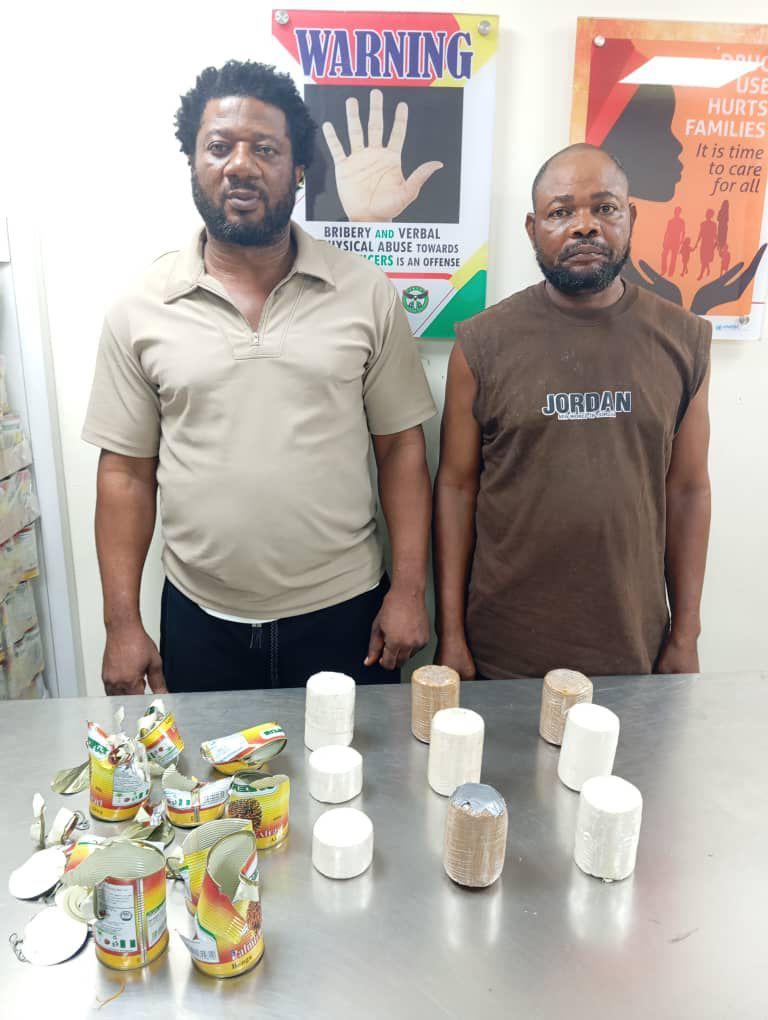
Operatives of the National Drug Law Enforcement Agency (NDLEA) have dismantled a drug trafficking syndicate that concealed cocaine in tins of palm kernel oil for export to the United Kingdom, leading to the arrest of a suspected kingpin in Lagos.
A statement by the spokesman of the anti-narcotics agency, Femi Babafemi on Sunday, said the operation, lasted three weeks, began on March 11, 2026, when NDLEA officers at the Murtala Muhammed International Airport (MMIA), Ikeja, intercepted 3.1 kilogrammes of cocaine hidden in tins of palm kernel extract at the export shed.
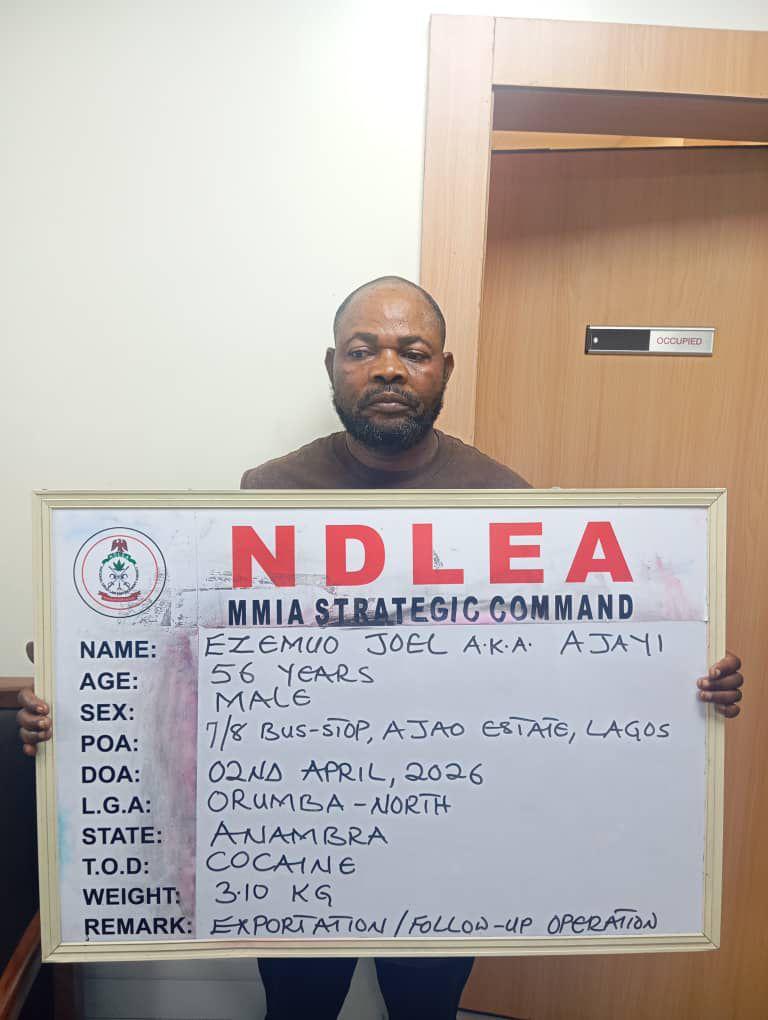
He revealed that two suspects, Idris Amoo and Akinlami Adedoyin, were arrested in connection with the shipment.
He said a follow-up sting operation on April 2 led to the arrest of the sender, Ezemuwo Joel, who was operating under a false identity, noting that his arrest exposed the leader of the syndicate, identified as King Arinze, 52, who was subsequently apprehended at his hideout in the Isolo area of Lagos.
Babafemi said NDLEA operatives later raided his warehouse in Bucknor, Isolo, where they recovered 886 tins prepared for drug concealment, along with industrial tools including a sealing machine, tin openers, paint sprays, and 52 grammes of cannabis, with the suspect reportedly confessed to draining the oil from the tins to conceal cocaine.
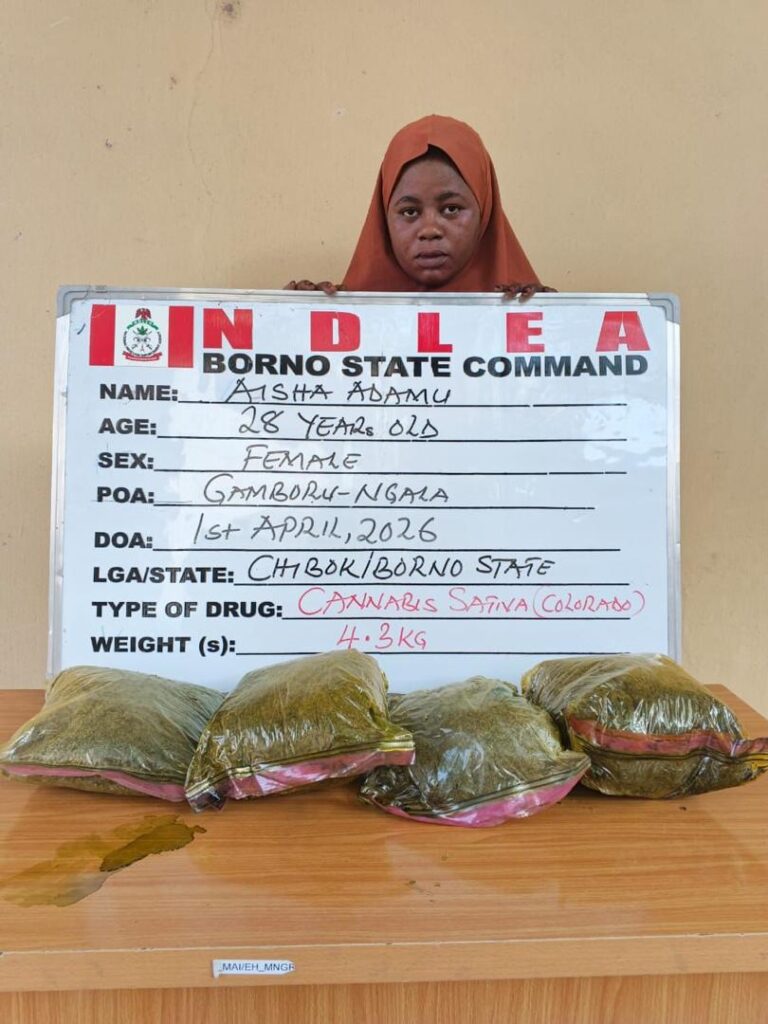
In a separate operation in Borno State, NDLEA operatives arrested a 28-year-old woman, Aisha Adamu, alleged to be a supplier of illicit drugs to bandit groups operating across the North-East and parts of Chad. She was intercepted along Gamboru Ngala road with 4.3 kilogrammes of Colorado, a synthetic strain of cannabis.
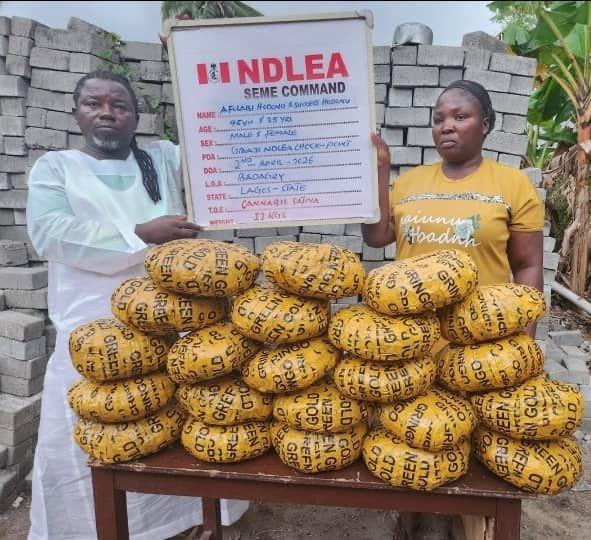
Meanwhile, a pastor of the Celestial Church of Christ, Agonvi Sea Beach, Badagry, Pastor Afolabi Hodonu, and his wife, Success Hodonu, were arrested at the Gbaji checkpoint in Lagos last Thursday with NDLEA officers recovering 11 kilogrammes of skunk concealed in hidden compartments of their vehicle.
Babafemi said their arrest followed the earlier apprehension of a suspected fake security agent, Sunday Samuel, who was intercepted at the same checkpoint last Monday with 24.5 kilogrammes of skunk.
In Adamawa State, NDLEA operatives intercepted a truck conveying 48,000 pills of tramadol along Namtari road in Yola South. The driver, Abdulaziz Korede, was arrested, while a subsequent operation led to the arrest of the intended recipient, Idris Adamu.
Babafemi said other operations across the country led to multiple arrests and seizures. In Osun State, a 60-year-old woman was arrested with 15 kilogrammes of skunk in Osogbo, while in Ondo State, operatives recovered 351 kilogrammes of skunk from a forest in Akure.
In Benue State, a 66-year-old suspect was arrested with 28,600 capsules of tramadol in Aliade, while in Edo State, NDLEA operatives recovered 1,378 kilogrammes of skunk from a warehouse in Egbanke community.
Similarly, in Oyo State, a suspected drug dealer, Ayantola Omodunmomi, was arrested in Ibadan, where 45.6 kilogrammes of skunk were recovered. The agency said she used her 11-year-old daughter to distribute illicit drugs.
The NDLEA also said its War Against Drug Abuse (WADA) sensitisation campaign continued nationwide, with awareness programmes conducted in schools across Oyo, Lagos, Kano, Anambra, and Zamfara states.
Chairman and Chief Executive Officer of the agency, Brig. Gen. Buba Marwa (Rtd) commended officers across various commands for the arrests and seizures.
He said: “These successful operations are a testament to the agency’s evolving intelligence capabilities and our unwavering commitment to choking the supply lines of drug cartels.”
NDLEA Uncovers Cocaine Concealed in Palm Kernel Oil Cans, Arrests Kingpin in Lagos

Why truth, not narratives, will end the killings in Plateau’s endless cycle of bloodshed

Military eliminate 50 bandits, kill Ado Allero’s son in Zamfara offensive in coordinated ground, air offensive

NDLEA Uncovers Cocaine Concealed in Palm Kernel Oil Cans, Arrests Kingpin in Lagos

Roger Federer’s Shock as DNA Results Reveal Myla and Charlene Are Not His Biological Children

THE PLIGHT OF FARIDA

FAILED COUP IN BURKINA FASO: HOW TRAORÉ NARROWLY ESCAPED ASSASSINATION PLOT AMID FOREIGN INTERFERENCE CLAIMS
-
 News2 years ago
Roger Federer’s Shock as DNA Results Reveal Myla and Charlene Are Not His Biological Children
-
Opinions4 years ago
THE PLIGHT OF FARIDA
-
 News12 months ago
FAILED COUP IN BURKINA FASO: HOW TRAORÉ NARROWLY ESCAPED ASSASSINATION PLOT AMID FOREIGN INTERFERENCE CLAIMS
-

 News2 years ago
EYN: Rev. Billi, Distortion of History, and The Living Tamarind Tree
-
 Opinions4 years ago
POLICE CHARGE ROOMS, A MINTING PRESS
-

 ACADEMICS2 years ago
A History of Biu” (2015) and The Lingering Bura-Pabir Question (1)
-

 Columns2 years ago
Army University Biu: There is certain interest, but certainly not from Borno.
-

 Opinions2 years ago
Tinubu,Shettima: The epidemic of economic, insecurity in Nigeria
