
News
How propaganda and exaggerated genocide narratives triggered punitive international actions against Nigeria

How propaganda and exaggerated genocide narratives triggered punitive international actions against Nigeria
By: Zagazola Makama
Recent United States visa restrictions and mass deportation measures affecting Nigerian nationals have reopened debate on how sustained propaganda, misinformation and alarmist narratives about insecurity in Nigeria shaped international perceptions and policy responses against the country.
While Nigeria continues to face real security challenges including terrorism by ISWAP, Boko Haram, AlQaeda, banditry, farmer–herder clashes and transnational jihadist infiltration, the framing of these conflicts as an organised, state-backed “Christian genocide” has increasingly been questioned by Nigerians.
Yet, for several years, a powerful campaign driven largely by Nigerian activists, politicians and diaspora-based pressure groups portrayed Nigeria as the world’s epicentre of religious extermination, with claims that were grossly exaggerated, unverifiable or outright false.
The agitations grew domestic grievance to international propaganda. Between 2021 and 2024, a wave of advocacy emerged accusing the Nigerian state of deliberately sponsoring or protecting jihadists allegedly engaged in the daily slaughter of Christians. Some campaigners claimed that 1,500 Christians were being killed every day, a figure that would translate to more than 540,000 deaths annually, a number exceeding fatalities recorded in most active war zones globally.
One widely circulated narrative claimed that between 2010 and October 2025, 185,000 people were killed on account of their faith, including 125,000 Christians and 60,000 Muslims, allegedly based on reports from Intersociety, one of the NGO created to push the false claims.” The same narrative alleged that 19,100 churches had been burned and 1,100 Christian communities completely seized and occupied by jihadists supposedly backed or shielded by the Nigerian government.
However, independent verification of these figures consistently failed. No global conflict-monitoring organization, including ACLED, UN agencies, or major international human rights bodies as well as official bodies like Police, DSS, and the NHRC, corroborated such numbers. Nigeria’s total population stands at approximately 240 million, making such casualty claims statistically implausible without triggering global humanitarian emergency responses on the scale of Gaza, Syria or Ukraine.
Zagazola Makama report that while religiously motivated attacks occur, Nigeria’s violence landscape is far more complex, driven by criminal banditry, resource conflict, insurgency, arms proliferation, climate stress and weak border control, affecting Muslims, Christians, Pagan, traditionalist and adherents of other faiths alike.
Despite the lack of empirical grounding, these activities keep weaponizing faith to internationalise pressure. The genocide narrative gained traction in U.S. political circles, evangelical advocacy groups and sections of Western media. Some Nigerian politicians amplified these claims at international forums, urging sanctions, arms embargoes and even military intervention against their own country.
The expectation among agitators was that Trump’s administration would deploy American forces or impose targeted sanctions against Nigerian officials and groups like Miyetti Allah, Boko Haram, Bandit and those that once push for Shariah laws. Instead, the policy response took a different and far more consequential direction. Rather than physical military intervention, Washington opted for strategic intervention with the armed forces of Nigeria through technical support while in their country they opted for tougher penalties like border control, immigration enforcement and visa restrictions, citing insecurity, terrorist activity, document integrity issues and vetting challenges.
Nigeria was subsequently placed under partial U.S. travel restrictions, with the U.S. government explicitly referencing the activities of Boko Haram and ISWAP, and difficulties in screening travellers from affected regions.
The unintended security backlash
Ironically, following persistent framing of Nigeria’s violence as a religious war produced outcomes opposite to what campaigners claimed to seek. Rather than protecting Christians, the rhetoric emboldened extremist groups to carry even more deadlier attacks.
Terrorist organisations, including ISWAP, JAS and al-Qaeda-linked JNIM elements now infiltrating North-Central Nigeria, capitalised on global narratives portraying Nigeria as a battlefield of faith. By attacking churches, clergy and Christian communities, these groups sought to validate the propaganda, provoke sectarian retaliation and trigger a broader religious conflict. This strategy mirrors jihadist doctrine across the Sahel: manufacture sectarian violence, polarise society, delegitimise the state and attract recruits.
Security intelligence from Kwara and Niger States, for instance, shows JNIM’s Katiba Macina exploiting communal tensions along the Benin–Nigeria corridor, recruiting Fulani youths while framing attacks as resistance against “tyranny” language deliberately aimed at feeding international narratives of persecution.
The U.S. Department of Homeland Security has since justified its tougher posture using data-driven assessments: visa overstay rates, terrorism risks, weak civil documentation systems and law-enforcement information gaps.
For Nigeria, these translated into: Partial visa suspensions for B, F, M and J categories, increased scrutiny of Nigerian travellers, inclusion in broader immigration enforcement actions, Indirect reputational damage affecting trade, education and diplomacy
Meanwhile, The Department Homeland Security announced record deportations and self-removals, over 2.5 million exits since January 2025, a development that disproportionately affects nationals of countries portrayed as high-risk, Nigeria included. Crucially, those most affected are ordinary Nigerians students, professionals, families and entrepreneurs, not terrorists, bandit leaders or militia commanders.
The Fulani bandit in the forest has no interest in a U.S. visa. It is the Nigerian student, pastor, doctor and trader who bears the cost.
Notably, as sanctions and restrictions took effect, the loud genocide rhetoric largely faded from public discourse. The activists who once dominated international media cycles have grown quieter, perhaps confronted by the reality that the consequences fell on Nigeria as a whole, not on imagined perpetrators. This pattern point to a broader lesson in strategic communication: when a nation’s internal crises are exaggerated into existential falsehoods, external actors respond not with rescue but with containment.
A cautionary lesson for national discourse is that; Nigeria’s security challenges are real and demand sustained reform, diplomatic support, and international cooperation. But weaponising religion, spreading unverifiable casualty figures and lobbying for foreign punitive action against one’s own country undermines national security rather than strengthening it. More dangerously, it feeds extremist propaganda, deepens communal mistrust and invites external decisions based on distorted perceptions.
When internal challenges are projected internationally without context or factual balance, foreign governments respond not with solidarity but with restrictions, sanctions and containment. In this environment, propaganda even when framed as advocacy, erodes diplomatic goodwill and inflicts long-term harm on citizens whose lives and opportunities are shaped by external policy decisions.
False alarms and absolutist narratives fracture social trust, embolden extremists and inflame the very fault lines terrorists seek to exploit. Ultimately, propaganda however emotionally persuasive does not protect communities; it weakens national resilience and leaves society more vulnerable to the forces it hopes to defeat.
Zagazola Makama is a Counter Insurgency Expert and Security Analyst in the Lake Chad region
How propaganda and exaggerated genocide narratives triggered punitive international actions against Nigeria


News
Madiba Advocates Raise Alarm, Urge Presidency, Labour Ministry, NSITF Management Board & relevant authorities to Probe Alleged ₦297bn NSITF Irregularities Linked to MD Faleye Oluwaseun
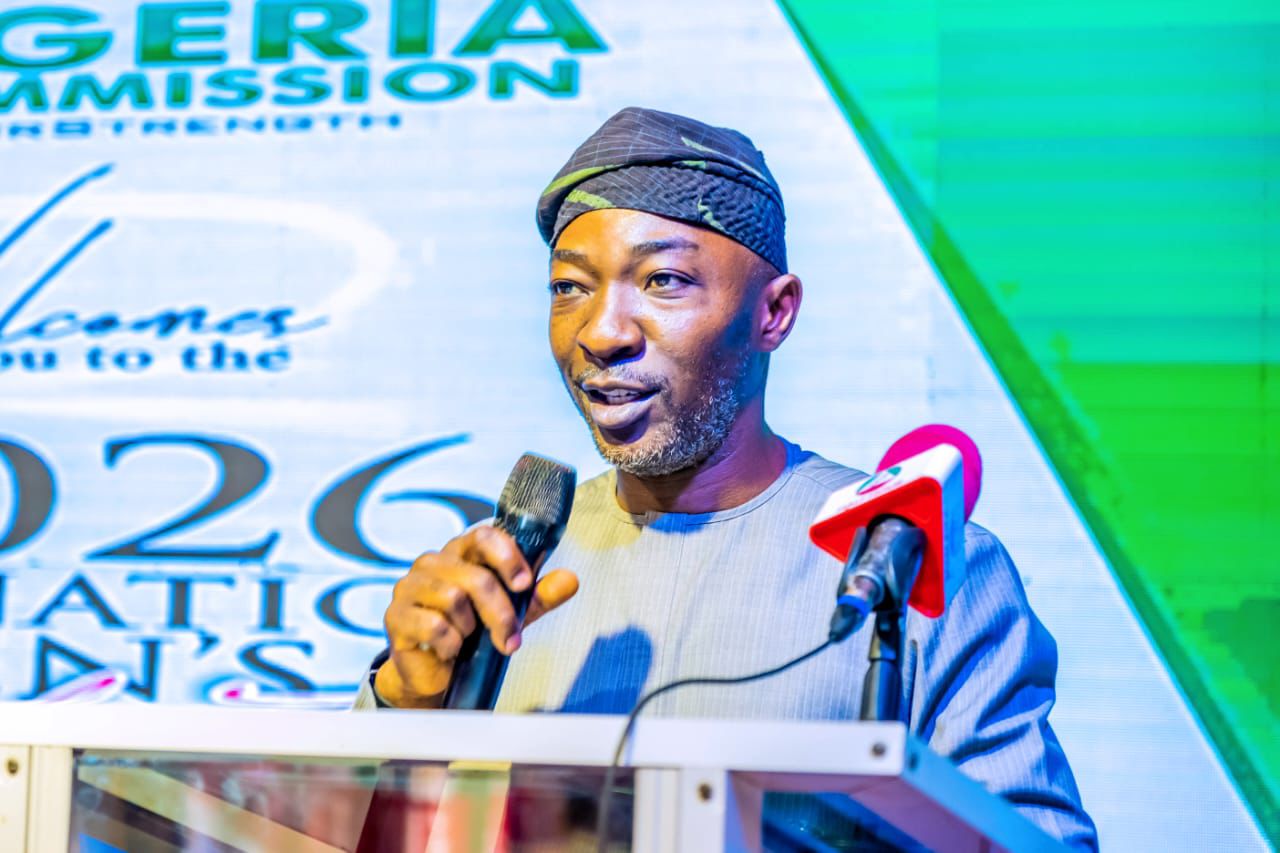
Madiba Advocates Raise Alarm, Urge Presidency, Labour Ministry, NSITF Management Board & relevant authorities to Probe Alleged ₦297bn NSITF Irregularities Linked to MD Faleye Oluwaseun
Madiba Advocates for Good Governance has criticised what it described as the continued silence of authorities over serious allegations of financial irregularities at the Nigeria Social Insurance Trust Fund (NSITF), calling on President Bola Ahmed Tinubu, the Honourable Minister of Labour and Employment, the NSITF Management Board, and other relevant agencies to urgently initiate a comprehensive investigation.
The group said the allegations, which have persisted in the public domain for weeks, involve the Managing Director/Chief Executive Officer of NSITF, Mr. Oluwaseun Mayomi Faleye, and have yet to receive any clear institutional response despite their gravity.
The call follows a series of petitions and public disclosures that have brought increased scrutiny to the management of the Fund, particularly in relation to financial transactions and governance processes within the institution. Madiba Advocates noted that the scale of the allegations and the sensitivity of the funds involved make immediate intervention both necessary and urgent.
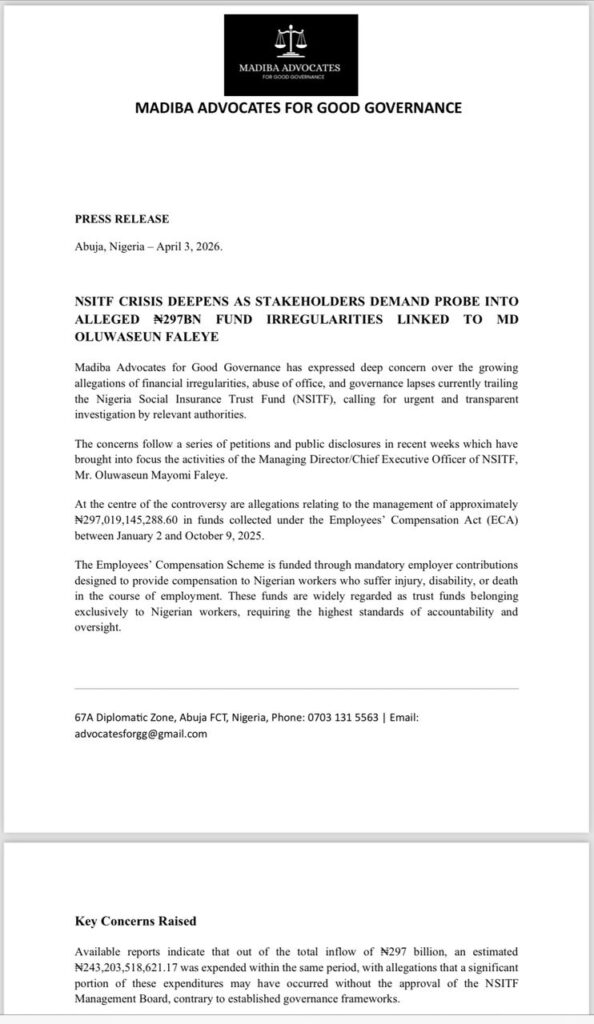
At the centre of the controversy are allegations involving the management of approximately ₦297,019,145,288.60 in funds collected under the Employees’ Compensation Act (ECA) between January 2 and October 9, 2025.
The Employees’ Compensation Scheme is funded through mandatory employer contributions designed to provide compensation to Nigerian workers who suffer injury, disability, or death in the course of employment. Stakeholders have consistently emphasised that these funds are not government revenue, but trust funds belonging exclusively to Nigerian workers, requiring strict oversight and accountability.
₦243bn Allegedly Spent Without Board Approval
Documents referenced in the public domain indicate that out of the total inflow of ₦297 billion, an estimated ₦243,203,518,621.17 was expended within the same period. Sources allege that a significant portion of these expenditures may have been carried out without the approval of the NSITF Management Board, raising concerns about compliance with the NSITF Act and established financial regulations.
‘No Approval Limit’ Raises Governance Concerns
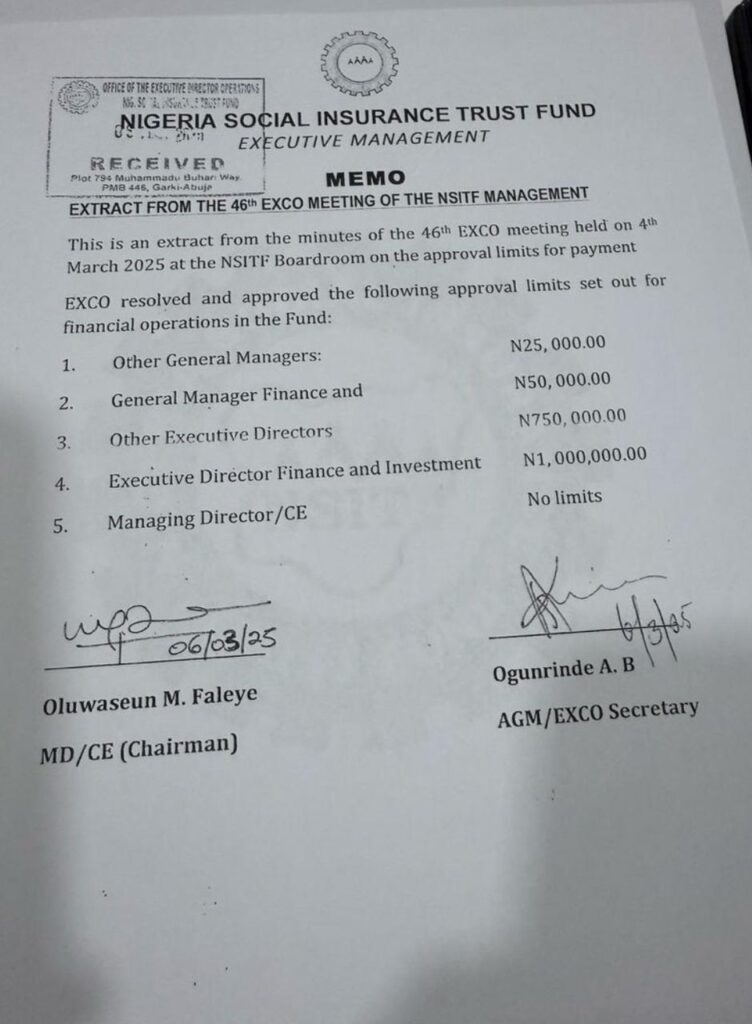
Central to the allegations is an internal document reportedly linked to a March 4, 2025 Executive Committee (EXCO) meeting, which outlined financial approval thresholds for officials. While limits were reportedly set for other officers, the Managing Director was allegedly assigned “no approval limit”, a development that has raised serious concerns about internal controls and governance safeguards.
Multiple Accounts and Financial Flow Allegations
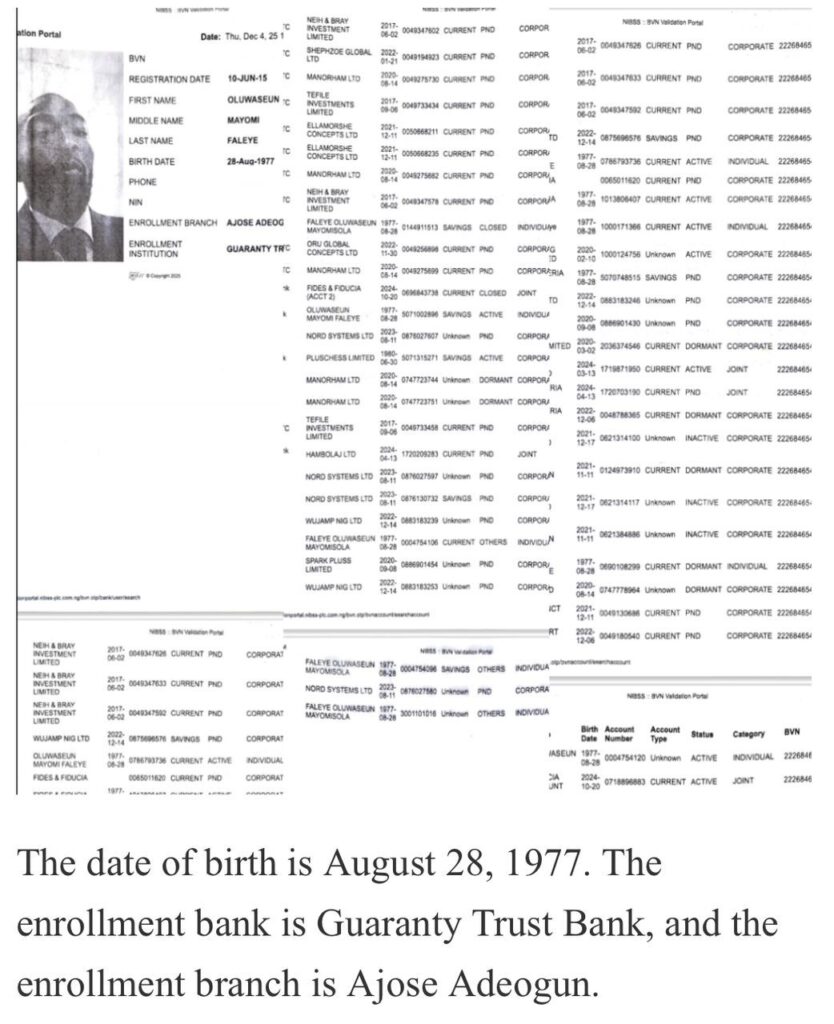
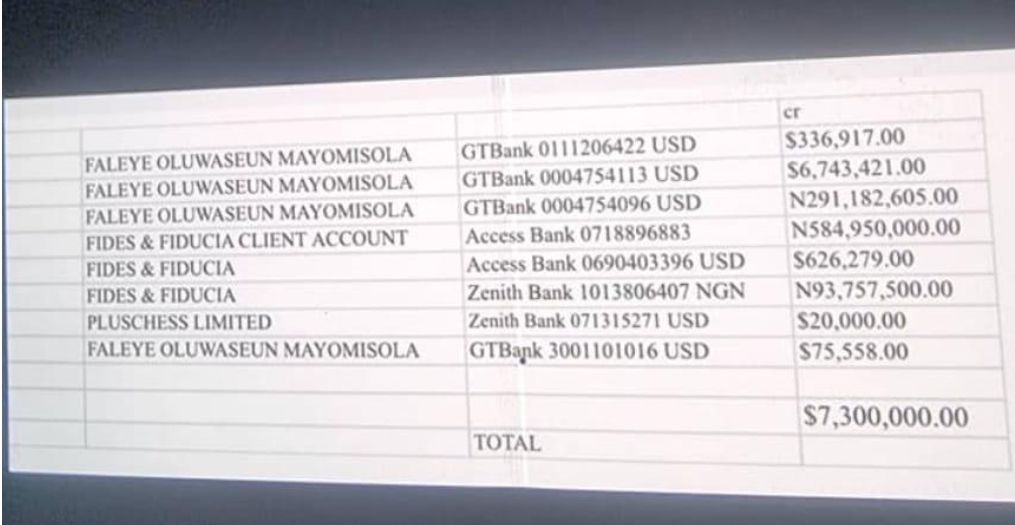
Further reports allege the existence of over 100 bank accounts linked to a single Bank Verification Number (BVN), alongside financial inflows amounting to over $7.3 million and hundreds of millions of naira into accounts linked to the Managing Director and associated entities. Analysts note that such patterns, if verified, would require thorough scrutiny by relevant financial and regulatory authorities.
₦5.5bn Commission Payments Queried
Additional concerns have been raised over alleged commission payments totalling ₦5.53 billion, reportedly made without clear evidence of requisite approvals from the Board or the supervising Ministry. The payments are said to range between 15 and 20 per cent commissions and were allegedly executed outside standard procedures.
Governance Gap Raises Further Questions
Observers have also pointed to a governance gap between July 2023, when the Managing Director was appointed, and January 2025, when the Management Board was reportedly constituted, raising concerns about the level of oversight during that period.
Madiba Advocates for Good Governance stated that the issues have now reached a critical point, requiring decisive action from all relevant authorities to ensure transparency and accountability in the management of the Fund.
Call for Urgent Investigation
Reacting to the development, Madiba Advocates for Good Governance, led by its Executive Director, Alhassan Kabiru, expressed concern over the prolonged delay in addressing the allegations and the absence of a coordinated institutional response.
The group called on:
• The Chairman of the NSITF Management Board,
• The Honourable Minister of Labour and Employment,
• Relevant regulatory and anti-corruption agencies, and
• President Bola Ahmed Tinubu
to urgently intervene and ensure a thorough and independent investigation into the matter.
“This matter has lingered in the public space without clarity. It is important that the appropriate authorities take decisive steps to investigate and establish the facts,” the group stated.
Madiba Advocates emphasized that transparency in handling the allegations is essential to restoring confidence in public institutions and safeguarding workers’ funds.
Responses and Presumption of Innocence
When contacted, Mr. Faleye reportedly stated that he was not aware of the allegations. Officials of the Ministry of Labour were also said to have denied prior knowledge of the claims, while the NSITF Management Board indicated that the issues would be verified.
All allegations remain unproven and subject to investigation.
A Test of Accountability
Analysts say the situation presents a significant test of Nigeria’s public finance accountability framework, particularly for institutions entrusted with workers’ welfare.
Madiba Advocates for Good Governance warned that the continued delay in addressing these allegations risks sending the wrong signal about accountability within public institutions. The organisation urged the Presidency, the Ministry of Labour, and the NSITF Management Board to act without further delay to investigate the issues and restore confidence in the system. It added that failure to act decisively could further erode public trust and undermine the Federal Government’s Renewed Hope Agenda on transparency, accountability, and good governance.
Madiba Advocates Raise Alarm, Urge Presidency, Labour Ministry, NSITF Management Board & relevant authorities to Probe Alleged ₦297bn NSITF Irregularities Linked to MD Faleye Oluwaseun
Easter: IPCR Calls for Peace, Unity, National Reconciliation
By: Michael Mike
The Institute for Peace and Conflict Resolution (IPCR) has called on Nigerians to embrace peace, unity, and national reconciliation as Christians across the country mark Easter.
In a press statement issued on Saturday, the Director-General of the institute, Joseph Ochogwu, extended warm greetings to Christians, describing Easter as a sacred season that reflects sacrifice, redemption, and hope.
He noted that the celebration of the death and resurrection of Jesus Christ remains a defining moment in the Christian faith, symbolising victory over adversity, renewal of life, and the triumph of light over darkness.
Ochogwu urged Christians to use the period to pray for peace, tranquility, and harmony in Nigeria, especially at a time when the country is grappling with security challenges. He referenced recent incidents of violence in parts of the country, including Plateau State, Kaduna State, and Maiduguri.
The IPCR boss expressed condolences to families and communities affected by the violence, offering prayers for strength, healing, and comfort for those grieving.
He emphasised that Easter serves as a reminder of the enduring power of hope, urging Nigerians—regardless of religion, ethnicity, or background—to embrace peaceful coexistence and mutual respect.
Ochogwu also called on citizens to remain vigilant and support lawful efforts to safeguard lives and property, stressing that peacebuilding is a collective responsibility.
“As we celebrate this holy season, let us preach love, extend kindness, and demonstrate compassion in our daily interactions,” he said, adding that the spirit of Easter should inspire reconciliation and a renewed commitment to building a peaceful and prosperous nation.
The institute reaffirmed its commitment to promoting dialogue, strengthening conflict resolution mechanisms, and supporting initiatives aimed at achieving sustainable peace across Nigeria.
He gave a message of hope, praying that Easter would bring healing to the nation, comfort to the afflicted, and renewed optimism for a future defined by unity and shared progress.
Easter: IPCR Calls for Peace, Unity, National Reconciliation
Army, DSS arrest notorious cultist, gunrunner in Cross River, recover weapons
By: Zagazola Makama
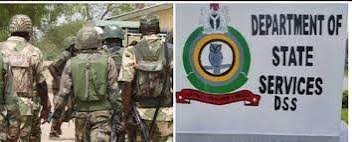
Troops of 13 Brigade, in collaboration with the Department of State Services (DSS), have arrested a suspected cultist and gunrunner during a raid operation in Ikom Local Government Area of Cross River State.
Security sources said the operation was carried out at about 1:10 a.m. on April 3 along Effangha Spring Road in Ikom.
The sources disclosed that the suspect, who hails from Khana Local Government Area of Rivers State, was apprehended during the coordinated raid.
According to the sources, troops recovered one revolver pistol, one sword, two laptops, four mobile phones, one digital camera, one wristwatch, three identity cards, and a sack of garri allegedly used to conceal the weapon.
The suspect and recovered items have since been handed over to the DSS for further investigation and possible prosecution.
Security authorities said the operation is part of ongoing efforts to curb cult-related violence and illegal arms circulation in the South-South region.
Army, DSS arrest notorious cultist, gunrunner in Cross River, recover weapons

ADC; Coalition Is Not Enough

Madiba Advocates Raise Alarm, Urge Presidency, Labour Ministry, NSITF Management Board & relevant authorities to Probe Alleged ₦297bn NSITF Irregularities Linked to MD Faleye Oluwaseun

The Sahel: Seeing Through Russia’s Disinformation Playbook in Africa

Roger Federer’s Shock as DNA Results Reveal Myla and Charlene Are Not His Biological Children

THE PLIGHT OF FARIDA

FAILED COUP IN BURKINA FASO: HOW TRAORÉ NARROWLY ESCAPED ASSASSINATION PLOT AMID FOREIGN INTERFERENCE CLAIMS
-
 News2 years ago
Roger Federer’s Shock as DNA Results Reveal Myla and Charlene Are Not His Biological Children
-
Opinions4 years ago
THE PLIGHT OF FARIDA
-
 News12 months ago
FAILED COUP IN BURKINA FASO: HOW TRAORÉ NARROWLY ESCAPED ASSASSINATION PLOT AMID FOREIGN INTERFERENCE CLAIMS
-

 News2 years ago
EYN: Rev. Billi, Distortion of History, and The Living Tamarind Tree
-
 Opinions4 years ago
POLICE CHARGE ROOMS, A MINTING PRESS
-

 ACADEMICS2 years ago
A History of Biu” (2015) and The Lingering Bura-Pabir Question (1)
-

 Columns2 years ago
Army University Biu: There is certain interest, but certainly not from Borno.
-

 Opinions2 years ago
Tinubu,Shettima: The epidemic of economic, insecurity in Nigeria
