
Uncategorized
Inside Enugu’s anti-cultism crackdown: how one suspect’s confession led to the arrest of three cultists in Udi


Inside Enugu’s anti-cultism crackdown: how one suspect’s confession led to the arrest of three cultists in Udi
By: Zagazola Makama
For weeks, residents of Umuasi Ngwo in Udi Local Government Area of Enugu State lived with an uneasy silence. Whispers of cult-related violence, extortion, and intimidation crept through the community like a shadow.
But in the early hours of July 21, a breakthrough by the Anti-Cultism Squad of the Enugu State Police Command brought a glimmer of hope.
It all began with the confession of a 31-year-old cult suspect, Ikemefuna Ani, popularly known as “Majority,” who was already in custody and undergoing investigation for cult-related offenses.
According to sources within the Anti-Cultism Unit, Ani’s detailed statement cracked open what had long been a closely guarded network. Acting on his revelations, the Officer in Charge of the squad led a pre-dawn operation to Umuasi Ngwo at about 4:30 a.m.
The result was the arrest of three notorious cultists: Stephen Chidiebere Ugwu (alias “Shaggy”), aged 42; Arinze Udeh (alias “Anonymous”), aged 30; and Onuigbo Kingsley, all residents of the area and self-confessed members of the Black Axe confraternity.
Their arrest marks a significant milestone in Enugu’s ongoing efforts to rid its communities of cult-related violence and criminality.
One locally fabricated cut-to-size double-barrel gun was recovered during the raid, further strengthening suspicions that the cultists were involved in activities far beyond mere fraternity.
“These are not just men hanging out in secret corners. They’re part of a dangerous network that has, for too long, threatened the peace and safety of our people,” said a senior officer involved in the operation.
The suspects, now in police custody, reportedly confessed to longstanding involvement in cult activities ranging from intimidation of residents to violent clashes with rival groups. Some community members who spoke to NAN under anonymity said the suspects had long been feared figures in the neighbourhood.
“People avoided them. We knew they were up to no good, but fear kept everyone quiet,” said a youth leader in Umuasi Ngwo.
The Police Command says discreet investigations are ongoing and that more arrests may follow as operatives continue to unravel the network’s operations across the state.
Police sources have reiterated the Command’s zero-tolerance stance on cultism, urging citizens to continue cooperating with law enforcement agencies.
“We are taking proactive steps. Anyone involved in cultism should know there’s no hiding place. Communities are safer when the people support our work with information,” he said.
This latest development adds to the growing list of successful operations by Enugu’s Anti-Cultism Squad, which has intensified its crackdown on secret cults in both urban and rural areas.
For the people of Umuasi Ngwo, the arrests bring a renewed sense of security. But as investigations continue, residents hope the momentum won’t stop with these three.
“There are more of them out there,” said one elderly resident. “We just pray the police won’t stop until they clean up everything.”
Inside Enugu’s anti-cultism crackdown: how one suspect’s confession led to the arrest of three cultists in Udi


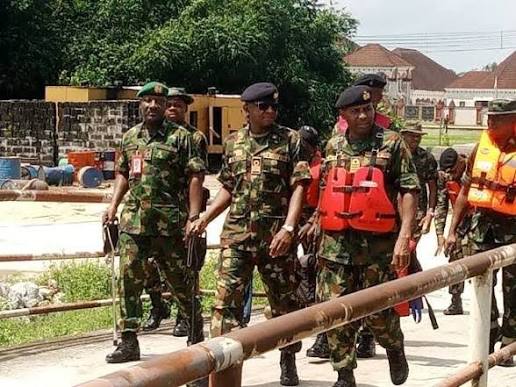
Troops arrest suspect with 75 live cartridges in Awka, Anambra
By: Zagazola Makama
Troops of Sector 5 Operation UDO KA have arrested a suspected criminal in Awka, Anambra State, and recovered 75 live cartridges in his possession.
Security sources said the arrest was made at about 7:00 a.m. on April 5, 2026, during a routine operation in the state capital.
The suspect was allegedly found with the ammunition concealed in his bag at the time of arrest.
During preliminary questioning, the suspect claimed he received the cartridges from a friend, while efforts are ongoing to identify and track the source of the consignment.
Authorities said the suspect is currently in custody as investigations continue.
Troops arrest suspect with 75 live cartridges in Awka, Anambra
Troops uncover illegal crude oil storage facility in Ahoada West forest in Rivers
By: Zagazola Makama
Troops of Joint Task Force, South-South, Operation DELTA SAFE, have uncovered an illegal crude oil storage site in the Orashi National Forest in Ahoada West Local Government Area of Rivers State.
Security sources said the discovery was made at about 9:00 a.m. on April 4, 2026, during an anti-illegal bunkering operation conducted by troops deployed at Aminigboko, alongside personnel of 103 Battalion and 16 Brigade Garrison.
During the operation, troops reportedly found two long galvanized pipes estimated at about 500 metres each, two hoses approximately 50 metres long, and a large reservoir containing stolen crude oil estimated at about 15,000 litres.
The recovered items were handled in line with the directives of Operation DELTA SAFE. Authorities said efforts are ongoing to identify and dismantle other illegal bunkering networks in the area.
Troops uncover illegal crude oil storage facility in Ahoada West forest in Rivers
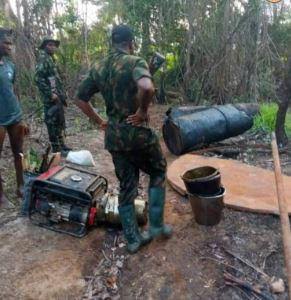
Troops and Tantita operatives arrest 2 suspected oil bunkerers, recover AGO in Delta
By: Zagazola Makama
Troops of 181 Amphibious Battalion, in collaboration with Tantita Security Services operatives, have arrested two suspected illegal oil bunkerers in Ndokwa West Local Government Area of Delta State.
Security sources said the suspects were apprehended at about 9:25 a.m. on April 4, 2026, around the Transpalodec Hotel junction in Kwale, following intelligence on their alleged activities.
Preliminary investigations indicated that the suspects had been on the watchlist of suspected bunkerers operating within the Kwale axis and were under surveillance prior to their arrest.
Items recovered from them included about 60 litres of Automotive Gas Oil (AGO), 32 sacks, and four mobile phones.
The suspects and recovered items were handed over to the Nigerian Police, Kwale Division, for further investigation and possible prosecution.
Troops and Tantita operatives arrest 2 suspected oil bunkerers, recover AGO in Delta

Agriculture partnership: Gov Yahaya to get Sasakawa’s Special Award

JNIM terrorists clashes with rival factions in rare encounter in Nigeria’s Kebbi state

Troops foil mob attack, rescue suspected terrorist in Danmusa in Katsina

Roger Federer’s Shock as DNA Results Reveal Myla and Charlene Are Not His Biological Children

THE PLIGHT OF FARIDA

FAILED COUP IN BURKINA FASO: HOW TRAORÉ NARROWLY ESCAPED ASSASSINATION PLOT AMID FOREIGN INTERFERENCE CLAIMS
-
 News2 years ago
Roger Federer’s Shock as DNA Results Reveal Myla and Charlene Are Not His Biological Children
-
Opinions4 years ago
THE PLIGHT OF FARIDA
-
 News12 months ago
FAILED COUP IN BURKINA FASO: HOW TRAORÉ NARROWLY ESCAPED ASSASSINATION PLOT AMID FOREIGN INTERFERENCE CLAIMS
-

 News2 years ago
EYN: Rev. Billi, Distortion of History, and The Living Tamarind Tree
-
 Opinions4 years ago
POLICE CHARGE ROOMS, A MINTING PRESS
-

 ACADEMICS2 years ago
A History of Biu” (2015) and The Lingering Bura-Pabir Question (1)
-

 Columns2 years ago
Army University Biu: There is certain interest, but certainly not from Borno.
-

 Opinions2 years ago
Tinubu,Shettima: The epidemic of economic, insecurity in Nigeria
