
News
NAPTIP Calls for Unified National Response to Rising Violent Crime


NAPTIP Calls for Unified National Response to Rising Violent Crime
By: Michael Mike
The Director-General of the National Agency for the Prohibition of Trafficking in Persons (NAPTIP), Dr. Binta Bello has called for a coordinated national effort to confront the growing wave of violent crime across the country.
She made the appeal in Abuja on Wednesday at the High-Level Policy Dialogue on stopping violent crime in Nigeria.
Speaking to an audience of government officials, development partners, civil society organisations, traditional leaders, and security agencies, Dr. Bello said the country could no longer rely on fragmented responses to issues ranging from gender-based violence to cyber-enabled crimes.
She said: “This Dialogue is not ceremonial; it is a strategic gathering. Nigeria must move beyond isolated interventions and embrace a truly integrated framework for protecting its citizens—especially women, children, and vulnerable groups.”
She disclosed that the forthcoming 2024 Violence Against Persons Prohibition (VAPP) Report paints a troubling picture.
According to her, the data shows increasing cases of gender-based violence, widespread underreporting, delayed justice processes, and weak survivor support systems in several states.
She noted that although more states have domesticated the VAPP Act and awareness continues to grow, gaps in institutional capacity and data coordination still hinder effective response, warning that: “No society can achieve sustainable peace when the vulnerable remain unprotected.”
The NAPTIP DG also highlighted significant progress made by the Agency’s Cybercrime Response Team (CRT) in tackling online exploitation and tech-enabled trafficking. She revealed that between January and November 2025, the specialized unit handled 56 cases, investigated 48, referred 12, and secured three active court prosecutions.
The CRT, which works with partners including INTERPOL, NCA-UK, UNODC, ICMPD, Meta, NFIU, ONSA, and the Nigeria Police NCCC, recently became a founding member of the Joint Case Team on Cybercrimes (JCTC) established by the Attorney-General of the Federation.
She said: “These achievements position NAPTIP as a national leader in combating cyber-enabled trafficking and protecting vulnerable populations in the digital ecosystem.”
A major highlight of the event was the launch of NAPTIP’s E-Learning App, designed to expand capacity-building for law enforcement officers, social workers, prosecutors, community leaders, and other stakeholders nationwide.
Bello described the platform as a strategic tool to bridge knowledge gaps and ensure no state or institution is left behind in the fight against violent crime.
She however emphasised that effective prevention and response require seamless collaboration between sectors including health, education, justice, traditional institutions, the media, and digital service providers.
She also called for the strengthening of early-warning systems, improved reporting channels, trauma-informed service delivery, and harmonised national and state-level data systems.
She said: “As Nigeria marks the 16 Days of Activism against Gender-Based Violence, we must reaffirm our commitment to ending digital violence and all other forms of abuse.”
She expressed gratitude to the First Lady, the Attorney-General of the Federation, development partners, and the various ministries, departments, agencies, and community groups represented at the Dialogue.
She added that: “Our deliberations today must translate into stronger policies, stronger partnerships, and stronger protection for every Nigerian.”
NAPTIP Calls for Unified National Response to Rising Violent Crime



2027: Constituents declare support for Tinubu, Goje’s re-election
Yamaltu/Deba constituents have declared support for President Bola Tinubu and Senator Danjuma Goje’s re-election ahead of the 2027 General Elections.
Dr Newton Moses, declared the support in a statement read on behalf of the people of Yamaltu/Deba Local Government Area of Gombe State on Friday in Gombe.
Moses said voting for experienced leaders in 2027 remained key to addressing Nigeria’s challenges and delivering dividends of democracy to Nigerians.
He said the group’s decision to support Tinubu and Goje was guided by patriotism, and a sincere desire to see competent, and result-driven leadership that would benefit their constituents and the country.
He said that Goje’s leadership in the past 16 years at the Senate has benefitted the constituents and given effective representation to the people of Akko and Yamaltu/Deba LGAs that make up the district.
He dismissed allegations that the people of Yamaltu/Deba have been marginalised and were demanding the seat to be zoned to Yamaltu/Deba and not Akko where Goje is from.
He said that the constitution did not impose any zoning limitation or tenure restriction on membership in the National Assembly, hence urged those seeking the seat to test their popularity through election.
“We are not part of that group saying Goje should not return to the senate in 2027; that is not the voice of the grassroots from Yamaltu Deba.
“ Goje has, over the years, built invaluable networks and acquired the experience necessary to effectively advocate for the interests of his constituency and contribute meaningfully to national development.
“ By returning Goje to the Senate, Gombe Central stands to gain even more.
“ His established influence will ensure greater access to federal opportunities, increased developmental projects, and stronger representation in critical national decisions,” he said.
The group further advised President Tinubu to stay away from those working to tarnish the good name of Goje, stating that Goje’s influence in Gombe was important for the success of the All Progressives Congress in 2027.
Moses said at a time when Nigeria is focused on economic recovery, institutional strengthening, and inclusive growth under Tinubu, it was imperative that proven leaders like Goje to continue contributing his expertise toward national progress.
2027: Constituents declare support for Tinubu, Goje’s re-election

Hope in the Hard Times: Ashlee Momoh Foundation Spreads Easter Joy to Military Widows
By Comrade Philip O. Ikodor
The Ashlee Momoh Foundation (AMF), a non-profit organization dedicated to supporting the families of fallen officers, marked the Easter season with a heartwarming outreach to military widows at different locations in Abuja and Nasarawa state, respectively on April 2nd, 2026. This thoughtful initiative was designed to bring joy, hope, and support to the widows of our fallen Military Officers, who have made immense sacrifices for their country.

“Easter is the season of renewal, hope, and the triumph of light over darkness,” Princess Ashlee said. “It reminds us that even after the longest winter, spring arrives and even after the deepest sorrow, there is the possibility of a new dawn.” The outreach was designed to show support and encouragement to the military widows, and to felicitate with them on the occasion of Easter.
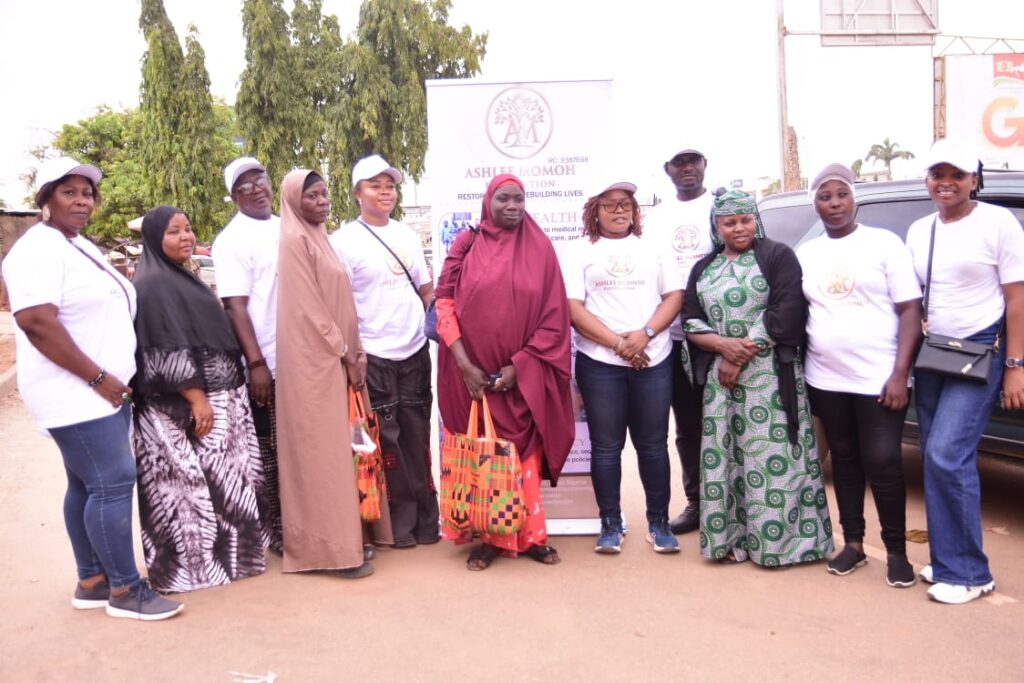
Princess Ashlee Momoh reassured the widows that while their loved ones are no longer physically present, their legacy lives on, and AMF is committed to standing with them, supporting them, and celebrating their strength. “Today, we celebrate you, our heroes’ widows, and the sacrifices you’ve made,” she said.
The event was filled with moments of joy and fulfilment, as beneficiaries received gift items, cash gifts, and scholarship opportunities. The Foundation also announced enlistment for skill acquisition and empowerment programs, aimed at equipping the widows with the tools they need to rebuild their lives.

The outreach was a testament to AMF’s unwavering commitment to supporting the families of fallen officers, and its dedication to making a positive impact in the lives of those who have made immense sacrifices for their country. As one beneficiary put it, “This Easter, we’ve received more than just gifts – we’ve received hope, love, and a sense of belonging.”

The Ashlee Momoh Foundation’s Easter outreach was a powerful reminder that even in the darkest moments, there is always hope, and that together, we can overcome any challenge.
Hope in the Hard Times: Ashlee Momoh Foundation Spreads Easter Joy to Military Widows

Six die, 12 injured in Kwara road crash
By: Zagazola Makama
Six persons have been confirmed dead and 12 others injured in a fatal road traffic accident along the Okolowo–Jebba expressway in Kwara State.
Police sources said the accident occurred at about 6:00 a.m. on April 2 near Danjuma Bakery area, involving a Toyota Hummer bus and a stationary truck.
According to the sources, the bus with registration number BTR-161-XA was conveying 18 passengers from Lagos State to Katsina State when it rammed into a parked truck with registration number BUU-495-ZD.
The truck was reportedly driven by Kamarudeen Abdullahi, said to be from Jos North Local Government Area of Plateau State.
The impact of the collision resulted in the death of six passengers on the spot, while 12 others sustained varying degrees of injuries.
The injured victims were rushed to the University of Ilorin Teaching Hospital, Oke-Oyi, for medical attention, while the remains of the deceased were deposited in the hospital morgue for autopsy.
Police said investigation had commenced to determine the circumstances surrounding the crash.
Six die, 12 injured in Kwara road crash

2027: Constituents declare support for Tinubu, Goje’s re-election

Hope in the Hard Times: Ashlee Momoh Foundation Spreads Easter Joy to Military Widows

Police arrest newly recruited suspected ISWAP member in Kwara

Roger Federer’s Shock as DNA Results Reveal Myla and Charlene Are Not His Biological Children

THE PLIGHT OF FARIDA

FAILED COUP IN BURKINA FASO: HOW TRAORÉ NARROWLY ESCAPED ASSASSINATION PLOT AMID FOREIGN INTERFERENCE CLAIMS
-
 News2 years ago
Roger Federer’s Shock as DNA Results Reveal Myla and Charlene Are Not His Biological Children
-
Opinions4 years ago
THE PLIGHT OF FARIDA
-
 News12 months ago
FAILED COUP IN BURKINA FASO: HOW TRAORÉ NARROWLY ESCAPED ASSASSINATION PLOT AMID FOREIGN INTERFERENCE CLAIMS
-

 News2 years ago
EYN: Rev. Billi, Distortion of History, and The Living Tamarind Tree
-
 Opinions4 years ago
POLICE CHARGE ROOMS, A MINTING PRESS
-

 ACADEMICS2 years ago
A History of Biu” (2015) and The Lingering Bura-Pabir Question (1)
-

 Columns2 years ago
Army University Biu: There is certain interest, but certainly not from Borno.
-

 Opinions2 years ago
Tinubu,Shettima: The epidemic of economic, insecurity in Nigeria
