
News
NCTC, UNODC Inaugurate Working Group to Counter Criminal and Terrorist Finance in Nigeria’s Mineral Sector

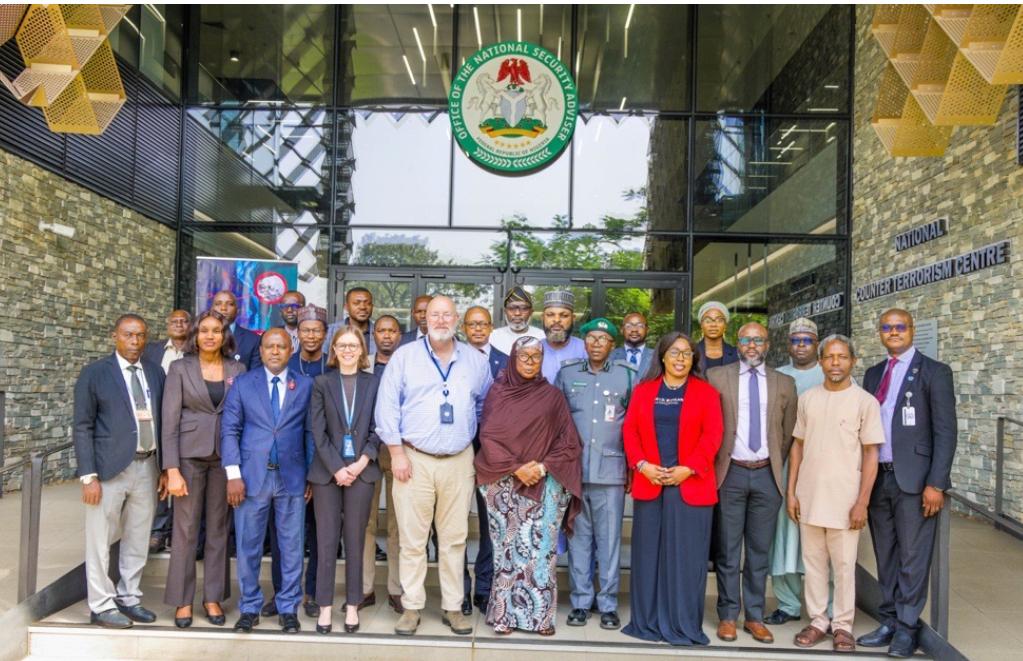
NCTC, UNODC Inaugurate Working Group to Counter Criminal and Terrorist Finance in Nigeria’s Mineral Sector
By: Michael Mike
The National Counter Terrorism Centre (NCTC), Office of the National Security Adviser (ONSA), in collaboration with the United Nations Office on Drugs and Crime (UNODC), and with the support of the Government of Canada, has established a Technical Working Group (TWG) on Mineral Crime and Terrorism Financing.
Nigeria’s mineral sector, particularly artisanal and small-scale gold mining, has increasingly been exploited by criminal and terrorist networks.
These illicit activities have continued to deprive the government of vital tax and royalty revenues, weaken state capacity to deliver essential services, and fuel instability nationwide. By exploiting regulatory gaps and opaque value chains, criminal groups disguise illicit proceeds, perpetuating conflict and organized crime in the country.
The TWG, comprising representatives of law enforcement, intelligence and other security agencies, including those of other strategic MDAs and the Presidential Artisanal Gold Mining Initiative (PAGMI) under the latest agreement, will collaborate to strengthen the nation’s criminal justice capacity to address illicit financial flows tied to terrorism financing and money laundering in the mining sector by coordinating individual agency responses, supporting national efforts, and guiding policy reforms.
It will also promote community resilience in artisanal mining regions while integrating gender equality and human rights into government interventions.
In his keynote speech at the inaugural meeting of the working group, the NCTC National Coordinator, Major General Adamu Garba Laka, who was represented by the Centre’s Director of Preventing and Countering Violent Extremism, Ambassador Mairo Musa Abbas underscored the Federal Government of Nigeria’s commitment to cutting off terrorist financing at its source, including in the mineral sector.
He said: “Nigeria’s mineral resources remain some of the most valuable national assets we possess. Yet in recent years, the growing exploitation of these resources by criminal syndicates and violent extremist elements has become a significant threat. This is not merely a theoretical risk; it is a lived reality in several regions of our country, where illegal mining intersects with banditry, insurgency, arms trafficking and cross-border smuggling. In past years, the NCTC has recorded remarkable progress in strengthening Nigeria’s counter-terrorism financing architecture. Today’s initiative builds on this momentum. Protecting our mineral resources from criminal capture is not only a security imperative, but it is also a development imperative, an economic imperative and, ultimately, a sovereign duty.”
On his part, UNODC Country Representative for Nigeria, Mr Cheikh Toure,, in his remarks conveyed by Mr Tom Parker, Head of the UNODC Counter Terrorism Unit, praised the leadership of the NCTC, while emphasising that “Illegal mining, and the illicit financial flows generated by this activity, undermine Nigeria’s stability and development. The creation of this interagency Working Group by the NCTC is an important step in reversing this trend. UNODC is committed to strengthening Nigeria’s capacity to detect, investigate, and prosecute financial crimes linked to terrorism and organized crime. Collaboration is fundamental to defeating criminal and terrorist threats, and helps foster shared learning and policy innovation.”
Funded by the Government of Canada, UNODC is working closely with the NCTC together with agencies like Economic and Financial Crimes Commission, National Financial Intelligence Unit, the Mining Marshals Corps and the Ministry of Solid Minerals Development to build Nigeria’s capacity towards combating illicit financial flows linked to Nigeria’s mineral sector by deepening analysis of relationship between mineral-related crimes and the financing of terrorism, strengthening supervision in the financial sector by equipping both private and government actors to detect suspicious transactions, and supporting the effective investigation, prosecution, and adjudication of money laundering and terrorism financing cases at the state and federal levels.
NCTC, UNODC Inaugurate Working Group to Counter Criminal and Terrorist Finance in Nigeria’s Mineral Sector


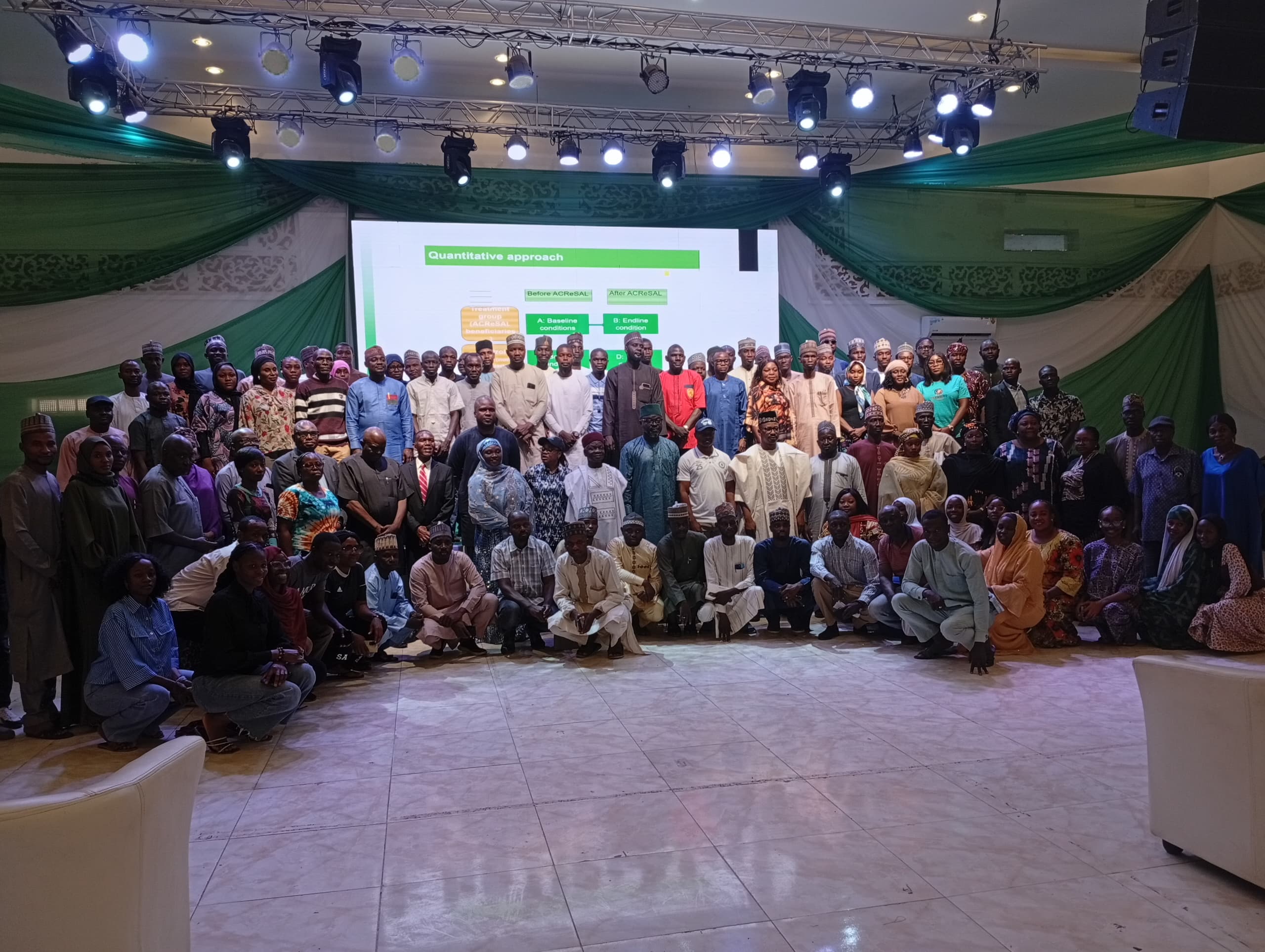
Over 930, 000 persons benefit from ACReSAL Projects in Gombe
Mr Mohammed Fawu, the Gombe State Commissioner of Water, Environment and Forest Resources, has stated that no fewer than 930,162 persons across the state have benefitted from the implementation of the World-Bank-funded Agro-Climatic Resilience in Semi-Arid Landscapes (ACReSAL) Project in the state within the past three years
Fawu stated this in Gombe on Monday while declaring open a four-day training of enumerators for ACReSAL Third Party Assessment.
Fawu stated that Gombe State has within the three years received disbursements amounting to $27.51 million for the implementation of the project which had impacted positively on the lives of residents.
He said that the projects so far implemented have contributed to combating land degradation, erosion, and climate change while improving on the lives of persons living around communities were projects were executed.
“Gombe State has advanced a wide range of landscape and community-level interventions, including: establishment of 313 hectares of woodlot plantation.
“Upgrading of Kanawa Forest into a biosphere resort and botanical garden, indigenous tree plantations and roadside shelterbelts spanning 110 kilometres.
“Canalization of Balanga Dam irrigation channels covering 6,329 hectares provision of 250 wash boreholes to support irrigation farming.
“ At the community level, we have distributed clean cook stoves to 3,000 households, provided rainwater harvesting facilities to 1,000 households and institutions, and supplied drought-tolerant seeds to 10,000 farmers.
“Solar-powered irrigation schemes, borehole drilling, and Community Revolving Fund activities are ongoing, supporting agro-processing, livestock, and farm enterprise development,” he said.
He added that ACReSAL has strengthened smart agricultural practices through the establishment a farm centre dedicated to training and research.
Fawu commended the partnership between the Gombe State government and World Bank, which he said has impacted several sectors while improving the livelihoods of residents of Gombe State.
On his part, Dr Sani Jauro, the Gombe State ACReSAL Project coordinator said that no fewer than 220 enumerators drawn from the 19 Northern States and the Federal Capital Territory were being trained.
Jauro said that the third-party assessment would ensure unbiased review of the projects so far implemented by ACReSAL from independent party.
He said the assessment was part of the procedure of ACReSAL project implementation meant to review the progress and challenges of the projects by enumerators who are not involved in the day-to-day running of ACReSAL projects.
Jauro urged the enumerators to carry out their jobs with fairness and be just in their report, adding that “the credibility of the exercise lies on your shoulder.”
On her part, the World Bank Task Team Leader, Dr. Joy Agene who was represented by Mr Joseph Abang, Operations Officer with World Bank said the assessment would unravel what has changed since the commencement of the implementation of the project.
Agene urged the enumerators to be steadfast and report accurately in line with the essence of the exercise.
Over 930, 000 persons benefit from ACReSAL Projects in Gombe
Police repel attack during attempt to arrest suspected bandit leader, one killed in Kano
By; Zagazola Makama
The Police Command in Kano State has repelled an attack on its personnel during an operation to arrest a suspected bandit leader in Bichi Local Government Area.
Security sources told Zagazola Makama that the incident occurred at about 6:30 p.m. on March 22, following a distress call from Tudun Wulli Outpost.
According to the sources, a team of the Anti-Kidnapping Squad, led by ASP Abubakar Musa, acted on credible intelligence and trailed a suspected bandit leader identified as Muhammad, also known as “Senator” or “Kirchi,” who had reportedly visited Tudun Wulli village for Sallah celebrations.
“The suspect was sighted in possession of an AK-47 rifle, but upon attempt to apprehend him, he fled into a crowd,” the source said.
The situation escalated when a mob allegedly attacked the police team with stones and other dangerous weapons, injuring ASP Lawali Hamidu and damaging the windscreen of a patrol vehicle.
“In the process of tactical withdrawal, four persons sustained gunshot injuries and were rushed to General Hospital, Bichi, for treatment,” the source added.
One of the victims, identified as Halima Saidu, was later confirmed dead by a medical doctor, while the others are responding to treatment.
The police personnel involved in the operation were safely evacuated, and additional security deployments have been made to the area to forestall further breakdown of law and order.
The command said the situation has been brought under control, adding that investigations are ongoing, while efforts are being intensified to apprehend the fleeing suspect.
Police repel attack during attempt to arrest suspected bandit leader, one killed in Kano
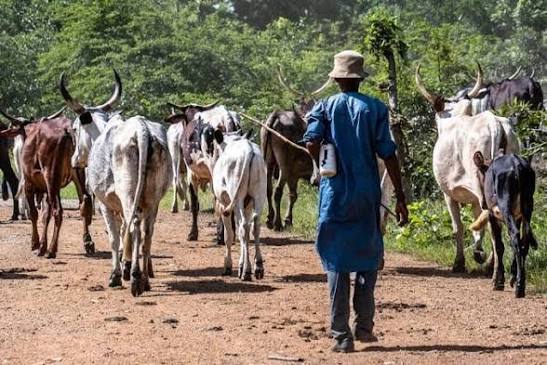
Two suspects arrested over killing of cows in Benue
By: Zagazola Makama
Security operatives have arrested two suspects over the killing of cows and recovery of suspected stolen meat in Guma LGA of Benue State.
Sources said the suspects, identified as Sylvester Kuman and Nyitor Akaangee, both of Udei Village, were arrested at about 1:00 p.m. on March 22 following credible intelligence.
Items suspected to be cow meat were recovered from the suspects during the operation.
Authorities said efforts were ongoing to track and arrest other accomplices, while investigations had commenced to determine the full circumstances surrounding the incident.
Two suspects arrested over killing of cows in Benue

Over 930, 000 persons benefit from ACReSAL Projects in Gombe

Police repel attack during attempt to arrest suspected bandit leader, one killed in Kano

Two suspects arrested over killing of cows in Benue

Roger Federer’s Shock as DNA Results Reveal Myla and Charlene Are Not His Biological Children

THE PLIGHT OF FARIDA

FAILED COUP IN BURKINA FASO: HOW TRAORÉ NARROWLY ESCAPED ASSASSINATION PLOT AMID FOREIGN INTERFERENCE CLAIMS
-
 News2 years ago
Roger Federer’s Shock as DNA Results Reveal Myla and Charlene Are Not His Biological Children
-
Opinions4 years ago
THE PLIGHT OF FARIDA
-
 News11 months ago
FAILED COUP IN BURKINA FASO: HOW TRAORÉ NARROWLY ESCAPED ASSASSINATION PLOT AMID FOREIGN INTERFERENCE CLAIMS
-

 News2 years ago
EYN: Rev. Billi, Distortion of History, and The Living Tamarind Tree
-
 Opinions4 years ago
POLICE CHARGE ROOMS, A MINTING PRESS
-

 ACADEMICS2 years ago
A History of Biu” (2015) and The Lingering Bura-Pabir Question (1)
-

 Columns2 years ago
Army University Biu: There is certain interest, but certainly not from Borno.
-

 Opinions2 years ago
Tinubu,Shettima: The epidemic of economic, insecurity in Nigeria
