
Crime
NDLEA Detains Two Wanted Drug Barons, Arrests Two Others for Ingesting 175 Wraps of Heroin

NDLEA Detains Two Wanted Drug Barons, Arrests Two Others for Ingesting 175 Wraps of Heroin
By: Michael Mike
Operatives of the National Drug Law Enforcement Agency (NDLEA) have taken into custody two wanted alleged heads of transnational criminal organisations with multi-billion-naira worth of illicit drugs and assets seized from them.
According to a statement on Sunday by the spokesman of NDLEA, Femi Babafemi, their arrest was after weeks of intelligence-led operations across the country and outside Nigeria.
He revealed that the arrest of the wanted drug lords came on the heels of the interception of consignments of cocaine and heroin buried in the bellies of two traffickers heading to Paris, France and Doha, Qatar by NDLEA officers at the Nnamdi Azikiwe International Airport, Abuja.
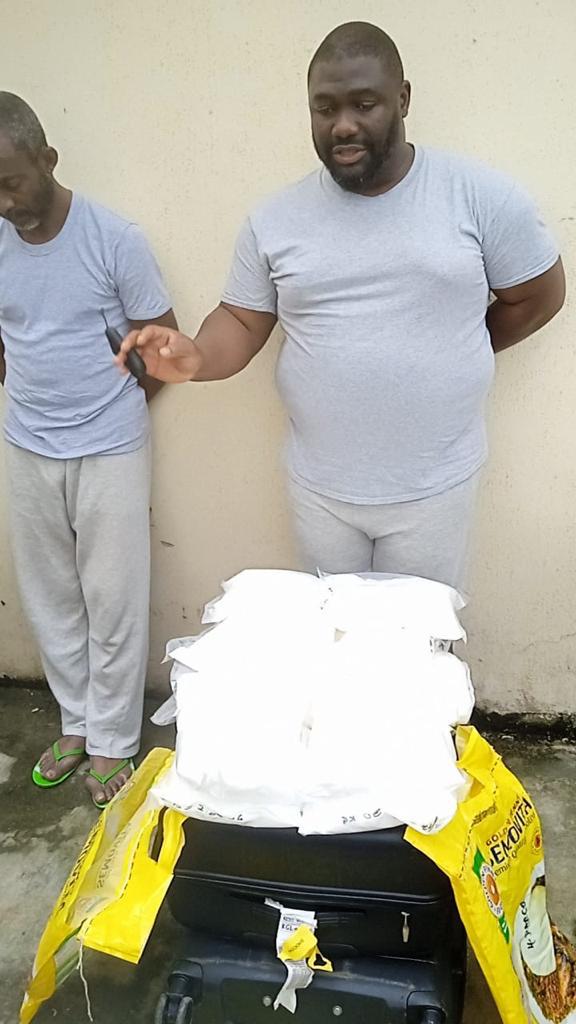
He said operatives at the Murtala Mohammed International Airport, Lagos last Tuesday succeeded in taking into custody, Hakeem Salami, the arrowhead of “Tajudeen Babatunde Abioye Transnational Criminal Organization” involved in the illicit trade of several narcotics including cocaine, heroin, methamphetamine, and ephedrine between Nigeria, Brazil, Ghana, South Africa, Mozambique, and Europe.
Salami, was said to have fled Nigeria to South Africa upon the arrest of a member of his syndicate, Suleiman Oba at the Lagos airport on August 25 over attempt to export 25.1 kilogrammes of ephedrine to South Africa.
Babafemi said Hakeem Salami was however smoked out of hiding through partnership with South African authorities and other intelligence and investigative mechanisms, while some of his luxury vehicles have been seized and his home in Surulere, Lagos sealed, other members of the cartel already in custody include Suleiman and Godwin Edet Mathew.
According to Babafemi, Salami in his statement claimed he was into the importation of building materials from China to Nigeria and used to sell gold in South Africa before delving into the illicit drug trade about two years ago.
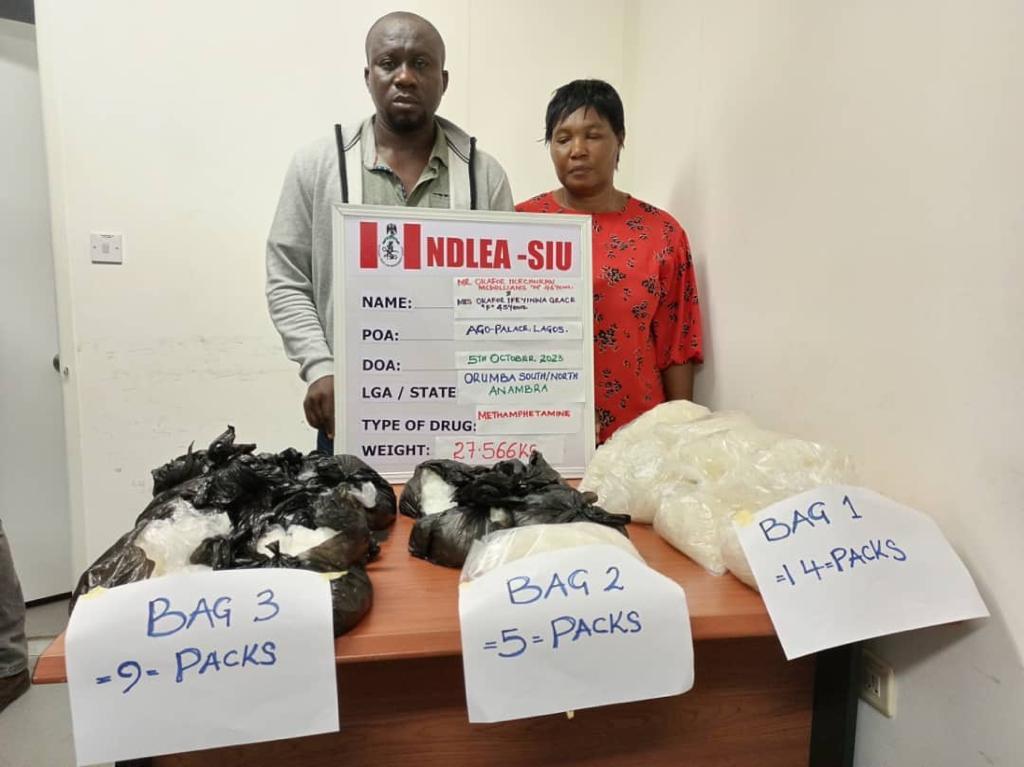
He said the alleged head of another cartel, Okafor Ikechukwu (aka Jantu) and his wife, Okafor Ifeyinwa were also taken into custody on Thursday 5th October when NDLEA operatives raided their hideout at 9 Awa Street, Ago Palace, Okota area of Lagos where they recovered 27.566 kilogrammes of methamphetamine concealed in a blue box and two sacks, ready for export to Europe and Asia.
He said their Lexus RX350 marked ABJ 512 AY parked in the house was also seized during the operation, noting that their arrest followed weeks of intelligence gathering about the activities of the criminal network.
Babafemi, said at the Abuja airport, operatives on Friday 6th October arrested a drug trafficker, Nwofor Ejiogu, 45, during the outward clearance of Qatar Airways flight QR 1432 to Doha. After body scan revealed he ingested cocaine, he was placed under observation during which he excreted 75 pellets of cocaine weighing 1.653 kilogrammes and at the point of his arrest, Nwofor who was the last passenger to board his flight allegedly offered to compromise an NDLEA officer with $3,000 to free him.
The spokesman said the following day, Saturday 7th October, another trafficker, Nwufo Okwudili, 45, was also arrested while attempting to board Lufthansa Airlines flight LH 0595 to Paris, France via Frankfurt, Germany. After being put through body scanner, he was taken into recovery room where he excreted 96 wraps of heroin he ingested with a total weight of 1.413 kilogrammes.
Meanwhile, NDLEA operatives on patrol along Okene -Lokoja-Abuja expressway last Tuesday intercepted a commercial bus coming from Lagos to Kano. A search of the bus led to the seizure $4,880,000 and CFA57,000,000 suspected to be counterfeits.
In Sokoto, the Federal High Court in the state capital presided over by Justice Ahmad Mahmud has sentenced an acting district head, Alhaji Umar Mohammed (aka Dan Bala) to five and a half years in jail on four count charges of possession and dealing in 436.38 kilogrammes of cannabis and 7 kilogrammes psychotropic drugs brought against him by NDLEA in October 2022. He was convicted and sentenced to two years on each of counts 1 and 2 with an option of N1 million fine, and eight months on each of counts 3 and 4 without an option of fine.
Operatives in Edo state last Wednesday stormed the Orue forest, Owan West local government area where they arrested Happy Akashili, 37, and Solomon Uwesue, 40 in a hut located inside a cannabis farm measuring 2.367308 hectares which was destroyed, with 92 kilogrammes already processed skunk recovered, while 49 kilogrammes of same substance were also seized at Ogbeturu camp.
Babafemi said the Commands across the country balanced their drug supply reduction operations with War Against Drug Abuse, WADA, advocacy campaigns to schools, markets, worship centres and communities. Some of these include: WADA sensitisation lecture on Drug Use and Mental Health for students of 15 secondary schools in Ibadan metropolis at the University of Ibadan, Oyo state; WADA sensitisation lecture for students of Ascension College, Iworo Imeke, Badagry Lagos; WADA sensitisation lecture at Modern Comprehensive College, Amokwe, Udi LGA, Enugu; WADA sensitisation lecture for students of National Secondary school, Awka; Students of JIBWIS Islamic Science Secondary school, Herwagana, Gombe; students of Government College, Makurdi, Benue; students of Government secondary school (Boys), Kafin Maiyaki, Kano and students of JNI Special Model primary School, Gusau, Zamfara.
The Chairman/Chief Executive Officer of NDLEA, Brig. Gen. Buba Marwa (Retd) while commending the efforts of the NAIA, MMIA, Kogi, Sokoto and Edo Commands of the agency as well as the Special Operations Unit targeting the drug cartels, for jobs well done in the past week, assured that officers and men of the agency will never let down their guards no matter the tricks and distractions orchestrated against it by criminal networks.
NDLEA Detains Two Wanted Drug Barons, Arrests Two Others for Ingesting 175 Wraps of Heroin


Troops rescue herder from drowning in Plateau
By: Zagazola Makama
Troops of Sector 1 under Operation Enduring Peace have assisted in the rescue and evacuation of a herder who nearly drowned in Dogo Nauwa River in Jos South Local Government Area of Plateau State.
Security sources told Zagazola Makama that the incident occurred at about 3:46 p.m. on July 17 after troops responded to a distress report of a herder drowning in the river.
The sources said that upon arrival at the scene, troops discovered that local residents had already pulled the victim, identified as Kabiru Mohammed, from the water.
The troops immediately evacuated the victim to Latya Clinic, where he received medical attention.
Military authorities said the prompt response illustrates the commitment of troops not only to maintaining security but also to providing humanitarian assistance and emergency support to residents within their areas of operation.
Troops rescue herder from drowning in Plateau
Troops arrest suspected foreign terrorist fighter, alleged illegal immigrant in Borno
By: Zagazola Makama
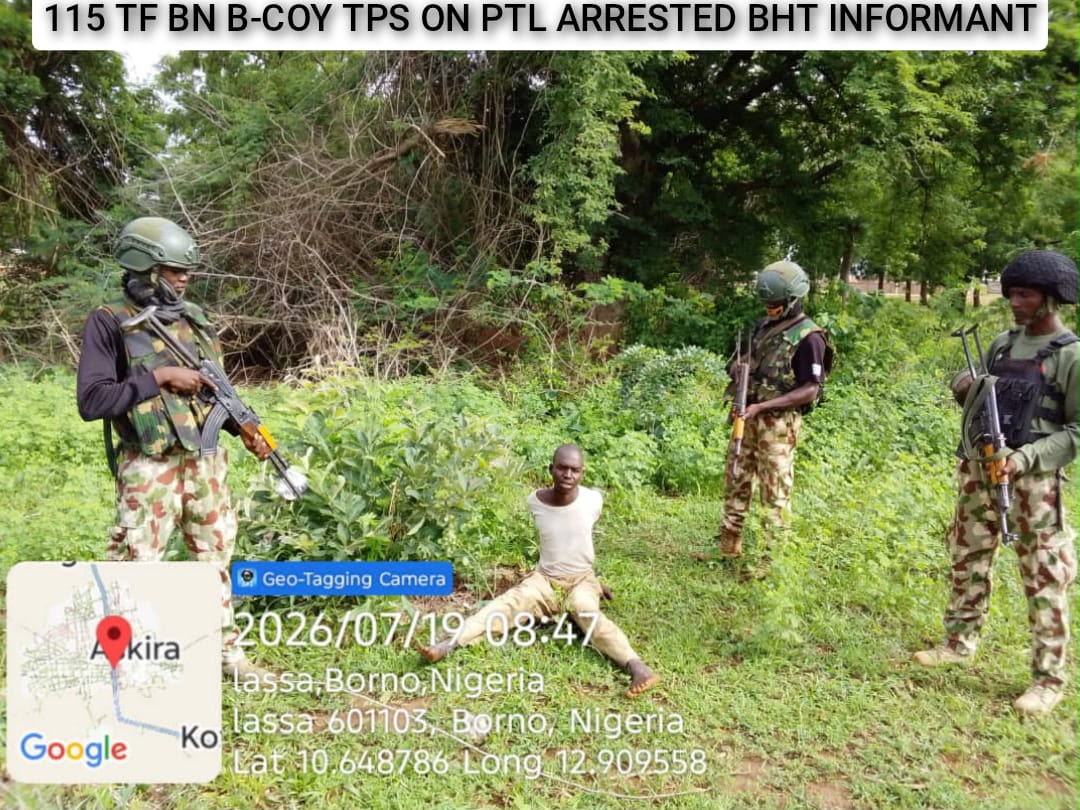
Troops of Operation HADIN KAI have arrested a man suspected to be a foreign terrorist fighter alongside a woman who claimed to be an illegal immigrant during a security operation in Askira/Uba Local Government Area of Borno State.
Sources told Zagazola Makama that the suspects were apprehended at about 11:48 a.m. on July 19 by troops of the 115 Task Force Battalion operating in the Lassa–Dilli general area.
According to the sources, the first suspect, identified as Musa Fashir, 32, is alleged to be a Sudanese national suspected of having links to terrorist elements operating in the North-East.
The second suspect, identified as Mary Florence, 36, reportedly claimed during preliminary questioning to be an illegal immigrant from Ghana.
Both suspects are currently in military custody and are undergoing preliminary investigation to verify their identities, immigration status and any possible links to terrorist activities.
Military sources said further details would emerge as investigations progress, adding that the operation forms part of sustained efforts by Operation HADIN KAI to disrupt terrorist networks, identify foreign fighters and strengthen border security across the North-East.
Troops arrest suspected foreign terrorist fighter, alleged illegal immigrant in Borno
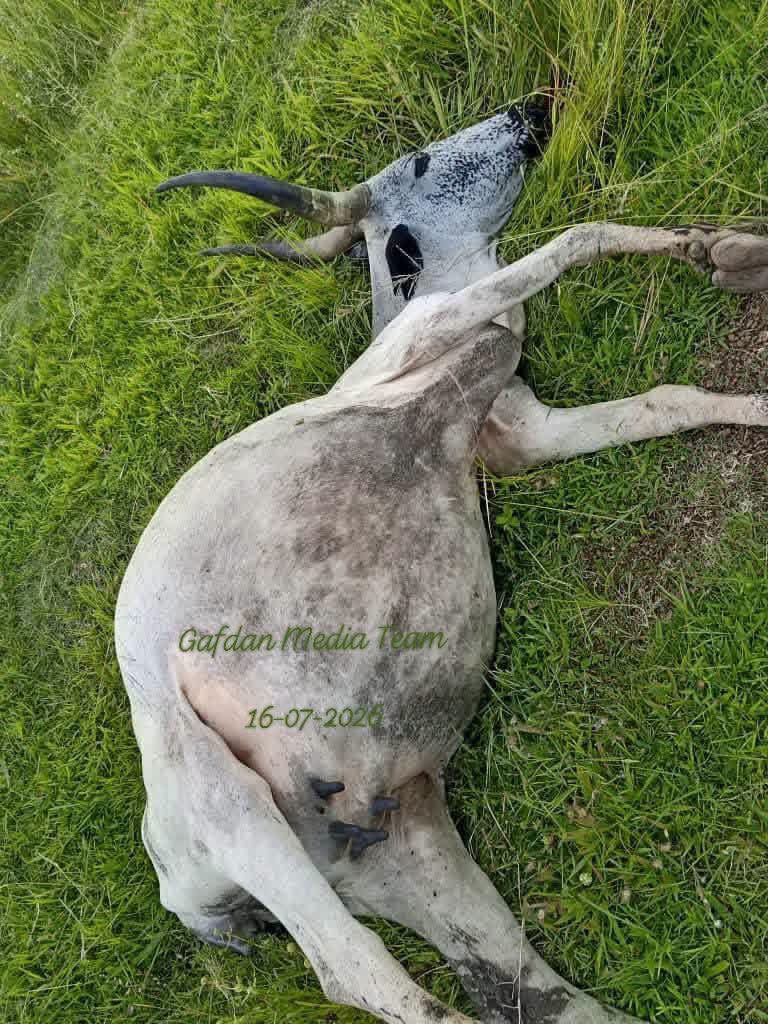
Suspected Berom Militia Shoot Eight Cattle in Attack on Herdsman in Plateau
By Zagazola Makama
Suspected Berom Militia have attacked a herder and his livestock in Nyerwie Village, Barkin Ladi Local Government Area of Plateau State, leaving eight cattle with gunshot wounds.
Sources told Zagazola Makama that the incident occurred at about 6:25 p.m. on July 16, prompting troops of Sector 4, Operation SAFE HAVEN (OPSH), to swiftly mobilise to the scene following a distress report.
However, the assailants fled before the arrival of the troops, evading arrest.
Security sources said preliminary findings indicated that the attackers opened fire on the herd, inflicting gunshot wounds on eight cows. No human casualty was reported during the incident.
Troops have since intensified efforts to track down and apprehend the fleeing suspects, while security has been reinforced in the area to prevent further escalation.
The military urged residents to remain calm and cooperate with security agencies by providing credible information that could assist in the arrest of those responsible for the attack.
Suspected Berom Militia Shoot Eight Cattle in Attack on Herdsman in Plateau

NIMC Seals Strategic Partnerships with Women Affairs Ministry, BOI to Deepen Digital Identity, Financial Inclusion

Inside Katsina’s Forgotten School: Over 1,000 Students Learn on Bare Ground as Billion-Naira Education Budgets Fail Maidabino

Breaking: DSS Rescues Four Remaining Kidnapped Polytechnic Students

Roger Federer’s Shock as DNA Results Reveal Myla and Charlene Are Not His Biological Children

THE PLIGHT OF FARIDA

FAILED COUP IN BURKINA FASO: HOW TRAORÉ NARROWLY ESCAPED ASSASSINATION PLOT AMID FOREIGN INTERFERENCE CLAIMS
-
 News2 years ago
Roger Federer’s Shock as DNA Results Reveal Myla and Charlene Are Not His Biological Children
-
Opinions4 years ago
THE PLIGHT OF FARIDA
-
 News1 year ago
FAILED COUP IN BURKINA FASO: HOW TRAORÉ NARROWLY ESCAPED ASSASSINATION PLOT AMID FOREIGN INTERFERENCE CLAIMS
-

 News2 years ago
EYN: Rev. Billi, Distortion of History, and The Living Tamarind Tree
-
 Opinions5 years ago
POLICE CHARGE ROOMS, A MINTING PRESS
-

 ACADEMICS2 years ago
A History of Biu” (2015) and The Lingering Bura-Pabir Question (1)
-

 Columns2 years ago
Army University Biu: There is certain interest, but certainly not from Borno.
-

 Politics1 year ago
2027: Why Hon. Midala Balami Must Go, as Youths in Hawul and Asikira/Uba Federal Constituency Reject ₦500,000 as Sallah Gift
