
Crime
NDLEA Opens 24/7 Call Centre to Assist People with Drug Related Issues

NDLEA Opens 24/7 Call Centre to Assist People with Drug Related Issues
By: Michael Mike
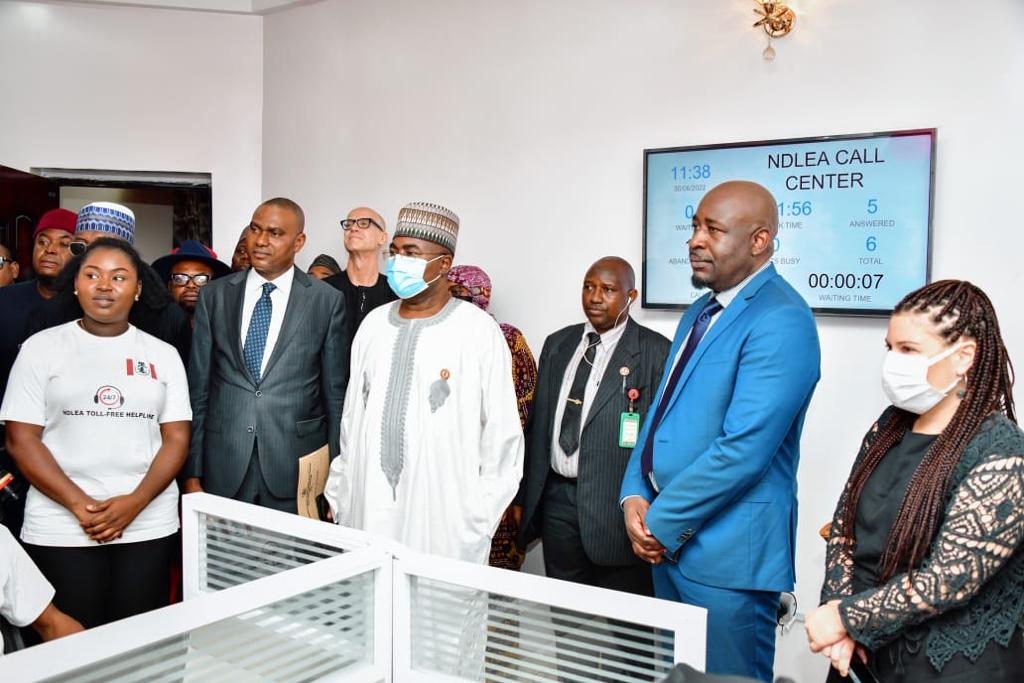
Chairman/Chief Executive of the National Drug Law Enforcement Agency (NDLEA), Brig. Gen. Buba Marwa (Retd) has commissioned a modern 24/7 call centre set up to attend to Nigerians from all parts of the country with needs on drug related issues.
Speaking at the commissioning, Marwa said that drug users and addicts no longer have excuse not to seek treatment with the commissioning of the modern 24/7 call centre set up to attend to Nigerians from all parts of the country.
The NDLEA call centre with toll free helpline is manned by professionals and experts in counselling, psychotherapy, psychology and psychiatry among others.
According to Marwa, “the provision of this toll-free helpline is a milestone in our resolve to broaden access to quality health care for drug users in the country. This has become a necessity and a strategic intervention in our determined effort to bring under control the increasing cases of drug use disorder and related health concerns.”
He said though the country has treatment centres, while NDLEA has 26 treatment facilities across its commands, they are nevertheless grossly inadequate in the face of statistics of drug users and those suffering from drug use disorder
Also Read: Dabiri-Erewa Demands Justice and Arrest of Killers of…
He said: “NDLEA recognised the importance of providing a safety bubble for users who ordinarily cannot access the conventional treatment services at established rehabilitation centres due to poverty, social stigma and the resultant discrimination attached to being an identified drug user in society, among other factors. Therefore, the inevitability and the utility of a toll-free helpline that guarantees anonymity, confidentiality and safety, as a motivation for those in need of health help to freely seek such.”
He noted that: “The NDLEA Call Centre is manned by a team of licensed and credible clinical psychologists, counsellors, support workers and mental health professionals who would provide the needed support in aiding recovery, managing social and emotional problems, improving quality of life and enhancing performance and productivity of the users of the service. With its state-of-the-art equipment and its team of highly trained professionals in substance abuse disorder, this centre offers a teletherapy service according to global best practices.”
He disclosed that: “The benefit of the Call Centre is manifolds. Aside from helping us in providing telephone-based psychosocial support and addiction services in the War Against Drug Abuse (WADA), it will at the same time provide us with information that will deepen our understanding of the country’s dynamics of drug use and potentially put us ahead of the game.”
He said: “To those in need of help, we open a new chapter today, whereby help is just a phone call away. We have simplified the helpline service by making it language-sensitive whereby callers have the choice of language including English, Pidgin, Hausa, Yoruba and Igbo. And very importantly, the helpline is open 24/7. A call to the helpline, 0800 1020 3040, elicits a prompt response from professionals, regardless of the time or geographic location.
“The calls open the door to engagements with counsellors, followed by service orientation that leads to case management, at which point the engagement moves from telephone assessment to follow-up therapy sessions and referral. This seamless process ends in Resolution and Aftercare Follow-Up. Given the simplicity of the process, there is no valid excuse for not accessing treatment by drug users and their concerned families. We expect those concerned to take advantage of this opportunity.”
In their remarks at the event, Attorney General of the Federation and Minister of Justice, Abubakar Malami, SAN represented by the Director of Public Prosecution of the federation, Muhammed Abubakar; UNODC country representative, Oliver Stolpe and European Union delegation representative, Eleni Zerzerlidou commended the NDLEA for the initiative, while calling for its expansion and sustenance.
The Chief Executive of the company managing the centre, Primly Services Ltd, Dr. Vincent Udenze commended Marwa for providing the leadership that made the initiative a reality.
NDLEA Opens 24/7 Call Centre to Assist People with Drug Related Issues


Freed victims expose evolving logistics, coercion tactics of terrorists in Kainji forest
By: Zagazola Makama
Fresh revelations by two freed abductees have shed light on the growing sophistication of terrorist logistics and control mechanisms within the Kainji Forest Reserve, raising concerns over the scale of insurgent entrenchment in the area.
The victims, identified as Badiyu Hamidu and Saminu Isah, regained their freedom and arrived in Babanna at about 1100hrs, providing what security analysts describe as “critical human intelligence” on insurgent operations.
According to their account, no fewer than 10 trucks conveying grains, yams, and other farm produce were offloaded at a terrorist camp deep within the forest. The scale of the supplies, analysts say, points to an organised logistics chain capable of sustaining prolonged insurgent activity.
More striking, however, is the reported use of abducted civilians to support these operations. The victims said they were compelled at gunpoint to assist in offloading the supplies, highlighting a pattern of forced labour increasingly adopted by terrorist groups to reduce exposure and maintain operational secrecy.
The presence of young boys guarding the supply operation further underscores concerns about the continued recruitment and use of minors in insurgent activities, a development experts warn could deepen the cycle of radicalisation in affected communities.
The narrative of “betrayal” advanced by the terrorists against fleeing communities also offers insight into the evolving relationship between armed groups and local populations. According to the victims, the insurgents claimed to have previously granted locals access to restricted economic activities such as farming, fishing, mining, and logging within the forest, despite government prohibitions.
This was interpreted as a form of shadow governance, where terrorist groups create informal economic systems to win local cooperation or compliance. However, the backlash against communities attempting to flee suggests a shift towards coercion as military pressure intensifies.
“The accusation of betrayal indicates that these groups are losing voluntary support and are now resorting to intimidation to retain control,” sources noted.
The development also illustrates the strategic importance of the Kainji forest corridor, which has increasingly emerged as a hub for criminal and insurgent activities, partly due to its difficult terrain and limited state presence.
The reported stockpiling of food and supplies may be linked to preparations for sustained resistance against ongoing and anticipated counter-terrorism operations in the region.
Freed victims expose evolving logistics, coercion tactics of terrorists in Kainji forest
Crime
NDLEA Foils Drug Smuggling Attempts at Lagos Airport, Seizes Large Consignments Across Nigeria

NDLEA Foils Drug Smuggling Attempts at Lagos Airport, Seizes Large Consignments Across Nigeria
By: Michael Mike
Operatives of the National Drug Law Enforcement Agency (NDLEA) have intercepted multiple consignments of illicit drugs concealed in unusual ways, including inside carton walls, winter jackets and body cream containers, at the Murtala Muhammed International Airport and a courier company in Lagos.
The anti-narcotics agency also reported major seizures and arrests during coordinated operations across several states including Kano State, Kaduna State, Edo State, Oyo State, Federal Capital Territory, Taraba State and Adamawa State.
According to the spokesman of the agency, Femi Babafemi, desperate attempts by drug trafficking organisations to smuggle opioids and methamphetamine to European countries were thwarted through intelligence-led operations.
He said in a statement on Sunday that at the Lagos airport, NDLEA operatives arrested 37-year-old Friday Ehianuka last Friday,, while attempting to board an Ethiopian Airlines flight to Rome. A search of his luggage uncovered 2,698 pills of tramadol 225mg concealed inside containers of skin-lightening body cream.
Ehianuka, who resides in Milan, was said to have admitted he was promised payment in euros if he successfully delivered the drugs.
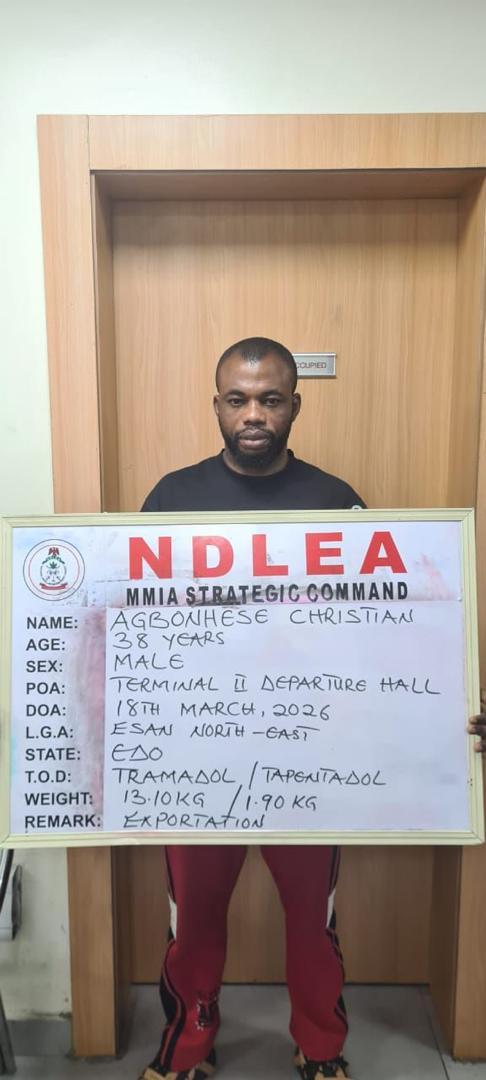
In another operation on March 18, NDLEA officers at the departure hall of the airport intercepted Christian Agbonhese, 38, who was preparing to board a Lufthansa flight to Milan. A thorough search of his luggage revealed 28,470 pills of opioids hidden inside two large winter jackets. The seized drugs included 23,150 pills of tramadol 225mg, 4,000 tablets of tapentadol 250mg and 1,320 pills of tramadol 100mg.
Elsewhere in Lagos, NDLEA operatives at a courier firm intercepted two parcels containing one kilogramme of “Loud,” a potent strain of cannabis shipped from the United States to Nigeria. Another parcel containing 158 grammes of methamphetamine concealed in the walls of a carton and destined for New Zealand was also seized.
In Kano, two suspects were arrested on March 18 with large quantities of skunk, a strong cannabis strain. Abdulkadir Mamuda, 35, was apprehended at Dan-Tsalle with 102.5 kilograms of the substance, while Uche Festus, 47, was arrested at Naibawa Gabas with 95.5 kilogrammes.
A raid in the Otto area of Ijora in Lagos led to the recovery of 21,737 bottles of codeine-based syrup, while two suspects — Chidiebere Anigbogu and Paul Nwagbara — were arrested on the Third Mainland Bridge with 8,380 bottles of the same substance.
In Edo State, NDLEA operatives recovered 97.5 kilogrammes of skunk from the residence of Akeem Idde, 37, in Ojah, Akoko-Edo Local Government Area.
Similarly, officers in Abuja intercepted a commercial bus along the Gwagwalada Expressway, recovering 91,840 pills of tramadol hidden inside the vehicle’s body compartments. The driver, 27-year-old Aminu Ali, was taken into custody.
In Oyo State, a suspect identified as Bankole Bari was arrested on March 17 at Oke-Oyan in Ibarapa Local Government Area with 71.2 kilogrammes of skunk believed to have been smuggled into Nigeria from Benin through the Oyan River.
Further seizures were recorded in Kaduna State where NDLEA operatives recovered 586,000 pills of tramadol and Exol-5 from Lawal Anas along the Kaduna–Zaria highway. Another suspect, Musa Shuaibu, was arrested at the same location with 7,290 tablets of tramadol 225mg.
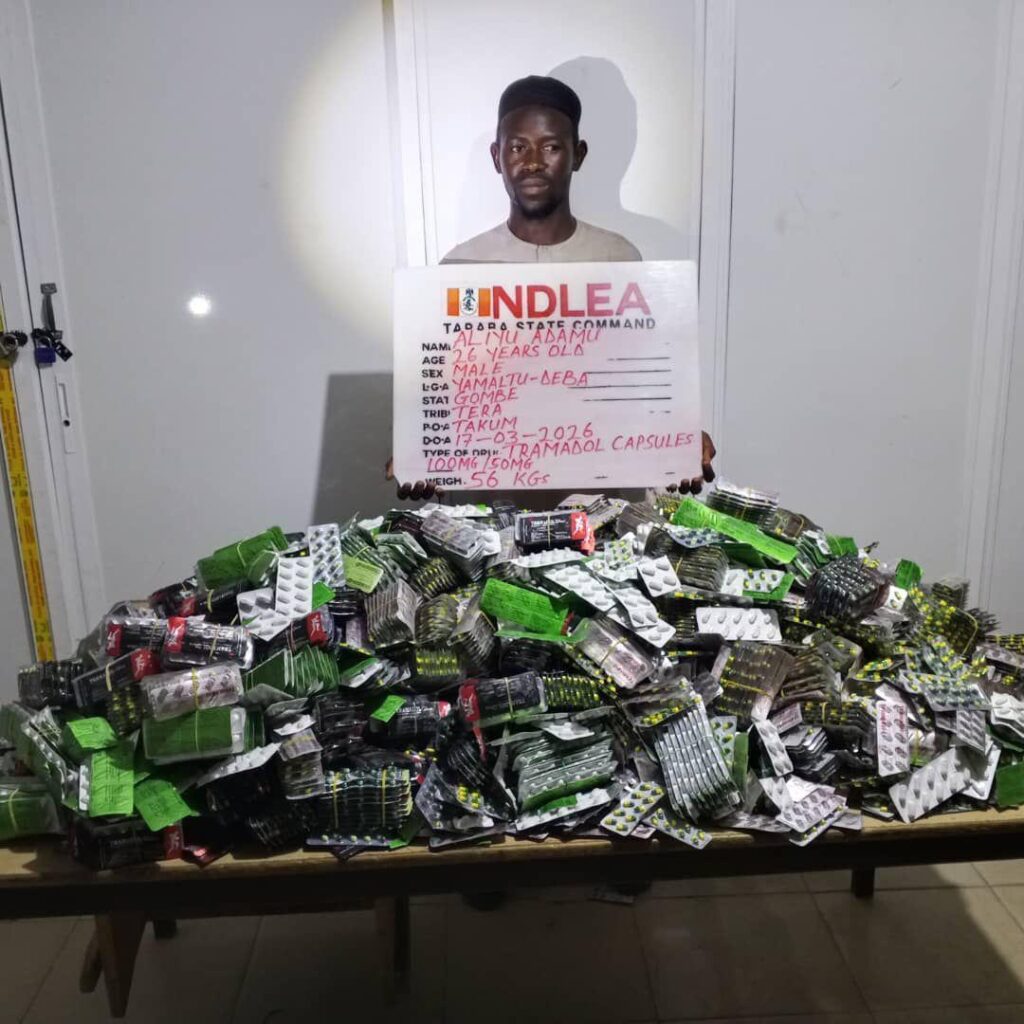
In Taraba State, NDLEA officers intercepted Aliyu Adamu along the Takum–Jalingo highway with 77,660 capsules of tramadol being transported to Gombe State.
Meanwhile, in Yola, six suspects were arrested in connection with the seizure of 82.8 kilograms of tramadol concealed in a truck. Those arrested include Ramatu Aliyu, Jungudo Abdullahi, Najid Abdullahi, Musa Mohammed, Usman Abdulrahim and Musa Mohammed.
Beyond enforcement operations, the NDLEA said it also intensified its War Against Drug Abuse (WADA) sensitisation campaigns across schools and communities nationwide.
Chairman and Chief Executive Officer of the NDLEA, Brig. Gen. Buba Marwa (Rtd.) commended officers of the agency’s commands involved in the arrests and seizures. He urged them to sustain the balanced strategy of enforcement and public sensitisation in tackling drug abuse and trafficking across the country.
NDLEA Foils Drug Smuggling Attempts at Lagos Airport, Seizes Large Consignments Across Nigeria
Crime
Armed Mob Led By “Bullet” Storms Aboh Ogwashi-Uku, Attacks Police Officers, Destroys Property Amid Ongoing Federal Court Case
Armed Mob Led By “Bullet” Storms Aboh Ogwashi-Uku, Attacks Police Officers, Destroys Property Amid Ongoing Federal Court Case
Aboh Ogwashi-Uku, Delta State —
Pandemonium broke out yesterday in Aboh Ogwashi-Uku as a violent group of attackers alleged to be from Ibusa descended on the community in a coordinated assault that left residents injured, properties destroyed, and a serving police officer seriously wounded.
Eyewitness accounts and security sources confirmed that the attack was led by one Lucky Abuah, popularly known as “Bullet,” described by law enforcement authorities as a repeat offender and a person of interest in multiple violent incidents across jurisdictions.
The attackers reportedly invaded the area in broad daylight, unleashing violence on residents and damaging structures before security forces responded.
Swift intervention by officers from the Ogwashi-Uku Area Command and reinforcements from the Delta State Police Headquarters, Asaba, brought the situation under control after an intense confrontation.
The attackers were eventually repelled, restoring a tense calm to the area.
Police sources disclosed that Lucky Abuah is already wanted by authorities in Abuja in connection with similar violent activities, and that criminal charges bordering on aggravated assault and grievous harm have been filed against him at the Delta State High Court.
A senior community leader, Chief Ralph Okafor, reacting to the incident, condemned the attack in strong terms, describing Abuah and his associates as “notorious land grabbers” who have repeatedly carried out violent incursions into neighbouring communities.
“This is not an isolated incident. These individuals have a pattern of using violence and intimidation to push false claims. What happened in Aboh Ogwashi-Uku is a clear example of lawlessness that must be decisively addressed,” he stated.
The attack comes at a highly sensitive time, coinciding with the commencement of proceedings at the Federal High Court in Abuja on March 18, 2026, before Honourable Justice Omotosho, concerning the proper name and legal location of Admiralty University.
Members of the Ogwashi-Uku community maintain that the institution is situated within Ogwashi-Uku Kingdom in Aniocha South Local Government Area, and not in Oshimili North, stressing that local government boundaries are constitutional matters that cannot be altered arbitrarily or by administrative claims.
According to community sources, the recognized boundary between Ibusa (Oshimili North) and Ogwashi-Uku lies several kilometers away from the university’s actual location, and the matter is now squarely before the Federal High Court for judicial determination.
Observers have raised concerns that the violent incident may not be unconnected with attempts by certain elements to preempt or influence ongoing judicial proceedings through intimidation and public pressure.
There are also growing criticisms of calls from some Ibusa figures urging government intervention in a matter already pending before competent courts, a move legal experts describe as a dangerous encroachment on judicial independence.
Chief Okafor further dismissed claims circulating in some quarters about a purported 1986 Supreme Court judgment allegedly settling the boundary dispute, describing such assertions as “false, misleading, and legally untenable.”
“The Delta State Government does not execute court judgments. It is the courts that enforce their decisions through due process. How can anyone suddenly resurrect a supposed judgment from forty years ago, which did not even address boundary issues, and attempt to use it to justify present-day claims? It is completely absurd,” he said.
He emphasized that the actual boundary dispute between the two communities is currently before the Delta State High Court, presided over by Honourable Justice Obi, and urged all parties to respect the judicial process.
“No amount of intimidation, propaganda, or violent grandstanding will alter the facts before the court. Ogwashi-Uku will not be bullied or pushed around by fabricated claims,” he added.
The latest development sharply contradicts recent narratives from Ibusa representatives portraying the community as peaceful and law-abiding, raising serious questions about the credibility of such claims in light of the violent events in Aboh Ogwashi-Uku.
Security has since been reinforced in the affected areas, while residents remain on edge, calling on authorities to ensure the immediate arrest and prosecution of those responsible.
As tensions continue to rise, all eyes are now on both the Federal High Court in Abuja and the Delta State High Court in Asaba, where the legal battles over boundary and institutional identity are expected to provide definitive answers.
For many observers, however, one thing is clear — the rule of law, not violence, will determine the true ownership and identity of the disputed territory.
Armed Mob Led By “Bullet” Storms Aboh Ogwashi-Uku, Attacks Police Officers, Destroys Property Amid Ongoing Federal Court Case

Minister of Agriculture, Senator Abubakar Kyari: The Unassailable Choice for APC Candidate in Borno State

Nigeria Launches Unified Framework to Tackle Humanitarian Crises and Poverty

One Week After Black Monday in Maiduguri, Police Headquarters Count Losses

Roger Federer’s Shock as DNA Results Reveal Myla and Charlene Are Not His Biological Children

THE PLIGHT OF FARIDA

FAILED COUP IN BURKINA FASO: HOW TRAORÉ NARROWLY ESCAPED ASSASSINATION PLOT AMID FOREIGN INTERFERENCE CLAIMS
-
 News2 years ago
Roger Federer’s Shock as DNA Results Reveal Myla and Charlene Are Not His Biological Children
-
Opinions4 years ago
THE PLIGHT OF FARIDA
-
 News11 months ago
FAILED COUP IN BURKINA FASO: HOW TRAORÉ NARROWLY ESCAPED ASSASSINATION PLOT AMID FOREIGN INTERFERENCE CLAIMS
-

 News2 years ago
EYN: Rev. Billi, Distortion of History, and The Living Tamarind Tree
-
 Opinions4 years ago
POLICE CHARGE ROOMS, A MINTING PRESS
-

 ACADEMICS2 years ago
A History of Biu” (2015) and The Lingering Bura-Pabir Question (1)
-

 Columns2 years ago
Army University Biu: There is certain interest, but certainly not from Borno.
-

 Opinions2 years ago
Tinubu,Shettima: The epidemic of economic, insecurity in Nigeria
