
Uncategorized
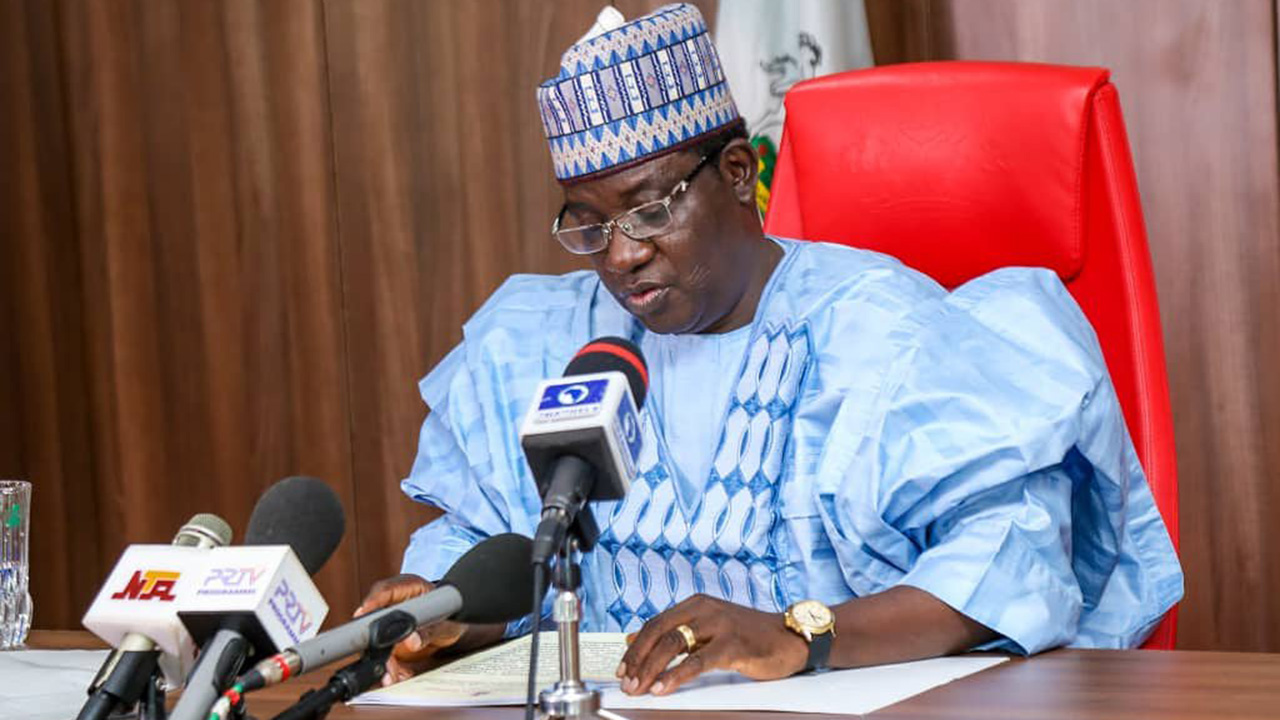
Nigeria: Governor Lalong relaxes curfew in Jos

Nigeria: Governor Lalong relaxes curfew in Jos
Governor Simon Bako Lalong of Plateau State in North Central Nigeria has relaxed the 24-hour curfew earlier imposed on Jos North Local Government on Sunday following the killings of 25 travelers along Rukuba road in the capital.
A statement from the Director of Press to the governor, Dr. Makut Simon made available to Newsmen on Wednesday, under the new arrangement, the curfew will be observed from 6 pm to 6 am daily beginning from Thursday 19th August 2021. This will also apply to Bassa and Jos South Local Government Areas until further notice.
The decision was reached after the State Security Council meeting held at the Government House Rayfield on Wednesday, 18th August 2021 where the Governor received briefings from the heads of security agencies and also reviewed the situation.
In relaxing the curfew, Governor Simon Lalong warned trouble makers to desist from threatening lives and properties of citizens or be ready for a showdown with security forces who have been directed to be tough with anyone causing a breach of the peace.
He expressed outrage over what he called the desperation of criminals bent on causing mayhem in the State, as there were isolated attacks that led to the loss of lives and destruction of properties in some areas of Jos North and Bassa LGAs during the curfew.
Read Also: Inside Bingham University
While the curfew is relaxed in Jos North, security agencies will mount permanent checkpoints in highly vulnerable areas; deploy more uniform and plainclothes personnel, and also observe the conduct of citizens round the clock.
The Governor also reiterated that the prohibition on processions was still in force and anyone found violating the order will be dealt with according to the law.
The Governor appreciated the cooperation of law-abiding citizens and urged them to continue to support the Government to deal with the situation and restore normalcy to the affected areas and the State at large.
He urged parents and community leaders to prevail on their wards to maintain peace as the Government does not want to be forced to always resort to curfews which affect the economy and freedom of the people and the State as a whole.



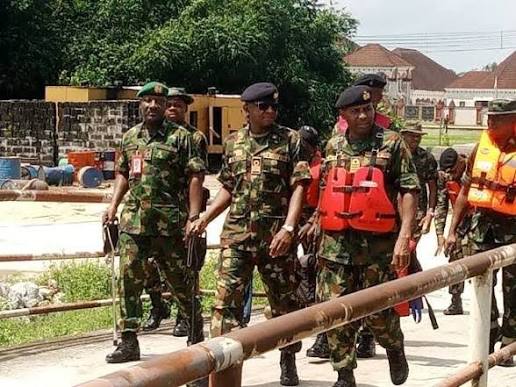
Troops arrest suspect with 75 live cartridges in Awka, Anambra
By: Zagazola Makama
Troops of Sector 5 Operation UDO KA have arrested a suspected criminal in Awka, Anambra State, and recovered 75 live cartridges in his possession.
Security sources said the arrest was made at about 7:00 a.m. on April 5, 2026, during a routine operation in the state capital.
The suspect was allegedly found with the ammunition concealed in his bag at the time of arrest.
During preliminary questioning, the suspect claimed he received the cartridges from a friend, while efforts are ongoing to identify and track the source of the consignment.
Authorities said the suspect is currently in custody as investigations continue.
Troops arrest suspect with 75 live cartridges in Awka, Anambra
Troops uncover illegal crude oil storage facility in Ahoada West forest in Rivers
By: Zagazola Makama
Troops of Joint Task Force, South-South, Operation DELTA SAFE, have uncovered an illegal crude oil storage site in the Orashi National Forest in Ahoada West Local Government Area of Rivers State.
Security sources said the discovery was made at about 9:00 a.m. on April 4, 2026, during an anti-illegal bunkering operation conducted by troops deployed at Aminigboko, alongside personnel of 103 Battalion and 16 Brigade Garrison.
During the operation, troops reportedly found two long galvanized pipes estimated at about 500 metres each, two hoses approximately 50 metres long, and a large reservoir containing stolen crude oil estimated at about 15,000 litres.
The recovered items were handled in line with the directives of Operation DELTA SAFE. Authorities said efforts are ongoing to identify and dismantle other illegal bunkering networks in the area.
Troops uncover illegal crude oil storage facility in Ahoada West forest in Rivers
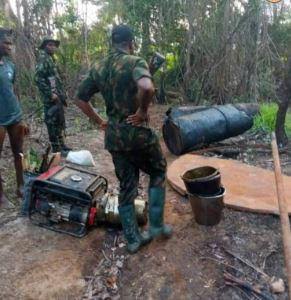
Troops and Tantita operatives arrest 2 suspected oil bunkerers, recover AGO in Delta
By: Zagazola Makama
Troops of 181 Amphibious Battalion, in collaboration with Tantita Security Services operatives, have arrested two suspected illegal oil bunkerers in Ndokwa West Local Government Area of Delta State.
Security sources said the suspects were apprehended at about 9:25 a.m. on April 4, 2026, around the Transpalodec Hotel junction in Kwale, following intelligence on their alleged activities.
Preliminary investigations indicated that the suspects had been on the watchlist of suspected bunkerers operating within the Kwale axis and were under surveillance prior to their arrest.
Items recovered from them included about 60 litres of Automotive Gas Oil (AGO), 32 sacks, and four mobile phones.
The suspects and recovered items were handed over to the Nigerian Police, Kwale Division, for further investigation and possible prosecution.
Troops and Tantita operatives arrest 2 suspected oil bunkerers, recover AGO in Delta

Berom militia kill Fulani herder in Riyom as tit-for-tat violence escalates in Plateau

Political Landscape Shifts as Yobe South Mobilizes for 2027 Elections Amid Marginalization Concerns

FG Directs MDAs to Halt New Policies Pending Full RIA Compliance

Roger Federer’s Shock as DNA Results Reveal Myla and Charlene Are Not His Biological Children

THE PLIGHT OF FARIDA

FAILED COUP IN BURKINA FASO: HOW TRAORÉ NARROWLY ESCAPED ASSASSINATION PLOT AMID FOREIGN INTERFERENCE CLAIMS
-
 News2 years ago
Roger Federer’s Shock as DNA Results Reveal Myla and Charlene Are Not His Biological Children
-
Opinions4 years ago
THE PLIGHT OF FARIDA
-
 News12 months ago
FAILED COUP IN BURKINA FASO: HOW TRAORÉ NARROWLY ESCAPED ASSASSINATION PLOT AMID FOREIGN INTERFERENCE CLAIMS
-

 News2 years ago
EYN: Rev. Billi, Distortion of History, and The Living Tamarind Tree
-
 Opinions4 years ago
POLICE CHARGE ROOMS, A MINTING PRESS
-

 ACADEMICS2 years ago
A History of Biu” (2015) and The Lingering Bura-Pabir Question (1)
-

 Columns2 years ago
Army University Biu: There is certain interest, but certainly not from Borno.
-

 Opinions2 years ago
Tinubu,Shettima: The epidemic of economic, insecurity in Nigeria
