
Military
Reuters’ mercenary journalism and Nigerian Military

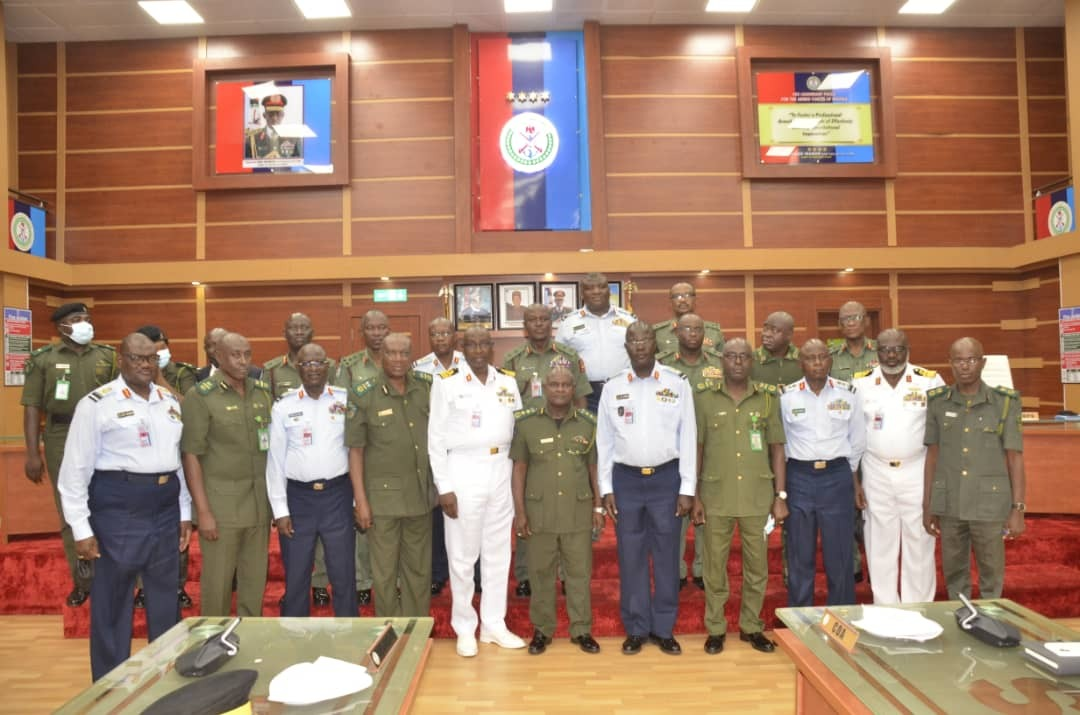
Reuters’ mercenary journalism and Nigerian Military
By: JIMMY AKPOR
Reuters, an international news agency, now part of Thomson Reuters, wrote that it was working on a series of stories about purported actions of the Nigerian military during the government’s 13-year war against Islamist insurgents in the country’s North East. To them, they were committed to producing an accurate, fair and complete report hence, their request to arrange a time to discuss before their reporting. The supposed stories were purported to focus on 2 specific areas: First, supposed military-run programme of forced abortions performed on women and girls who were held captive and impregnated by Islamist militants and second, a supposed killing of children by the military as part of counterinsurgency operations.
The Reuters report was to also allege that, since 2013, Nigeria’s military had run a secret, systematic and illegal abortion programme in the country’s North East terminating at least 12,000 pregnancies among women and girls. That, many children were shot, poisoned, suffocated or run down by vehicles in army-led actions. Furthermore, the report was to allege that soldiers selected babies and toddlers for killing after rescuing them and their mothers from Islamist militants, amongst other weighty concocted allegations. The key motive for supposedly carrying out the abortions was allegedly the notion that the children of Islamist militants, because of the blood in their veins, would one day follow in their father’s footsteps and take up arm against the Nigerian Government and society.
Hmmm! Wickedness really runs in the veins of some people and it surely runs deep in the veins of the Reuters team that concocted such evil for interrogation. The fictitious series of stories actually constitute a body of insults on the Nigerian peoples and culture for, no people or culture in Nigeria practices such evil as dreamt up by the Reuters team. Irrespective of the security challenges we face as a nation, Nigerian peoples and cultures still cherish life. Hence, Nigerian military personnel have been raised, bred and further trained to protect lives, even at their own risk especially, when it concerns the lives of children, women and the elderly. This much is reflected in Standing Operating Procedures (SOPs), Concepts of Operations, Rules of Engagements (ROEs) and other documents that guide military operations. Hence, nowhere has the Nigerian military operated (Congo, Liberia, Sierra Leone, Somalia, Rwanda, Yugoslavia, [Darfur] Sudan, Gambia and Guinea Bissau, amongst others) that, there has been any trace or allegation of infanticide. The Nigerian military will not therefore, contemplate such evil of running a systematic and illegal abortion programme anywhere and anytime, and surely not on our own soil. The Nigerian military will not also deliberately plan to target children during its counterinsurgency operations or other operations, both within and outside Nigeria.
The Reuters team must have been schooled in, and have now become proponents of scorched-earth and inhuman policies employed by colonialists during the colonial era and during the battles for independence in Indo-China, Malaysia, Algeria and other places. Villages and crops were burnt. Children, women, elderly, the innocent were killed in systematic and inhuman programmes. Nigerians, and by extension Nigerian military, are not made in such wicked mould, and the Reuters team cannot appropriate the evil of infanticide to the Armed Forces of Nigeria and the Nigerian peoples.
But, let’s interrogate the issues. It took Reuters 13 solid years to craft an allegation of infanticide against the Nigerian military and the Nigerian nation. This shows that a news agency as ‘renown’ as Reuters is itself complicit for failing in its mandate to draw attention, to inform the publics about supposed occurrences that offend not only the laws of armed conflict but also international humanitarian law.
Let us analyze the period from July 2021 till November 2022. A total of 82,064 Boko Haram fighters with members of their families have surrendered to troops of Op HADIN KAI. Out of this number, 16,553 were active male fighters, 24,446 were women while 41,065 were children. The Borno State Government is camping and accommodating them family-by-family, as per households, without having to separate the children from their parents. In the same camp are thousands of pregnant women and nursing mothers. A total of 262 babies were born within a period of 4 months (94 in July, 98 in August, 60 in September and 11 in October 2022). This figure comprises 150 female and 112 male children. The children were neither aborted nor yanked from their mothers and killed, as may have been the joy of Reuters.
Let us now spotlight the rescued Chibok girls who were kidnapped from their school by Boko Haram Terrorists in 2014. A total of 11 of the Chibok girls were rescued this year 2022. Hauwa Joseph with her child, Mary Dauda with her child, and Ruth Bitrus were rescued in June 2022. Troops also rescued Kauna Luka with her child and Hanatu Musa with her 2 children in July 2022. In the same vein, Aisha Grema with her 4 year-old child and Falmata Lawal were rescued in August 2022. Furthermore, Asabe Ali with her child, Jinkai Yama with her 3 children, Yana Pogu with her 4 children and Rejoice Senki with her 2 children were rescued in September and November this year. The names of the rescued girls are in Serials 18, 46, 41, 38, 7, 11, 3, 12, 20, 19 and 70 respectively (in the order of rescue) in the list of the abducted Chibok School girls. The rescued girls were handed over to the Borno State government after their rescue.
A visit to the Rehabilitation Centre accommodating the Chibok girls on 29 November 2022 revealed that, there were 2 other Chibok girls (with their children) recued earlier, making the number of the Chibok girls in the Centre to be 13. Other residents in the facility were children who were rescued by troops unaccompanied (by any adult) or who separated from their parents/relatives due to fog of war. The welfare of the Chibok girls with their children and the unaccompanied children, is a major priority of the Borno State Government. UNICEF is assisting the Centre in tracing the relatives of the Chibok girls as well as those of the unaccompanied/separated children to facilitate reintegration with their communities. If there was any evil, illegal programme to systematically kill the children of Boko Haram terrorists, then the children that the terrorists begat through the Chibok girls would have been prime targets.
The Joint Investigation Centre (JIC) is where captured terrorists (men and women) are being processed, to determine their level of complicity in the heinous crimes committed by the Boko Haram Terrorist group. There were 1,952 persons in the facility, which included 23 women with 11 children who remain attached to their mothers as at 30 November 2022. There is also a medical facility being run by the Centre in collaboration with medical staff of ICRC. The welfare of all the occupants at the JIC is thus highly prioritised, including basic education for the children, tailoring and hat-making skills acquisition for the adults as well as provision of recreational and sporting facilities for all the occupants.
READ ALSO: https://dailypost.ng/2022/12/02/many-iswap-fighters-killed-in-damboa-after-pledging-allegiance-to-new-isis-leader/
Since July 2021 when the Boko Haram terrorists started surrendering with their families in droves, a community-based reintegration process is evolving, involving local traditional leaderships, town councils and family members. The process is made easier due to the fact that most of the surrendered terrorists were actually conscripted from their villages by the core terrorists, whose ranks have been degraded by more than 95 percent. Accordingly, a total of 4,933 recued civilians/surrendered persons (including 1,977 children, 1,423 women and 1,533 men) have been reintegrated with their communities from the camp housing the Chibok girls alone. The children were not taken from their parents and killed; unaccompanied ones were not also rounded up and killed.
A crucial point to note is the fact that, more than 245 United Nations agencies, International NGOs and local NGOs operate in the North East, who are active in the IDP camps and other concentrations of vulnerable peoples. They provide food, medical care and other services in collaboration with the Nigerian and Borno State Governments. But the wickedness of the Reuters team members must have blinded them, shutting them off from the humanitarian realities in the North East of Nigeria. UNICEF, Girl Child Concern, International Medical Corps, Save the Children International, Girl Effect, Concern For Women and Children Development Foundation, International Federation of Women Lawyers, Women and Children’s Right and Peace Building Awareness Initiative, Medicin Sans Frontiers (France, Switzerland, Belgium and Spain) as well as Centre for Protection of Women and Girls are some of the humanitarian organizations operating in the North East. These have direct responsibilities for the welfare of children and/or women in the crisis area. Could the humanitarian community operating in the North East of Nigeria be equally complicit in condoning or supporting infanticide as thought of by Reuters? Could the United Nations Secretary General have commended troops of OP HADIN KAI when he visited Maiduguri recently? Or, is he, himself also complicit for failure to address an organized infanticide in the North East, which exists only in the warped, wicked imagination of the Reuters team?
The history of the Nigerian military dates back to 1863, especially with respect to the Nigerian Army that conducts land operations either as a single Service or in joint operations with other Services or security agencies. So, what metamorphosed into the Nigerian military actually passed through several processes and experiences through the First and Second World Wars as well as a Nigerian Civil War. Contingents of the Nigerian military have also taken part in several UN or regional peace keeping or peace enforcement missions abroad, with honours as mentioned in previous paragraphs. To participate in such missions, Pre-Induction Training and In-Theatre Training are usually carried out vigorously. The protection of civilians especially women, children and the elderly, always formed a major plank of such training sessions.
Military training institutions in Nigeria also focus extensively on Laws of Armed Combat and International Humanitarian Law. Aside all these, Nigerians and the Nigerian military are lovers of children. Nigerian military personnel have thus constantly denied themselves ration, supplies, transport and medicine in order to cater for rescued civilians especially children, women and the elderly. The Nigerian military have grown in leaps and bounds in experience and stature in humanizing operations, even in the most confused and intense operational environment. Hence, it offends the pedigree of the Nigerian military, it offends the Nigerian culture, and it offends honour for Reuters to postulate that the Nigerian military had routinely carried out both small-scale and mass killings of children in its counter-insurgency/counter-terrorism efforts in the North-East of Nigeria.
The Reuters condemnable series of stories can only have arisen from a mentality of “media or Press-bullying”. Reuters is a media company with world-wide reach that sells news to print, electronic and online media outlets. The so-called News Editor for Sub-Saharan Africa, Alexandra Zavis, remains in South Africa and concoct evil lies to insult Nigerian peoples and cultures with allegations of infanticide purportedly being sponsored and carried out by the military and civilian leaderships in North East of Nigeria.
The Reuters’ series of stories are akin to telling the world that Nigerians still live on top of trees. It now seems that the new stock in trade for Reuters is, ‘mining’ and selling lies to demonize Nigerian military, Nigerian institutions and Nigerian leaderships. This new vocation of Reuters is worse than illegal arms trade, worse than hard-drug trafficking, and actually worse than terrorism. The so-called Reuters’ News Editor for Sub-Saharan Africa, Alexandra Zavis, should better retrace her steps, before the founder, Paul Julius Reuter, starts to regret the demonic journalism being practiced by the journalists that he left behind!
***JIMMY AKPOR (Major General) is the
Director Defence Information
Reuters’ mercenary journalism and Nigerian Military


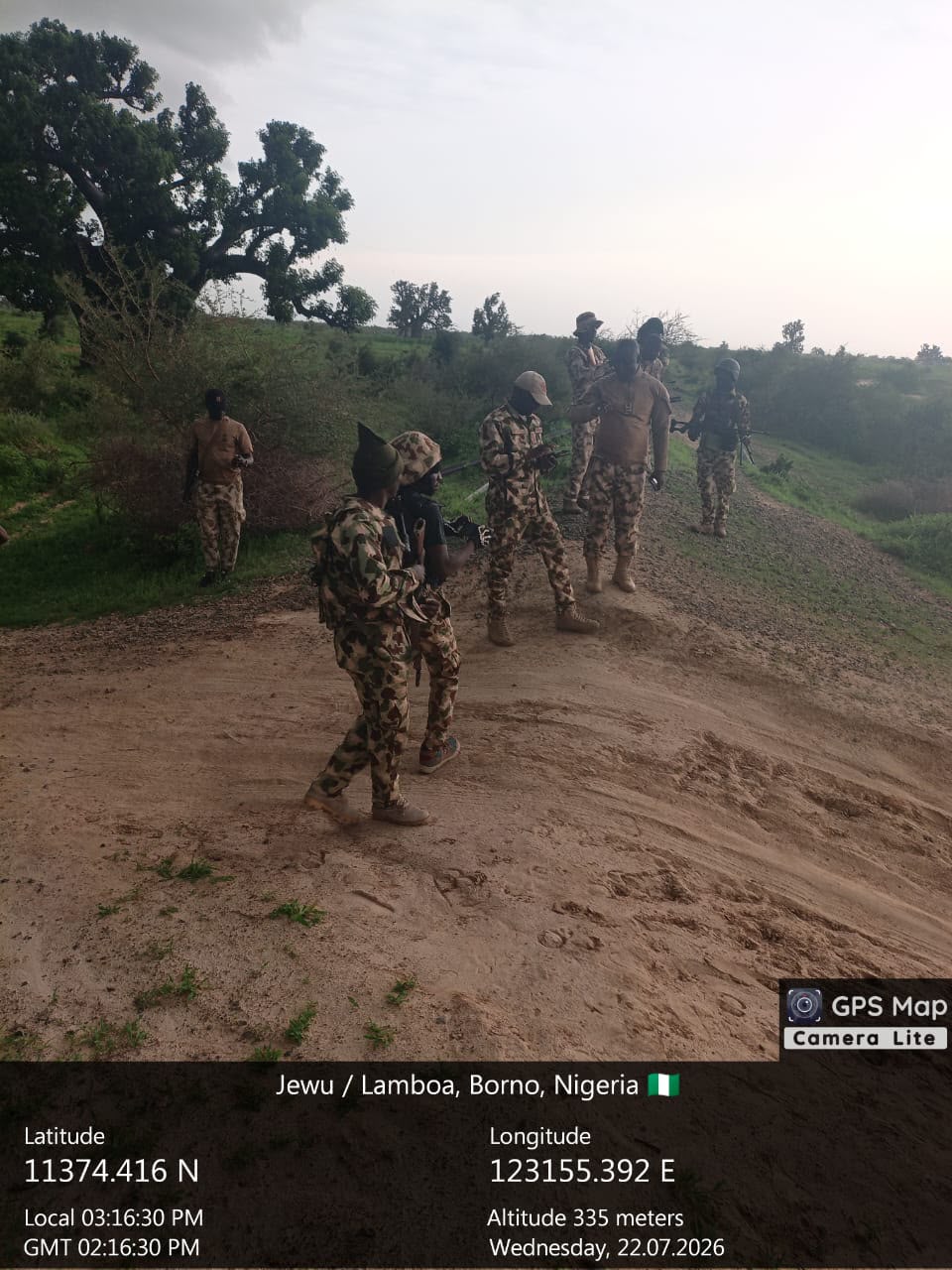
Troops conduct clearance patrol in Borno
By: Our Reporter
Following the clearance mission, the patrol occupied a tactical ambush position along a suspected terrorist route to monitor movement and deter any attempt by insurgents to infiltrate the area.
Military sources described the patrol as hitch-free, adding that troops maintained a high level of vigilance throughout the operation.
The clearance mission forms part of the ongoing Operation Desert Sanity V, which is aimed at sustaining pressure on Boko Haram and ISWAP elements, preventing their return to previously cleared locations, and creating a secure environment for civilian populations to carry out their livelihoods.
Sources added that the general security situation in the area remained calm but fluid, while the morale and fighting efficiency of the troops were reported to be satisfactory.
Troops conduct clearance patrol in Borno
Military
Residents Cheer Troops as Operation FANSAN YAMMA Returns with Captured Terrorists’ Logistics in Zamfara

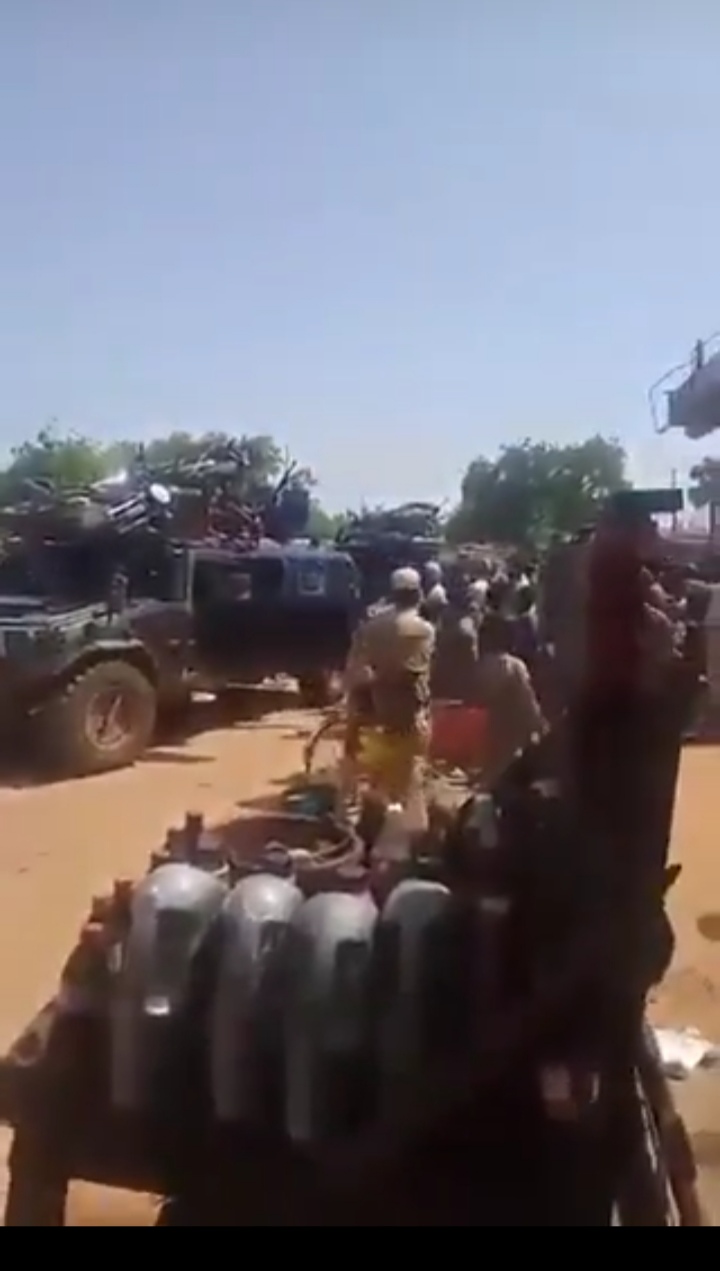
Residents Cheer Troops as Operation FANSAN YAMMA Returns with Captured Terrorists’ Logistics in Zamfara
By Zagazola Makama
Residents of Gummi town in Zamfara State on Thursday poured into the streets to celebrate troops of the Joint Task Force North West, Operation FANSAN YAMMA, following a major operational success against terrorists in the area.
Eyewitnesses said the jubilant crowd gathered as soldiers arrived in town with logistics recovered from terrorists after a successful counter-ambush operation that reportedly left more than 100 terrorists neutralised.
The recovered items, including eight motorcycles used by the armed groups for movement during attacks on communities, were transported on an Armoured Personnel Carrier (APC) to the Headquarters of Operation FANSAN YAMMA in Gummi.
Residents were seen cheering, waving at the troops and applauding their efforts as the convoy entered the military base, with many expressing appreciation for the soldiers’ courage and sacrifices in the ongoing fight against banditry in the North West.
Security sources told Zagazola Makama that the successful operation dealt a significant blow to the criminal networks operating in the area, disrupting their mobility and logistical capabilities.
The spontaneous celebration by residents is seen as a reflection of growing public confidence in the military’s sustained offensive against terrorists and bandits across Zamfara and neighbouring states.
Military authorities reaffirmed that Operation FANSAN YAMMA remains committed to sustaining offensive operations aimed at dismantling terrorist enclaves, denying criminal elements freedom of movement, and restoring lasting peace across the North West.
The Joint Task Force also acknowledged the continued support and actionable intelligence provided by residents, describing community cooperation as critical to the success of ongoing operations.
Residents Cheer Troops as Operation FANSAN YAMMA Returns with Captured Terrorists’ Logistics in Zamfara
Military
Establishment of Army Depot in South-East Reflects FG’s Commitment to National Unity, Security and inclusiveness– COAS
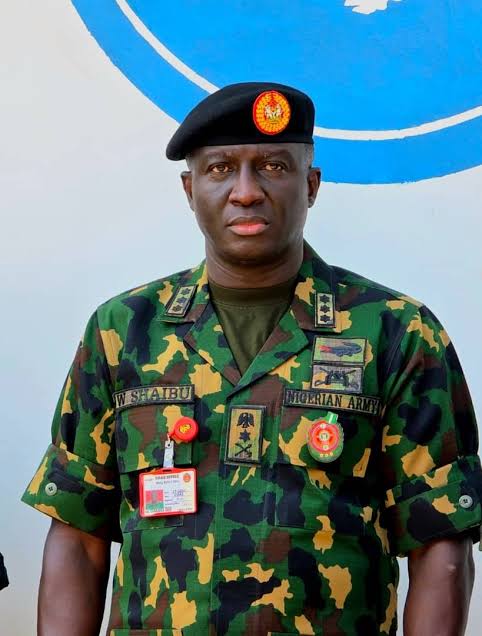
Establishment of Army Depot in South-East Reflects FG’s Commitment to National Unity, Security and inclusiveness– COAS
By Zagazola Makama
The Chief of Army Staff (COAS), Lt.-Gen. Waidi Shaibu, has said that the establishment of the Depot Nigerian Army in Amasiri-Edda, in Ebonyi State is a clear demonstration of the Federal Government’s commitment to national security, inclusiveness, national integration and balanced development across the country.
Shaibu made the remarks while addressing dignitaries during activities marking the inauguration of the newly established military training institution in Abakaliki, Ebonyi State.
According to the Army Chief, the depot, which is the first primary recruit training institution of the Nigerian Army in the South-East geopolitical zone, represents a strategic investment by President Bola Ahmed Tinubu’s administration in strengthening national security and promoting equitable distribution of critical national institutions.
“The establishment of this depot reflects the Federal Government’s commitment to national security, inclusiveness, national integration and balanced development,” Shaibu said.
He described the inauguration of the facility as a landmark achievement in the ongoing transformation of the Nigerian Army under President Tinubu, noting that it would significantly enhance the Army’s capacity to train professionally competent and combat-ready soldiers.
The COAS disclosed that the first set of recruits trained at the new depot would graduate the following day, describing the event as a historic milestone not only for the institution but also for the evolution of recruit training within the Nigerian Army.
“Their graduation will not only mark the successful completion of basic military training but will also usher in a new chapter in the evolution of recruit training in the Nigerian Army,” he said.
Shaibu explained that since its establishment, the depot had steadily developed into a modern recruit training institution designed to produce disciplined, professional and capable soldiers in line with the Nigerian Army’s transformation agenda and long-term strategic vision.
He said the facility forms part of the Federal Government’s broader efforts to modernise the Armed Forces and expand military capacity to address Nigeria’s dynamic security environment.
The Army Chief expressed profound appreciation to President Tinubu for approving the establishment of the institution and providing the necessary resources for its successful implementation.
He noted that the new depot would not only improve military training capacity but also strengthen the strategic importance of the South-East within Nigeria’s security architecture.
According to him, locating the institution in Ebonyi State underscores the government’s determination to ensure that all parts of the country benefit from national development initiatives while fostering greater national cohesion.
Shaibu also commended Ebonyi State Governor Francis Nwifuru for his unwavering support towards the establishment and successful take-off of the depot.
He said the state government provided accommodation, logistics and other essential support that contributed significantly to the successful training of the pioneer batch of recruits.
“From facilitating the historic groundbreaking ceremony to providing sustained support for this institution, the governor has demonstrated remarkable patriotism and an enduring commitment to national security,” he said.
The COAS further described the Government and people of Ebonyi State, as well as the entire South-East, as indispensable partners in the establishment and growth of the institution.
He also acknowledged the contributions of traditional rulers, political leaders, religious leaders, community leaders and residents of the state for creating a peaceful and conducive environment for the depot to thrive.
Shaibu reaffirmed the Nigerian Army’s commitment to deepening its partnership with host communities and stakeholders, stressing that sustained collaboration between the military and the people remains critical to enhancing national security and maintaining lasting peace.
According to him, the state’s sustained support demonstrates a strong commitment to national security, peace and development.
The Army Chief further commended traditional rulers, community leaders, members of the State Development Committee, political and religious leaders, and other stakeholders for fostering a peaceful environment that enabled the successful establishment of the Depot.
He reaffirmed that the Nigerian Army values its partnership with the state and pledged to continue strengthening collaboration in pursuit of improved security and national development.
The COAS also paid tribute to distinguished retired senior military officers from the region for their contributions to the growth and development of the Nigerian Army.
The establishment of the Depot Nigerian Army in Ebonyi is widely regarded as one of the landmark military infrastructure projects under the Tinubu administration, aimed at expanding recruit training capacity while promoting inclusiveness, national integration and balanced development across Nigeria’s six geopolitical zones.
Establishment of Army Depot in South-East Reflects FG’s Commitment to National Unity, Security and inclusiveness– COAS

Wanted Boko Haram spy arrested in Monguno over Cross Kauwa attack, kidnappings

Three suspected ISWAP fighters surrender to troops in Damasak after fleeing sustained bombardment

Troops foil IED threat on Dikwa–Gajibo road, safely detonate explosive

Roger Federer’s Shock as DNA Results Reveal Myla and Charlene Are Not His Biological Children

THE PLIGHT OF FARIDA

FAILED COUP IN BURKINA FASO: HOW TRAORÉ NARROWLY ESCAPED ASSASSINATION PLOT AMID FOREIGN INTERFERENCE CLAIMS
-
 News2 years ago
Roger Federer’s Shock as DNA Results Reveal Myla and Charlene Are Not His Biological Children
-
Opinions4 years ago
THE PLIGHT OF FARIDA
-
 News1 year ago
FAILED COUP IN BURKINA FASO: HOW TRAORÉ NARROWLY ESCAPED ASSASSINATION PLOT AMID FOREIGN INTERFERENCE CLAIMS
-

 News2 years ago
EYN: Rev. Billi, Distortion of History, and The Living Tamarind Tree
-
 Opinions5 years ago
POLICE CHARGE ROOMS, A MINTING PRESS
-

 ACADEMICS2 years ago
A History of Biu” (2015) and The Lingering Bura-Pabir Question (1)
-

 Columns2 years ago
Army University Biu: There is certain interest, but certainly not from Borno.
-

 Politics1 year ago
2027: Why Hon. Midala Balami Must Go, as Youths in Hawul and Asikira/Uba Federal Constituency Reject ₦500,000 as Sallah Gift
