
News
Save us From Heavy Trailers Killing Our People… Muna Garage Residents Cry Out to Zulum

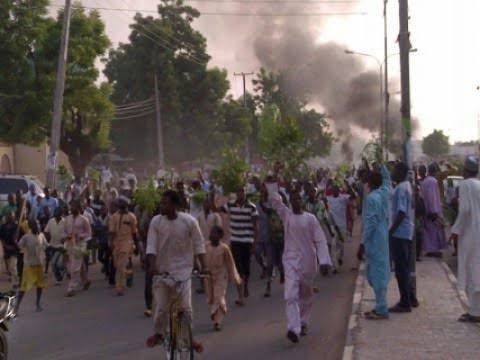
Save us From Heavy Trailers Killing Our People… Muna Garage Residents Cry Out to Zulum
By: Bodunrin Kayode
Residents of Muna axis after customs area in Maiduguri have called on Governor Babagana Zulum to save them from the excesses of heavy duty vehicles who deliberately clog the international highway leading to Gamboru Ngala council area on a daily basis.
Some of the residents who spoke to this reporter after a recent crash which almost killed all the occupants of a commercial “Keke” regretted that the road traffic authorities in the state have not given this international highway the priority it deserves in terms of traffic management due to it’s prominence.
A careless trailer which was parked along the road close to the Alkome police hospital had narrowed the road for another trailer and a Keke nappe which struggled for the little space remaining all driving towards the Muna Garage area when a brush occurred and a sudden bang from the back by a third trailer which almost killed all the occupants of the keke nappe.
Some of the commuters came out alive from the crushed Keke with minor wounds while a particular man had his forefoot crushed almost hanging away from the ball of one of that very foot.
It was a bloody weekend for the commuters as blood from one of them flowed freely into the Keke and on the tarred road leading to Muna while onlookers rushed to see if anyone survived the crash.
Since no security personnel showed up within the first 30 minutes of the crash, the wounded were rushed to a nearby hospital while the trailer cleared from the road to ease traffic movement.
Most of the eye witnesses were enraged by the incident with some blaming it on the Keke riders while others castigated the trailers who insist on parking on the shoulder of this international route which should be free from these kinds of challenges.
Baana, a vulcanizer who says he has spent over three decades on this axis of the town called on Governor Babagana Zulum to as a matter of urgency build a massive modern trailer park for the heavy trucks so that they will stop parking along the road while they wait for clearance in the morning to embark on their journeys to Ngala and beyond.
“Lack of a modern trailer park is the main reason why we keep recording lingering accidents on a daily basis here with countless of people being wounded and are not recorded in the government statistics.” He stressed.
For mallam Isa, a teacher inside the suburb behind Alkome police Hospital, the Governor should as a matter of urgency sign an executive fiat to stop trailers from parking on main roads like this one leading to Mafa,Dikwa and Ngala.
” We are calling on the Governor to invoke an executive order based on section 5 of the 1999 constitution by banning all trailers from parking on the trunk A roads leading to Chad, Niger and Cameroon.
” This is because, apart from endangering the lives of commuters, prolonged stay on the tarred roads cause a lot of damage to the roads which the Governor has dualized after destruction by insurgency.”
Mallam Isa also called on Federal and State Road Safety managers in the state to create a road side emergency station along this route that would be assisting them in clearing accident victims in the road throughout the week and even during the weekend.
“look at this accident that just happened, they are all guilty of one offence or the other. But I equally blame the Keke riders because if they have respect for human lives, they will not be contesting for right of way with heavy duty trailers.
” These trailers are very wicked people. They use their big structures to block and entrap people only to be begging for mercy when the damage has been done.
” Their excesses are as grave as that of the keke napep people. The Federal Road Safety and the Borno traffic management authorities should increase their fines further to serve as deterrent on the rest.
Save us From Heavy Trailers Killing Our People… Muna Garage Residents Cry Out to Zulum


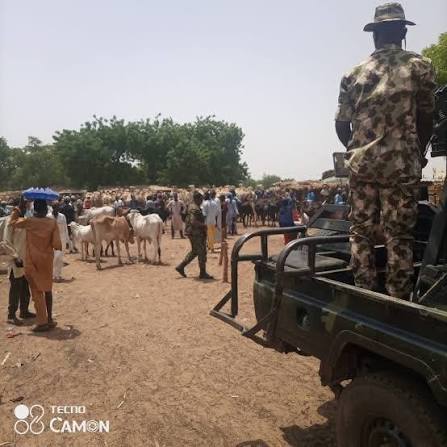
Troops recover 48 rustled cattle in Plateau community
By: Zagazola Makama
Troops under Operation PEACE EAGLE (OPEP) have recovered 48 rustled cattle in Yelwa village, Heipang District of Barkin Ladi Local Government Area of Plateau State.
Security sources said the recovery followed a distress call received at about 0635 hours on Wednesday reporting the rustling of cattle belonging to a resident of the community.
Troops of Sector 4 OPEP were immediately deployed to the area where they conducted a search and rescue operation across surrounding bushes and grazing routes.
The 48 recovered cattle were subsequently handed over to the rightful owner after due verification.
Authorities said troops have continued sustained patrols in the general area to track the perpetrators and prevent further incidents of cattle rustling and related criminal activities.
The operation is part of ongoing efforts to restore peace and security in parts of Plateau State affected by farmer-herder-related tensions.
Troops recover 48 rustled cattle in Plateau community
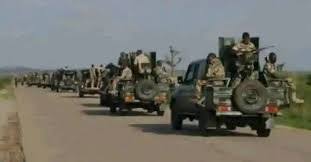
Troops arrest three suspected log suppliers in Kwara
By: Zagazola Makama
Troops of Operation SAVANNAH SHIELD have arrested three suspected log suppliers in Kaiama Local Government Area of Kwara State for alleged involvement in illegal supply activities.
Security sources said the suspects were apprehended at about 1315 hours on Wednesday by troops of Sector 1, operating from Forward Operating Base (FOB) Kaiama.
The arrest followed routine operational checks and intelligence-led patrols in the area.
The suspects were subsequently handed over to troops of 22 Brigade for further investigation and necessary action.
Military authorities said the operation forms part of ongoing efforts to curb criminal logistics networks and disrupt support structures aiding armed groups in the region.
They added that troops have continued sustained surveillance and patrols across border communities to prevent the movement of illicit materials and criminal supplies.
Troops arrest three suspected log suppliers in Kwara
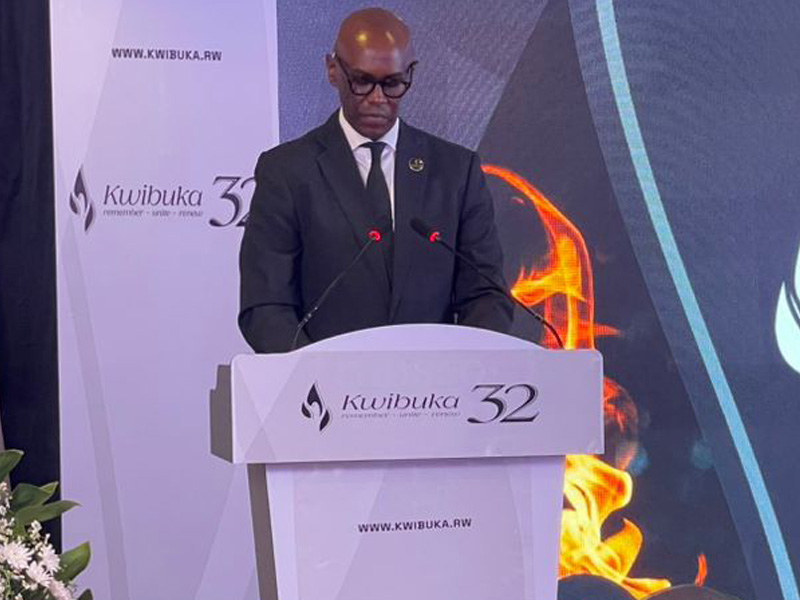
Kwibuka 32: Rwanda Sounds Alarm on Evolving Genocide Ideology, Demands Global Accountability
By: Michael Mike
Rwanda has issued a powerful warning to the world as it marks the 32nd anniversary of the 1994 Genocide against the Tutsi, cautioning that the dangerous ideologies that fueled the mass killings have not disappeared—but are mutating in more sophisticated and far-reaching ways.
Speaking at a solemn commemoration in Abuja, the Rwandan High Commissioner to Nigeria, Moses Rugema, urged the global community to move beyond ceremonial remembrance and confront the persistent and evolving threat of genocide ideology, particularly in an era shaped by digital influence and artificial intelligence.
The event, held under the theme “Remember. Unite. Renew.”, marked Kwibuka 32, an annual period of reflection on one of the darkest chapters in modern history.
He said: “Remembrance must carry responsibility. It is not enough to honour the dead—we must actively resist the forces that made such atrocities possible.”
He recalled the scale of the Genocide against the Tutsi, in which more than one million people were systematically killed within 100 days in 1994. The envoy stressed that the genocide was not a spontaneous eruption of violence, but a calculated campaign driven by propaganda, division and state-backed extremism.
Drawing a direct line between the past and present, Rugema warned that similar patterns are re-emerging globally, now amplified by technology.
“The tools may have changed, but the intent has not. Today, hate can spread faster, deeper and more dangerously through digital platforms,” he said, noting that misinformation, denial and distortion are increasingly weaponised to rewrite history and inflame divisions.
He called for stronger international legal frameworks, improved civic education and stricter accountability measures to counter what he described as a “resilient and adaptive threat.”
Rugema also revisited the failure of the international community during the 1994 crisis, stating that early warning signs were ignored and the scale of the violence was initially downplayed. At the United Nations Security Council, only a handful of voices—including Nigeria’s former envoy, Ibrahim Gambari—pressed for recognition of the atrocities as genocide.
The killings were eventually halted by forces of the Rwandan Patriotic Front, led by current President Paul Kagame, ushering in a new chapter focused on national rebuilding.
Highlighting Rwanda’s recovery, Rugema pointed to deliberate policies aimed at unity and reconciliation, including the dismantling of ethnic classifications and the use of community-based justice systems such as gacaca courts, which enabled millions of cases to be heard while fostering dialogue and healing.
Yet, he warned that the work is far from over.
“Genocide ideology is not confined to history—it is a present danger,” he said, citing ongoing instability in parts of Africa’s Great Lakes region and the growing normalization of hate speech globally.
Also addressing the gathering, the UN Resident Humanitarian Coordinator in
Nigeria, Mohamed Fall described the commemoration as a call to action for the international community to prevent future atrocities.
Represented by the UN Women Coordinator to Nigeria and ECOWAS, Beatrice Eyong, Fall emphasised that the genocide was enabled by sustained propaganda and exclusionary policies.
“Mass atrocities do not begin with weapons—they begin with words,” Fall said. “And today, those words travel faster than ever.”
He warned that the unchecked spread of hate speech and incitement in the digital space poses a growing global risk, urging governments to strengthen legal protections, uphold international law and fully implement the Genocide Convention.
Both speakers stressed that remembrance must translate into concrete action, insisting that the phrase “Never Again” risks becoming hollow if not backed by political will and societal vigilance.
As the world reflects on Kwibuka 32, Rwanda’s message was unmistakable: the cost of indifference has already been written in blood—and failing to act now could allow history to repeat itself.
Kwibuka 32: Rwanda Sounds Alarm on Evolving Genocide Ideology, Demands Global Accountability

Troops recover 48 rustled cattle in Plateau community

Troops arrest three suspected log suppliers in Kwara

Kwibuka 32: Rwanda Sounds Alarm on Evolving Genocide Ideology, Demands Global Accountability

Roger Federer’s Shock as DNA Results Reveal Myla and Charlene Are Not His Biological Children

THE PLIGHT OF FARIDA

FAILED COUP IN BURKINA FASO: HOW TRAORÉ NARROWLY ESCAPED ASSASSINATION PLOT AMID FOREIGN INTERFERENCE CLAIMS
-
 News2 years ago
Roger Federer’s Shock as DNA Results Reveal Myla and Charlene Are Not His Biological Children
-
Opinions4 years ago
THE PLIGHT OF FARIDA
-
 News12 months ago
FAILED COUP IN BURKINA FASO: HOW TRAORÉ NARROWLY ESCAPED ASSASSINATION PLOT AMID FOREIGN INTERFERENCE CLAIMS
-

 News2 years ago
EYN: Rev. Billi, Distortion of History, and The Living Tamarind Tree
-
 Opinions4 years ago
POLICE CHARGE ROOMS, A MINTING PRESS
-

 ACADEMICS2 years ago
A History of Biu” (2015) and The Lingering Bura-Pabir Question (1)
-

 Columns2 years ago
Army University Biu: There is certain interest, but certainly not from Borno.
-

 Opinions2 years ago
Tinubu,Shettima: The epidemic of economic, insecurity in Nigeria
