
National News
Tinubu Says Resources Need to be Mobilized to Achieve Nation’s Climate Goals

Tinubu Says Resources Need to be Mobilized to Achieve Nation’s Climate Goals
By: Michael Mike
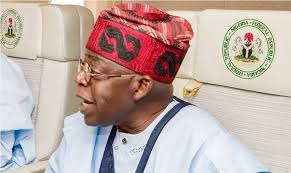
President Bola Tinubu on Tuesday called for collaborate efforts from all stakeholders and insist that there is need to accelerate and mobilize the necessary resources to achieve the nation’s climate goals.
The President stated this at a Climate Security Summit in Abuja organized by the National Council on Climate Change Secretariat in collaboration with stakeholders and development partners.
Represented by the Minister of Regional Development, Abubakar Momoh, the president noted that climate poses threats to the world including Nigeria.
He listed some of the efforts towards addressing climate change to include Nigeria’s Paris Agreement pledge which is to reduce greenhouse gas emissions by 20 percent by 2030.
He lamented that: “The climate crisis is no longer looming threat but a present and undeniable danger inflicting devastation upon our nation.”
The President added that “it’s merciless actio. Is evidence nationwide from the relentless surge of the sea level threatening our coastal communities to creeping drought that ignores farmers/herders crisis that has brought insecurity upon Nigeria.
“The frequent and extreme weather effect such as flood and heatwave and harsh weather effect that have ravaged our economy and displaced vulnerable populace and destroyed infrastructure.”
He said: “Climate crisis are existential threat to our nation, continent and indeed the entire world. It is a threat that increase problems in our development plan,” stating that “with urgency, we must act now to address this very crisis.”
He however noted that: “Recognizing this urgent challenge, Nigeria has demonstrated its commitments to climate action through various initiatives most notably our promise through Paris Agreement.”
Also speaking the Director General, National Council on Climate Change, and the Special Presidential Envoy on Climate Change, Dr Nkiruka Maduekwe noted that the law provides for the establishment of climate change fund to enable Nigeria to strengthen her resilient and safeguard the people from the impact of climate change, but Nigeria is yet to operationalize the fund.
She noted that one of the reasons for the meeting was to bring together stakeholders to plan useful strategies that would ensure Nigeria is able to benefit from the fund.
She equally noted that the meeting would device Nigeria’s strategies at the upcoming COP 29, insisting that Nigeria should expect positive outcomes from the global meeting.
Maduekwe said already in place a trained negotiators which would be on attendance at the COP 29 for Nigeria so that the nation can come out from the meeting with goodies.
Tinubu Says Resources Need to be Mobilized to Achieve Nation’s Climate Goals


Giwa detention facility completes 1,450 terrorism cases, moves 500 suspects for trial
By: Zagazola Makama
The Joint Investigation Center located at Giwa Barracks, Maiduguri, says it has concluded investigations in about 1,450 terrorism-related cases, while over 500 suspects have recently been transferred for prosecution, many of whom were subsequently convicted.
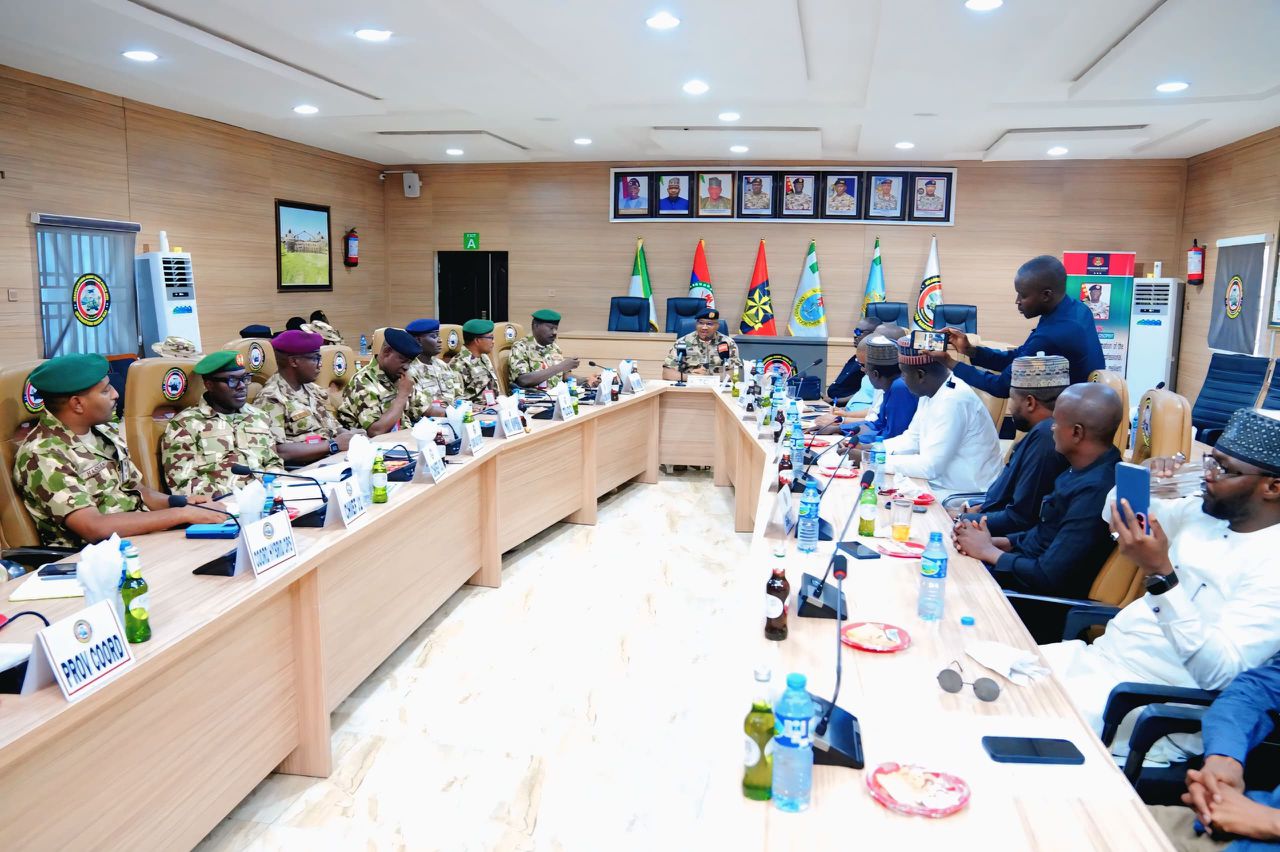
The Commander of the facility, Brig.-Gen. Yusuf Audu, disclosed this on Wednesday in a detailed briefing delivered by Capt. Obinwale, where he outlined the structure, operations and reforms of the multi-agency detention and investigation centre supporting counter-terrorism efforts in the North-East.
Audu said the facility, established as a unified interrogation and screening hub for suspects arrested during counter-insurgency operations, remains central to Nigeria’s fight against Boko Haram and ISWAP insurgents.
He explained that all suspects processed through the centre undergo structured investigations, legal review, and eventual classification into prosecution, rehabilitation, or reintegration pathways, depending on findings.
“After investigation, a complex casework group reviews all reports and provides legal advice. Based on the outcome, detainees are categorised into three groups: prosecution, rehabilitation, and reintegration,” he said.
He disclosed that “recently, the centre moved over 500 suspects for trial, most of whom were convicted,” adding that the development reflects improved coordination among security and justice institutions handling terrorism cases.
Audu said the centre operates as a multi-agency platform comprising personnel from the Nigerian Army, Defence Intelligence Agency, Nigeria Police Force, Department of State Services, Nigerian Correctional Service, Nigeria Security and Civil Defence Corps, National Drug Law Enforcement Agency, and Nigeria Immigration Service, alongside legal experts from the Office of the Attorney-General of the Federation.
According to him, the arrangement ensures a holistic approach to terrorism investigations and strengthens the integrity of prosecution processes.
He noted that suspects are received with preliminary investigation reports from frontline units, formally documented, and assigned to investigators drawn from various security agencies.
The commander said detainees are kept in segregated facilities, with special provisions for women and children, while minors accompanied by mothers are provided with basic education and care within the centre.
He added that medical support is a key component of the facility’s operations, with isolation and treatment available for detainees suffering from illnesses such as tuberculosis, in collaboration with humanitarian partners.
Audu said the centre maintains structured feeding arrangements, with three meals daily provided to detainees, supported by improved water supply systems, including a 40,000-litre solar-powered borehole constructed with support from the International Committee of the Red Cross (ICRC).
He also disclosed that inmates are provided with clothing, toiletries, and hygiene materials upon admission, while periodic fumigation is carried out to maintain sanitation standards.
According to him, detainees also benefit from physical and psychological support programmes, including access to sports, indoor games, and supervised exercise periods aimed at improving mental and physical well-being.
Audu said the facility also operates a “restoration of family links” programme, through which detainees communicate with relatives with support from international humanitarian organisations, including the ICRC.
On legal processes, he explained that investigations are conducted under the Terrorism Prevention Act of 2011, as amended in 2013 and 2022, with judicial oversight through federal high court remand orders and adherence to human rights standards.
He noted that biometric data of all suspects is captured and stored in a national database to support intelligence gathering and future security operations.
The commander further highlighted collaboration with international partners, including the International Organization for Migration (IOM), United Nations Office on Drugs and Crime (UNODC), UNICEF, and other humanitarian agencies, which have supported infrastructure development, training, and detainee welfare programmes.
He said UNODC constructed an evidence storage facility, while IOM established a data management system to improve screening and classification of suspects.
Audu added that UNICEF has provided educational materials for juveniles, while the ICRC continues to support healthcare delivery and humanitarian interventions within the facility.
He said detainees are also engaged in skill acquisition programmes such as tailoring, farming, poultry, fish farming, cap making, and bakery operations, designed to equip them with vocational skills for reintegration.
According to him, the bakery project recently established within the centre was introduced to reduce operational costs and enhance vocational training opportunities.
“The idea is to keep detainees engaged productively while awaiting investigation outcomes,” he said.
He explained that officers posted to the centre are carefully selected based on professional backgrounds in psychology, criminology, sociology, and related fields to improve investigative efficiency.
Audu also noted that the facility has received commendations from local and international dignitaries, including former defence ministers, service chiefs, United Nations officials, and counter-terrorism experts who have visited the centre.
He said the centre’s operations align with global best practices, particularly the United Nations principle that “effective counter-terrorism measures and protection of human rights are mutually reinforcing.”
Despite the achievements, he acknowledged challenges, including difficulty in securing witnesses from affected communities due to insecurity and fear of reprisal, as well as delays in prosecution processes which often prolong detainees’ stay in custody.
Giwa detention facility completes 1,450 terrorism cases, moves 500 suspects for trial
National News
How Nigeria’s Frontline Troops Are Fed, Managed, and Monitored Amid Social Media Controversy
How Nigeria’s Frontline Troops Are Fed, Managed, and Monitored Amid Social Media Controversy
By: Zagazola Makama
In recent weeks, a wave of social media videos alleging poor feeding and neglect of Nigerian troops in frontline operations has reignited public debate about military welfare. But behind the viral claims lies a more structured, and less visible, system of logistics, oversight, and soldier participation that military authorities say is often misunderstood outside the theatre of operations.
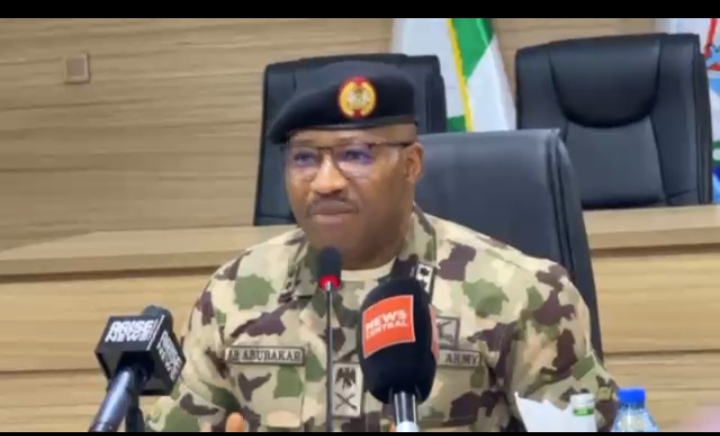
At the centre of the clarification, the Theatre Commander, Joint Task Force North East Operation Hadin Kai, Maj.-Gen. Abdulsalam Abubakar, who insists that what circulates online is far removed from the realities on ground.
Speaking during an interaction with journalists on Thursday, Abubakar described troop welfare as a “deliberately structured and soldier-driven system” built on accountability and internal checks rather than perception.
According to him, every operational base in the theatre operates a food committee system designed to give troops direct involvement in what they eat and how supplies are managed.Every location has a food committee. That food committee is made up of mostly non-commissioned personnel. They know the menu of what they want to eat,” he said.
He explained that these committees are not symbolic but functional, conducting monthly assessments of feeding arrangements, inspecting supplies, and documenting conditions using written reports, photographs, and field feedback from troops.
In practical terms, commanders are not responsible for deciding meals. Their role, he said, is to ensure logistics are provided based on government allocation.
“The responsibility of the commander is to provide the resources as given by the government to ensure that meal,” Abubakar noted.
The commander acknowledged that social media narratives often emerge from isolated incidents, sometimes recorded under difficult field conditions, but argued that such content is frequently stripped of context.
He cited cases where soldiers, after receiving their rations, allegedly altered or partially consumed them before recording videos, which then went viral as evidence of systemic neglect.
“For someone to have been given his meal with soft drinks, he consumed the soft drinks, take out the protein of the food, take out half of your meal, and now make a video. That is mischief,” he said.
He stressed that such portrayals distort the reality of a system that, according to him, has improved significantly over time.
“That is mischief. What was posted out there in the media is not a true reflection of the feeding pattern that we have in the theatre,” he added.
Contrary to public perception, Abubakar said troops routinely receive structured meal packages that include protein, beverages, water, and operational rations adapted to field conditions.
He described a typical day for deployed soldiers as involving breakfast, lunch, dinner, and field packs during patrols.
“Even when they go on patrol, they have their cold trip, they have their lunch, they have their water meal pack, they have their takeout. This is what is obtainable across most of our locations,” he said.
The system, he explained, is designed not only for sustenance but also for operational continuity in remote and high-risk environments.
While defending the system, the commander also acknowledged that lapses can occur, but insisted they are neither ignored nor tolerated.
“We are not 100 percent. There are instances where commanders have been found wanting, and where that happens, you lose your command,” he said.
He referenced the directive of the Chief of Army Staff, Lt.-Gen. Waidi Shaibu, who he said enforces a strict “Soldier First” doctrine across all formations.
“You cannot take care of the soldiers, the Chief of Army Staff has directed that that commander must lose command. Every commanding officer in the field knows that the Chief of Army Staff does not joke with the welfare of our soldiers,” Abubakar stated.
Beyond feeding arrangements, the Army has introduced several reforms aimed at improving morale and efficiency across theatres.
These include an upward review of troop welfare allowances from N20,000 to N50,000 for personnel ranging from privates to warrant officers, as well as expanded access to foreign training and peacekeeping deployments.
Abubakar also revealed that three batches of troops are currently being prepared for international assignments, with priority given to personnel who have served in operational theatres.
To reduce stress and improve rotation cycles, welfare flight operations have also been sustained, allowing troops easier movement between deployment areas and home stations.
In addition, quick intervention funds have been introduced to help commanders address urgent maintenance and logistics needs in the field.
“Consistent welfare is not an afterthought, but a command priority embedded in structure, oversight, and policy enforcement.
While much of the public attention has focused on controversy, troops reportedly maintain active food committees that monitor supplies, verify quality, and ensure equitable distribution of rations across units.
Who have our troops for instance in Biu LGA who established their own Bakery, water factory and other packages for their troops.
According to him, these internal systems have contributed to higher morale and improved operational discipline despite persistent security pressures.
He argue that the current debate reflects a broader challenge in modern warfare, the struggle between battlefield reality and digital perception.
He warned that misinformation, if left unchecked, risks undermining troop morale and public trust in ongoing operations.
As Abubakar put it, the system is not perfect, but it is actively monitored, internally corrected, and designed with one principle in mind: the soldier comes first.
How Nigeria’s Frontline Troops Are Fed, Managed, and Monitored Amid Social Media Controversy
National News
Nigeria, UNESCO Launch World’s First Media and Information Literacy Institute in Abuja
Nigeria, UNESCO Launch World’s First Media and Information Literacy Institute in Abuja
By: Michael Mike
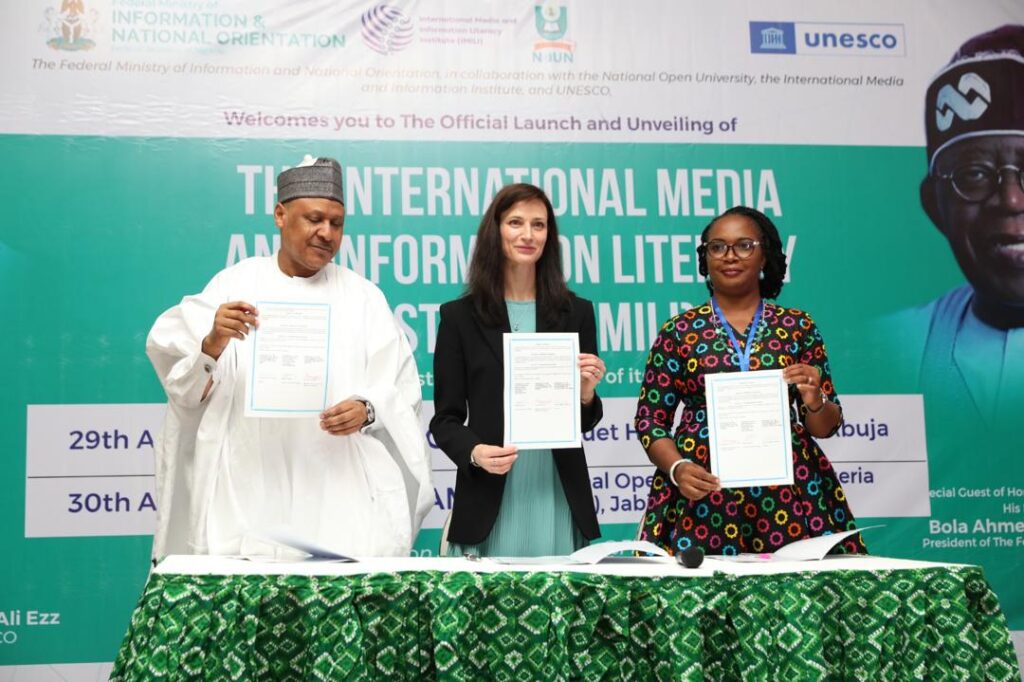
Nigeria has taken a significant step onto the global stage with the launch of the world’s first International Media and Information Literacy Institute (IMILI), a landmark initiative developed in partnership with United Nations Educational, Scientific and Cultural Organisation (UNESCO).
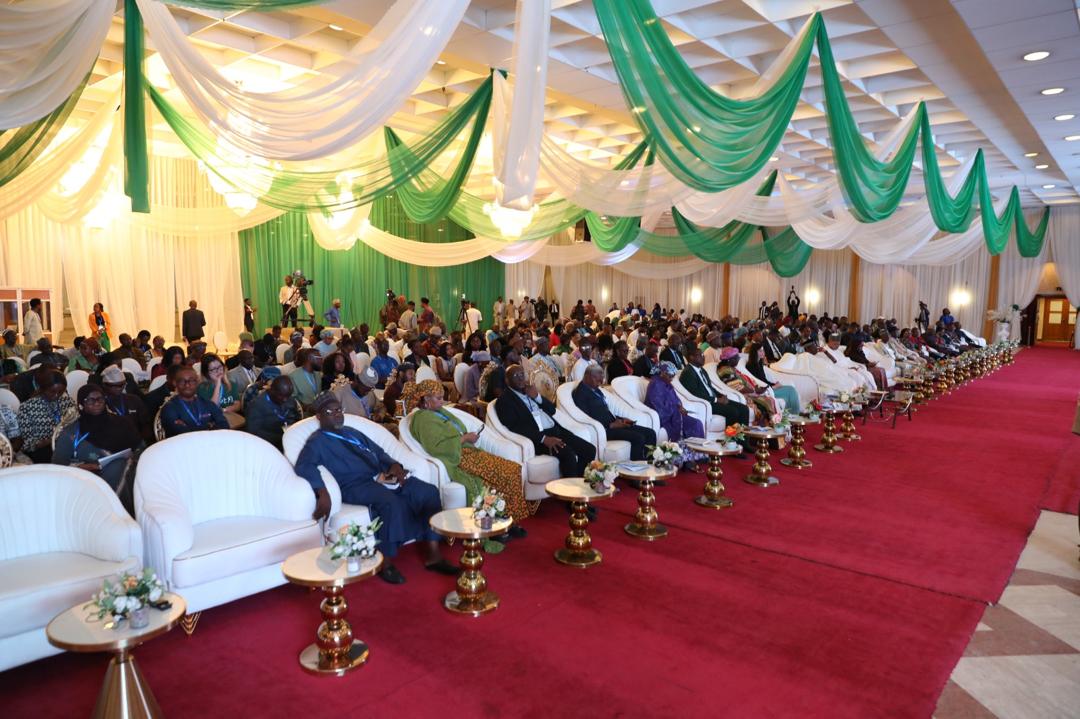
The institute was officially unveiled on Wednesday in Abuja by the Federal Ministry of Information and National Orientation, positioning Nigeria at the forefront of global efforts to strengthen media literacy, combat misinformation, and promote critical thinking in an increasingly complex digital age.
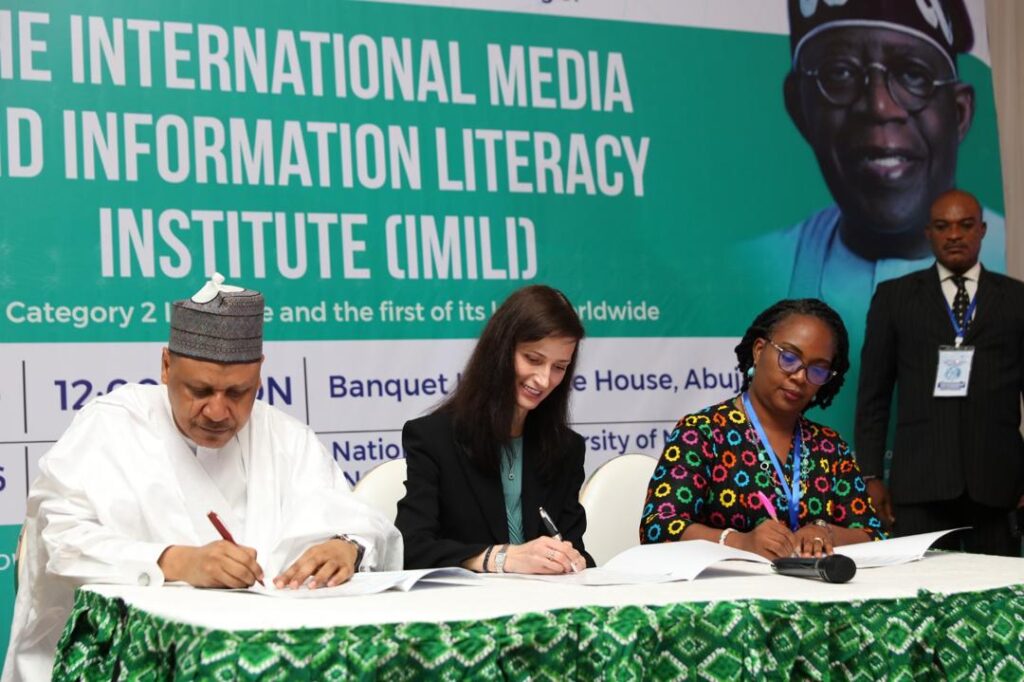
The establishment of IMILI marks a historic milestone not just for Nigeria, but for Africa and the international community, as it becomes the first UNESCO Category 2 Institute globally dedicated solely to Media and Information Literacy (MIL).
Speaking at the launch, UNESCO Assistant Director-General for Communication and Information, Mariya Gabriel, described the institute as a timely and transformative response to one of the defining challenges of the modern era — ensuring that access to information translates into informed, responsible, and empowered societies.
“In a world where the volume of information continues to grow exponentially, the ability to distinguish between reliable and misleading content has become essential,” she said.
IMILI is expected to serve as a global hub for research, innovation, and capacity development in media literacy. It will provide training for educators, policymakers, media professionals, and young people, equipping them with tools to critically engage with information, counter misinformation, and actively participate in democratic processes.
The institute will also support curriculum development, foster international collaboration, and connect Nigeria to a global network of expertise, reinforcing Media and Information Literacy as a universal public good.
UNESCO commended the leadership of President Bola Ahmed Tinubu for his vision and commitment in bringing the initiative to fruition. It also acknowledged the pivotal role played by the Minister of Information and National Orientation, Mohammed Idris Malagi, whose strategic leadership was described as instrumental in advancing the media literacy agenda in Nigeria.
The organisation further recognised contributions from key stakeholders, including the Nigerian National Commission for UNESCO, the UNESCO Abuja Office, and Nigeria’s Permanent Delegation to UNESCO, whose collaborative efforts ensured the successful establishment of the institute.
By hosting IMILI, Nigeria is sending a strong signal that Africa is not only responding to the challenges of the digital age but is actively shaping global solutions. With its vibrant media landscape, youthful population, and expanding digital ecosystem, the country is seen as uniquely positioned to lead this transformative agenda.
Beyond its institutional significance, the launch of IMILI represents a broader commitment to empowering citizens — not just to access information, but to understand, question, and use it responsibly.
As the institute begins operations, it is expected to serve as a catalyst for strengthening trust, promoting informed decision-making, and advancing democratic values across Nigeria, Africa, and the wider world.
Nigeria, UNESCO Launch World’s First Media and Information Literacy Institute in Abuja

Billionaire Drug Baron, Two Female Kingpins Nabbed in Global Anti-Narcotics Sting

Troops, police arrest nine suspected kidnappers in Edo raid operation

Troops recover bodies of two civilians in Platea

Roger Federer’s Shock as DNA Results Reveal Myla and Charlene Are Not His Biological Children

THE PLIGHT OF FARIDA

FAILED COUP IN BURKINA FASO: HOW TRAORÉ NARROWLY ESCAPED ASSASSINATION PLOT AMID FOREIGN INTERFERENCE CLAIMS
-
 News2 years ago
Roger Federer’s Shock as DNA Results Reveal Myla and Charlene Are Not His Biological Children
-
Opinions4 years ago
THE PLIGHT OF FARIDA
-
 News1 year ago
FAILED COUP IN BURKINA FASO: HOW TRAORÉ NARROWLY ESCAPED ASSASSINATION PLOT AMID FOREIGN INTERFERENCE CLAIMS
-

 News2 years ago
EYN: Rev. Billi, Distortion of History, and The Living Tamarind Tree
-
 Opinions4 years ago
POLICE CHARGE ROOMS, A MINTING PRESS
-

 ACADEMICS2 years ago
A History of Biu” (2015) and The Lingering Bura-Pabir Question (1)
-

 Columns2 years ago
Army University Biu: There is certain interest, but certainly not from Borno.
-

 Opinions2 years ago
Tinubu,Shettima: The epidemic of economic, insecurity in Nigeria
