
Columns
UMTH: Fakeeh University Hospital Dubai commended Professor Ahidjo and the management team for uplifting hospital standards beyond national boundaries

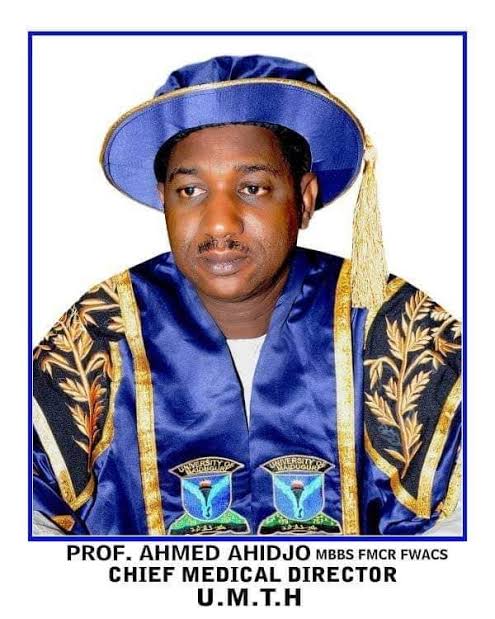
UMTH: Fakeeh University Hospital Dubai commended Professor Ahidjo and the management team for uplifting hospital standards beyond national boundaries
By: Balami Lazarus
In a recent workshop organized by the management of the University of Maiduguri Teaching Hospital in collaboration with Fakeeh University Hospital of Dubai on ‘Advances in Kidney and Neurosurgical Management’ in Maiduguri, experts within and without spoke on the latest advances in kidney diseases and neurosurgical treatments/management and their remedies. While some made presentations on advances in neurosurgical management.
Dr. Omer Mohammed Al-Derwish, a urological surgeon/consultant from the Fakeeh University Hospital in Dubai, has commended the Chief Medical Director (CMD) of the University of Maiduguri Teaching Hospital, Professor Ahmed Ahidjo, and his management team for uplifting the standard of the hospital, stating that ‘Your capacity in both human and medical materials/equipment is of global standard.’
Al-Derwish made the observation while giving a talk on ‘Overview of Advances in Urology’ recently at the Babagana Zulum Conference Hall UMTH, medical
Speaking on urinary tract stones, urological cancers, bladder dysfunction, and urodynamics, among other related ailments. Al-Derwish drew the attention of his colleagues to the advances in the treatment and management of these diseases. He also stressed the need for UMTH to replicate Fakeeh University Hospital methods.
Also in his paper, Dr. Tommaso Tufo, a neurosurgeon/consultant, spoke extensively on ‘Overview of Advances in Neurosurgery,’ paying more attention to advances made in neurosurgery. He said that neurosurgery is more scientific than what was obtainable in the past, where death mortality was high in the course of surgery. ‘Today medical neuroscience tools and materials/equipment have heralded a new chapter in neurosurgical treatments and management.’
The Fakeeh University Hospital experts said that CMD Prof. Ahmed Ahidjo and his management team are to be commended for their efforts. Adding that those at the helm of affairs for the day-to-day running of the hospital are to be applauded in no small measure.
During the workshop, Dr. Hassan Dogo of UMTH spoke on ‘Update on Infrastructure/Equipping of Kidney/Urology Centre of UMTH.’ Dr. Dogo informed participants on the available advances in medical tools and equipment at the center, which are of international standard, and these are being utilized in medical treatment of kidney/urology. He, however, said that the center needs more tools, materials, and equipment to meet her patients medical demands. He further said that the center is making progress in the treatments of kidney/urology using the latest medical methods.
In a similar vein, Dr. Babagana Usman, also of UMTH, made a presentation on ‘Update on Infrastructure/Equipping of Stroke and Neuroscience Centre of UMTH,’ making clear that the Stroke and Neuroscience Centre has first-class modern medical materials and equipment for the treatments of stroke. He called for more additional tools/material to achieve her aims.
“Patients and visitors to the hospital are witnesses to all this progress made by the CMD, Prof. Ahmed Ahidjo, for putting the hospital on the medical world map as being the best in Nigeria.” He said,
NEWSng reports that both experts gave UMTH a pass mark on her medical services, teaching, and research facilities. They promised to initiate the processes of partnership between Fakeeh University Hospital Dubai and UMTH.
UMTH: Fakeeh University Hospital Dubai commended Professor Ahidjo and the management team for uplifting hospital standards beyond national boundaries


Columns
Descendants of Yamtra-Wala: Surfing in the Comfort of the Bura Ethnic Tribe/Cultural Identity
Descendants of Yamtra-Wala: Surfing in the Comfort of the Bura Ethnic Tribe/Cultural Identity
By: Balami Lazarus
I have spoken and written articles on the Bura-Pabir, where I was called names with insults of convex images. I am here once again with nearly the same subject on ethnic tribe/cultural identity: the dilemma of the Pabir group of people who are standing poised between being Pabir or Babur.
The Bura people are an independent ethnic nation historically, geographically, and politically within the Biu territory long before Yamtra-Wala. Is it then wrong for anyone to think and say that the Pabir group of people are the same as the Bura from an ethnic-tribe/historically cultural perspective? What made them the same? How and when did they become the same? Are the Bura people descendants of Yamtra-Wala?
Historically, the Pabir are an extraction of Kanuri/Kanembu through the bloodline of a disgruntled prince, Abdulla, from the Kanem-Borno Empire, who, with his band of 70 men, founded the Biu kingdom and her royal dynasty in or about 1535.
In this work, I will write using Pabir, their original name given to them by the Bura people. I will also raise some thought-provoking questions with the uffti of truth in the space of ethnic tribe/cultural identity.
In history, I was taught to always take note of historical facts and figures and be objective in analyzing historical events/source materials with a sense of reasoning because many histories were falsified through irrational narratives/oral history from one generation to the other.
What is then the rationale behind the Pabir people addressing themselves as Babur? I believed answers to this are rooted in ethno-religious sentiments capped with an inferiority complex in the claws of
Babur. Why are they now forcing themselves on the Bura people’s cultural identity considering the recent development on the yearly Bura Cultural Festival at Marama? And this is the same ethnic tribe many Pabir scorned with contempt.
I was privileged to ask some few individuals from both divides, and what they said on this matter was the plain truth. “The Bura people are the first inhabitants of this territory, people with unique culture, traditions, and customs.” One individual said, “We have to be part of them (Bura) because we are a minority with no ethnic/cultural identity, nor are we an ethnic tribe/nation… They gave us the collective name “Pabir,” not “Babur,” as we are being called and addressed wrongly today.
The distant and recent events have not been in favor of the Bura people. Proponents of the Babur conspiracy theory presumably thought that by being addressed as Babur, they would be given ethnic tribe and cultural identity garments. But has it?
In the context of history, if and when one is speaking or writing for the purpose of ethnic tribe/cultural identity of the Bura people, I believe that such
Submissions shall probably be in favor of the Bura as an independent ethnic nation, unlike the Pabir, who are direct descendants (Yamara-Wala) of Prince Abdulla from Birni Ngarzargamu in the Kanem-Borno Empire.
“I am a Pabir man. Can you point at any cultural source material or genre tied to us as our cultural heritage? And neither are we of common ancestry or lineage with the Bura.”
Let us rewind back, taking into consideration the name Yamtra-Wala, the founder of the royal dynasty of Biu. In the Bura dialect, it is pronounced and spelled as “Yamta Ola.” However, you may wish to know that it has its roots in the Arabic language.
But in an attempt to improvise and starve the term “Pabir,” choking it with “Babur” has further perpetuated historical miscarriage, a clear distortion of history.
What was the position of the Pabir in the ethnic/cultural unity of the Bura people of the Biu territory? Where were they when they had the Bura Almanac of the 1950s, 60s, and 70s titled Bura Community in the following towns and cities like Kaduna, Lagos, Kano, Jos, Enugu, Ibadan, Zaria, and other locations within Nigeria? It is on record that there was absolutely no mention of Pabir in unity with Bura combined as a united community in such places. How then did Pabir get into the ethnic tribe/cultural identity of the Bura people, considering the recent development on the yearly Bura Cultural Festival? Note that these are the same people the Pabir scorned with sentiments of “mission.” However, it still remains the healthy stock where many have reached the sun.
Be as it may, probably they are afraid to be left out individually or collectively in the ethnic identity provided by the Bura people. And to also bask in the comfort of Bura cultural identity and heritage.
Historically, before 1535, there was no such group of people in the Biu territory. Therefore, the band of the 70 led by Prince Abdullah of Birni Ngazargamu in Kanem-Borno does not add up to give the Yamtra descendants the permit to claim ethnic tribe and cultural identity of the Bura people. Archaeological sources around the greater Biu territory like the ancient abandoned settlement sites such as Kumba in old Bwala village. Ghenchabiri in Kwajaffa, among many others in the Hawul Local Government Area, is evidence of the presence of the Bura people before c.1535.
I hereby tie myself with roots of history to say that the Pabir people, who are the descendants of Yamtra-Wala, will find it difficult to disengage and/or isolate themselves from the beautiful Bura ethnic tribe and cultural identity despite sentiments of “mission” because Yamtra-Wala came without cultural identity. For this reason, Pabir or Babur are offshoots of the Bura ethnic tribe and cultural identity because they have an identity of their own.
Similarly, the Bura are the lighthouse of the Biu territory because they are found all over, contributing their quota to nation-building. They also made up the greater part of the Biu territory’s population.
Balami, Publisher/Columnist 08036779290
Descendants of Yamtra-Wala: Surfing in the Comfort of the Bura Ethnic Tribe/Cultural Identity
Columns
IBUAM: 5 Years Comprehensive Academic and Practical Training For Borno Indigenes Courtesy of Babagana Zulum’s Administration

IBUAM: 5 Years Comprehensive Academic and Practical Training For Borno Indigenes Courtesy of Babagana Zulum’s Administration
By: Balami Lazarus
Let me use this space and opportunity to make it clear that News Net Global Limited (NEWSng) Abuja and I are not media consultants to Isaac Balami University of Aeronautics and Management, Lagos (IBUAM). I have to bring this to the fore because some persons are presenting us as her media officers.
I was in Maiduguri recently on assignment for my firm, and during the course of the assignment, I decided to make time to do some independent investigations on the ₦12.9 billion scholarship offered to 54 students, indigenes of Borno State, courtesy of the state government, under the leadership of Governor Babagana Zulum, who believed in the progress and future of Borno State through Isaac Balami University of Aeronautics and Management, Oshodi-Lagos (IBUAM).
The scholarship is meant to educate and empower young students of Borno who meet the necessary requirements to study and be trained both intellectually and practically at IBUAM in various fields of aeronautics engineering and management as future pilots, aircraft/aerospace engineers, and aviation management experts to become future global leaders in the international aviation space (industry) equipped with comprehensive knowledge in modern aviation arts and techniques for the growth and development of Nigeria.
The Zulum administration has thought it wise to give young citizens of Borno State origin these golden opportunities through the State Scholarship Board.
This initiative, however, did not go well with some indigenes of Borno. Reliable sources based on my findings revealed that some members of the state executive council, Borno elders’ forum, among others, were not happy with the scholarship program meant for the 54 IBAUM students of Borno. In fact, before now it was a tug of war that generated a storm of bitter sentiments in a teacup greater than a mug.
In a brief chat with Engr. Isaac Balami, he informed this writer that he appreciates with gratitude the Borno State Government under the able leadership of Governor Babagana Zulum for believing in IBAUM to train its indigenes in the fields of aeronautics engineering and aviation management for the growth and development of the aviation industry in Nigeria and beyond. “IBUAM and I are grateful to my governor, Engr. Babagana Zulum, and those that have contributed to the realization of the scholarship program.”
Let me also state here categorically that scholarship programs are always provided under terms and conditions that are formulated by the offerer, like the case in question. But some individuals in government and other bodies are cogs in the wheel of such progress.
Are you aware that there are characteristics and physical differences between Engr. Isaac David Balami, an individual, and Isaac Balami University of Aeronautics and Management (IBUAM)? In a nutshell, herein are two entities—individual and institutional. But here are some citizens poised and wrapped in ignorance, raising eyebrows on collective future benefits.
The $12.9 billion doled out by the Borno State Government was not given to Engr. Isaac David Balami and shall never be his personal money from this day forward. I believed if and when anyone were to ask about the said money, that individual should go and ask IBUAM, not Engr. Isaac David Balami.
Balami, Publisher/Columnist. 08036779390
IBUAM: 5 Years Comprehensive Academic and Practical Training For Borno Indigenes Courtesy of Babagana Zulum’s Administration
IBUAM: Redefining the Nigerian Aerospace and Systems Through Aeronautics Disciplines
By: Balami Lazarus
The Wright brothers invented and flew the first airplane in 1903. They never knew that they had set the growth, development, and progress of the aviation industry with their invention.
Following the establishment of Isaac Balami University of Aeronautics and Management (IBUAM), Nigerians are optimistic that it will redefine with sophistication the aerospace systems, giving a new definition of the aviation through her academic courses by the quality of graduates that shall come on board sooner or later with made-in-Nigeria aircraft, their parts, and other related inventions.
I remembered one of my bright students whom I taught some years past, who has clamped and insulated her mind and interest to studying aeronautics engineering; my encouragements for her were endless.
And here we are, with a university that will give every candidate equal opportunities in his or her course of study, where future global stars are going to be trained to rule the aviation industry and her economy—national and international—through IBUAM academic disciplines.
The emergence of specialized universities in Nigeria was a big reality in the realm of our educational systems. These universities are no doubt making progress towards improving specialization by their trained professionals in various fields of studies for economic growth and industrialization, like what IBUAM is intended to do through one of her courses rarely taught in some Nigerian universities.
IBUAM is here to cater to the near-starved aviation needs of human capital and material resources through aeronautics engineering systems/management.
All courses at IBUAM are important for our nation’s development and in the aviation sector. Interestingly, IBUAM has state-of-the-art facilities to enhance teaching and learning—hangers, special workshops, tools, materials, and equipment. Her classrooms/lecture halls are also equipped with modern/standard facilities meant for effective and qualitative academic teaching and practical lessons for excellent performance of her students in their various courses. Therefore, IBUAM is doing the right thing in our education space and time.
Before I started this work, I was focused, mind made up on one fundamental course offered at IBUAM, and by all standards, that will automatically change the foundation and structure of the aerospace, which will provide Nigeria with aircraft and parts through the Aerospace Engineering course (B. Aerospace Engineering). This academic discipline is where students are expected to be trained in the science and skills of aerospace engineering “meant for designing, building, aircraft maintenance, and spacecraft systems.”
Therefore, this course of study and its related associates (metaphorically) will redefine the aviation aerospace and its science of engineering arts/skills, provided IBAUM academic teaching and learning are capped with practicals.
Engr. Isaac David Balami
whose passion for education and aeronautics is rooted in IBUAM, said that courses of study are all in the womb of JAMB requirements for candidates seeking admission in IBUAM: “For better and further understanding of our admission requirements and equal opportunities, I refer intended candidates to go through the JAMB prospectus.”
With no iota of doubt in my mind, this university will put Nigeria on the international aviation map of progress and value.
Balami, Publisher/Columnist. 08036779290
IBUAM: Redefining the Nigerian Aerospace and Systems Through Aeronautics Disciplines

JNIM terrorists clashes with rival factions in rare encounter in Nigeria’s Kebbi state

Troops foil mob attack, rescue suspected terrorist in Danmusa in Katsina

Plateau: troops launch manhunt after armed robbery attack in Bassa LGA

Roger Federer’s Shock as DNA Results Reveal Myla and Charlene Are Not His Biological Children

THE PLIGHT OF FARIDA

FAILED COUP IN BURKINA FASO: HOW TRAORÉ NARROWLY ESCAPED ASSASSINATION PLOT AMID FOREIGN INTERFERENCE CLAIMS
-
 News2 years ago
Roger Federer’s Shock as DNA Results Reveal Myla and Charlene Are Not His Biological Children
-
Opinions4 years ago
THE PLIGHT OF FARIDA
-
 News12 months ago
FAILED COUP IN BURKINA FASO: HOW TRAORÉ NARROWLY ESCAPED ASSASSINATION PLOT AMID FOREIGN INTERFERENCE CLAIMS
-

 News2 years ago
EYN: Rev. Billi, Distortion of History, and The Living Tamarind Tree
-
 Opinions4 years ago
POLICE CHARGE ROOMS, A MINTING PRESS
-

 ACADEMICS2 years ago
A History of Biu” (2015) and The Lingering Bura-Pabir Question (1)
-

 Columns2 years ago
Army University Biu: There is certain interest, but certainly not from Borno.
-

 Opinions2 years ago
Tinubu,Shettima: The epidemic of economic, insecurity in Nigeria
