
Politics
2027: Should Atiku Withdraw from the Race and Find Peace, or Continue and Live with Regrets?


2027: Should Atiku Withdraw from the Race and Find Peace, or Continue and Live with Regrets?
By: Dr James Bwala
As Nigeria approaches the 2027 general election, political conversations are already gathering momentum. Former Vice President Atiku Abubakar remains one of the country’s most experienced opposition figures and a familiar name in presidential politics. Yet experience, recognition, and persistence do not always guarantee victory. At a certain point, every political leader must confront an important question: Is continued participation an expression of courage, or has it become an unwillingness to accept political reality?
For Atiku Abubakar, the 2027 election may represent another opportunity to contest for the presidency, but it may also become the moment when he must decide whether to withdraw from the race and preserve his legacy. Continuing without a realistic path to victory could expose him to another painful defeat, deepen divisions within the opposition, and leave him with regrets about refusing to recognise changing political circumstances. There is no shame in surrendering when the political environment no longer favours a candidate. In some cases, withdrawal is not weakness; it is wisdom.
The central argument is not that Atiku lacks ability or experience. On the contrary, he has demonstrated remarkable resilience. He has contested presidential elections several times, built a national political network, and remained influential in Nigeria’s democratic development. However, politics is not merely a contest of personal ambition. It is also an exercise in timing, coalition-building, public confidence, strategic calculation, and the ability to recognise when a different generation or political arrangement is better positioned to succeed.
The signs surrounding the 2027 race suggest that Atiku may face a difficult and frustrating contest. A political image of Atiku struggling to wear a new pair of shoes, while Rotimi Amaechi attempts to assist him, offers a powerful metaphor. The shoes may represent a political arrangement, a coalition, or a new strategy that does not fit comfortably. Despite assistance, the effort ends in frustration, with the shoes thrown away. Whether viewed as symbolism, intuition, or political interpretation, the image reflects the difficulties that may confront Atiku as he attempts to build another presidential campaign.
A presidential campaign requires more than determination. It requires a structure capable of carrying the candidate to victory. Such a structure must include a broad and united coalition, strong party machinery, financial capacity, effective communication, popular enthusiasm, and a message capable of connecting with voters across Nigeria’s diverse regions. It must also persuade voters that the candidate represents a credible change from the existing administration. If any of these elements is missing, even an experienced politician can struggle.
Atiku’s previous campaigns demonstrate both his strengths and his limitations. He has consistently enjoyed national recognition and has been able to attract supporters across different parts of the country. However, his repeated attempts have not produced victory. Each failed campaign carries lessons, but it also creates political fatigue. Some voters may begin to question whether a candidate who has contested several times can offer a genuinely new direction. Others may prefer a younger or less familiar figure who symbolises generational change.
The issue of age and political renewal will likely be central in 2027. Nigerian voters, especially younger citizens, are increasingly demanding leaders who understand their economic realities, technological environment, and aspirations. They want employment, security, affordable education, reliable electricity, healthcare, and opportunities to participate meaningfully in national development. A campaign built primarily around past experience may not be sufficient. The opposition must present not only a candidate but also a convincing future.
Atiku’s greatest challenge may therefore be the changing political mood. A candidate who was once viewed as a strong alternative may find it more difficult to inspire the same level of enthusiasm after multiple contests. Political parties and alliances also change. Individuals who were once allies may pursue their own ambitions, while former supporters may move to different political platforms. In such circumstances, a campaign can become an exhausting struggle to recreate a coalition that no longer exists in its previous form.
The emerging political landscape could also favour the incumbent. President Bola Ahmed Tinubu and Vice President Kashim Shettima possess the advantages associated with incumbency: access to national visibility, established party structures, government influence, and the ability to present themselves as the centre of political attention. If the administration succeeds in improving economic conditions, strengthening security, and demonstrating measurable development before 2027, it may enter the election with a stronger position than the opposition expects.
A scene of Tinubu and Shettima dancing on a stage while Peter Obi and Rabiu Kwankwaso watch in shock can be understood as a metaphor for opposition fragmentation. It suggests a situation in which opposition leaders remain divided while the ruling party consolidates its position. Such division could be decisive. If major opposition figures compete against one another rather than forming a united front, they may divide the anti-government vote and make victory easier for the incumbent.
Nigeria’s electoral history shows that opposition parties rarely succeed when their leaders are unwilling to compromise. Presidential victory requires broad support beyond a candidate’s traditional base. It requires strategic partnerships and, in many cases, difficult personal sacrifices. If Atiku, Obi, Kwankwaso, Amaechi, and other influential figures all pursue separate ambitions, the opposition may repeat the mistakes of previous elections. Their supporters may be passionate, but passion without coordination can produce defeat.
This is why Atiku should seriously consider whether withdrawal could serve a larger national purpose. By stepping aside, he could help create space for a new opposition arrangement. He could support a younger candidate, negotiate a stronger coalition, or become a respected elder statesman whose influence extends beyond personal ambition. Withdrawal would not erase his political contributions. Instead, it could demonstrate that he places the stability and future of Nigeria above the desire to occupy the presidency.
Some may argue that withdrawing would amount to surrendering his dream. But a political dream must be assessed against reality. Persistence is admirable when it advances a meaningful objective; it becomes counterproductive when it ignores evidence. A leader who continues indefinitely despite declining prospects may eventually be remembered less for his accomplishments than for his refusal to recognise when it was time to step aside.
There is also a personal dimension to the decision. Presidential campaigns are demanding, expensive, and emotionally draining. They expose candidates to criticism, betrayal, public disappointment, and intense political pressure. A candidate who enters another race without a strong likelihood of success risks subjecting himself and his supporters to another cycle of anxiety and frustration. If the outcome is another major defeat, the political consequences may be more damaging than those of a voluntary withdrawal.
Atiku’s legacy should not be defined only by whether he eventually became president. His career includes important contributions to public service, democratic politics, and the development of political institutions. He has played significant roles in national debates and has remained an important figure in Nigeria’s political history. He can preserve that legacy by making a decision that reflects maturity and foresight.
However, withdrawal alone is not enough. If Atiku decides not to contest, he should use his influence to promote a credible democratic alternative. He could encourage opposition leaders to establish transparent rules for selecting a candidate, resolve regional and ideological disputes, and produce a common programme focused on economic recovery, security, social welfare, and institutional reform. He could also mentor younger politicians and support internal party democracy.
The greatest danger to the opposition is not necessarily the strength of the ruling party; it is the opposition’s inability to organise itself. A divided opposition can turn every leader into a candidate but no one into a winner. The lesson of 2027 should therefore be that personal ambition must not overwhelm collective responsibility. Political leaders must understand that the ultimate objective is not simply to appear on the ballot. It is to offer Nigerians a realistic, competent, and united alternative.
Atiku may still decide to contest, and he has every constitutional right to do so. No political interpretation or personal vision should be treated as an unquestionable fact. Elections are determined by voters, organisations, campaign quality, public sentiment, and verifiable political developments. Predictions can stimulate debate, but they cannot replace evidence or democratic choice. The final decision must be based on careful polling, grassroots feedback, coalition strength, and a realistic assessment of the electoral environment.
Nevertheless, the warning remains relevant. If the political cloud does not favour Atiku, continuing may bring more frustration than fulfilment. The image of struggling with shoes that do not fit captures the danger of forcing a political journey under unfavourable conditions. Sometimes the most courageous decision is not to continue walking at all costs but to stop, reassess, and choose a more meaningful path.
Atiku should therefore consider withdrawing from the 2027 presidential race—not as an admission of personal failure, but as an act of political wisdom. He could find peace in knowing that he served his country, contributed to democracy, and helped prepare the way for a stronger generation of leaders. If he continues without a viable route to victory, he may win admiration for his persistence but eventually live with the regret of having ignored the signs around him.
There is no shame in surrendering when surrender prevents greater damage. In politics, as in life, timing matters. A leader’s greatness is measured not only by the battles he fights but also by the battles he chooses to avoid. By withdrawing, Atiku may lose a place on the ballot, but he could gain something more enduring: respect, influence, peace, and a legacy of putting Nigeria’s future above his personal ambition.
- James Bwala, PhD, writes from Abuja
- 2027: Should Atiku Withdraw from the Race and Find Peace, or Continue and Live with Regrets?


Politics
2027: Unmasking the Double Standard Behind Seyi Tinubu and Amir Kashim Shettima’s Participation
2027: Unmasking the Double Standard Behind Seyi Tinubu and Amir Kashim Shettima’s Participation
By Abubakar M. Kareto
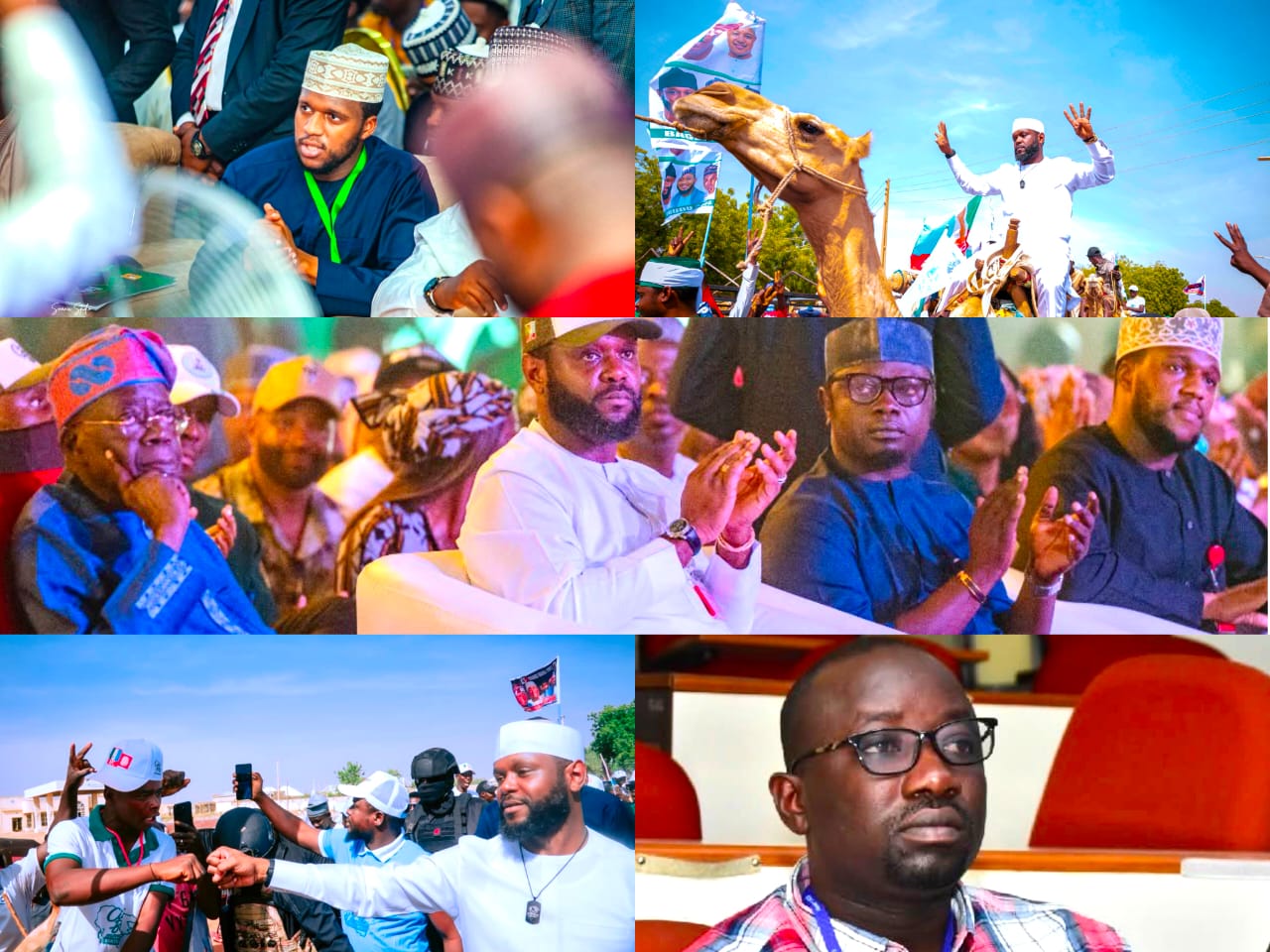
In Nigeria’s ever-heated political discourse, few things attract sharper criticism than the visible involvement of a leader’s child in campaign activities. Suddenly, words like dynasty, entitlement, and nepotism fill the air. Yet a calm, objective look at reality reveals a much simpler truth. Seyi Tinubu and Amir Kashim Shettima are actively participating in political campaigns to support their parents in retaining office, doing precisely what any supportive and loyal child would do. Public participation remains a fundamental right for every citizen, and the fierce, knee-jerk outrage directed at their engagement exposes a profound level of misplaced cynicism and partisan hypocrisy.
Seyi Tinubu’s energetic mobilisation through the City Boy Movement and Amir Kashim Shettima’s active presence in rallying youth ahead of upcoming electoral cycles represent a natural expression of family loyalty and civic duty. Critics often resort to cynical distractions, questioning whether these young men are the ones actually contesting an elective post. Such queries are not only unnecessary; they are intellectually lazy. Neither Seyi Tinubu nor Amir Kashim Shettima has ever declared a run for public office. They are simply mobilising for their parents, performing the natural support and solidarity anyone would extend to their own family. Their active engagement is an exercise of support, not a self-serving ballot entry, making the resulting public outrage entirely hollow.
This principle of family support and legacy stewardship extends far beyond politics into virtually every professional sphere of human endeavor. In global corporate business empires, multi-generational legal chambers, and specialized medical practices, children routinely step in to support, manage, or expand enterprises built by their parents. When the child of a renowned surgeon assists in running a family hospital, or when the offspring of an accomplished industrialist joins a corporate board to protect shared institutional values, society does not scream nepotism; it recognizes stewardship, dedication, and continuity. Proximity to a craft naturally breeds expertise and a desire to preserve hard-won milestones, making professional or political support a universally accepted standard of loyalty.
Consider the United States for a broader historical perspective on political continuity and institutional resilience. George H.W. Bush served as President, and his son, George W. Bush, later occupied the same office following a rigorous democratic contest. No serious American commentator argued that the younger Bush had no right to enter politics or to support his father’s vision. The same country produced the political legacies of the Kennedys, the Roosevelts, and the Clintons. Democracy did not collapse under these famous names. Instead, voters decided based on performance and preference, proving that electorate scrutiny remains the ultimate safeguard.
Closer to home, look at the music world and cultural preservation. Fela Anikulapo-Kuti remains one of Africa’s greatest cultural and political voices. His sons, Femi and Seun Kuti, did not abandon the family craft because critics might shout dynasty. They continued the tradition, refined it, and built their own distinct musical legacies. No one of goodwill has ever suggested that Femi or Seun should have chosen a different profession simply because their father was a giant. Continuity of passion, mentorship, and skill was celebrated rather than condemned by society.
When examining public critique objectively, a profound hypocrisy underpins the anti-participation narrative. If leaders’ children chose to step back, remain entirely detached, and avoid public service or grassroots mobilisation, the very same critics would launch a barrage of cynical counter-attacks. They would loudly demand to know where the leaders’ children are hiding, accusing them of elitism or aloofness. Public commentators would ask why politicians are shielding their own families while allowing or using underprivileged citizens and poor children as political foot soldiers on the streets. Stripped of emotion, fairness dictates a simple conclusion: citizens cannot hypocritically condemn leaders’ children for participating in politics to support their parents, while simultaneously attacking them if they chose not to. The outrage is entirely manufactured; active participation is an expression of civic duty, not a crime.
A famous name can certainly open doors, secure platforms, and attract initial attention, but it cannot manufacture sustained public goodwill or electoral victory. In a democracy, the electorate retains the ultimate veto power. Ultimately, it is left for Nigerians to decide whether they are convinced or not when making their choice on election day. Voters evaluate candidates based on tangible outcomes, governance track records, and responsiveness rather than mere lineage, meaning that children of public figures must ultimately work twice as hard to prove their individual competence in the public arena.
Intelligent political analysis requires separating genuine governance malfeasance from predictable partisan anxieties and emotional bias. Familial association is never a disqualifier for civic participation. Whether in corporate enterprises, legal practices, musical dynasties, or unfolding Nigerian political alignments, children leveraging networks to support their parents represent loyalty and active citizenship. They do not bypass democracy because they simply exercise their fundamental right to participate in it while enriching the broader national conversation.
Abubakar M. Kareto is a Public Affairs Analyst and Strategic Communications Specialist focusing on governance, political economy, and public policy across Nigeria and Africa. He can be reached via X (@amkareto) or email (amkareto@gmail.com).
2027: Unmasking the Double Standard Behind Seyi Tinubu and Amir Kashim Shettima’s Participation
APC gubernatorial candidate Wali promises to sustain youth development if elected in Yobe
By: Yahaya Wakili
Yobe state APC governorship candidate Alhaji Baba Malam Wali mni has assured that, if elected, his administration would sustain the development initiatives of Governor Buni, particularly those focused on youth development, economic empowerment, and improved living standards.
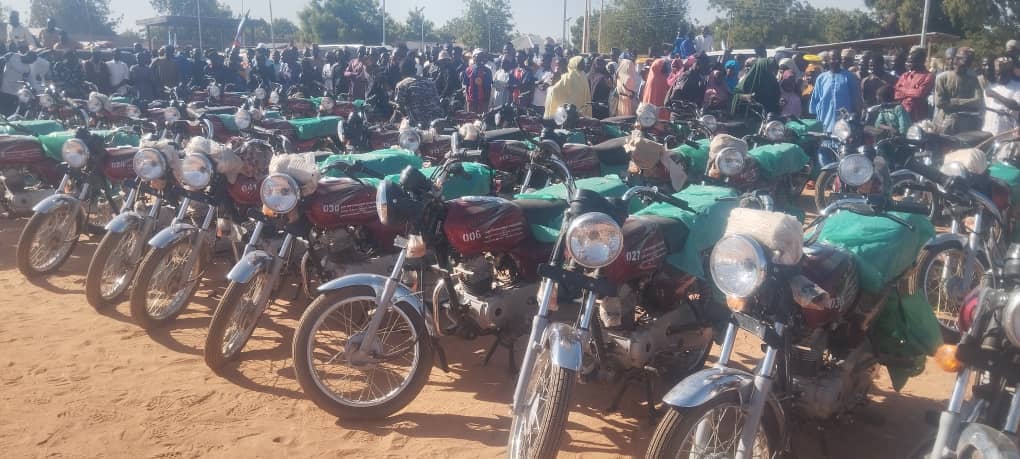
Baba Wali stated this today in Gadaka while flagging off the distribution of 500 empowerment items for youths and women in zone B on behalf of Governor Mai Mala Buni CON, COMN.
Wali said the initiatives reflected the government’s commitment to creating economic opportunities for the people, especially youths, by equipping them with the means to become self-reliant and productive members of society.
He maintained that the distribution of the empowerment items was designed to support beneficiaries in establishing sustainable means of livelihood.
The governorship candidate seeks reelection of President Bola Ahmed Tinubu GCFR and other APC candidates, citing examples of the developmental projects and programs initiated in the state and the country as a whole.
Baba Malam Wali further called on the people to come out and massively vote for Asiwaju and all other party candidates and emphasized that continuity would remain a guiding principle of Buni’s administration with renewed attention to programs that create opportunities for young people and enable them to contribute meaningfully to the state’s economic growth.
The distribution of the 500 items, which include 200 motorcycles, 100 tricycles (Jega), and 100 sewing machines, with beneficiaries cutting across youths and women, among others, is geared towards promoting inclusive economic participation and addressing unemployment through practical empowerment interventions.
APC gubernatorial candidate Wali promises to sustain youth development if elected in Yobe
ADC Massive Crowds Welcome Atiku, Intimidates APC in Yobe
By: Yahaya Wakili
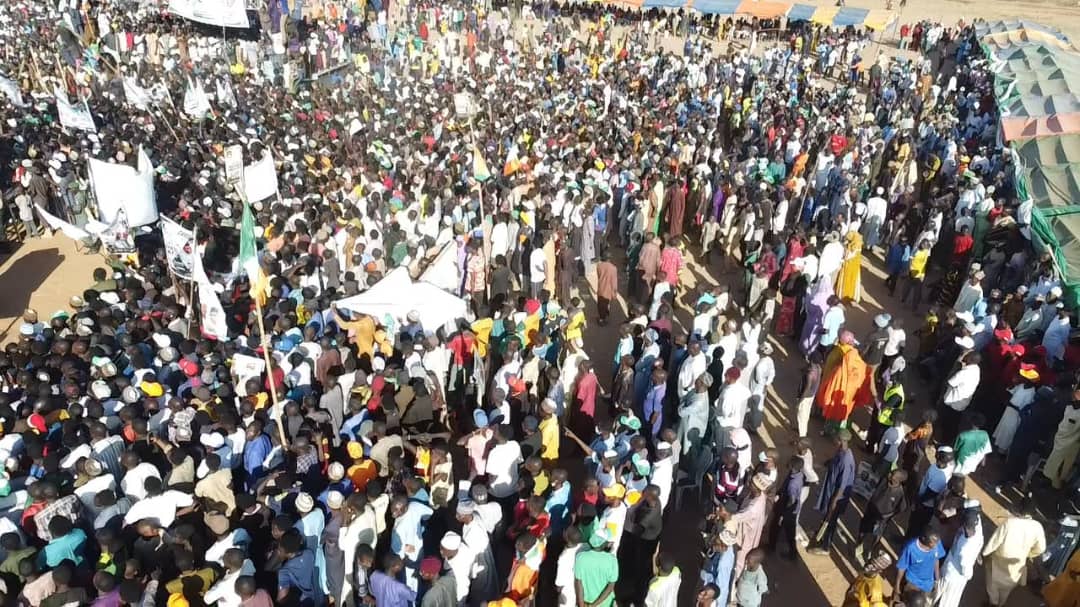
A massive crowd of supporters today welcomed the former Vice President and ADC Presidential candidate, Alhaji Atiku Abubakar, in Potiskum, the largest and most commercial city in Africa, and Yobe State in continuation of his political campaign across the country.
A large number of supporters, including youths, women and elderly residents, gathered to welcome Atiku and his entourage. The rally attracted a large turnout of supporters and marked what the campaign described as a historic event in the north-east.
Addressing a massive crowd of ADC supporters in Dabo Aliyu Stadium, Potiskum, the former Vice President and presidential candidate, Atiku Abubakar, said, ‘As I mentioned in other places, I swear if elected, I would return the oil and electricity subsidies, and nobody will increase your tax.’
“I would restore peace in Yobe and Nigeria, and for those youths who oppose peace in Nigeria, we will address them, assuring the people of Yobe that the ADC party is committed to empowering our youths to become self-reliant,” Atiku Abubakar said.
“Vote for competent persons; don’t vote for those who would steal your money.” Please note that all the promises I made will not become a reality unless you come out, cast your votes, protect them, count them, and ensure they are counted. Don’t allow somebody to snark at your votes.
He revealed that “I want you to promise in the presence of your leaders, in the presence of Almighty Allah, that you will vote for ADC from top to bottom.”
ADC Massive Crowds Welcome Atiku, Intimidates APC in Yobe

Fiscal Responsibility Commission Seeks Stronger Enforcement Powers, More Funding, Act Amendment

NHRC Seeks Stronger Dutch Partnership to Protect Civic, Political Spaces Ahead of 2027 Elections

Berom Militia Kill Three Fulani in Riyom injured One Other

Roger Federer’s Shock as DNA Results Reveal Myla and Charlene Are Not His Biological Children

THE PLIGHT OF FARIDA

FAILED COUP IN BURKINA FASO: HOW TRAORÉ NARROWLY ESCAPED ASSASSINATION PLOT AMID FOREIGN INTERFERENCE CLAIMS
-
 News3 years ago
Roger Federer’s Shock as DNA Results Reveal Myla and Charlene Are Not His Biological Children
-
Opinions5 years ago
THE PLIGHT OF FARIDA
-
 News2 years ago
FAILED COUP IN BURKINA FASO: HOW TRAORÉ NARROWLY ESCAPED ASSASSINATION PLOT AMID FOREIGN INTERFERENCE CLAIMS
-
 Opinions5 years ago
POLICE CHARGE ROOMS, A MINTING PRESS
-

 News3 years ago
EYN: Rev. Billi, Distortion of History, and The Living Tamarind Tree
-

 ACADEMICS3 years ago
A History of Biu” (2015) and The Lingering Bura-Pabir Question (1)
-

 Columns3 years ago
Army University Biu: There is certain interest, but certainly not from Borno.
-

 Politics1 year ago
2027: Why Hon. Midala Balami Must Go, as Youths in Hawul and Asikira/Uba Federal Constituency Reject ₦500,000 as Sallah Gift
