
Columns
Prof. Ahmed Ahidjo’s reappointment, a reward for notable achievements

Prof. Ahmed Ahidjo’s reappointment, a reward for notable achievements
By: James Bwala
It did not come to many as a surprise. Professor Ahmed Ahidjo, a renowned Interventional Radiologist deserved it. It was a result of hard work and for those who know the University of Maiduguri Teaching Hospital, UMTH before and the glaring difference today, one would agree to the facts on ground. It could not have been possible but one man working with data makes it happen. Today, the UMTH as being referred to is the largest hospital in Nigeria housing some of the best brains in the medical profession.
When I got the hint of his reappointment as CMD last night by the President and Commander in Chief of the Armed Forces, Federal Republic of Nigeria Muhammadu Buhari, I knew it would happen. The note I received reads: “President Muhammed Buhari has approved the reappointment of Professor Ahmed Ahidjo as the Chief Medical Director University of Maiduguri Teaching Hospital for a second term tenure of 4years”. I recalled our discussion during an interview with the Professor when my colleague, having heard him speaking on his achievements and award, concluded that for his achievements there must be a concomitant agreement for him to continue with the good work he is currently undertaking at the UMTH.
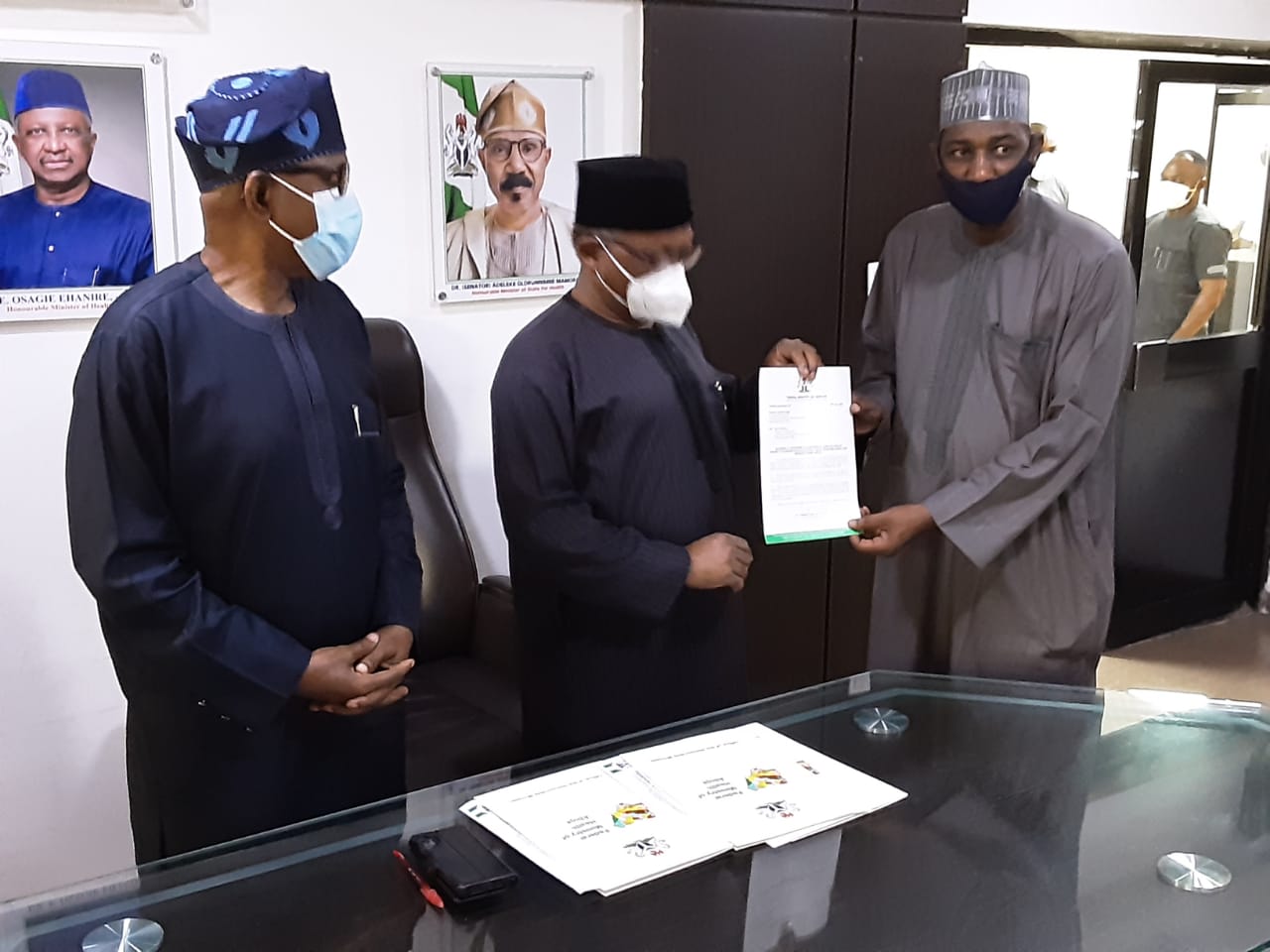
The reappointment which was conveyed to him by the Hon. Minister of Health on Friday, July 1, 2022 at the conference room of the FMH is to take effect from 3rd September, 2022. In the last three and a half years of his administration at UMTH, Professor Ahmed Ahidjo has brought a lot of changes in the management of the health system. The Professor of Interventional Radiology has combined both technical and managerial skills to change the way and manner things are done in the hospital making staff attend the best practices through behavioral change.
While congratulating Professor Ahidjo on his reappointment, the Minister of Health, Osagie Ehanire reminded him of the enormous responsibilities of his office and the yearnings of the people for effective and responsive healthcare services.
The Minister also advised the CMD to justify the confidence reposed on him by the President, Muhammadu Buhari commander in chief of the armed forces federal republic of nigeria and urged him to work with all stakeholders to ensure industrial harmony in the health sector and in support of Mr President’s Change Agenda.
The Professor has carved a niche for himself in his ability to turn around the physical structure and operational structure of the hospital within a short period of his appointment as CMD. During an interview recently, he answered some boggling questions about management skills he acquired to be able to work wonders in the administration of the UMTH.
Also Read: Kashim Shettima: An epitomic genre from Borno
According to him, he only had leadership training in health. However, having been a leader since his days as student’s union leader, Professor Ahmed Ahidjo developed and learnt by the ropes over a period of time to manage people and resources in making the difference in any area of development that he found himself. Therefore, when he came on board as the CMD for the first time he came equipped with knowledge on what is expected and what to do to change the old system and to bring in new and workable ideas that translated into what the University of Maiduguri Teaching Hospital is today. From a 630 bed rated hospital to a first class hospital and the largest in Nigeria with 1200 bed capacity.
Recently, Professor Ahmed Ahidjo was recognized by the National Productivity Centre and selected for an award where Mr. President was in attendance and so much was said about him from being a specialist to a good Manager of human and capital resources. One of the areas for recognition is that he was the first person to introduce Interventional Radiology Service in Nigeria and the West African sub-region.
Also the award was as a result of the work he has done at the Maiduguri Teaching Hospital to free bed space from the female and male medical ward through the construction of an extension for an 85 beds extended Kidney centre, to building the first stroke dedicated centre in the whole of West Africa, a 150 bed capacity as well as building another 150 bed capacity trauma centre, which was dedicated centre for the treatment of burns
Professor Ahmed Ahidjo held from Askira/Uba local government area of Borno state, in northeast Nigeria. He is from a village called Yimirgo and started his early primary school at Yimirgo Primary school from where moved to Government Secondary School Uba where he did his form one to three.
In those days, they would choose the best student to go to science schools. So he was chosen to go to WAKA Biu science school to complete his secondary school. From there he went to ABU Zaria then it was the school of Basic Studies, where he did his A levels. He return to Borno state and register at the University of Maiduguri to study medicine. Thereafter, he started his residency training programme – that is the Post Graduate medical training to become a Consultant.
Professor Ahmed Ahidjo was at the West African College of Surgeon faculty of Radiology and also the National Post Graduate College of Nigeria bagging two fellowships with specialization in Radiology.
Immediately after that, he felt the need to further his education, so he went to the Medical University of Vienna in Austria where he studied Interventional Radiology and became the first person in the West African sub-region to do interventional Radiology. He was also at the University of Washington to further study interventional Radiology as a specialty. He completed that study within a year and returned home to establish interventional Radiology in Nigeria.
Administratively, He was Head of Radiology Department at the University of Maiduguri and University of Maiduguri Teaching Hospital for almost ten years. He became the pioneer Head of Radiography Department to start training of Radiographers in the 19th Northern states. He also became the Deputy Provost College of Medical Sciences for a period of two years. Thereafter, he became the Provost, College of Medical Sciences University of Maiduguri.
He was also the secretary National PostGraduate Medical College of Nigeria in charge of Radiology training in the country for a period of four years in Lagos. From there he became the Chief Medical Director –UMTH. Within the period he also worked at the World Head Organization’s Headquarters in Geneva in Charge of all the Radiology devices globally with 198 member countries.
He was also a Research Scholar at the Uniformed Services University of Health Sciences in Maryland. Since becoming the CMD for over three years now he has been working in the office.
Professor Ahmed Ahidjo is happily married with Children. How wishes are big and part of that is the transformation being witnessed at the University of Maiduguri Teaching Hospital in Borno state.
Prof. Ahmed Ahidjo’s reappointment, a reward for notable achievements


Radical Approach: Ways of Ending the Menace of Insecurity in Nigeria
By Balami Lazarus
Insecurity remains the most daunting challenge confronting Nigeria today, undermining our very existence and threatening the social and economic fabric of the nation. As a concerned citizen and observer of Nigeria’s ongoing crises, I hereby present my personal and radical perspective on how to eradicate this menace once and for all. This discourse is not an official stance of any institution but rather a heartfelt plea for decisive and transformative actions.
The scale of insecurity in Nigeria is alarming. Kidnappings, banditry, and terrorism have become the ominous triad casting a shadow over the country. Daily headlines recount stories of abductions, killings, and destruction of property, raising urgent questions: Are Nigerians truly safe? What concrete measures have our leaders put in place? Equally important, what roles are citizens playing in reversing this trend? The answers to these questions are not encouraging.
Drawing inspiration from the defiant spirit of the rock band Twisted Sister and their 1984 anthem, “We’re Not Gonna Take It,” the Nigerian people are increasingly exasperated with governmental inertia and broken promises. There is a collective realization that the status quo is untenable, and something must change radically. Yet, the fog of insecurity thickens, shrouded in layers of suspected conspiracies and opaque dealings that complicate straightforward solutions.
Having reflected deeply on the root causes and potential remedies, I propose a multi-dimensional and radical strategy aimed at dismantling the structures that perpetuate insecurity. This approach challenges conventional wisdom and demands bold leadership and citizen cooperation. It begins with the fundamental re-evaluation of Nigeria’s historical, geographical, and political arrangements—a re-examination crucial for any meaningful intervention.
First and foremost, restructuring Nigeria is imperative. Our current centralized system breeds inefficiency and disconnects governance from ground realities. A major component of this restructuring is the establishment of state police forces across all federating units. Each state should deploy well-trained, properly equipped security personnel, armed with sophisticated weaponry and clear operational mandates to combat insurgents, kidnappers, and bandits proactively. Presently, the absence of localized policing forces handicaps rapid response and intelligence gathering, allowing criminal elements to thrive.
State police would serve as frontline defenders, customizing security strategies to the unique threats within their jurisdictions. The federal police force can then focus on broader national security tasks rather than overstretching its already limited resources. By decentralizing policing, the government would empower states to take ownership of their security challenges, fostering accountability and efficiency.
Nigeria has already paid a dear price in lives lost and properties destroyed due to insecurity. The ripple effects extend to economic downturns, reduced foreign investment, and increased poverty—factors that further entrench instability. Given the apparent lack of political will by federal authorities to decisively confront these threats, an alternative democratic mechanism such as a national referendum on regional governments should be considered. This would allow the six geopolitical zones plus the Middle Belt to govern their affairs with greater autonomy, tailoring policies and security frameworks to local needs.
Such regionalism could dilute the potency of criminal networks by disrupting their operations and reducing the power vacuum currently exploited in many areas. Regional governments would also be better positioned to address socio-economic development, a vital component in the fight against insecurity since marginalization and unemployment often fuel violence.
However, if these reforms fail or are ignored, a more drastic option looms: the peaceful separation and balkanization of Nigeria into distinct republics. While controversial, this last-resort proposal recognizes the deep divisions exacerbating insecurity and mistrust among ethnic and regional groups. Envision independent states such as Biafra, Oduduwa, Niger Delta Republic, Middle Belt Republic, and Arewa, alongside any other ethnic groups seeking self-determination. Would insecurity persist in this new arrangement? I argue capital “no.”
Fragmenting the country along ethnic and cultural lines could usher in relative peace by allowing homogeneous populations to govern themselves without imposed central authority that currently breeds conflict. While skeptics fear such a breakup could trigger further violence, history suggests that forced unity without consensus breeds chronic instability. Thus, a consensual and peaceful partition might be preferable to ongoing bloodshed and despair.
This is not a call for reckless division but a candid assessment of the realities Nigerians face daily. The government, under the leadership of President Ahmed Bola Tinubu, stands at a crossroads. It can either embrace genuine reforms and act boldly to restructure governance and security frameworks or risk the disintegration of the Nigerian state altogether.
I believe Nigeria’s insecurity crisis demands radical and multifaceted solutions beyond incremental adjustments. The establishment of state police forces, regional autonomy through a national referendum, and, if necessary, peaceful balkanization represent pathways to ending this menace. The time for rhetoric is over; the moment for courageous and visionary action is now. If neglected, Nigeria’s unity and stability will unravel, leaving behind fractured states grappling with even graver challenges.
I urge the government, stakeholders, and citizens alike to consider these proposals thoughtfully and engage in frank discussions about the future of our nation. Only then can we hope to reclaim the peace and prosperity that every Nigerian deserves.
Balami Lazarus
Publisher/Columnist
08036779290
Radical Approach: Ways of Ending the Menace of Insecurity in Nigeria
Holdings in Three Arm Business Investments, a Path to Financial Freedom
By: Balami Lazarus
Long-term investments have never been the likes of most Nigerians. In fact, few have come to realize the secret of letting my money work for me through my investments in some going concerns (businesses).
Good and profitable investments in the three businesses
Arms will go a long way for financial independence and freedom.
Let me draw your attention to life in the jungle where rules are conditioned based on territorial control. The honey badger, the most fearless of all animals, has no respect for territories, including the swamps where crocodiles are kings. The Honey Badgers have long realized that their physical strength and ability do not lie in their size but in their biological capacity and anatomical system to do what they are used to doing at ease among other animals in the wild.
Similarly, if you invest and take a position in the three business investments, no doubt your returns on investments (RoI) will give you the desired results to control and rule without territorial limits in your domestic affairs and the environment.
I am not a business owner but a part owner of some businesses. One thing I know, and I always do, is to continue to develop and improve myself with knowledge in business investments for financial freedom and independence, considering my attitudes for self-freedom for when to do and/or not to do. Reasonably, you can exhibit this financial freedom through your returns on investments (RoI).
This has taught me what to do and when. It has further educated me on how, when, and where to invest—short or long-term period. I have also learned to develop some businesses and lease them out to other people to run them.
The information age has these days made making money through investments much easier and cheaper for those who want to be financially independent if tomorrow comes, most times with a modicum of health.
challenges.
Investment benefits will improve and
stabilized your mental and social life; an alibi to aging gracefully when the body is tired, weak, and fragile.
What are these three (3) arm investments? The phrase is my coinage, which simply means property (real estate), agriculture, and stocks. While some called it business streams. However, the good
The thing about investments is that an investor is making money in other businesses and is free from being part of the management of the business.
Therefore, the objective of every business investment is to translate them into financial gains. That is why core investors are always on the lookout for investment opportunities to put their money in and become part owners of the business concerns.
This piece, I believe, will be food for thought for wise minds. Better late than never.
Balami, Publisher/Columnist 08036779290
Holdings in Three Arm Business Investments, a Path to Financial Freedom
Columns
Companies: Season of Dividends Declaration and Payments for Her Shareholders Worth Billions of Naira

Companies: Season of Dividends Declaration and Payments for Her Shareholders Worth Billions of Naira
By: Balami Lazarus
This piece made me recall my attempt to write the Chartered Institute of Stockbrokers (CIS) examinations years ago that I cannot remember now. I deliberately failed to continue with no reasons to give or shift blame as an escape route, which humans many do to console themselves of their failures. I (the writer) have learned never to do that.
However, no knowledge or experience is a waste for a wiseman. Hence, this work is derived from the knowledge gotten from the handouts and books I read on capital, equity, and/or stock market investments, where patience is the guiding principle as an investor taking into consideration this formula: Money > Units (Stocks) × Time + Patience = capital appreciations/dividends.
Many Nigerians are unaware of this equity/capital market. And if they do, they lack knowledge on what to do and how to invest in this market (kasuwan hanun jari).
It will shock you to know that there are so many share certificates in the hands of the citizens, amounting to thousands of units of shares worth billions of naira put together, laying fallow, not knowing what to do with them.
For I have seen many and assisted friends and relatives on what to do. Thanks for the digitalization of the market; it has made things much easier for investors and traders, including dividend payments currently taking place.
And surprisingly, there is over $190 billion in unclaimed dividends in the coffers of the federal government under the watch of the Securities and Exchange Commission (SEC), which is the regulatory body.
This large amount of money came as a result of some shareholders not knowing how to claim their dividends. While others may be due to the attitudes of procrastination.
The Nigerian Stock Exchange (NSE), now officially Nigerian Exchange Group Plc, which is run as a public liability company guided by the Companies and Allied Matters Act (CAMA), with its nomenclature as (NGX), also has her stocks traded on the exchange floor at Lagos.
I will not say much on the NGX. But be informed it is the trading floor of public companies’ stocks listed with the exchange where traders and investors can buy and sell their stocks or simply shares from Mondays to Fridays (5 times) in a week from 9am to 2pm daily.
Every year most companies hold their Annual General Meeting (AGM), informing their shareholders of the progress of their companies and whether or not to declare dividends to their shareholders depending on the strength of profits after tax (PAT) to those whose names appear on the list of the company registrars before the date of declaration.
The season of dividend declarations is most times done in April through June of each year. However, companies’ dividends vary in the sum of money paid to their shareholders depending on their units’ holdings in each company as part owners.
Dividends have added monetary value to shareholders and, by extension, improved the capacity of small- and medium-scale businesses in the economy because of the large amounts of money that have been paid into their various accounts either as individuals or as business enterprises.
Investors and capital market watchers are one group in society that is better informed on this segment of the Nigerian economy. And the investing group of citizens are making millions upon millions of naira from their investments in the market.
Take Guaranty Trust Company (GTCO) Plc, owners of Guaranty Trust Bank, as an example. Having declared a dividend of 11.67kobo per share for her shareholders. And assuming you, the reader, have a shareholding of only 1 million units. #11.67k x 1m = to #11,670,000 less 10% withholding tax (WHT), you will be credited with #10,503,000 your dividend as return on investment (RoI) on 28th April 2026 payment date.
What a profitable investment/dividend payment season.
Balami, Publisher/Columnist. 08036779290
Companies: Season of Dividends Declaration and Payments for Her Shareholders Worth Billions of Naira

Radical Approach: Ways of Ending the Menace of Insecurity in Nigeria

UN Women, TY Danjuma Foundation Boost Rural Women’s Livelihoods with Agro-Processing Centre in Abuja Community

Police Arrest 21 Suspects, Recover 20 Motorcycles in Zamfara Crackdown

Roger Federer’s Shock as DNA Results Reveal Myla and Charlene Are Not His Biological Children

THE PLIGHT OF FARIDA

FAILED COUP IN BURKINA FASO: HOW TRAORÉ NARROWLY ESCAPED ASSASSINATION PLOT AMID FOREIGN INTERFERENCE CLAIMS
-
 News2 years ago
Roger Federer’s Shock as DNA Results Reveal Myla and Charlene Are Not His Biological Children
-
Opinions4 years ago
THE PLIGHT OF FARIDA
-
 News1 year ago
FAILED COUP IN BURKINA FASO: HOW TRAORÉ NARROWLY ESCAPED ASSASSINATION PLOT AMID FOREIGN INTERFERENCE CLAIMS
-

 News2 years ago
EYN: Rev. Billi, Distortion of History, and The Living Tamarind Tree
-
 Opinions4 years ago
POLICE CHARGE ROOMS, A MINTING PRESS
-

 ACADEMICS2 years ago
A History of Biu” (2015) and The Lingering Bura-Pabir Question (1)
-

 Columns2 years ago
Army University Biu: There is certain interest, but certainly not from Borno.
-

 Politics1 year ago
2027: Why Hon. Midala Balami Must Go, as Youths in Hawul and Asikira/Uba Federal Constituency Reject ₦500,000 as Sallah Gift
