
Crime
Naira Redesign: 3 Serving Governors Under EFCC’s Watch List For Stashing Billions Of Naira In Their Houses – Bawa


Naira Redesign: 3 Serving Governors Under EFCC’s Watch List For Stashing Billions Of Naira In Their Houses – Bawa
Three serving state governors are being monitored over their moves to launder stashed billions of naira through table payment of salaries to workers, Chairman of the Economic and Financial Crimes Commission (EFCC), Abdulrasheed Bawa said.
He said raid on Bureau De Change operators will be sustained, urging Nigerians to support the system, for the benefit of all.
In an exclusive interview with Daily Trust, the EFFCC chairman disclosed that some governors are all out devising means to launder money they stashed in houses. He said so far, they are closely monitoring three of them.
Bawa, who refused to disclose the identity of the three governors, however, said two of them are from the North, while the 3rd one is from the southern part of the country.
He said intelligence at the disposal of the commission, showed that the three governors have concluded plans to inject the money into the system through table payment of their state workers’ salaries.
“Let me tell you something, the Intel that I have yesterday and I would want you to take this thing very seriously. Already, some state governors that have some of this cash stashed in various houses and the rest are now trying to pay salaries in cash in their state,” he said.
Asked whether the commission would summon the governors, the EFCC chair said they are closely monitoring them.
He added that “I don’t know how they want to achieve that but we have to stop them from doing that. Well, we are working, they have not paid the salaries in cash yet but it is a very serious thing”, saying the move is against section 2 of the Money Laundering Prohibition Act.
“The law is very clear regarding cash transactions. Anybody that is to consummate any cash transaction as an individual, if it is not through a financial institution must not be above N5million and if it is above that it is criminal for you to engage in such transaction. And for corporate entities it is N10million.
“Yes, I agree the salaries are not up to that but why are you all of a sudden, and all along you have been paying people salaries through their bank accounts and now you want to pay them in cash, what are you trying to do? They will come under a lot of guises, they are trying to do verification of officers, that is what we have gotten,” he said.
The EFCC boss also confirmed the mad rush by some people to dispose of their stashed funds by buying property.
“We are aware of that. Even if you dispose of your property and you receive cash, for that cash to be of value to you after January 31, 2023, you have to take it to the bank; so what happened, are you coming to the bank with those millions? That is why we are working with the bankers and if you have this information let us know about it,” he said.
He said the raids of BDC operators would continue. This he said, is very important to protect the system against the laundering of stashed funds.
“They (BDCs) are very important in the sense that a lot of people that have this naira cash, will want to convert them to USD or other foreign currencies, that is why they are very important.
“And based on the known gullibility of these people (BDCs), they are willing to accept this cash from the owners of these monies and they are willing to depart with the foreign currencies that they have and so that is why they are very important and very critical to us in this project that we said to ourselves that we are going to do,” he said. When Bawa’s attention was drawn to the fact that the dollar was rising despite the EFCC raids, he said it is a function of demand and supply.
“The truth of the matter here is just a simple function of demand and supply, people are rushing this commodity not that they are going to use it for any meaningful business engagement but they are just rushing for it, just a store of value, that is what is happening.
“And what they say in economics is the higher the demand, the higher the price; so people are just seeing USD or other hard currencies just the way that they are seeing gold, to get it exchanged and store their value,” he said.
On why he met chief compliance officers of banks in Lagos recently, he said the parley was part of efforts to properly monitor the system and to seek their collaboration in respect of the likelihood of people bringing in their illegitimate funds back to the system.
“We knew a lot of people are hoarding these funds, it is with them and they will always find a way of trying to bring it back to the system.
“So, irrespective of what they use their cash for, whether they exchange it for dollars, whether they use it to purchase houses for those that are willing to accept cash, it has to eventually come back to the financial institution. So, irrespective of what you do, the banks are very important and critical in the sense that they are the end recipients of this cash.
“The owner of BDC must deposit the money he exchanged for the currency he did, the owner of real estate must also do the same and all of that. So, we sat down, we deliberated and we agreed on what to do. Everybody is happy about it,” he said.
He, however, urged Nigerians to be calm, saying “this (naira redesign) is just a routine thing that ordinarily CBN ought to have done after every eight years, the monies are going to be taken.
“All that the government is saying is come and deposit the money at no cost to you; that is just what is happening, nothing more than that. “How can you have an economy where you have 85 per cent of your currency out there when you are calling for a cashless society when we have a lot of means by which people can consummate their transactions? What are you hiding? These days, people hardly go to the banks, you can transfer your money here using your app, and you can transfer your money through ATM, POS, and all of that, so why keep the money? Why are you scared of going to the bank to say that you want to deposit your money? He queried.
Naira Redesign: 3 Serving Governors Under EFCC’s Watch List For Stashing Billions Of Naira In Their Houses – Bawa


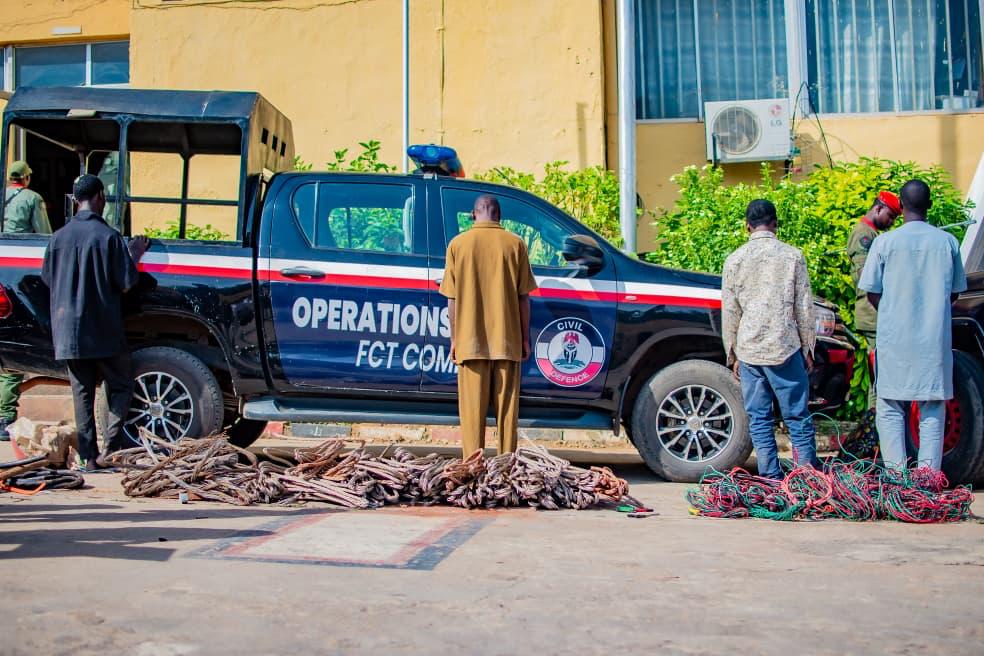
Cable Theft: NSCDC Uncovers Alleged Buyer Network, Arrests Four in Abuja
By: Michael Mike
The Nigeria Security and Civil Defence Corps (NSCDC) has arrested four suspects in three separate operations over alleged vandalism and trafficking of electricity cables in Abaji, Kubwa and Wuye areas of the Federal Capital Territory (FCT), uncovering alleged links between cable thieves and prospective buyers.
The arrests, involving high-tension aluminium conductors, electrical installation wires and armoured cables, followed an intensified crackdown on the destruction of critical national assets and infrastructure, barely a week after the corps paraded suspected Abuja Electricity Distribution Company (AEDC) cable vandals arrested in Kwali Area Council.
The FCT Commandant of the NSCDC, Dr Olusola Odumosu, disclosed this on Wednesday in Abuja, warning that the corps would pursue not only those who allegedly remove electrical installations but also individuals suspected of buying, receiving, concealing or facilitating the sale of stolen materials.
In one of the operations, two men were arrested over the alleged removal of electrical installation cables from Government Secondary School, Kubwa, popularly known as Black and White Secondary School.
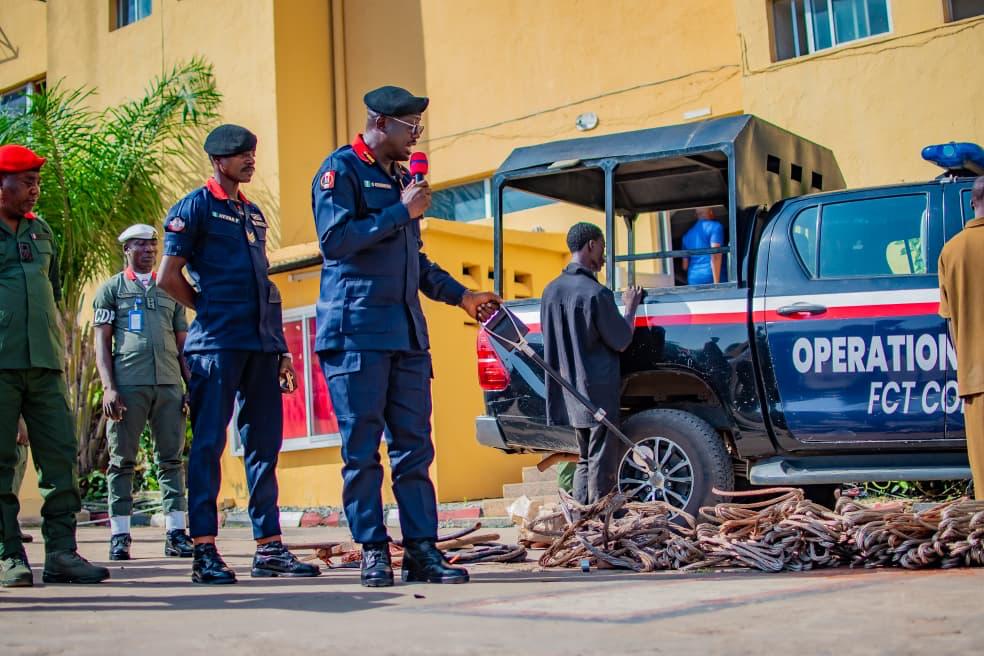
The suspects were identified as Amos Makama, 27, from Kokona Local Government Area of Nasarawa State, and Ibrahim Mohammed Maitama Inuwa, 27, from Dala Local Government Area of Kano State.
Odumosu said the incident occurred at about 1 a.m. on Saturday, October 17, following reports of suspicious movements around the school’s perimeter.
NSCDC operatives attached to the Kubwa Base Station reportedly apprehended Makama at the scene and recovered about 38 rolls of electrical installation cables, cut pieces of power cables concealed in a sack, a pair of pliers, a screwdriver and other items suspected to have been used in the operation.
Preliminary investigations, according to the commandant, indicated that Makama allegedly gained access to the school through its gate in the evening, cut electrical wires in the buildings and remained on the premises until around midnight before attempting to escape over the fence with the materials.
Odumosu said the suspect allegedly disclosed that he had contacted Inuwa to buy the cables and that the latter had paid an advance of N35,000.
The command subsequently contacted the alleged buyer under the guise of arranging the sale of the materials, leading to his arrest when he arrived at the agreed location.
Both suspects reportedly confessed to involvement in the business and said they had been engaged in it since 2024. The allegations and reported confessions have not been tested in court.
In a separate operation at the Residential Quarters in Abaji Area Council, NSCDC anti-vandal patrol operatives arrested a 44-year-old man, Mammud Nuhu, over the alleged unlawful possession and storage of high-tension aluminium conductor cables suspected to have been removed from critical electricity infrastructure.
Odumosu said the arrest followed credible intelligence and sustained surveillance by the command’s anti-vandal team.
According to him, preliminary investigations indicated that Nuhu allegedly told investigators that two other men, identified as Saifullah, 32, and Abdulrahman, 25, had brought the cables to him for safekeeping pending their sale to prospective buyers.
The two alleged accomplices remained at large as of Wednesday, while the command said efforts were ongoing to apprehend them and identify other persons connected with the alleged criminal activity.
Bundles of high-tension aluminium conductor cables suspected to have been vandalised from an AEDC installation in Abaji were recovered. Nuhu was profiled and his statement obtained after he was cautioned before he was granted administrative bail to produce a credible surety, the command said.
The third operation followed a tip-off from members of a local vigilante group about suspicious activities around Berger Roundabout along the Wuye axis of Abuja.
Odumosu said an officer attached to the command’s Critical National Assets and Infrastructure department received the information during a routine patrol at about 10.30 p.m. on October 20.
The operatives subsequently arrested a 20-year-old man, Suleiman Jafaru, from Riyom Local Government Area of Plateau State, over alleged excavation and theft of armoured cables.
An unspecified quantity of armoured cables and a digger were recovered at the scene, according to the command.
Preliminary investigations reportedly indicated that three people were involved in the operation, with two alleged accomplices escaping before Jafaru’s arrest. Their identities and whereabouts had yet to be established.
The commandant also disclosed that Jafaru alleged he had been assaulted by members of the vigilante group before being handed over to NSCDC operatives. He said the allegation required appropriate documentation and verification.
Odumosu described the vandalism of electricity infrastructure as an attack on public welfare and economic development, noting that damaged cables could disrupt electricity supply, impose repair costs on service providers and businesses, and expose residents to electrocution and fire hazards.
He said small businesses, artisans, healthcare facilities and educational institutions were particularly vulnerable to the effects of power disruptions, while the cost of replacing stolen materials diverted resources that could otherwise be invested in improving electricity services.
The commandant warned that the alleged involvement of buyers and receivers in the cases highlighted the need to tackle the market for stolen electrical materials alongside the theft itself.
“The NSCDC FCT Command will therefore pursue not only those who physically remove these materials but also those who knowingly purchase, receive, conceal or facilitate their sale,” he said.
He urged residents, community leaders, commercial motorcyclists, tricycle operators, traders and scrap-metal dealers to report suspicious activities around electricity installations to the appropriate authorities.
Odumosu said the command would sustain intelligence-led operations and strengthen collaboration with relevant stakeholders to protect critical national assets and infrastructure across the FCT.
The latest arrests follow an earlier operation in Kwali Area Council in which the corps paraded suspected AEDC cable vandals, signalling an expanded enforcement effort against the theft and destruction of electricity infrastructure in the federal capital.
Cable Theft: NSCDC Uncovers Alleged Buyer Network, Arrests Four in Abuja
Crime
Court Warns Lawyers Against Delaying Trial of Four IPOB Suspects Over Alleged Killing of DSS Operative

Court Warns Lawyers Against Delaying Trial of Four IPOB Suspects Over Alleged Killing of DSS Operative
By: Zagazola Makama
The Federal High Court in Abuja has warned defence lawyers against actions capable of delaying the trial of four suspected members of the proscribed Indigenous People of Biafra (IPOB), who are accused of kidnapping and killing a Department of State Services (DSS) operative, Ekpeyong Asuquo Owoh.
Justice Joyce Abdulmalik gave the warning on Wednesday while ruling on an application by the prosecution to conceal the identities of its witnesses and considering requests by defence counsel for an adjournment.
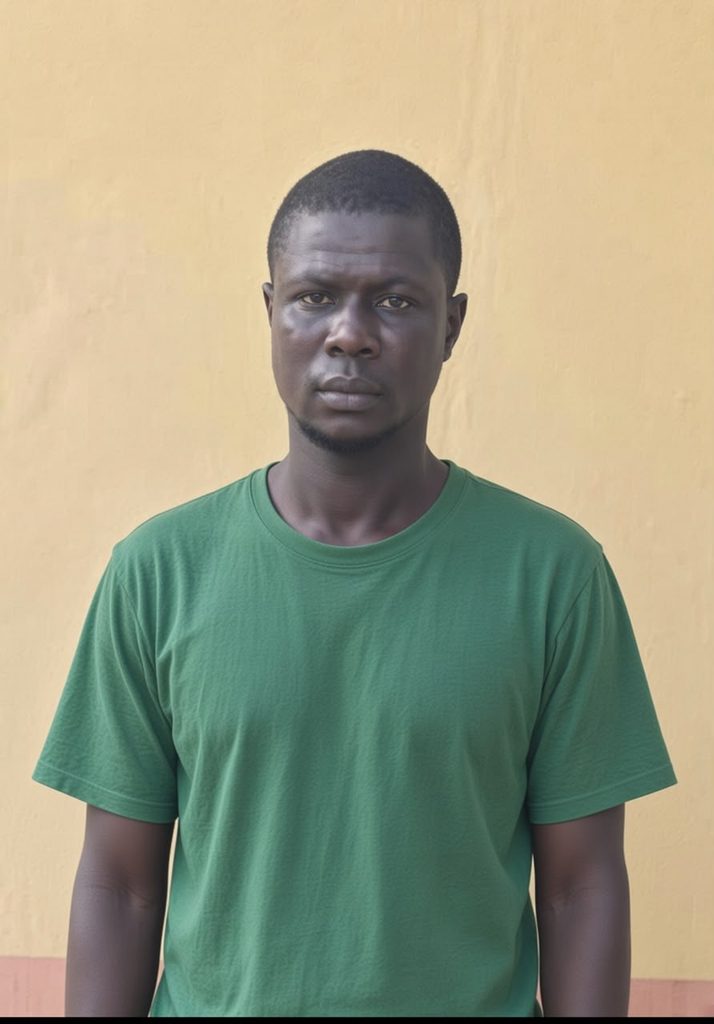
The defendants are Michael Okafor, also known as Onyechimeleze; Chinedu Chukwudozie, alias Kante; Chibunna Olisa; and Chigozie Olisa, also known as Ability.
They were arraigned on Sept. 28 on a six-count charge bordering on terrorism, kidnapping and other alleged offences. They pleaded not guilty to the charges.
The prosecution alleged that the defendants conspired to commit acts of terrorism and participated in the abduction of Owoh while he was travelling from Port Harcourt, Rivers State, to Awka, Anambra State.
They were further accused of taking the operative hostage and killing him.
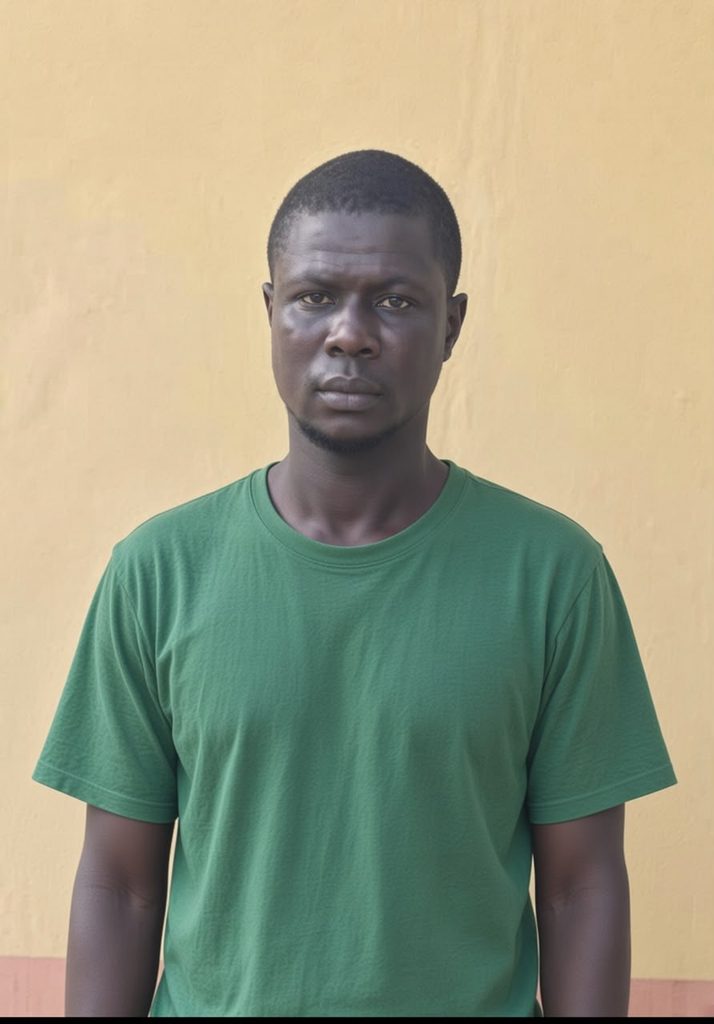
The defendants were also alleged to be members of IPOB and its armed wing, the Eastern Security Network (ESN), and to have been involved in activities linked to terrorism.
The prosecution further accused them of unlawful possession of firearms, including an AK-47 rifle and a pump-action gun, in connection with the alleged offences.
When the case came up on Wednesday, prosecution counsel, Munirat Oladunjoye, informed the court that the matter was scheduled for trial following the defendants’ denial of the allegations.
Oladunjoye applied for permission to conceal the identities of prosecution witnesses under Section 232(3)(b) of the Administration of Criminal Justice Act (ACJA), 2015.
She asked the court to allow the witnesses to testify under protected identities, arguing that the nature of the terrorism case warranted the measure.

However, Kelvin Ekwe, counsel to the first and second defendants, opposed the application, arguing that the prosecution had not demonstrated that revealing the witnesses’ identities would prejudice its case.
Ekwe also submitted that the application should be formally filed to enable the defence to respond appropriately and avoid being taken by surprise.
Justice Abdulmalik asked the lawyer to identify the legal provision requiring the prosecution to file a formal application before seeking such an order.
Ekwe relied on Section 36 of the 1999 Constitution, which guarantees the right to a fair hearing.
In her ruling, the judge agreed with the prosecution that exposing the identities of witnesses in a terrorism-related trial could undermine the interests of justice.
She consequently directed that the trial proceed with the witness identified by the code name “AB”.
The judge also warned that anyone who violated Section 232(5) of the ACJA would be liable to a one-year jail term.
The proceedings were subsequently disrupted by requests from the defence for an adjournment.
Geoffrey Uwadiegwu, counsel to the third and fourth defendants, told the court that he was appearing in the matter for the first time and needed additional time to study the case file.
Ekwe also informed the court that the prosecution had only recently served him with video evidence, insisting that he was not ready to proceed with the trial.
Oladunjoye responded that although the video evidence had just been served, it would not be used during the day’s proceedings.
She urged the court to allow the trial to continue, adding that Ekwe’s absence on Oct. 6 had contributed to an earlier adjournment.
The two defence lawyers subsequently stood up simultaneously to address the court on the need for an adjournment, prompting Justice Abdulmalik to caution them against unruly conduct.
“I run my court in line with international best practice, and that is why people say I am strict,” the judge said.
She added that proceedings in her courtroom must comply with the highest standards of courtroom discipline.
Justice Abdulmalik explained that she had a heavy workload, including several pre-election cases and at least nine judgments to deliver before Nov. 9.
She said she would ordinarily have been reluctant to list the matter for hearing because of the competing demands on the court’s docket.
However, she described the terrorism case as crucial and said it should be determined expeditiously.
After listening to the parties, the judge granted a short adjournment but warned the defence against any further conduct capable of delaying the proceedings.
The case was adjourned until Oct. 28, 2026, at the instance of the defence lawyers, for continuation of trial.
Court Warns Lawyers Against Delaying Trial of Four IPOB Suspects Over Alleged Killing of DSS Operative

Nigerian Army Arrests Notorious Suspect DJ Abam Over Alleged Reign of Terror in Peva
By: Zagazola Makama
The arrest of Denen Joe, popularly known as DJ Abam, has been described by residents of Peva and surrounding communities as a significant development in efforts to end years of alleged violence, extortion and criminal intimidation.
Abam, who was accused of operating a violent criminal network in the area, was reportedly apprehended by troops of the Nigerian Army following information provided by members of the community.
Accounts circulating within the affected communities attributed a series of violent crimes to the suspect, including kidnapping for ransom, cattle rustling, illegal taxation, unlawful detention, killings and the seizure of residents’ properties.
Residents alleged that Abam imposed illegal levies on locals, extorted money from community members and participated in large-scale cattle rustling and kidnapping operations.
He was also accused of issuing arbitrary judgments, detaining residents without lawful authority and collaborating with other armed groups to attack communities, burn houses and kill civilians.
One of the most serious allegations linked him to the killing of the late Zaki Sylvester Peter Suleagbough, a respected clan head who was reportedly targeted after speaking publicly against criminal activities.
Abam was alleged to have worked with another suspected gang leader, Verior John Gata, in connection with the killing. The allegations have not been independently verified.
The suspect was further accused of involvement in the murders of Terfa Iwambe and Paul Hwakar Ayuba, as well as an ambush on special forces personnel around September 2025, during which several security personnel were reportedly killed.
The exact number of casualties in the alleged ambush was not specified in the accounts provided.
Other allegations against Abam include the seizure of residential compounds and plots of land, collaboration with armed Fulani militants in attacks on communities, and sexual violence.
Residents also alleged that the suspect frequently boasted of killing security personnel and portrayed himself as beyond the reach of the law.
The allegations, if established, point to a pattern of criminal violence that reportedly left residents living in fear, with some allegedly forced to flee their homes or surrender their belongings.
The reported arrest has therefore raised hopes among affected residents that investigations could help establish responsibility for past crimes, recover seized property and bring other suspected accomplices to justice.
The Nigerian Army has continued to face the challenge of dismantling armed criminal networks operating in vulnerable communities, where residents often bear the brunt of killings, abductions, cattle rustling and disputes over property.
However, the allegations against Abam remain subject to investigation, and his arrest does not in itself establish guilt.
Authorities are expected to investigate the claims, determine the suspect’s possible links to other criminal networks and ensure that any prosecution is conducted in accordance with the law.
For residents who have endured years of insecurity, the development represents a potential turning point in their efforts to reclaim their communities from violence and intimidation.
Nigerian Army Arrests Notorious Suspect DJ Abam Over Alleged Reign of Terror in Peva

Congo: 10,000 confirmed Ebola cases demands rapid scale-up – NRC

AFD, BOI Sign $30m Deal to Unlock Finance for Nigeria’s Creative Sector

Family Seeks Fresh Probe into Missing Corpse at Anambra Hospital

Roger Federer’s Shock as DNA Results Reveal Myla and Charlene Are Not His Biological Children

THE PLIGHT OF FARIDA

FAILED COUP IN BURKINA FASO: HOW TRAORÉ NARROWLY ESCAPED ASSASSINATION PLOT AMID FOREIGN INTERFERENCE CLAIMS
-
 News3 years ago
Roger Federer’s Shock as DNA Results Reveal Myla and Charlene Are Not His Biological Children
-
Opinions5 years ago
THE PLIGHT OF FARIDA
-
 News2 years ago
FAILED COUP IN BURKINA FASO: HOW TRAORÉ NARROWLY ESCAPED ASSASSINATION PLOT AMID FOREIGN INTERFERENCE CLAIMS
-
 Opinions5 years ago
POLICE CHARGE ROOMS, A MINTING PRESS
-

 News3 years ago
EYN: Rev. Billi, Distortion of History, and The Living Tamarind Tree
-

 ACADEMICS3 years ago
A History of Biu” (2015) and The Lingering Bura-Pabir Question (1)
-

 Columns3 years ago
Army University Biu: There is certain interest, but certainly not from Borno.
-

 Politics1 year ago
2027: Why Hon. Midala Balami Must Go, as Youths in Hawul and Asikira/Uba Federal Constituency Reject ₦500,000 as Sallah Gift
