
Politics
Kashim Shettima: Of Sahara Reporters, The Lies And Satanic Theories of Reverend Kallamu Dikwa

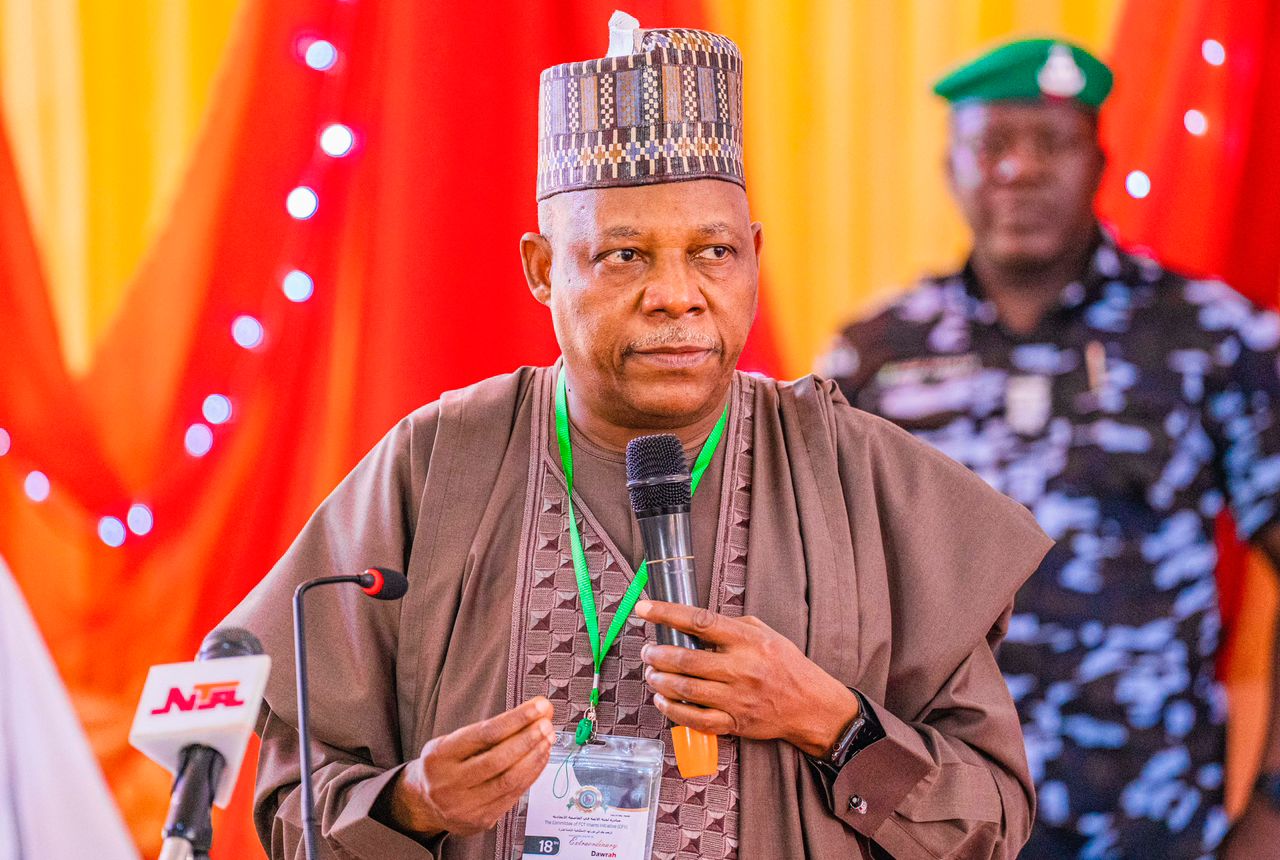
Kashim Shettima: Of Sahara Reporters, The Lies And Satanic Theories of Reverend Kallamu Dikwa
By: James Bwala
…And they shall know the truth and the truth shall set them free. I believe Reverend Kallamu Musa Ali Dikwa, Director General of the Centre for Justice on Religious and Ethnicity In Nigeria knows this scripture from the Book of John 8:32 as quoted in the beginning of this piece of writing. Indeed he has raised a weighty issue that many Christians would sit up to read from his lines of argument. But is Reverend Kallamu Musa saying the fact, especially about the former Borno state governor and APC Vice Presidential Candidate, Kashim Shettima?
I know that few people are magnifying the issues of religion in the ongoing campaign in the build up for 2023. However, the few still are rediculing themselves for choosing to attack the former Borno state governor over his choice as the running mate for the APC Presidential Candidate, Asiwaju Bola Ahmed Tinubu. I have told many people before and I am saying it again that no Borno state governor in history has favour the Christians than Kashim Shettima and he is still doing more. There are alot of Nigerians, who are very powerful and standing in the corridors of power. For many years they dictates what happen in the country and call the shots. They have caged many Presidents because their second in commands are weak however, now they are seeing a different ball game coming.
Kashim Shettima is both intelligent and powerful figure they cannot tow with. His coming as Nigeria’s Vice President will deflect the power of the courtiers in the centre. So, much focus was on him and the many reasons for the attacks. But if they failed to impress their pay masters for attacking Shettima in the past, how sure are they that if they continue to attack him, they will not end up praising him? Reverend Kallamu Musa was the next parrot available to use but he was never armed with facts. Again, they have failed and Sahara Reporters has failed to do the digging and fetched the facts from the statement they published. They have failed to ask to know when did Christian Religious Knowledge was stopped in public schools in Borno state. If they do, they would have known that it was far beyond the administration of Kashim Shettima, which lasted between 2011 and 2019.
I will take Reverend Kallamu Musa’s issue raised on the teachings of CRK in both primary and secondary school in Borno state.
As a journalist in Borno state, many who reads my bylines on the pages of the Nigerian Tribune Newspapers knows that I wrote with brave fingers and standing for the truth of what I know. It was on that premise that the late Bishop of Maiduguri, Emmanuel Kana Mani appointed me as the Diocese Director of Press Affairs even though I was coming from another Church. He (late) Emmanuel Kana Mani also gave me the award and honour as the defender of faith. When I write I do so as a journalist and nothing more. My pen to this day is neither Christian or Muslim but I stand for Justice where I stand. I read the publication by the Sahara Reporters with the title: “Former Borno Governor, Shettima Will Show He’s Anti-Christian At National Level If Voted In As Nigerian Vice President.” A statement to which it alleged in that report.
For a fact I know that Senator Kashim Shettima was not the governor of Borno state when the stoppage of teachings of Christian Religious Knowledge was hatched, planned and executed in Borno. Kashim Shettima was still a Banker seeking accounts to raise his cabals during the 1999 and 2003 reigns of late Borno state governor, Mala Abdulsalam Kachallah. So, I don’t know how this relates to his (Shettima’s) administration, which came between 2011 and 2019. I had the opportunity to sit in a group to chat with those who pushed for the removal of CRK in the school curriculum. And I understand what happened and how they force the government of late Mala Kachallah to succumb. This is certainly not about government policy but the inroad to Islamic fundamentalism in the buildup to Boko Haram insurgency in the state. It happened during the administration of late Kachallah and I got to know this during the Modu Sheriff administration where one Malam Buni, a former foot soldiers in the rank of the Yusufia Movement began the discussion on how they fought the Late Mala Kachallah’s government to stop the teachings of Christian Religious Knowledge in government schools in Borno state. That was the period between 2003 and 2011. Kashim Shettima was not the governor of Borno state at that time.
All those who had lived in Maiduguri, the Borno state capital between 1999 and 2003 are aware of the spiritual movement by a section of the Islamic group that later metamorphosis into what is now known as BOKO HARAM. Before then, those who could recalled would agree with me that, these group of people forces the government to remove the Eagle status infront of the Maiduguri Government House. They force the removal of the status of a Horse and it’s rider at the biggest roundabout which leads routes to Post Office Area, GRA and Kashim Ibrahim way. They force the government to remove the status of the Fish at Baga road roundabout leading also to Galadima side.
They also force the removal of the status of Camels on the Custom House roundabout to mention few base on the knowledge of the believe that on the last day Allah will ask them to breath on these status life or face his wrath. These were some of their reasons. When all these was happening, the APC Vice Presidential Candidate Senator Kashim Shettima was still a Banker. So, where did Reverend
Kallamu Musa Ali Dikwa, Director General of the Centre for Justice on Religious and Ethnicity In Nigeria missed out on his analysis to say in his statement that Kashim Shettima was the governor of Borno state when these attrocities were happening?
READ ALSO: https://dailypost.ng/2022/11/02/demand-accountability-improved-healthcare-from-your-leaders-group-tells-borno-community/
On February 18,2006 there was a coordinated attacks on Christians and Churches in Borno state, which gave birth to a reprisal attack on Hausas and Northeners in Anambra state in southeast Nigeria. Fifty-Seven Churches were bunrt down and Christians bleeds. Kashim Shettima was not the governor of Borno state at that time. These are facts and those who keeps history have the dates. Indeed, the Boko Haram conflict NOT it’s establishment started in 2008 and snowball into a major riot in 2009. Majority of the people in Borno state especially Muslims never believed a time would come when they had to flee their homes in mass Exodus because many were relaxed, they never saw the conflict as a flood that would wash away their homes and livelihoods until it happened.
Kashim Shettima took the leadership of Borno state at the time the conflict was at the height of bleeding from everyside. The period between 2011 and 2019 when he leads Borno state, it was full of stories of laughter and pain for every citizen of Borno state who remains at the home front or those who had fled to hibernate or relocated completely. Several time, governor Kashim Shettima appeared frustrated with much that is bleeding inside. There was bashing from all sides that at a point he had to be restrained because he got to a point that he told the media that if he opens his mouth to speak, heads would roll. It goes to show that the pressure was too high on him in the occasion of what transpired and the government at the centre is not will to give a listening ears but are looking for a scarecrow to blame on the politics of human-hodding, the result of which has ended the Jonathan’s administration in the wave of the Buhari emergence.
To blame Kashim Shettima on the abduction of the Chibok School Girls was dramatic given the number of soldiers and other security agencies in the state at that time. The rights of the Federal government to assert it’s powers to prevent such unfortunate occurance that give birth to many other conflict that engulf not only the northeast but the entire northern region, the southeast and some part of the southwest and south-south of Nigerian states was not because the governors were too powerful that they could stop the federal might. So was the case with Borno state during the April 14, 2014 episode.
Reverend Kallamu Musa Ali Dikwa, Director General of the Centre for Justice on Religious and Ethnicity In Nigeria probably knew nothing or very little of what has transpired between 1999 and 2023 Or between 2023 and 2011 to have been running and chasing goose in trying to link Kashim Shettima with happenings around that time in Borno state. Kashim Shettima came at the time of trouble, as a governor he tries to heal the wound by reconstructing Churches hitherto bunrt down by Boko Haram in many villages across Borno state. He should approach the former CAN Chairman, Reverend Titus Pona and the likes Bishop Naga to speak about what the government did or did not do for Christians in the state. He should approach other clargy-men who were there to speak on what the government do on behalf of the Christian communities at that time. They have books and records.
The struggle to stop the teachings of CRK dates back to military era but it could not be achieved. According to Malam Buni, they got the final order to completely implement their plans when democracy returns in 1999 with the coming of the late Mala Kachallah’s government. For peace to reign, he (late Mala Kachallah) reluctantly agreed to their request and they move out as of the Biblical Saul with the zeal to do as they please. Malam Buni is still alive. I recently saw him in Abuja. This has no place in history to do with Kashim Shettima as governor of Borno state as Reverend Kallamu Dikwa would want people to believe from his theories of falsehood.
While politics must come to play, in society like ours, it should be played with the decency of facts especially from so called religious people who are throwing bad theories as historical facts. Reverend Kallamu Dikwa should go back and search the books. On other issues I shall remind him of facts tested by fire. Kashim Shettima would have barbicue the Christians in Borno where he had all the powers as a governor if he has an Anti-Christian policy. But Reverend Kallamu Dikwa should know that religion is bigger than any government especially in a country like Nigeria.
Kashim Shettima: Of Sahara Reporters, The Lies And Satanic Theories of Reverend Kallamu Dikwa



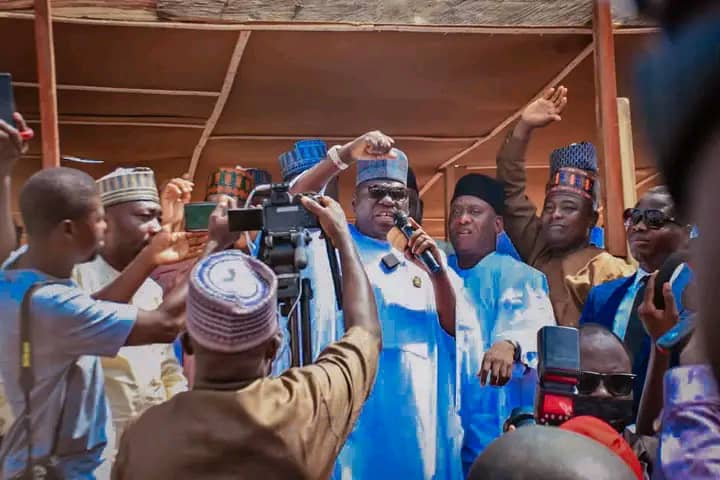
APC received 5000 decampees in Yobe
By: Yahaya Wakili
Yobe State All Progressives Congress (APC) has received 5,000 decampees from various political parties across the Yobe South Senatorial District (Zone B).
The All Progressives Congress receives defectors from the New Nigeria Peoples Party (NNPP), Peoples Democratic Party (PDP), and African Democratic Congress (ADC). The decampments are drawn from the Nangere, Fika, Potiskum, and Nangere local government areas.

Governor Mai Mala Buni CON, COMN, of Yobe State, ably represented by his deputy, Hon. Idi Barde Gubana (Wazirin Fune), assured those who shifted their loyalty to APC would be treated equally with the old members, adding that the APC believes in one Nigeria.
He appreciated the All Progressives Congress (APC) supporters for their commitment to the growth of the party, which, according to him, enhanced service delivery to the people of the state.
The governor expressed delight at receiving the decampments from the various political parties into the All Progressives Congress (APC), the ruling party in the state and Nigeria in general.
The state party chairman, Alhaji Mohammed Gadaka (Madakin Gudi), called on the people of the other political parties to join the APC to move Yobe state forward and assured to carry the new members along in all the party activities.
Hajiya Budu Lawan, the APC women’s leader in the state, promised that women in Yobe state would come out in mass to support and vote for the APC in the upcoming general election.
Hon. Musa Gulani, the state youth leader, expressed his appreciation for the youth in Zone B, adding that youth in Yobe state would vote for APC from top to bottom in the 2027 general election.
The APC governorship candidate, Alhaji Baba Mallam Wali mni (BMW), ably represented by his running mate, Hon. Sale Samanja, said, “If elected in 2027, we would uphold the legacies of Governor Mai Mala Buni. “
Hon. Yakubu Shehu Damagum (alias Yakubu Doctor), State chairman of the New Nigeria Peoples Party (NNPP), said, “I left the party last year due to some circumstances, but I didn’t join the APC officially till today.”
He said, “The reason behind my defection is that I watched the development strides in Yobe state under the APC administration of Governor Mai Mala Buni, and there is no need to continue fighting with the ruling party, because a small party in Yobe state has no impact.”
Abba Balube, a former chairman of the African Democratic Congress (ADC) from the Fune local government area, revealed that he decided to leave the ADC completely because of the bad leadership and because there is no respect in the party.
Ali DPO, former chairman of the Peoples Democratic Party (PDP) Potiskum local government area, said he joined APC, the ruling party in the state, because of Governor Mai Mala Buni’s transparency, especially the equal sharing of the developmental projects and employment across the state. The event ended up with the presentation of plagues to decampers.
APC received 5000 decampees in Yobe

Borno APC candidate, Gubio attacked by ISWAP as security forces repel deadly ambush
By: Zagazola Makama
The convoy of the All Progressives Congress (APC) governorship candidate in Borno State, Mustapha Gubio, came under attack by suspected Islamic State West Africa Province (ISWAP) terrorists along the Gubio–Kareto–Damasak road on Thursday evening.
Gubio and members of his entourage were reportedly returning to Maiduguri after a thank-you visit to Damasak, a border town in northern Borno State, when the convoy encountered an improvised explosive device (IED) planted along the highway.
A security source said a CRACK operational armoured vehicle leading the convoy ran over the explosive, resulting in a powerful blast that completely destroyed the vehicle.
The source said there were no casualties among the occupants of the convoy.
Following the explosion, the suspected ISWAP fighters reportedly attempted to exploit the incident by launching an ambush on the convoy.
Security personnel comprising troops of the Nigerian military, the police and members of the Civilian Joint Task Force (CJTF) quickly took defensive positions and engaged the attackers.
The security forces successfully repelled the terrorists, preventing them from advancing towards the main convoy or inflicting further damage.
The APC candidate and other members of the entourage were subsequently secured following the engagement.
The incident has heightened concerns over the security situation along the Damasak axis, which has remained vulnerable to attacks by insurgents.
The destroyed armoured vehicle was reportedly left severely damaged at the scene of the explosion, while security forces maintained control of the route.
Borno APC candidate, Gubio attacked by ISWAP as security forces repel deadly ambush
Politics
2027: How Borno Commissioner’s recklessness reduces city boys’ movement to finger-butchering boys.

2027: How Borno Commissioner’s recklessness reduces city boys’ movement to finger-butchering boys.
By: Dr. James Bwala
The recent conduct of Sainna Buba, the Borno State Commissioner for Youth and Sports Development, has sparked significant concern and debate. His incendiary remarks threatening those who oppose his political stance—“Whoever shows us a finger, we are ready to cut off his fingers,” and suggesting that dissenters “will be flogged”—are not only alarming but also deeply problematic for the democratic fabric and political culture in Borno State and Nigeria at large. Such rhetoric is detrimental, undermines democratic principles, damages the All Progressives Congress (APC) image, and threatens political stability ahead of the 2027 elections. Through examining the implications of Buba’s statements, the dangers inherent in inflammatory political language, and the wider context of Borno’s governance under Governor Babagana Zulum, his utterances call for urgent political recalibration and ethical accountability to restore decorum and foster inclusive political engagement not only in Borno State but also in Nigeria’s political landscape as a whole.
First and foremost, the role of a public official, particularly a commissioner, encompasses more than mere political allegiance; it demands leadership marked by responsibility, maturity, and respect for the rule of law. Sainna Buba’s language, which evokes physical violence against political opponents, crosses a line from robust political debate into outright intimidation and incitement. In a professional and democratic context, no politician—especially one holding executive office—should resort to threats that imply physical harm as a method of ensuring compliance or support. Such utterances severely erode public trust in governance and raise legitimate fears about the safety and rights of citizens who hold different political views. The commissioner’s choice of words reflects poor judgment and signals a troubling disregard for democratic norms where freedom of expression and political plurality must be respected.
READ ALSO: https://newsng.ng/why-borno-must-celebrate-governor-zulum/
Sainna Buba’s comments are particularly dangerous given Borno State’s fragile socio-political environment. Having endured prolonged insurgency and communal strife, the state requires leaders who promote unity, healing, and civility rather than exacerbating divisions through reckless rhetoric. By invoking violent imagery, the commissioner risks inflaming tensions among youth and political factions, potentially inciting unrest or even violent clashes. Such a posture is counterproductive to ongoing efforts by Governor Zulum’s administration to rebuild communities, foster peace, and attract investment critical for development. Instead of serving as a catalyst for cohesion, Buba’s remarks threaten to undermine decades of painstaking work to stabilize the state and promote harmonious coexistence.
From a political strategy standpoint, the commissioner’s statements also jeopardize the image of the ruling APC in Borno and nationally. Political parties thrive on credibility, discipline, and positive public engagement. When a prominent member publicly threatens violence, it undermines the party’s dedication to democratic values and good governance. This is particularly sensitive as the APC positions itself for the crucial 2027 presidential elections, where internal cohesion and broad-based appeal are critical. Political commentators and stakeholders are right to question whether such inflammatory rhetoric is an isolated lapse or symptomatic of broader issues within the party’s ranks in Borno. It raises uncomfortable questions about whether the commissioner’s approach aligns with the administration’s vision or if it inadvertently damages the party’s reputation and electoral prospects.
READ ALSO: https://newsng.ng/why-borno-must-celebrate-governor-zulum/
Furthermore, the allegation that Sainna Buba’s speech might be part of a political gambit aimed at either undermining Governor Zulum’s administration or positioning himself against President Tinubu’s 2027 ambitions adds another layer of complexity. If indeed his comments represent factional posturing rather than the official stance of the government, then it exposes fractures within the ruling elite that voters and citizens cannot ignore. Political competition within the same party should ideally be conducted through structured dialogue and policy debate, not through threats and fear-mongering. This intra-party discord risks creating a toxic environment that stifles constructive engagement and dissuades active participation by younger demographics who are critical to the political future of Borno and Nigeria.
Critics might argue that high-stakes political campaigns often involve fiery rhetoric and that politicians sometimes resort to exaggerated statements to galvanize support. While political bravado is not uncommon, there remains an essential boundary between rallying cries and incitements to violence. Effective political leadership entails harnessing passion while maintaining decorum, encouraging debate without sowing fear. The commissioner’s language violates this balance, demonstrating recklessness rather than strategic acumen. Leaders are expected to unify rather than divide, to inspire adherence through ideas and policies, not through threats. This is especially critical in a democracy where political contestation should safely occur within constitutional frameworks and respect for human rights.
READALSO: https://newsng.ng/why-borno-must-celebrate-governor-zulum/
The broader lesson from this episode is the urgent need for political actors, civil society, and the media to insist on ethical standards and accountability in public discourse. Public officials like Sainna Buba We must remind public officials like Sainna Buba that their words carry weight far beyond immediate crowds and social media echo chambers. Training, counseling, and strict regulatory frameworks governing political conduct could help mitigate the risk of such damaging pronouncements. Furthermore, party leadership must act decisively to censure or discipline members who engage in inflammatory behavior to preserve public confidence and safeguard democratic processes.
Sainna Buba’s reckless and violent threats against political opponents are a stark reminder of the challenges facing Nigeria’s political culture at all levels, but particularly in sensitive regions like Borno State. Such conduct undermines democracy, threatens social harmony, tarnishes the ruling party’s image, and risks destabilizing the political landscape as Nigeria approaches the 2027 elections. It is imperative that political leaders and institutions reaffirm their commitment to peaceful, respectful, and inclusive politics. Only by rejecting intimidation and fostering genuine dialogue can Borno, and Nigeria as a whole, hope to achieve sustainable development and democratic consolidation. The Borno Commissioner must therefore be counseled, held accountable, and guided towards embracing the virtues of responsible leadership that the people deserve.
* James Bwala, PhD, writes from Abuja.
2027: How Borno Commissioner’s recklessness reduces city boys’ movement to finger-butchering boys.

APC received 5000 decampees in Yobe

Borno APC candidate, Gubio attacked by ISWAP as security forces repel deadly ambush

NSCDC Rescues 15 Trafficked Children, Recovers Stolen Rifles, Busts Telecom Vandalism Syndicate

Roger Federer’s Shock as DNA Results Reveal Myla and Charlene Are Not His Biological Children

THE PLIGHT OF FARIDA

FAILED COUP IN BURKINA FASO: HOW TRAORÉ NARROWLY ESCAPED ASSASSINATION PLOT AMID FOREIGN INTERFERENCE CLAIMS
-
 News2 years ago
Roger Federer’s Shock as DNA Results Reveal Myla and Charlene Are Not His Biological Children
-
Opinions5 years ago
THE PLIGHT OF FARIDA
-
 News1 year ago
FAILED COUP IN BURKINA FASO: HOW TRAORÉ NARROWLY ESCAPED ASSASSINATION PLOT AMID FOREIGN INTERFERENCE CLAIMS
-

 News2 years ago
EYN: Rev. Billi, Distortion of History, and The Living Tamarind Tree
-
 Opinions5 years ago
POLICE CHARGE ROOMS, A MINTING PRESS
-

 ACADEMICS3 years ago
A History of Biu” (2015) and The Lingering Bura-Pabir Question (1)
-

 Columns3 years ago
Army University Biu: There is certain interest, but certainly not from Borno.
-

 Politics1 year ago
2027: Why Hon. Midala Balami Must Go, as Youths in Hawul and Asikira/Uba Federal Constituency Reject ₦500,000 as Sallah Gift
