
News
Yobe: Two Questions with Former Deputy Governor Aliyu Bagare


Yobe: Two Questions with Former Deputy Governor Aliyu Bagare
By: Yahaya Wakili
Alhaji Aliyu Saleh Bagare Turakin Tikau Emirate Council in Yobe State Former Deputy Governor during the Senator Bukar Abba Ibrahim regime. Aliyu Saleh Bagare spoke to NEWSng on the credibility of appointing Senator Ibrahim Geidam as the Minister of Police Affairs of the Federal Republic of Nigeria.
NEWSng: How will you describe the appointment of Senator Ibrahim Geidam as a minister of police affairs by President Bola Ahmed Tinubu, GCON?
Bagare: This is a very welcome development because Ibrahim Geidam has been one of the outstanding governors in Nigeria who really performed, and during his tenure, subjects in Yobe State really enjoyed his tenure. People enjoyed his promotion of salary payment, gratitude payment, pension and salary payment throughout his tenure. There are no arrears on pensions; when you are due for retirement, parting with your salary means you are getting your pension.
So he really showed the people that he was a vebtrant civil servant to the core; he programmed his program such that his subject never suffered; adequate supply of fertilizer to the farmers; adequate supply of farm implements; I think he is an every-round governor; he performed in all aspects of development. You go to the hospital side, and you must credit this gentleman because he performed wonderfully there. He built an outstanding teaching hospital, and today the teaching hospital in Yobe is modernized and moderly equipped, even that of the teaching hospital in Maiduguri that has been around for many years. Senator Ibrahim Geidam deserved to be a minister in all capacities because if performance is rewarded, Ibrahim Geidam deserves every reward from the federal government.
Right from day one, when I contacted him, among the presidential aspirants who we follow, he told me that Baba Turaki today our merger survived because of Tinubu and that he really performed more than 80% of the merger requirement; he provided the money; he provided the state logistics. So he did everything possible to see that in 2015 Buhari emerged, and that is why Buhari emerged as president. Therefore, we have no person to push for the presidential seat apart from Bola Ahmed Tinubu, and you know we had a common tenure with Tinubu as governors, so I know his performance, his ability, and he is a wonderful person. That is why if you have good intentions, God will be with you.
Senator Ibrahim Geidam becoming a minister does not surprise me, as I am told, because I know he is active, because I know he can deliver, and because he has performed in Yobe, so I am sure the police will witness and witness developments that they have never witnessed in their lives, because I know he is the one who, when he promised, never broke his promise. That is one thing you will reward Geidam for everything; he is always standing by his words; he never changes; he will not tell you to do this and go and do that; that is never in his character. I have the privilege to work with him as my permanent secretary. He never betrays me; he is the type of person who calls them Ba Kona. So everything he will tell you is the truth, and such people are very nice to work with.
NEWSng: Finally, do you have something to add to what I asked you before?
Bagare: What I expect Mr. President to do is give Senator Ibrahim Geidam a chance to work. I know he will work differently; he will reorganize the police, and I am sure he will take them to greater heights. Therefore, let him have a chance to work; I know he will work.
Yobe: Two Questions with Former Deputy Governor Aliyu Bagare


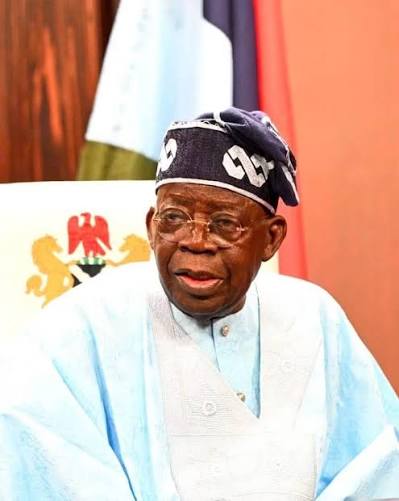
Tinubu: Economic outlook has improved, reforms have laid foundation for prosperity
By: Zagazola Makama
President Bola Ahmed Tinubu has said Nigeria’s economic outlook has improved significantly, citing stronger growth, rebuilt foreign reserves, lower oil theft and increased non-oil exports as evidence that the country’s economic reforms are beginning to yield results.
Tinubu stated this in his Independence Day address to Nigerians, where he reviewed the country’s economic challenges and outlined his administration’s plans for the next phase of development.
The President said Nigeria’s economic situation had deteriorated significantly before his administration took office in 2023, leaving the government with difficult choices.
He said the reforms introduced by his administration were designed to address structural weaknesses rather than merely manage their symptoms.
“Our reforms did not create the weaknesses in our economy. They confronted them,” Tinubu said.
According to him, Nigeria’s economy has grown by more than four per cent in the year, with contributions from both the oil and non-oil sectors.
He said oil theft had declined, inflation had fallen substantially from its peak, foreign reserves had been rebuilt and the foreign exchange market had stabilised.
Tinubu also highlighted Nigeria’s non-oil export performance, saying the country recorded more than six billion dollars in non-oil export revenue in 2025.
“These are not idle claims. International observers, journalists, NGOs and multilateral institutions can see the change,” he said.
The President said the private sector had also responded positively, while foreign direct investment continued to rise.
He, however, acknowledged that economic indicators alone would not be sufficient if ordinary Nigerians did not experience improvements in their daily lives.
Tinubu said prosperity should mean safer and more productive farming, reliable electricity for factories, access to credit for businesses, productive employment for young people and more affordable food, transportation and education.
He said the government would therefore focus on increasing productivity across agriculture and industry while improving infrastructure connecting producers to consumers.
Tinubu also acknowledged the continued hardship faced by millions of Nigerians, particularly those struggling to meet the costs of food, education, healthcare and transportation.
He said the government would continue strengthening social protection and essential public services while pursuing long-term economic growth.
The President said Nigeria could not eliminate in four years the economic difficulties accumulated over generations, but insisted that the country could change its direction.
“For the first time in decades, we embark on this task from a position of strength; with an economy whose fundamental direction has been corrected,” he said.
Tinubu described the period ahead as an “age of prosperity,” following what he called the “age of reform.”
He urged Nigerians to maintain faith in the country and work collectively towards building an economy where prosperity is broadly shared.
“Our destination is in sight. Our foundations are strong. Our direction is clear. So let us go forward. No looking back,” he said.
Tinubu: Economic outlook has improved, reforms have laid foundation for prosperity
News
A year of military reform, operational expansion and democratic professionalism under President Tinubu
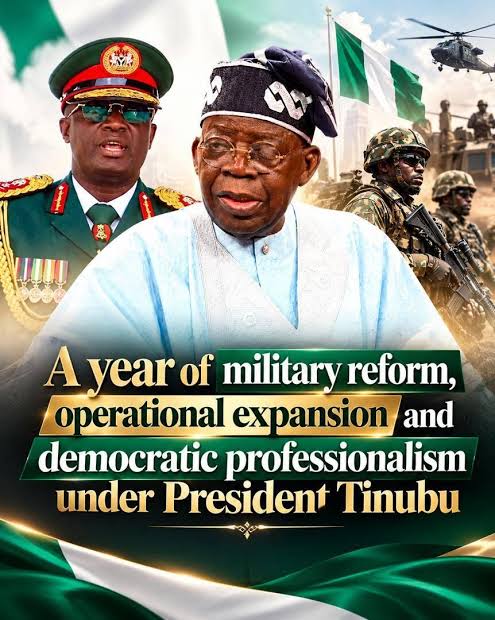
A year of military reform, operational expansion and democratic professionalism under President Tinubu
By: Zagazola Makama
The effectiveness of the Nigerian Army is inseparable from the country’s ability to confront terrorism, banditry, kidnapping, communal violence and other threats to national security. Since Lieutenant General Waidi Shaibu assumed office as the 25th Chief of Army Staff in October 2025, his tenure has been marked by an emphasis on institutional reform, operational readiness, technology, troop welfare, force expansion and the constitutional relationship between the military and democratic authority.
Almost one year into his tenure, the emerging record presents a military leadership attempting to combine battlefield pressure with institutional rebuilding. It is a record that also reflects a broader reality of President Bola Ahmed Tinubu’s administration: the government has increasingly placed national security, military modernisation and the welfare of personnel at the centre of its response to Nigeria’s complex security environment.
Rather than measuring Shaibu’s tenure solely by the number of terrorists neutralised or criminals arrested, its significance can also be assessed through the less visible changes taking place inside the Army how soldiers are trained, how formations are positioned, how technology is integrated, how personnel and their families are treated, and how the Army understands its place within a constitutional democracy.
Lieutenant General Waidi Shaibu was appointed Chief of Army Staff by President Tinubu on Oct. 24, 2025, succeeding Lt. Gen. Olufemi Oluyede, who moved on to become Chief of Defence Staff. Shaibu brought to Army Headquarters considerable operational experience, having previously commanded major formations and served in counter-insurgency operations in the North-East. His professional background includes service with Operation Lafiya Dole and Operation Hadin Kai, as well as senior command and staff appointments.
That background has shaped the character of his command. Rather than presenting the Army merely as a force that reacts to attacks, Shaibu has consistently spoken about building a force capable of anticipating threats, integrating intelligence, exploiting technology and operating jointly with other security agencies.
His early visits to operational theatres reinforced that approach. In November 2025, during his maiden tour of Operation Hadin Kai in Maiduguri, he directed troops to sustain offensive operations against insurgents and deny terrorist groups the support and sanctuary required to regenerate their capabilities. The message was clear: the Army under his leadership would seek to maintain pressure on armed groups while simultaneously strengthening the institution behind the frontline.
Perhaps the clearest expression of Shaibu’s institutional thinking came in February 2026 with the introduction of the PROSE Command Philosophy. PROSE represents Professional Excellence, Robust Administration, Operational Readiness, Strategic Cooperation and Exemplary Leadership. Shaibu unveiled the philosophy while addressing participants of Senior Course 48 at the Armed Forces Command and Staff College, Jaji.
He argued that leadership in Nigeria’s contemporary security environment must be anchored in character, courage and genuine concern for personnel. The significance of PROSE goes beyond an acronym. It attempts to connect five areas that are sometimes treated separately in military administration: professionalism, administration, combat preparedness, cooperation and leadership.
For an Army operating simultaneously in counter-insurgency, counter-terrorism, banditry, kidnapping and internal-security deployments across several regions, the approach recognises that battlefield success cannot be sustained without institutional discipline. In March 2026, Shaibu further linked the philosophy to respect for human rights, international humanitarian law and the Rules of Engagement. He directed commanders to protect civilians and stressed that adherence to those standards was not simply a legal obligation but also a practical requirement for building public confidence and improving intelligence-led operations.
This aspect of the command philosophy is particularly important in counter-insurgency warfare, where the population is not merely a community to be protected but a crucial source of information. One of the strongest features of Shaibu’s tenure has been the emphasis on technology. The Army Chief has repeatedly argued that the nature of warfare is changing and that Nigeria cannot confront modern armed groups exclusively through conventional ground operations.
In May 2026, the Army disclosed the acquisition of additional TP-2 tactical drones and the reconfiguration of Army aviation assets for combat operations. Shaibu said the investments were intended to strengthen surveillance, target acquisition, precision operations and casualty evacuation. He has also advocated deeper integration of unmanned aerial systems and combat aviation into Army training and operations. At the Combat Arms Training Week in Jaji, he described drone warfare and combat aviation as increasingly indispensable components of modern military operations.
This represents an important shift in the Army’s operational philosophy. The traditional model of troops moving into difficult terrain to locate hostile forces is gradually being complemented by persistent surveillance, aerial reconnaissance, improved intelligence fusion and precision-enabled operations. The objective is not technology for its own sake. The strategic purpose is to give commanders better information, shorten reaction time and reduce the exposure of soldiers to unnecessary risk.
Since his assumption of office, the Army has combined offensive operations with expanded formations, improved intelligence fusion, new equipment, specialised training, troop welfare programmes and a reorganisation of the force structure. Perhaps the most consequential development of the year has occurred above the level of individual battlefield engagements. On July 23, 2026, President Bola Ahmed Tinubu approved the expansion of the Nigerian Army from eight divisions to 12 divisions.
The four additional divisions are: 5 Division Makurdi, Responsible for Benue, Nasarawa and Kogi States., 9 Division — Ilorin, Responsible for Kwara and Niger States. 10 Division — Jalingo, Responsible for border areas of Taraba and Adamawa States and 83 Division — Benin City, designed to cover Edo, Delta and Bayelsa States.
The reorganisation also redistributed the responsibilities of existing divisions to create a more rational operational footprint. This represents one of the most substantial structural changes to the Nigerian Army in recent years. Another development that provides the clearest example of Shaibu’s approach to force structure. On Sept. 28, 2026, the Nigerian Army operationalised the 28 Armoured Brigade and Garrison in Birnin Kebbi, alongside the 281 Tank Battalion in Yauri and 381 Artillery Regiment in Kaoje, all in Kebbi State.
The Army said the new formations are intended to expand its operational footprint, strengthen command and control and reduce response times to security threats in the North-West.
This is significant because the North-West’s security challenge is geographically extensive.
Large distances, difficult terrain and dispersed rural communities can give armed groups an operational advantage when security forces must respond from distant bases.
A more distributed force structure is therefore designed to bring troops, armour and fire-support capabilities closer to vulnerable areas.
The development is consistent with a broader restructuring of the Army’s force posture, creating new opportunities but also additional responsibilities for commanders. The philosophy is straightforward: an Army cannot effectively secure territory if its command structures and operational assets are too distant from the communities requiring protection.
Shaibu has also placed emphasis on expanding the Army’s manpower pipeline. From manpower shortages to a larger training architecture.
According to the COAS, two additional training depots have been established in Osogbo, Osun State, and Amasiri-Idda, Ebonyi State, alongside the existing Depot Nigerian Army in Zaria. The objective is to increase the capacity to produce disciplined and combat-ready personnel capable of meeting the country’s expanding security requirements.
This is an important institutional investment.
Recruitment alone does not create combat power. Personnel must be trained, equipped, professionally socialised and deployed within effective command structures. The graduation of 1,182 Special Forces personnel from the Advanced Infantry Training Programme in August 2026 further demonstrated the emphasis on specialised capabilities. At the ceremony, Shaibu again linked combat effectiveness with discipline, human rights and adherence to the Rules of Engagement.
The message coming from Army Headquarters is therefore increasingly consistent, Nigerian soldiers must be capable of confronting armed groups while remaining accountable to the Constitution and the law.
Perhaps another most consequential aspect of Shaibu’s leadership is one that cannot be measured in battlefield statistics: the treatment of the soldier. The Army’s operational effectiveness ultimately depends on the morale, confidence and welfare of the men and women sent into dangerous environments. Under the welfare programme, the Army has reported extensive construction, renovation and infrastructure projects across the six geopolitical zones. The Affordable Home Ownership Option for All Soldiers, or AHOOAS, has also expanded.
The pilot project at Idu, Abuja, delivered more than 400 housing units, which the Army said were occupied by personnel and their families. The scheme has subsequently expanded to locations including Ibadan, Benin, Jos, Gombe and Akwa Ibom. In December 2025, Shaibu commissioned a 60-unit AHOOAS estate in Ibadan, reinforcing the connection between housing, morale and post-service stability.
In June 2026, he commissioned another 80 housing units in Jos.
The Army described the project as part of its broader effort to provide serving and retired personnel with decent and affordable accommodation. At Maxwell Khobe Cantonment in Plateau State, renovated accommodation blocks were also commissioned as part of the welfare drive. These initiatives address an issue that military historians and commanders have long understood: a soldier who knows that his family is secure is better positioned to concentrate on the mission.
The welfare agenda extends beyond serving personnel but also caring for the families of fallen soldiers. The Army has reported improvements in its Group Life Assurance arrangements, including efforts to clear outstanding claims to families of fallen personnel.
Its Education Sponsorship Scheme had supported more than 15,000 children of deceased personnel across different levels of education as of May 2026, according to figures cited by Shaibu. This is more than an administrative intervention. For a military institution that asks its personnel to accept the possibility of death in service, the knowledge that families will not be abandoned after a soldier’s death is an important component of institutional trust. It also reinforces the message behind the Soldier First approach: military professionalism is not only about demanding sacrifice; it is also about creating a system that recognises and supports that sacrifice.
Another emerging feature of Shaibu’s approach is the emphasis on indigenous defence capacity.
The Army Chief has pointed to greater patronage of Nigerian defence institutions and industrial facilities, including the Defence Industries Corporation of Nigeria, the Command Engineering Depot in Kaduna and the Special Vehicle Plant in Bauchi. The objective is to improve logistics, strengthen self-reliance and reduce institutional dependence on external sources for selected capabilities. For a country facing persistent security challenges, local defence production has strategic implications.
Equipment that cannot be maintained, repaired or replaced quickly can become a liability.
The development of local technical capabilities can therefore contribute to sustainability, especially when operations continue for prolonged periods.
Another defining feature of Shaibu’s public messaging has been the recognition that military effectiveness depends partly on the confidence of the civilian population. The Army has increasingly framed human rights, civilian protection and humanitarian cooperation as operational requirements rather than peripheral public-relations issues. In July 2026, during a meeting with the International Committee of the Red Cross, Shaibu reaffirmed the Army’s commitment to international humanitarian law, human rights and established Rules of Engagement. He also highlighted the Civilian Harm Mitigation and Response Plan, detention-management reforms and efforts to facilitate humanitarian access.
That approach matters in Nigeria’s conflict zones. When communities trust security forces, they are more likely to report suspicious activity, provide early warning and cooperate with investigations. When that confidence collapses, intelligence becomes harder to obtain and criminal and terrorist groups can exploit the resulting information vacuum. For this reason, civil-military relations should be understood as part of the operational architecture.
Perhaps the most politically sensitive dimension of the Army Chief’s tenure is his position on the military’s relationship with democracy.
Shaibu has repeatedly stated that the Nigerian Army must remain apolitical and subordinate to constituted civil authority.
In December 2025, he told newly commissioned officers that the Army must protect democratic governance and remain apolitical in the discharge of its constitutional responsibilities.
That position assumes particular importance as Nigeria approaches the 2027 general elections.
The role of the military in elections is constitutionally defined and normally exists in support of civil authorities and the lead security agency, principally the police, rather than as a partisan political actor. Recent military sensitisation activities have reiterated the requirement for neutrality, professionalism and adherence to constitutional responsibilities during electoral duties. This is one of the areas where military professionalism and democratic consolidation directly intersect. A strong military in a democracy is not one that determines political outcomes. It is one that protects the constitutional order while remaining under civilian authority.
Recognition of the Nigerian Army’s counter-terrorism effort
The Army’s reported progress has also attracted external recognition. In July 2026, the Nigerian Army received the Africa’s Best National Army in Counter-Terrorism Operations for 2025 award from African Security Watch. The award was formally presented to Lt. Gen. Waidi Shaibu at Army Headquarters in Abuja. Such recognition should not be treated as proof that Nigeria’s security problems have been solved. Terrorism, banditry, kidnapping and communal violence remain serious challenges.
But it is evidence that the Army’s counter-terrorism performance has received recognition beyond Nigeria.
Operational gains—and the unfinished task
More than 1,106 Boko Haram and ISWAP terrorists during his tenure, including several high-profile commanders operating across the North-East.
Among the notable terrorist leaders neutralised by troops were Abu Bilal Al-Muniki, also known as Abu Mainok; Malam Jidda, Amir of Ngorgore and Malumti villages; Abu Modu; Modu Dogo; Munzir of Dogon Chukun; Abu Aisha, Qaid of Tumbun Mota; and Abul Kaka, among others.
In May 2026, Defence Headquarters announced that coordinated operations involving Nigerian forces and U.S. Africa Command had produced additional strikes against ISIS/ISWAP elements around Metele in the North-East.
The operation demonstrated another important development of the military under President Bola Ahmed Tinubu’s leadership, the growing importance of intelligence sharing and international cooperation in targeting senior terrorist commanders and concentrations of fighters.
The Army leadership has reported notable operational gains across several theatres, including the use of joint operations, intelligence fusion, modern combat platforms and stronger cooperation with other security agencies. Shaibu has attributed recent successes to investments in MRAP vehicles, armoured personnel carriers, surveillance drones, armed drones and expanded Army Aviation. The broader security environment, however, remains difficult.
Under Operation FANSAN YAMMA, the Army reported that troops neutralised 1,717 bandits, arrested 2,660 suspects and rescued 4,052 civilians during the period covered by the COAS’s operational assessment. The operation also recovered more than 527 AK-47 rifles and over 156,000 rounds of ammunition.
In the North-Central zone, where Nigeria faces a complicated mixture of terrorism, banditry, kidnapping, communal violence and other criminal activities, Army formations operating under Operation Enduring Peace, Operation Whirl Stroke and Operation Sahel Sanity recorded another set of gains. The Army reported: 576 criminals neutralized, 8,837 suspects arrested and 2,225 civilians rescued.
In the South-East, troops operating under Operation UDO KA reported the neutralisation of 219 criminals, the arrest of 1,494 suspects and the recovery of weapons and improvised explosive devices. The Army said operations had targeted criminal enclaves, including areas around Orsu Forest and the Okigwe axis, while efforts continued to restore normal socio-economic activity. In the South-South, the Army reported that troops neutralised 134 criminals, arrested 3,896 suspects and rescued 341 civilians. In the South-West, the Army reported 13 criminals neutralised, 1,720 suspects arrested and 131 civilians rescued.
The Army itself has not claimed that these problems have disappeared. Indeed, Shaibu’s repeated emphasis on modernisation, training, intelligence and force expansion reflects an acknowledgement that the security environment is changing faster than conventional military structures can comfortably accommodate.
That may ultimately be the most important test of his tenure: whether the institutional reforms now being implemented can outlast individual operations and survive changes in the security environment.
Why Shaibu’s tenure matters to democratic stability
The connection between military professionalism and democracy is sometimes misunderstood. Democracy does not require a weak military. It requires a professional
military that is strong enough to defend the country but disciplined enough to remain within constitutional boundaries. Nigeria’s experience makes that distinction particularly important.
The Army’s responsibilities extend from counter-terrorism to internal security support, border protection, critical infrastructure security and election-related assistance.
At each level, the constitutional position remains the same: the military serves the Nigerian state and its constitution, not a political party. Shaibu’s repeated emphasis on neutrality, civilian protection and subordination to constituted authority therefore provides an institutional framework for the Army’s democratic role.
The bigger picture was building an Army for the next decade. The significance of Shaibu’s first year is therefore not contained in one operation, one weapon system or one military formation. It lies in the attempt to connect several reforms into one institutional direction. President Tinubu’s role in the transformation is particularly important.
President Tinubu’s role in military modernisation
Shaibu has publicly acknowledged this relationship. In his assessment of Army performance, he attributed recent gains partly to the strategic direction and sustained support of the Commander-in-Chief, saying that the President’s leadership had provided political will, resources and policy guidance for operational success. The relationship between the President and the military is constitutionally defined.
The President, as Commander-in-Chief, establishes the strategic direction and provides the political authority and resources within which the Armed Forces operate. The service chiefs are then responsible for translating that direction into military policy, command and operations. Under Tinubu, the expansion from eight to 12 Army divisions provides one of the clearest institutional examples of this strategic relationship. Shaibu’s tenure has also demonstrated that Nigeria’s security challenge is no longer confined to the conventional battlefield. The expansion of the Army, approval for additional personnel, procurement of critical platforms and investment in troop welfare all require decisions at the highest political level.
The military increasingly operates in an environment where propaganda, social media manipulation, misinformation and psychological operations can influence public confidence almost as significantly as a physical attack.
The Army’s growing emphasis on intelligence fusion, drones, surveillance and information management reflects this changing environment. The battle is simultaneously being fought in forests, villages, highways, borders, cyberspace and the information space.
The first year of Lieutenant General Waidi Shaibu’s tenure is best understood as a period of institutional consolidation and operational expansion.
There are also substantial challenges that remain unresolved. Nigeria’s security crisis is too complex to be attributed to one service chief or solved within on year. The Army operates alongside the Navy, Air Force, Police, intelligence agencies, state institutions and local communities. Its performance is therefore one component of a much larger national-security system. But the direction of travel under Shaibu is clear.
It is toward an Army that seeks to be more technologically enabled, more geographically responsive, more attentive to the welfare of its personnel, more integrated with other security institutions and more conscious of its constitutional obligations.
For President Tinubu’s administration, that institutional development has an important national consequence: the government requires a professional military capable of defending the territorial integrity of Nigeria while remaining firmly within democratic civilian control.
That is the constitutional space in which Lieutenant General Waidi Shaibu’s tenure should ultimately be assessed not by partisan expectations, but by whether the Nigerian Army becomes more capable, more professional, more accountable and better prepared to protect Nigerians.
And as Nigeria moves toward another electoral cycle, that distinction will matter. The Army’s most important contribution to democracy will not be choosing political outcomes. It will be ensuring that Nigerians are able to live, work, travel, vote and participate in civic life under a constitutional order protected by a professional military that knows precisely where its mandate begins and where it ends.
Zagazola Makama is a Counter Insurgency Expert and Security Analyst in the Lake Chad Region
A year of military reform, operational expansion and democratic professionalism under President Tinubu

The Armed Forces and Nigeria at 66: What Does History Say?
By Chidi Omeje
As Nigeria marks its 66th Independence Anniversary today, 1 October 2026, the Nigerian Armed Forces occupy a complicated but ultimately important place in the country’s national story. Their record cannot be reduced either to military heroism or to the darker history of military rule. Both are part of the historical record.
The incontrovertible truth, however, is that since independence, the Nigerian Armed Forces have been one of the principal institutions holding together the Nigerian state through periods of war, insurgency, communal violence, separatist agitation, banditry and other threats to territorial integrity.
Perhaps the most consequential chapter was the Nigerian Civil War (1967–1970). Whatever the controversies surrounding the war and its conduct, the Federal Military Government’s victory preserved Nigeria as one political entity. The subsequent challenges have been transforming that territorial unity into a deeper sense of national belonging.
The military’s contribution has also extended well beyond Nigeria’s borders. Since the 1960s, Nigeria has been a major contributor to international peacekeeping, including operations in Liberia, Sierra Leone and elsewhere. The United Nations notes that Nigerian forces formed the military backbone of the UN Mission in Liberia between 2003 and 2018, helping create the security conditions for Liberia’s democratic transition.
There is, therefore, a legitimate argument that Nigeria’s military tradition has always contained a strong peacekeeping dimension. Nigerian soldiers have not merely defended Nigeria; they have repeatedly been deployed to help stabilise other African countries.
However, history must also be honest about military rule It would therefore be historically incomplete to celebrate the Armed Forces without acknowledging their political interventions. From the coups of 1966 through successive periods of military government, the military suspended democratic institutions and governed Nigeria for prolonged periods. Those interventions left an enduring imprint on Nigeria’s political development and civil-military relations. That is why the most important transformation in the military’s historical role may be the transition from being an institution that once governed Nigeria to being an institution constitutionally subordinate to civilian democratic authority.
The return to civilian rule in 1999 was particularly significant. The current Fourth Republic has now lasted more than 27 years, the longest continuous period of civilian government in Nigeria’s history. President Bola Tinubu, in his June 2026 Democracy Day address, described this as Nigeria’s longest uninterrupted democratic era.
And there is an interesting historical irony here: the military itself eventually became part of the process that restored democracy. General Abdulsalami Abubakar’s transition programme culminated in the 1999 return to civilian government. President Tinubu recently described Abubakar’s role as instrumental in restoring democratic institutions and establishing the Fourth Republic.
The strongest evidence of the Armed Forces’ changed role is not simply what military leaders say about democracy; it is what the institution does within the constitutional order. Today, the Armed Forces operate under civilian political authority and are deployed by the elected government in accordance with constitutional and statutory responsibilities. The Ministry of Defence describes itself as the civilian face of Nigeria’s military authority and the apex policy organ of the defence establishment. That evolution matters enormously.
The Nigerian military today is simultaneously confronting Boko Haram and ISWAP in the North-East, banditry and terrorism in the North-West and North Central, oil theft and attacks on critical infrastructure in the Niger Delta, violent separatist agitation in the South East and other security challenges across the federation. Current operations include HADIN KAI, FANSAN YAMMA, ENDURING PEACE, WHIRL STROKE, SAFE HAVEN, DELTA SAFE and UDO KA, alongside Nigeria’s continuing contribution to multinational operations. This is a vastly different constitutional role from that of the military governments of the past.
So, what exactly is history’s verdict? History’s verdict on the Nigerian Armed Forces is neither an unqualified commendation nor an unqualified indictment. It is a record of sacrifice, national service, political intervention, institutional evolution and, ultimately, a significant return to constitutional professionalism.
The soldier who fought to preserve Nigeria’s territorial integrity, the peacekeeper who helped stabilise a neighbouring African country, and the service member currently risking his or her life against terrorists and criminals all belong to the military’s history. So too does the soldier who participated in a coup and helped suspend democratic government. One cannot erase the other.
However, there is another important point as Nigeria turns 66: the military should not be judged only by its history of fighting wars. It should also be judged by its relationship with democracy. The real measure of military professionalism in a democracy is not the capacity to seize political power, but the discipline to possess enormous coercive power and remain subordinate to constitutional civilian authority. That is perhaps the most important journey the Nigerian Armed Forces have made since independence.
And as the country confronts increasingly complex security threats, that democratic compact becomes even more important. The military needs public confidence, but public confidence is strengthened by professionalism, accountability, respect for constitutional authority and effective communication with the citizens it protects.
At 66, therefore, Nigeria’s Armed Forces deserve recognition for six decades of national and international service, while their history demands that the country remember both their sacrifices and their institutional mistakes.
Happy 66 Independence Anniversary to Nigeria and kudos to the Armed Forces of Nigeria for being there all the way!
*Chidi Omeje is the publisher of Security Digest magazine and member of Zagazola Media Network
The Armed Forces and Nigeria at 66: What Does History Say?

Tinubu: Economic outlook has improved, reforms have laid foundation for prosperity

A year of military reform, operational expansion and democratic professionalism under President Tinubu

The Armed Forces and Nigeria at 66: What Does History Say?

Roger Federer’s Shock as DNA Results Reveal Myla and Charlene Are Not His Biological Children

THE PLIGHT OF FARIDA

FAILED COUP IN BURKINA FASO: HOW TRAORÉ NARROWLY ESCAPED ASSASSINATION PLOT AMID FOREIGN INTERFERENCE CLAIMS
-
 News3 years ago
Roger Federer’s Shock as DNA Results Reveal Myla and Charlene Are Not His Biological Children
-
Opinions5 years ago
THE PLIGHT OF FARIDA
-
 News1 year ago
FAILED COUP IN BURKINA FASO: HOW TRAORÉ NARROWLY ESCAPED ASSASSINATION PLOT AMID FOREIGN INTERFERENCE CLAIMS
-

 News3 years ago
EYN: Rev. Billi, Distortion of History, and The Living Tamarind Tree
-
 Opinions5 years ago
POLICE CHARGE ROOMS, A MINTING PRESS
-

 ACADEMICS3 years ago
A History of Biu” (2015) and The Lingering Bura-Pabir Question (1)
-

 Columns3 years ago
Army University Biu: There is certain interest, but certainly not from Borno.
-

 Politics1 year ago
2027: Why Hon. Midala Balami Must Go, as Youths in Hawul and Asikira/Uba Federal Constituency Reject ₦500,000 as Sallah Gift
