
News
18 Nigerian Lecturers Get $250,000 Grants to Develop Prototypes into Commercially Viable Products

18 Nigerian Lecturers Get $250,000 Grants to Develop Prototypes into Commercially Viable Products
By: Michael Mike
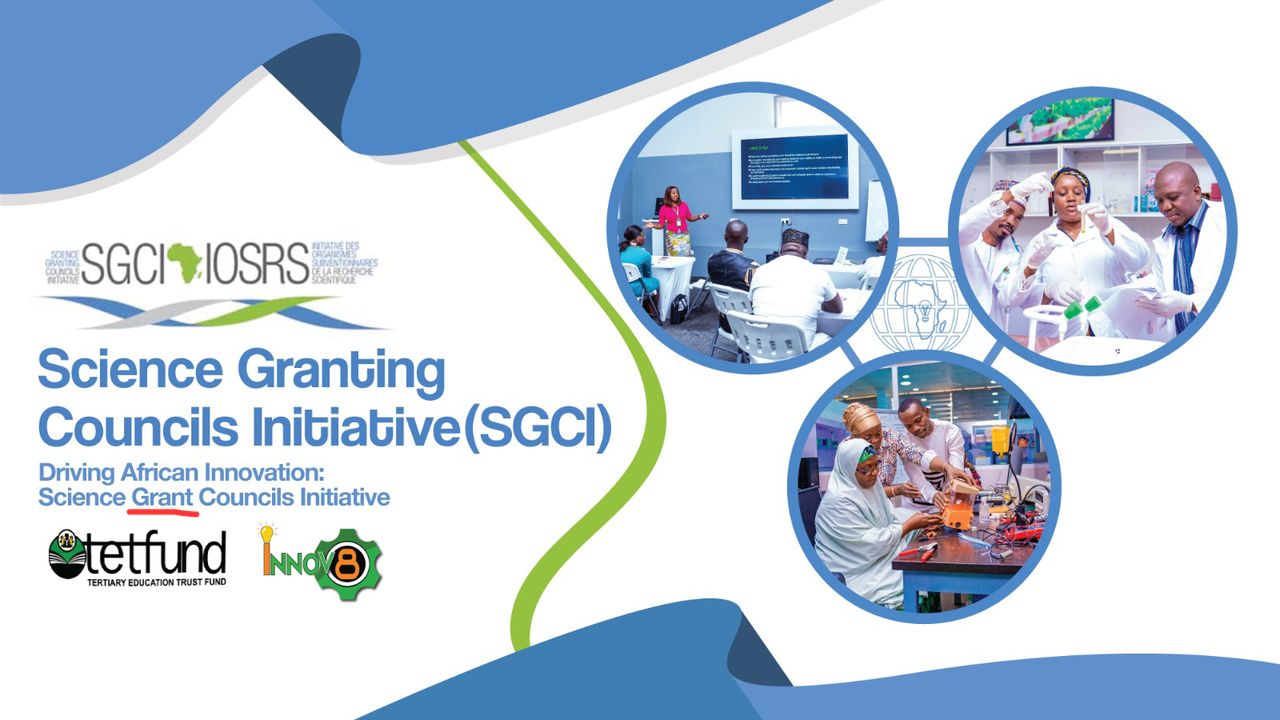
Eighteen lecturers from Nigerian higher institutions of learning have gone through the Tertiary Education Trust Fund (TETFund)’s Research for Impact Initiative (R4I) have received a grant of $250,000 from the Science Granting Councils Initiative (SGCI) to develop four prototype projects into commercially viable products
The 18 lecturers, who were distributed into four groups were assisted at Innov8, an innovation hub in Abuja to come out with four prototypes; Development of Technology to Mitigate the Effect of Drought in Desert Areas of Northern Nigeria, Development of Automated Garri Frying Technology (Jollyfryer), Creation of Biosensor Device for Water Purification Using Solar Energy, AirVolt: An Affordable Access to Electricity with Vertical Axis Wind Turbines.
The SGCI is a multi-funded initiative aimed at strengthening the capacities of 17 Science Granting Councils (SGCs) in sub-Saharan African, with the councils contributing significantly towards strengthening national research and innovation ecosystems in their respective councils.
The Management of Tertiary Education Trust Fund, representatives of the Science Granting Council Initiative, representatives of the Association of African Universities, members of the academia, partners in research and development, esteemed guests, I welcome you all to Innov8 Hub.
Speaking at the SGCI Launch Event in Abuja on Monday, the Deputy General Manager, Innov8 Hub, Mr. Deji Ige said the landmark event of today marks the beginning of new possibilities. “It is a testament to the power of foresight, the power of commitment, and collaboration. On the mandate of TETFUND, a journey began about three years ago called the Research for Impact- R4i initiative, later, the TETFund Alliance for Innovative Research- TETFAIR. These two initiatives have tremendously instigated a paradigm shift in the Nigerian academia, where lecturers are now researching for solution, innovation, venture creation and impact, as against the previous pattern of researching just for the sake of publication and promotion.
“As the technical partner and collaborator to TETFUND on the implementation of R4i and TETFAIR, Innov8 Hub is delighted and grateful for leadership and commitment of TETFund to these collaborative initiatives that are now yielding fruits of Human Capital Development, R & D Advancement, Home-Grown Solution, Economic Growth and National Development. One of such fruits is the reason we are here today. It may interest you to know that 18 participants (Grouped into 4 Teams), in the TETFund Research for Impact- R4i programme were selected as recipients of R&D grant from the Science Granting Councils Initiative.
“These 18 members of the Nigerian academia will use the grant to advance their innovations already developed at Innov8 hub during their R4i programme. The beneficiaries, from various tertiary institutions across Nigeria were selected after critical assessment of their projects developed at R4i. This success story would not have been possible without TETFund, and the paradigm shifting collaboration with Innov8 Hub; through which Nigerian academics are now translating their ideas into innovations, solutions and prototypes, worthy of advancement to the next level of Minimum Viable Product.”
Ige added that: “By championing the current positive change in the landscape and output of R&D efforts in Nigeria, it is evident that TETFund is more than an agency of government, but a light in the tunnel of the academia, a lamp unto the path of Nigerians, and a champion of national development; while Innov8 Hub is the oil that fuels the lamp.”
On his part, the director of research and development, TETFund, Dr. Saliba Bakare said, though Nigeria joined the SGCI in 2020—five years after the program’s inception—the impact of this collaboration is poised to be transformative.
According to Bakare, the $250,000 grant will support four Nigerian research teams, each working on projects with the potential to drive significant change.
He noted that among these initiatives are advancements in the processing of garri, a staple food, and pioneering efforts in renewable energy, amongst others.
He said the funding aims to bridge the gap between research and practical application, fostering innovations that can be commercialized.
He explained that: “The essence is to help them transform their research findings into commercializable goods and services in this country.”
He further explained that a critical component of the grant is its focus on helping research teams develop their innovations into market-ready prototypes.
This, he said involves not only technical development but also pitching these products to industries, ensuring that the research translates into tangible economic benefits.
“Four teams are going to use this money to develop their research into prototypes and pitch them with industries so that there will be take-off of the product coming out from the research,” he noted.
18 Nigerian Lecturers Get $250,000 Grants to Develop Prototypes into Commercially Viable Products


Security forces Conduct Show of Force In Jos, Bukuru During Church Services
By: Zagazola Makama
Joint Security forced in Plateau State on Sunday conducted a joint show of force across major flashpoints within Jos metropolis and the Bukuru general area to ensure peaceful church services and strengthen public confidence.
The operation involved troops of Operation Enduring Peace, personnel of the Nigerian Air Force 551 Station, Operation Keystone, the Nigeria Security and Civil Defence Corps (NSCDC), and other security agencies.
Security sources said the exercise commenced at about 7:30 a.m. and was aimed at denying criminal elements freedom of action while providing adequate security coverage during church services.
The coordinated patrols and visibility operations covered identified vulnerable areas and strategic locations within Jos and Bukuru.
According to the sources, the operation was conducted without any security breach or incident, while religious activities across the affected areas remained peaceful.
The security agencies reaffirmed their commitment to sustaining collaborative operations aimed at maintaining law and order as well as protecting lives and property in Plateau State.
Security forces Conduct Show of Force In Jos, Bukuru During Church Services
Teenage Sensations Rosemary, Miracle Win Gold for Nigeria, Secure World Championship Spot
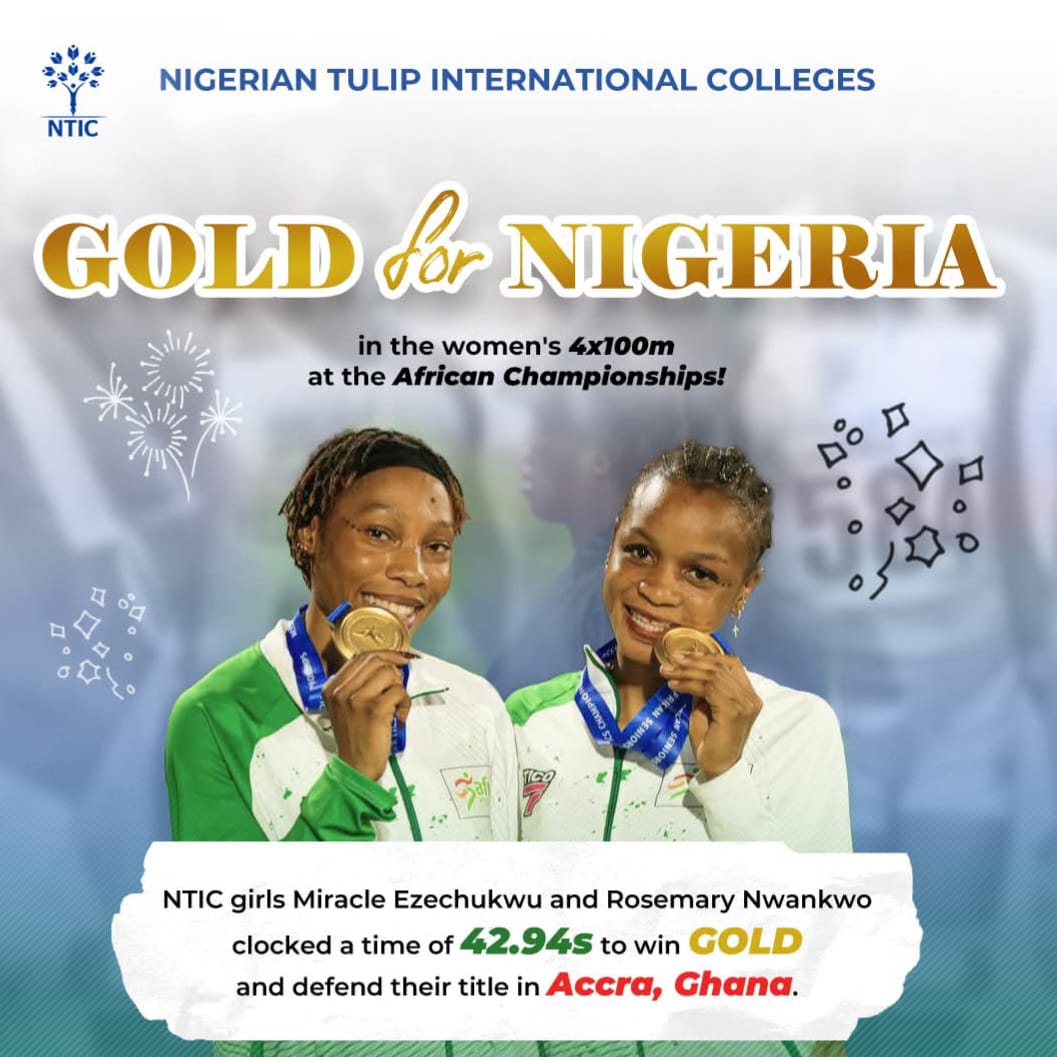
Nigeria recorded a major triumph at the 24th CAA Senior Athletics Championship in Accra, Ghana, as teenage athletes Rosemary and Miracle delivered a stunning performance to win gold for the country in the women’s 4x100m relay event.
The young stars, both students of NTIC Secondary School, helped Team Nigeria clinch the gold medal with an impressive time of 42.94 seconds, further underlining the country’s growing strength in athletics.
Their victory also secured Nigeria a ticket to the World Championships in Gaborone, while guaranteeing qualification for the 2027 World Championship in China.
The feat was particularly remarkable for Rosemary, who was making her senior debut for Nigeria at the continental championship.
Sports enthusiasts have since praised the duo for proving that age is no barrier to excellence, with many describing their performance as a glimpse into the bright future of Nigerian athletics.
Teenage Sensations Rosemary, Miracle Win Gold for Nigeria, Secure World Championship Spot
News
The Role of Intelligence in the Nigeria-US Joint Counter-Terrorism Operations That Neutralized Top ISWAP Commander, Fighters
The Role of Intelligence in the Nigeria-US Joint Counter-Terrorism Operations That Neutralized Top ISWAP Commander, Fighters
By Augustine Aminu
On Friday, May 16, 2026, the world was jolted by news of the killing of top commander of the Islamic State’s West Africa Province (ISWAP), Abour Mainok and several other fighters. Also known as Abu Bilal al-Minuki, and considered the second-in-command of ISIL (ISIS) globally, the top terrorist commander was reportedly killed during a joint Nigeria-U.S. Counter Terrorism operation in Metele, Borno State.
Ever since the elimination of al-Minuki, considered one of the biggest blows in recent times to terrorists in the world over, torrents of encomium have been pouring in for the Nigeria -U. S. joint terrorism operations.
Posting on his Truth Social handle, U. S. President Donald Trump, wrote, “Brave American forces and the Armed Forces of Nigeria flawlessly executed a meticulously planned and very complex mission to eliminate the most active terrorist in the world from the battlefield,”
Al-Minuki, added President Trump, “thought he could hide in Africa, but little did he know we had sources who kept us informed on what he was doing.”
On his part, President Bola Tinubu stated that both countries had “recorded a significant example of effective collaboration in the fight against terrorism”.
Early assessments indicate that al-Minuki, along with “several of his lieutenants,” were killed during a strike on his compound in Metele, Borno State,” Tinubu said.
“Nigeria appreciates this partnership with the United States in advancing our shared security objectives,” he added. “I extend my sincere gratitude to President Trump for his leadership and unwavering support in this effort,” he added.
A few days after President Trump praised Nigerian Intelligence services for helping to hunt down Abu-Bilal al-Minuki, a man he described as “the most active terrorist in the world,” US Air Force General, Dagvin R.M. Anderson, Commander of U.S. Africa Command, also spoke glowingly of Nigeria’s Intelligence services.
Remarked Anderson, “The Nigerians have been instrumental throughout the last several months, developing the target, helping us with the Intelligence and providing support. So, it could not have been done by our own Forces. We needed to do that in conjunction with them.”
Security sources who analyzed President Trump’s terse statement, alongside that of the to head of AFRICOM, General Anderson, were quick to point out that the “sources” who kept the United States and Nigerian Armed Forces informed of the movements of al-Minuki and his fighters, may be none other than Nigeria’s Intelligence agencies: the Department of State Services (DSS), the Nigerian Intelligence Agency (NIA), and Defence Intelligence Agency (DIA).
Interestingly, six days before al-Minuki’s elimination, something crucial to the fight against terrorism happened in one North central town, well over 1,100 kilometres away from Metele, Borno State, where al-Minuki and over 175 of his fighters would meet their Waterloo.
Just as DSS, NIA and DIA operatives were helping US and Nigerian troops monitor the movement of Al-Minuki and his fighters around the Lake Chad region, a set of DSS operatives covertly captured a notorious leader of one of ISWAP’s critical cell in Nigeria . His name is Abdulrahman Ozovieh Muhammad alias Abu Ghozi.
Abu Ghozi, security sources believe, masterminded the December 2020 attack on a military checkpoint in Okene, killing two naval personnel and carting away their weapons.
Additionally, Abu Ghozi is believed to have masterminded the 11th March, 2021 bank robbery at Okuku, in Oda-Atin LGA of Osun State; carried out several attacks on police formations in Okene, Okehi and Adavi LGAs. He didn’t spare security checkpoints along Okene-Auchi, Okene –Kabba and Okene-Ajaokuta roads.
Also believed to be behind several kidnaps, including the October 2025 kidnap of a Chinese national in Okpella, Edo State, during which eight personnel of the Nigerian Security and Civil Defence Corps (NSCDC) were killed, is Abu Ghozi.
In January, 2026, his group reportedly attacked and burnt down the house of the Chief Priest at Uhodo area of Okehi LGA. Members of his suspected terrorist group were, before his arrest by the DSS, reportedly set to attack detention facilities in Kainji and Abuja, to release detained members of their group.
Security sources believe that Abu Ghozi’s capture by DSS officers may have greatly helped the Nigerian Intelligence Services (DSS, NIA and DIA) gather further Intelligence that was ultimately used to nail al-Minuki and his fighters six days later in faraway Metele, Borno State.
No doubt, Nigeria’s Intelligence community and their military counterpart again proved very invaluable to the recent successes in the global fight against terrorism, and helped position Nigeria as a very trusted ally in the fight against terrorism.
For the first time since Nigeria began fighting terrorism circa 2010, the country has now fully turned the heat on terrorists, smoking them.out on a daily basis.. The recent successes recorded shows that with our Armed Forces increasingly relying on the intelligence supplied by the DSS, NIA and DIA, Nigeria will sooner than later overcome her security challenges.
Aminu has been online editor of several newspapers, and lives in Abuja

2027: When Tinubu’s endorsement of Vice President Kashim Shettima’s unwavering support speaks volumes

Troops Arrest Suspected Security Impersonator In Plateau

Security forces Conduct Show of Force In Jos, Bukuru During Church Services

Roger Federer’s Shock as DNA Results Reveal Myla and Charlene Are Not His Biological Children

THE PLIGHT OF FARIDA

FAILED COUP IN BURKINA FASO: HOW TRAORÉ NARROWLY ESCAPED ASSASSINATION PLOT AMID FOREIGN INTERFERENCE CLAIMS
-
 News2 years ago
Roger Federer’s Shock as DNA Results Reveal Myla and Charlene Are Not His Biological Children
-
Opinions4 years ago
THE PLIGHT OF FARIDA
-
 News1 year ago
FAILED COUP IN BURKINA FASO: HOW TRAORÉ NARROWLY ESCAPED ASSASSINATION PLOT AMID FOREIGN INTERFERENCE CLAIMS
-

 News2 years ago
EYN: Rev. Billi, Distortion of History, and The Living Tamarind Tree
-
 Opinions4 years ago
POLICE CHARGE ROOMS, A MINTING PRESS
-

 ACADEMICS2 years ago
A History of Biu” (2015) and The Lingering Bura-Pabir Question (1)
-

 Columns2 years ago
Army University Biu: There is certain interest, but certainly not from Borno.
-

 Politics12 months ago
2027: Why Hon. Midala Balami Must Go, as Youths in Hawul and Asikira/Uba Federal Constituency Reject ₦500,000 as Sallah Gift
