
News
President Tinubu: All New Mining Licenses Must Have Local Value

President Tinubu: All New Mining Licenses Must Have Local Value
… Says directive will position Nigeria as critical metals leader
By: Our Reporter
President Bola Ahmed Tinubu has instructed the Federal Ministry of Solid Minerals Development to only issue mining licenses if they are tied to local value addition.
This is to ensure that young Nigerians are actively engaged in economic activities, acquiring skills and contributing to the overall development of the economy.
The President gave the directive on Wednesday during the opening session of the African Natural Resources & Energy Investment Summit, 2024, held at the State House Conference Centre, Abuja.
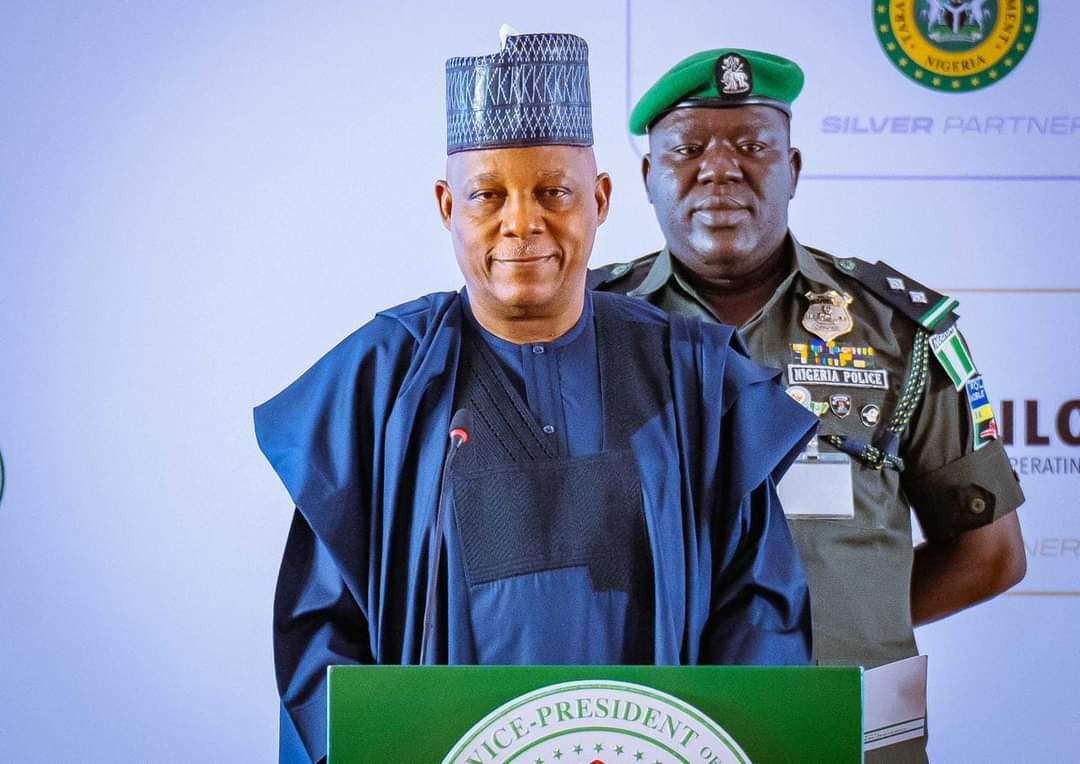
President Tinubu, who was represented at the event by his deputy, Vice President Kashim Shettima, said his administration is fully committed to creating an enabling business environment to attract investment that encourages ‘value addition’ on solid minerals before they are exported.
“We recognize the losses incurred from exporting crude mineral commodities and understand that it is time to change this narrative. By doing so, we aim to ensure that our teeming youth are actively engaged in economic activities, acquiring skills, and contributing to the nation’s foreign exchange earnings. Therefore, the Ministry will only issue mining licenses if they are tied to local value addition,” the President noted.
President Tinubu noted that his administration’s target in the solid minerals sector is “to make Nigeria a leader in critical metals.”
While commending stakeholders for the establishment of the African Minerals Strategy Group with Nigeria as the first chairman of the initiative, the President said, “We aim to set new standards in the mining industry and ensure that Africa gets an equitable slice of supplying the world with critical metals.
“In our transition to cleaner and more sustainable energy systems, we also recognize the pivotal role that natural gas plays. Natural gas is a transition fuel that will fundamentally restructure our nation’s economy,” he added.
In leveraging opportunities in the renewable energy space, President Tinubu explained that “Nigeria has attracted over $2 billion in investment in the renewable energy sector, making it a fast-growing sector in the economy.
“Our commitment is to continue this trajectory and attract more private sector involvement in the renewable energy space, including manufacturing locally produced solar panels and batteries.”
He, however, emphasized that discussions on the energy transition must also include the significance of the petroleum industry as a cornerstone of the nation’s economy.
“While we strive to embrace renewable and cleaner energy sources, we acknowledge that oil and gas continue to play a vital role in our energy and economic landscape,” he stated.
The President highlighted strategic priorities in the sector to include the goal to attract more investment in the oil and gas industry; grow oil production to 2.1 million barrels a day by December 2024; improve investment in midstream and downstream infrastructure; tackle theft; and hold developers accountable for the highest environmental standards.
President Tinubu further restated the administration’s commitment to manage resources responsibly, minimizing their ecological footprint and maximizing their benefits for the nation.
Earlier in his opening remarks, Minister of Solid Minerals Development, Dr. Dele Alake, announced the government’s strategy under the Renewed Hope Agenda to position Nigeria as a major player in the global minerals market.
“We are committed to transforming Nigeria’s solid mineral sector into a cornerstone for our nation’s economic diversification,” he said.
The minister noted that the government is implementing wide-ranging reforms to create a more attractive environment for investors, with a focus on enhancing transparency, regulatory clarity, and investor confidence.
The plan, he explained, encompasses several key areas, including policy reforms, sustainable practices, infrastructure development, and human capital enhancement. These initiatives are designed to address longstanding challenges in the sector and unlock the full potential of Nigeria’s vast mineral resources.
“This summit represents a significant milestone in our collective journey toward addressing Africa’s vast natural resources and sustainable economic development,” Alake said.
Dignitaries at the summit included the Senator representing Niger East Senatorial District, Mohammed Sani Musa; Minister of State for Environment, Dr. Ishaq Salako; Minister of State for Steel Development, Mr. Uba Maigari Ahmadu, and Permanent Secretary in the Ministry of Solid Minerals Development, Dr. Mary Ogbe.
Others were Minister of Mines and Mineral Resources of Sierra Leone, Julius Mattai; Minister of Mining of South Sudan, Martin Gama Abucha; Minister of Mining of Malawi, Monica Chang’anamuno, MP; Minister of Mines and Energy of Liberia, Wilmot Paye; Deputy Minister of Petroleum, Mines and Geology of Chad, Oumar Moussa, and representatives of the governors of Abia, Ebonyi, Taraba, Kwara, Enugu, Nasarawa and Akwa Ibom States, among others.
President Tinubu: All New Mining Licenses Must Have Local Value


Security forces Conduct Show of Force In Jos, Bukuru During Church Services
By: Zagazola Makama
Joint Security forced in Plateau State on Sunday conducted a joint show of force across major flashpoints within Jos metropolis and the Bukuru general area to ensure peaceful church services and strengthen public confidence.
The operation involved troops of Operation Enduring Peace, personnel of the Nigerian Air Force 551 Station, Operation Keystone, the Nigeria Security and Civil Defence Corps (NSCDC), and other security agencies.
Security sources said the exercise commenced at about 7:30 a.m. and was aimed at denying criminal elements freedom of action while providing adequate security coverage during church services.
The coordinated patrols and visibility operations covered identified vulnerable areas and strategic locations within Jos and Bukuru.
According to the sources, the operation was conducted without any security breach or incident, while religious activities across the affected areas remained peaceful.
The security agencies reaffirmed their commitment to sustaining collaborative operations aimed at maintaining law and order as well as protecting lives and property in Plateau State.
Security forces Conduct Show of Force In Jos, Bukuru During Church Services
Teenage Sensations Rosemary, Miracle Win Gold for Nigeria, Secure World Championship Spot
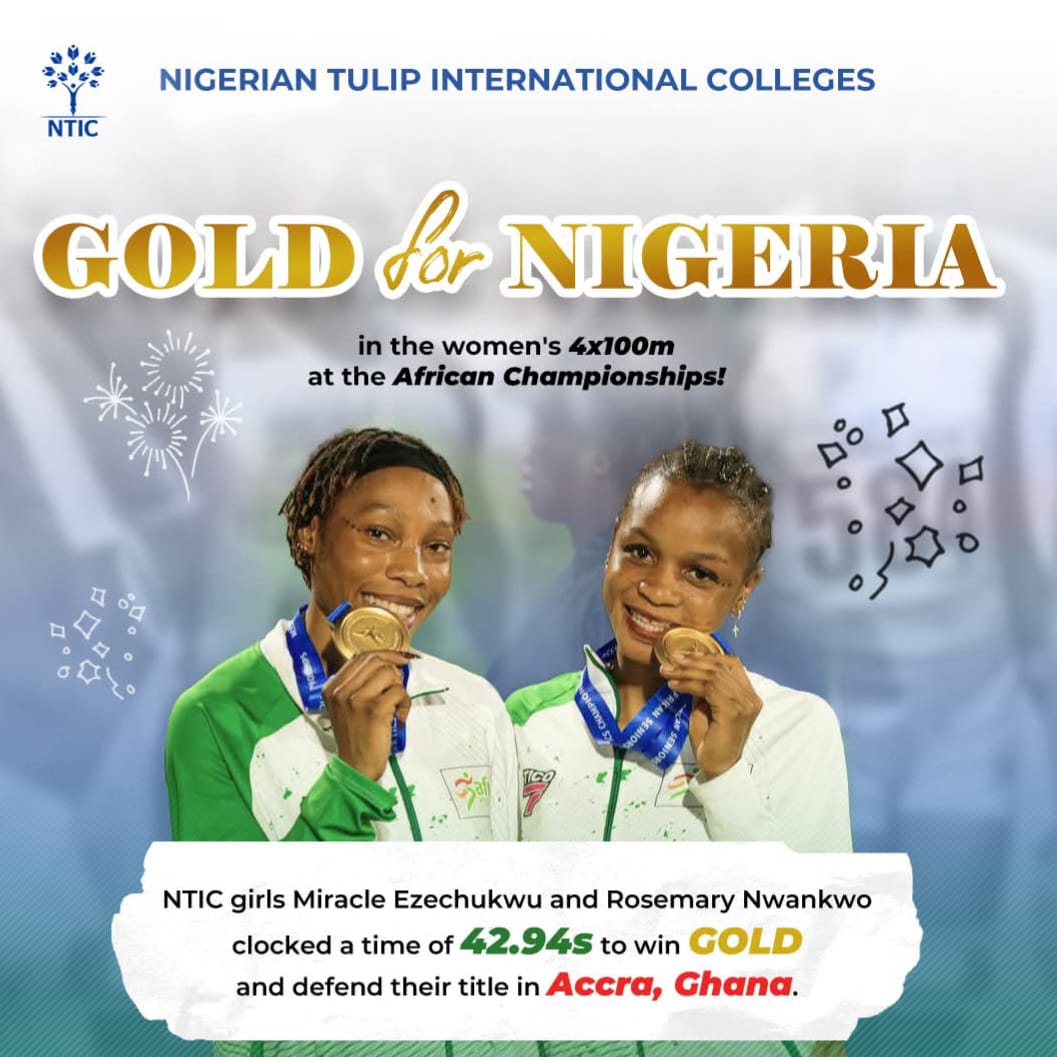
Nigeria recorded a major triumph at the 24th CAA Senior Athletics Championship in Accra, Ghana, as teenage athletes Rosemary and Miracle delivered a stunning performance to win gold for the country in the women’s 4x100m relay event.
The young stars, both students of NTIC Secondary School, helped Team Nigeria clinch the gold medal with an impressive time of 42.94 seconds, further underlining the country’s growing strength in athletics.
Their victory also secured Nigeria a ticket to the World Championships in Gaborone, while guaranteeing qualification for the 2027 World Championship in China.
The feat was particularly remarkable for Rosemary, who was making her senior debut for Nigeria at the continental championship.
Sports enthusiasts have since praised the duo for proving that age is no barrier to excellence, with many describing their performance as a glimpse into the bright future of Nigerian athletics.
Teenage Sensations Rosemary, Miracle Win Gold for Nigeria, Secure World Championship Spot
News
The Role of Intelligence in the Nigeria-US Joint Counter-Terrorism Operations That Neutralized Top ISWAP Commander, Fighters
The Role of Intelligence in the Nigeria-US Joint Counter-Terrorism Operations That Neutralized Top ISWAP Commander, Fighters
By Augustine Aminu
On Friday, May 16, 2026, the world was jolted by news of the killing of top commander of the Islamic State’s West Africa Province (ISWAP), Abour Mainok and several other fighters. Also known as Abu Bilal al-Minuki, and considered the second-in-command of ISIL (ISIS) globally, the top terrorist commander was reportedly killed during a joint Nigeria-U.S. Counter Terrorism operation in Metele, Borno State.
Ever since the elimination of al-Minuki, considered one of the biggest blows in recent times to terrorists in the world over, torrents of encomium have been pouring in for the Nigeria -U. S. joint terrorism operations.
Posting on his Truth Social handle, U. S. President Donald Trump, wrote, “Brave American forces and the Armed Forces of Nigeria flawlessly executed a meticulously planned and very complex mission to eliminate the most active terrorist in the world from the battlefield,”
Al-Minuki, added President Trump, “thought he could hide in Africa, but little did he know we had sources who kept us informed on what he was doing.”
On his part, President Bola Tinubu stated that both countries had “recorded a significant example of effective collaboration in the fight against terrorism”.
Early assessments indicate that al-Minuki, along with “several of his lieutenants,” were killed during a strike on his compound in Metele, Borno State,” Tinubu said.
“Nigeria appreciates this partnership with the United States in advancing our shared security objectives,” he added. “I extend my sincere gratitude to President Trump for his leadership and unwavering support in this effort,” he added.
A few days after President Trump praised Nigerian Intelligence services for helping to hunt down Abu-Bilal al-Minuki, a man he described as “the most active terrorist in the world,” US Air Force General, Dagvin R.M. Anderson, Commander of U.S. Africa Command, also spoke glowingly of Nigeria’s Intelligence services.
Remarked Anderson, “The Nigerians have been instrumental throughout the last several months, developing the target, helping us with the Intelligence and providing support. So, it could not have been done by our own Forces. We needed to do that in conjunction with them.”
Security sources who analyzed President Trump’s terse statement, alongside that of the to head of AFRICOM, General Anderson, were quick to point out that the “sources” who kept the United States and Nigerian Armed Forces informed of the movements of al-Minuki and his fighters, may be none other than Nigeria’s Intelligence agencies: the Department of State Services (DSS), the Nigerian Intelligence Agency (NIA), and Defence Intelligence Agency (DIA).
Interestingly, six days before al-Minuki’s elimination, something crucial to the fight against terrorism happened in one North central town, well over 1,100 kilometres away from Metele, Borno State, where al-Minuki and over 175 of his fighters would meet their Waterloo.
Just as DSS, NIA and DIA operatives were helping US and Nigerian troops monitor the movement of Al-Minuki and his fighters around the Lake Chad region, a set of DSS operatives covertly captured a notorious leader of one of ISWAP’s critical cell in Nigeria . His name is Abdulrahman Ozovieh Muhammad alias Abu Ghozi.
Abu Ghozi, security sources believe, masterminded the December 2020 attack on a military checkpoint in Okene, killing two naval personnel and carting away their weapons.
Additionally, Abu Ghozi is believed to have masterminded the 11th March, 2021 bank robbery at Okuku, in Oda-Atin LGA of Osun State; carried out several attacks on police formations in Okene, Okehi and Adavi LGAs. He didn’t spare security checkpoints along Okene-Auchi, Okene –Kabba and Okene-Ajaokuta roads.
Also believed to be behind several kidnaps, including the October 2025 kidnap of a Chinese national in Okpella, Edo State, during which eight personnel of the Nigerian Security and Civil Defence Corps (NSCDC) were killed, is Abu Ghozi.
In January, 2026, his group reportedly attacked and burnt down the house of the Chief Priest at Uhodo area of Okehi LGA. Members of his suspected terrorist group were, before his arrest by the DSS, reportedly set to attack detention facilities in Kainji and Abuja, to release detained members of their group.
Security sources believe that Abu Ghozi’s capture by DSS officers may have greatly helped the Nigerian Intelligence Services (DSS, NIA and DIA) gather further Intelligence that was ultimately used to nail al-Minuki and his fighters six days later in faraway Metele, Borno State.
No doubt, Nigeria’s Intelligence community and their military counterpart again proved very invaluable to the recent successes in the global fight against terrorism, and helped position Nigeria as a very trusted ally in the fight against terrorism.
For the first time since Nigeria began fighting terrorism circa 2010, the country has now fully turned the heat on terrorists, smoking them.out on a daily basis.. The recent successes recorded shows that with our Armed Forces increasingly relying on the intelligence supplied by the DSS, NIA and DIA, Nigeria will sooner than later overcome her security challenges.
Aminu has been online editor of several newspapers, and lives in Abuja

2027: When Tinubu’s endorsement of Vice President Kashim Shettima’s unwavering support speaks volumes

Troops Arrest Suspected Security Impersonator In Plateau

Security forces Conduct Show of Force In Jos, Bukuru During Church Services

Roger Federer’s Shock as DNA Results Reveal Myla and Charlene Are Not His Biological Children

THE PLIGHT OF FARIDA

FAILED COUP IN BURKINA FASO: HOW TRAORÉ NARROWLY ESCAPED ASSASSINATION PLOT AMID FOREIGN INTERFERENCE CLAIMS
-
 News2 years ago
Roger Federer’s Shock as DNA Results Reveal Myla and Charlene Are Not His Biological Children
-
Opinions4 years ago
THE PLIGHT OF FARIDA
-
 News1 year ago
FAILED COUP IN BURKINA FASO: HOW TRAORÉ NARROWLY ESCAPED ASSASSINATION PLOT AMID FOREIGN INTERFERENCE CLAIMS
-

 News2 years ago
EYN: Rev. Billi, Distortion of History, and The Living Tamarind Tree
-
 Opinions4 years ago
POLICE CHARGE ROOMS, A MINTING PRESS
-

 ACADEMICS2 years ago
A History of Biu” (2015) and The Lingering Bura-Pabir Question (1)
-

 Columns2 years ago
Army University Biu: There is certain interest, but certainly not from Borno.
-

 Politics12 months ago
2027: Why Hon. Midala Balami Must Go, as Youths in Hawul and Asikira/Uba Federal Constituency Reject ₦500,000 as Sallah Gift
