
Uncategorized
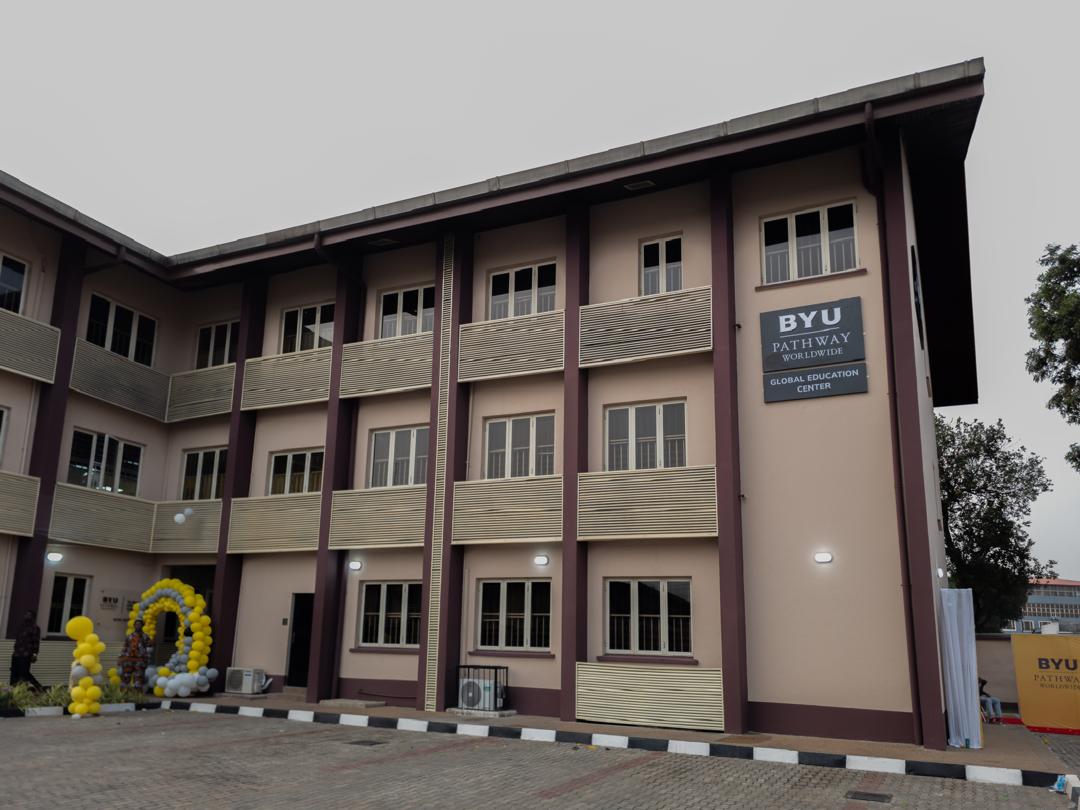
BYU-Pathway Worldwide opens Global Education Centre in Lagos, Nigeria

BYU-Pathway Worldwide opens Global Education Centre in Lagos, Nigeria
By: Michael Mike
The BYU-Pathway Worldwide has opened a state-of-the-art Global Education Centre in the heart of Lagos, Nigeria to serve the growing number of studentsp who wish to attain higher education certification online from BYU-Idaho and Ensign College.
With affordability at the centre of this initiative, BYU-Parthway Worldwide allows over 74,000 students in over 180 countries to gain access to spiritually based, United States of America-accredited degrees that can be completed online and in as little as three years. In Nigeria, the total cost to attaining this high quality education via BYU-Pathway Worldwide comes at only NGN379,579.
With sponsorship from The Church of Jesus Christ of Latter-day Saints, BYU-Pathway Worldwide is on a mission to develop disciples of Jesus Christ who are leaders in their homes, congregations and communities. In addition to securing top-notch degrees, students get opportunities to do internships with global organisations remotely and upon graduation, secure full-time high-paying jobs with these organisations across all economic sectors.
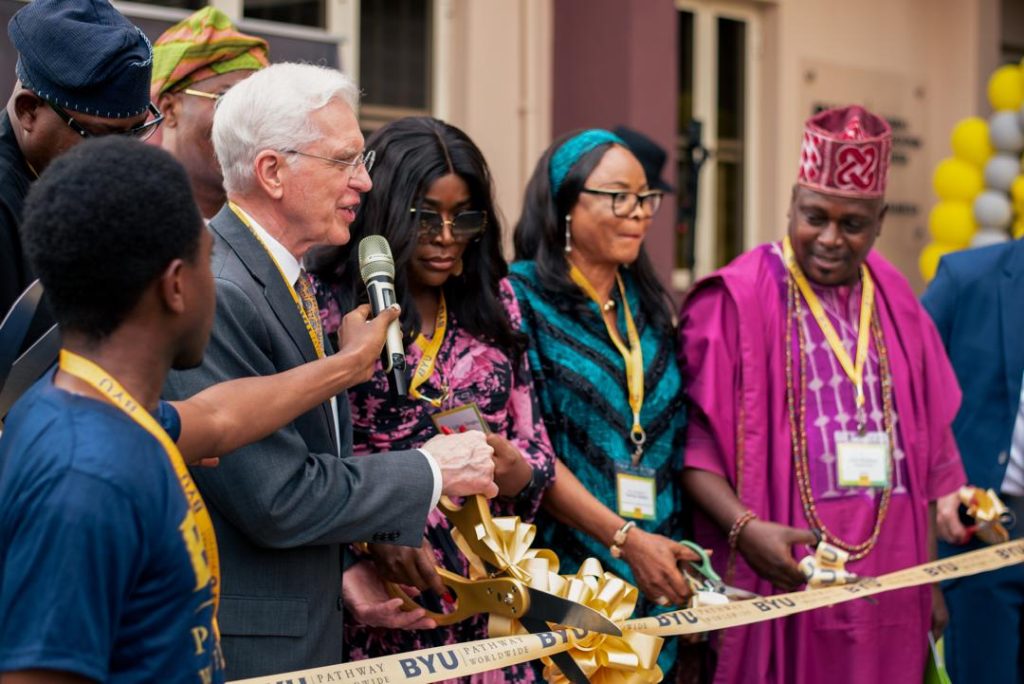
At the official unveiling of the Global Education Centre at Opebi, Ikeja in Lagos, Nigeria, Elder D. Todd Christofferson, of the Quorum of the Twelve Apostles, noted that the Church of Jesus Christ of Latter-day Saints spends over a US$1billion annually funding the education of the rising generation. He expressed his happiness for the establishment of the Global Education Centre in Lagos and assured that this won’t be the last in Nigeria and Africa.
“We spend a great deal of money in furthering education and education opportunities of the rising generation. We spend over a US$1billion annually to create opportunities for them. But since it is prohibitively expensive to establish physical universities everywhere it is needed, how can we expand opportunities for higher education? This is what brought about the idea of online university closer to more and more people without the high cost of university fees and accommodation.
We are thrilled to do this and expand opportunities for the younger generation. My experience in Africa convinces me that Africans are intelligent, hardworking and disciplined. All they need are opportunities and that is what we are hoping to provide through this Global Education Centre from BYU-Pathway Worldwide,” he said.
Brian K. Ashton, President of BYU-Pathway Worldwide, noted that the Church introduced BYU-Pathway to bless everyone with an education and that is why the fees are heavily subsidized and anyone anywhere can apply to join and students can also enjoy scholarships of almost 50percent on tuition.
“The best part is, it is not reserved for only members of the Church but anyone can apply and benefit from this opportunity. The Church is not here to make a profit but to bless people’s lives. We believe that as we learn truth we become more like our father Jesus Christ and we are better able to serve people. BYU-Pathway is online and this allows us to serve everyone at the most affordable rates,” he added.
Elder Adeyinka A. Ojediran, 1st Counselor of Africa West Area Presidency, noted that the effort of the Church of Jesus Christ and Latter-day Saints to strengthen the rising generation is patterned after the earthly development of the Savior who as one reads in Luke 2:52 increased in wisdom and stature, and in favor with God and man.
“Our effort is to help our rising generation to grow in wisdom by gaining knowledge through education, grow in statute through support for healthy physical development and find favor with God in spiritual growth through gospel living. And lastly grow in favor with man as they increase their social capacity to live in peace and harmony with others and positively impact their communities and the world at large.
This building would serve as a place of learning to develop and strengthen our rising generation spiritually, socially, emotionally, educationally and professionally. The activities held in here will help to develop disciples of Jesus Christ who will become leaders in their homes, the Church, and their communities. They will gain and grow in one of the attributes of God, which is knowledge.
Knowledge is something that cannot be taken away from God’s children. It will progress with us into the next life. In the leadership of the church in West Africa, our vision for the young single adults is to encourage them to stay on the covenant path, qualify for gainful employment and be married for time and eternity in the temple,” he said.
Elder Ojediran noted that the Global Education Centre in Lagos is a place for wholesome activities and experiences that will bring every participant closer to one another and to God.
“It opens access to educational opportunities, provides a foundation for the development of leadership skills, and offers built-in mentoring and support options for members, especially our rising generation. The programmes in this facility are also open to non-members of our church, and we find significant numbers participating in the programmes.
From here, we will raise leaders who will build and strengthen families, the church, our communities and the nation at large. I admonish these leaders of today, as many are currently serving in leadership callings and those of tomorrow to be humble in their accomplishments and be selfless in their service to humanity.”
Honourable Prof Lilian Oby Orogbu, Member, representing Awka North/South Federal constituency and Cecilia Ezeilo, Former Deputy Governor, Enugu State assured the Church of a deeper collaboration between the Church and society. They both urged the youth to take advantage of this opportunity and improve their lives and those of their friends and family.
Dignitaries present include Elder Alfred and Sister Lucie Kyungu, of the Seventy and Africa West Area President; Elder Michael T. and Sister Rosaline Ringwood, Presidency of the Seventy; Elder Isaac K. and Sister Hannah Morrison of the Seventy and member of the Africa West Area Presidency; Bishop W. Christopher and Sister Carol Waddell, Presiding Bishopric; Victor Ukorebi, Senior Area Manager for Africa, BYU Pathway Worldwide; Matt Downs, Chairman of Career Advisory Board of BYU Pathway Worldwide; and J.D. Griffiths, Vice President, BYU Pathway Worldwide in charge of Global Education Centres.
BYU-Pathway Worldwide is sponsored by The Church of Jesus Christ of Latter-day Saints and serves more than 74,000 students in 180 countries annually. Its mission is to develop disciples of Jesus Christ who are leaders in their homes, congregations, and communities.
In partnership with BYU-Idaho and Ensign College, BYU-Pathway provides access to spiritually based, U.S.-accredited degrees that can be completed in as little as three years-online and at a significantly reduced cost.
BYU-Pathway Worldwide opens Global Education Centre in Lagos, Nigeria


Uncategorized
UN Women, TY Danjuma Foundation Boost Rural Women’s Livelihoods with Agro-Processing Centre in Abuja Community
UN Women, TY Danjuma Foundation Boost Rural Women’s Livelihoods with Agro-Processing Centre in Abuja Community
By: Michael Mike
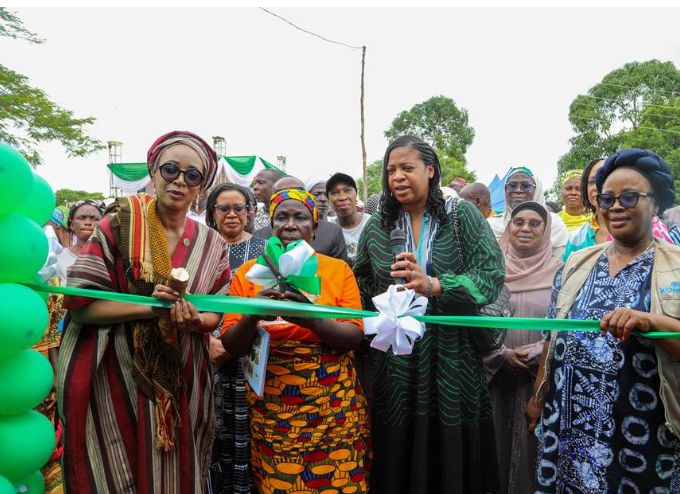
Rural women in Great Sheda Community of Kwali Area Council, Abuja, have received a major economic boost following the inauguration of a modern agro-processing centre designed to ease cassava processing and expand income-generating opportunities for women farmers and processors.
The facility, established through a partnership between UN Women and the TY Danjuma Foundation, was officially launched on Monday in the community, with stakeholders describing the intervention as a significant step toward strengthening women’s economic empowerment and rural development.
At the heart of the project is a cassava peeling and grinding machine that is expected to transform the production of Akpu, a staple food that serves as a major source of livelihood for many women in the area. For years, local processors relied largely on manual methods that demanded long hours of labour and limited production capacity. The new facility is expected to reduce processing time, improve efficiency and enable women to devote more time to other productive ventures.
Speaking during the inauguration, the UN Women Representative to Nigeria and ECOWAS, Beatrice Eyong said the initiative goes beyond providing equipment, stressing that it represents an investment in the productivity and economic future of rural women.
According to her, reducing the burden associated with manual cassava processing would help women increase their earnings, pursue additional economic activities and contribute more effectively to the development of their families and communities.
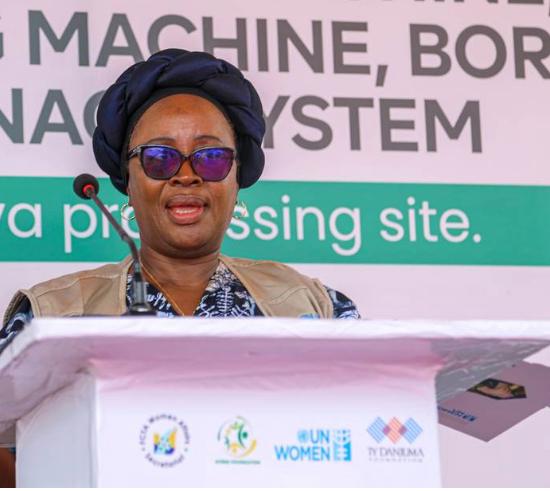
Chairman of the Board of Trustees of the TY Danjuma Foundation, Hannatu Gentles, reaffirmed the foundation’s commitment to supporting underserved communities through strategic interventions in health, education and economic empowerment.
She described women as the backbone of the rural economy and expressed confidence that members of the Akpu Women Association would utilise the facility to expand their businesses and improve the welfare of their households.
Also speaking at the event, former FCT Mandate Secretary and Director-General of the Mariam Babangida Centre, Adedayo Benjamins-Laniyi, noted that access to modern processing tools would not only improve cassava production but also strengthen food security, stimulate economic growth and enhance community resilience.
Residents of Great Sheda welcomed the intervention, describing it as a transformative project capable of increasing productivity, raising household incomes and stimulating economic activities across the community and neighbouring settlements.
The agro-processing centre is expected to serve women processors within Great Sheda and surrounding communities, creating opportunities for improved food processing practices, higher earnings and stronger local economic growth.
The project underscores growing efforts by development partners and philanthropic organisations to support women as key drivers of economic development, food security and sustainable community growth in rural Nigeria.
UN Women, TY Danjuma Foundation Boost Rural Women’s Livelihoods with Agro-Processing Centre in Abuja Community
Police Arrest 21 Suspects, Recover 20 Motorcycles in Zamfara Crackdown
By: Zagazola Makama
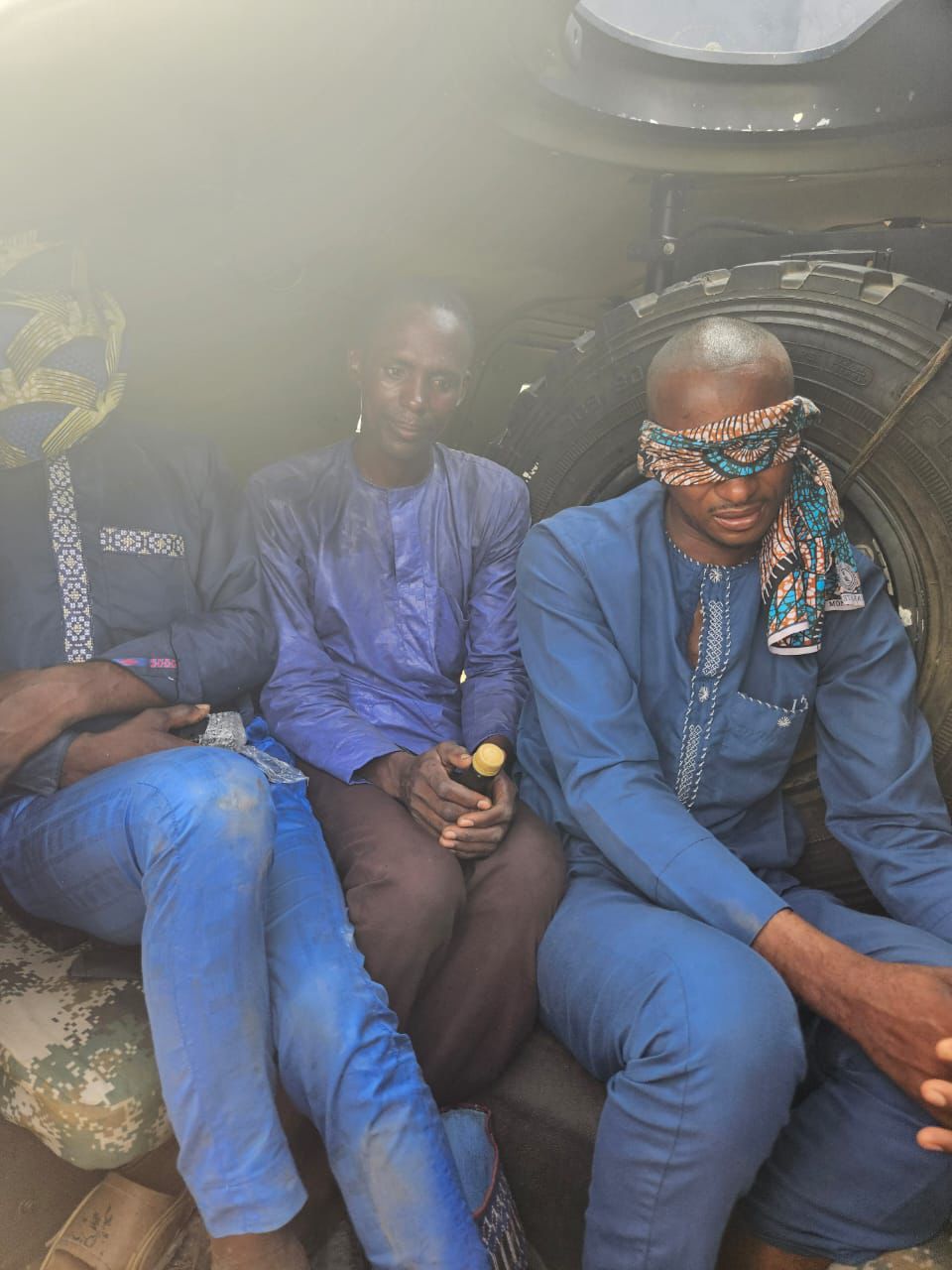
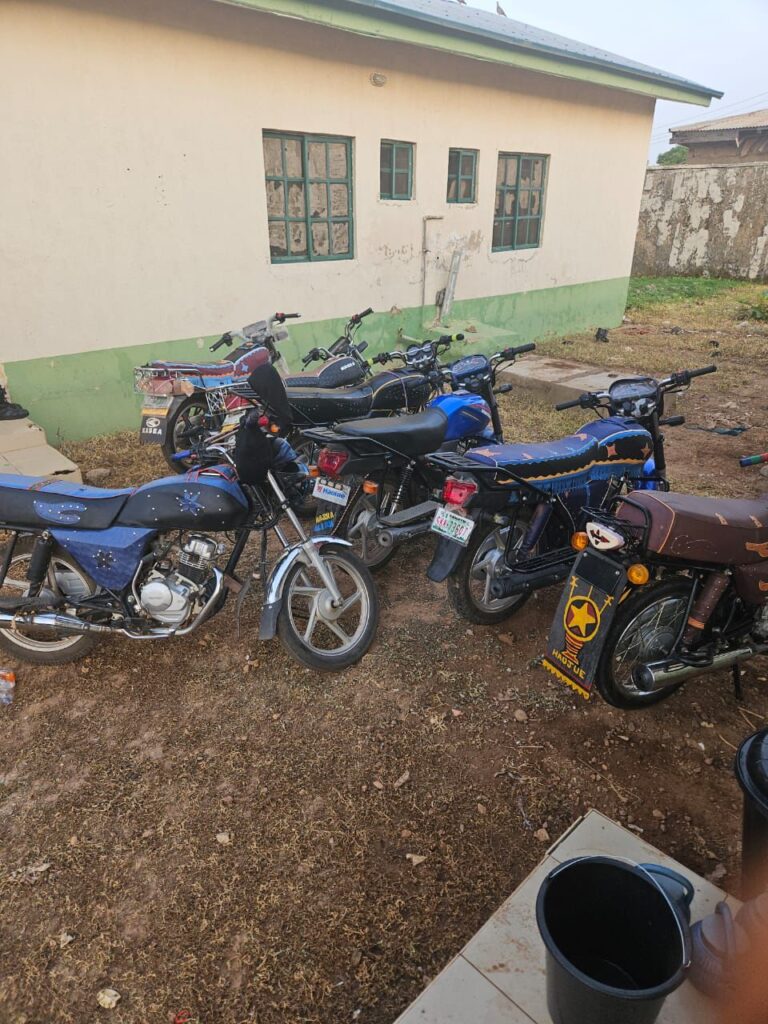
The Zamfara State Police Command says it has arrested 21 suspects and recovered 20 motorcycles during a special operation targeting reckless motorcycle riders and public disturbances in parts of Gusau Local Government Area.
The command disclosed this in a statement issued on Thursday in Gusau.
According to the statement, the operation followed repeated complaints from residents of Birnin Ruwa, Tullukawa and Yar Gada communities over the activities of groups of youths popularly known as “Arlet Boys.”
The police said the youths were allegedly involved in reckless motorcycle riding and other acts capable of causing public disorder in the affected communities.
The statement explained that on June 7 at about 7:30 p.m., police operatives carried out coordinated raids on identified criminal hideouts and black spots within the three communities.
It said the operation led to the arrest of 21 suspects and the recovery of 20 motorcycles.
“The arrested suspects will be subjected to thorough screening and investigation, while those found culpable will be charged to court accordingly,” the statement said.
The command assured residents that the operation would be sustained to rid the affected communities of criminal elements and enhance public safety.
It also urged members of the public to continue providing timely and credible information to security agencies to support crime prevention efforts across the state.
The police reiterated their commitment to maintaining law and order as well as protecting lives and property throughout Zamfara.
Police Arrest 21 Suspects, Recover 20 Motorcycles in Zamfara Crackdown

June 12 Democracy Day: Democracy Remains Nigeria’s Surest Path to Peace, Unity — IPCR
By: Michael Mike
The Institute for Peace and Conflict Resolution (IPCR) has declared that democracy remains Nigeria’s most reliable pathway to lasting peace, national cohesion and sustainable development, urging both government and citizens to deepen their commitment to democratic values and institutions.
In a statement issued ahead of the June 12 Democracy Day commemoration, the Director-General of the institute, Dr. Joseph Ochogwu, said the significance of June 12 extends beyond a historical milestone, serving as a constant reminder of the sacrifices made in the struggle for democratic governance and the collective responsibility required to sustain it.
According to him, Nigeria’s democratic journey continues to offer critical lessons on the need for accountability, inclusiveness and effective governance as foundations for peace and stability.
Ochogwu stressed that democratic governance can only deliver its full benefits when government institutions operate transparently and efficiently while citizens actively support programmes and initiatives designed to advance national development.
He noted that all government processes and structures must remain firmly rooted in democratic principles and geared toward improving the welfare of citizens, adding that public participation and responsibility are equally essential to the consolidation of democracy.
The IPCR boss also linked Nigeria’s democratic credentials to its international standing, pointing out that democracy occupies a central place in President Bola Ahmed Tinubu’s foreign policy agenda.
He said the country’s commitment to democratic principles is reflected not only in its domestic governance framework but also in its advocacy for reforms within the international system, including calls for the democratization of the United Nations to make it more responsive to emerging global realities.
“At both the national and international levels, democracy must remain inclusive, participatory and responsive to the needs of the people,” he said, adding that citizens should not merely be recipients of governance but active stakeholders in shaping democratic outcomes.
Ochogwu maintained that where democratic institutions function effectively and citizens are meaningfully engaged, the result is greater national stability, stronger social cohesion and a more peaceful society.
Against the backdrop of ongoing security and social challenges confronting parts of the country, the institute called for renewed investment in peacebuilding initiatives, dialogue and national unity, warning that democracy cannot flourish in an environment characterized by division, violence and mistrust.
The institute urged Nigerians to embrace democracy not only as a system of government but also as a culture built on tolerance, mutual respect and shared responsibility.
It further emphasized that the enduring legacy of June 12 should inspire continued efforts to strengthen democratic institutions, improve service delivery and promote justice, inclusion and peaceful coexistence across the country.
The IPCR reaffirmed that Nigeria’s democratic future depends on the collective resolve of leaders and citizens to uphold the principles of accountability, inclusiveness and national unity, describing these values as essential for achieving lasting peace and development.
June 12 Democracy Day: Democracy Remains Nigeria’s Surest Path to Peace, Unity — IPCR

Radical Approach: Ways of Ending the Menace of Insecurity in Nigeria

UN Women, TY Danjuma Foundation Boost Rural Women’s Livelihoods with Agro-Processing Centre in Abuja Community

Police Arrest 21 Suspects, Recover 20 Motorcycles in Zamfara Crackdown

Roger Federer’s Shock as DNA Results Reveal Myla and Charlene Are Not His Biological Children

THE PLIGHT OF FARIDA

FAILED COUP IN BURKINA FASO: HOW TRAORÉ NARROWLY ESCAPED ASSASSINATION PLOT AMID FOREIGN INTERFERENCE CLAIMS
-
 News2 years ago
Roger Federer’s Shock as DNA Results Reveal Myla and Charlene Are Not His Biological Children
-
Opinions4 years ago
THE PLIGHT OF FARIDA
-
 News1 year ago
FAILED COUP IN BURKINA FASO: HOW TRAORÉ NARROWLY ESCAPED ASSASSINATION PLOT AMID FOREIGN INTERFERENCE CLAIMS
-

 News2 years ago
EYN: Rev. Billi, Distortion of History, and The Living Tamarind Tree
-
 Opinions4 years ago
POLICE CHARGE ROOMS, A MINTING PRESS
-

 ACADEMICS2 years ago
A History of Biu” (2015) and The Lingering Bura-Pabir Question (1)
-

 Columns2 years ago
Army University Biu: There is certain interest, but certainly not from Borno.
-

 Politics1 year ago
2027: Why Hon. Midala Balami Must Go, as Youths in Hawul and Asikira/Uba Federal Constituency Reject ₦500,000 as Sallah Gift
