
Uncategorized
Nigeria, China Sign Culture and Tourism Statute

Nigeria, China Sign Culture and Tourism Statute
By: Michael Mike
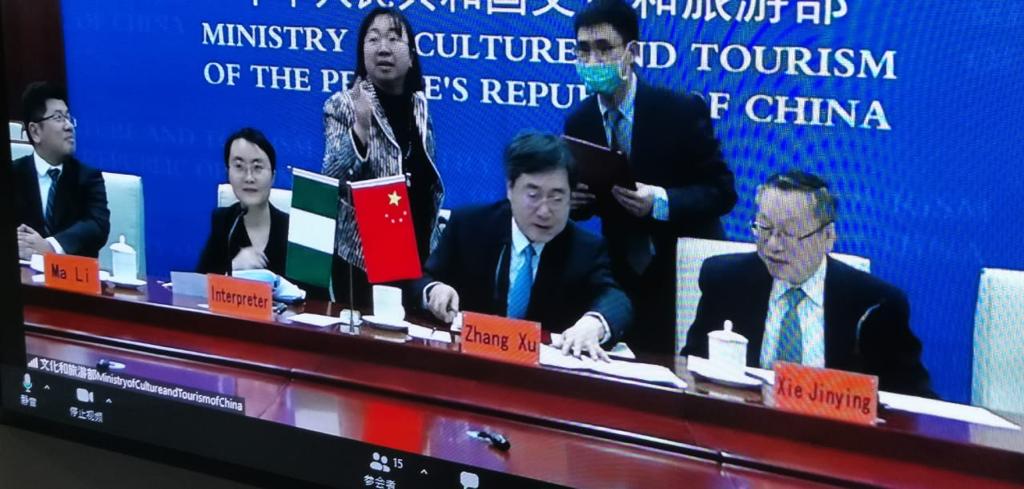
Nigeria and the People’s Republic of China have signed a joint Culture and Tourism Statute and inaugurated a sub-committee that would further strengthen bilateral cooperation between both countries.
Representatives of both countries signed the act and inaugurated the committee during a virtual event hosted by the Chinese Embassy in Abuja on Wednesday.
During the event, China’s Vice Minister of Culture and Tourism, Mr Zhang Xu, while recalling that Nigeria and China “have enjoyed good bilateral relations in the past 50 years,” noted that culture and tourism have played critical roles in strengthening the ties.
He revealed that the aim of adopting the act and establishing the sub-committee was to promote inter-cultural collaboration and connectivity between the Chinese and Nigerian people in furtherance of China-Africa relations.
He said the establishment of an inter-governmental committee with Nigeria is the first-ever between China and Africa, noting that this action testify to how important and strategic China considered Nigeria.
He said: “As important contributors to the strategic partnership between our two countries, culture and tourism should play greater roles in increasing the people-to-people connectivity for the benefit of the two countries.
“That is the mission of the culture and tourism sub-committee that we are establishing today.
“Therefore, members of our ministries and sub-committees must make good use of the platform in alignment with the objectives of FOCAC, its eight ministerial meetings, Belt and Road Initiative, and FOCAC Action Plan 2022-2024.”
He added that: “We must work together to offset the COVID-19 pandemic’s impact and the planned programmes that the sub-committee covers such as culture, tourism, publishing heritage, library, and museum.
“Our goal must always be to promote our interculturality, and cultural collaboration, full relationship and connectivity between China and Nigeria people in the new areas of China-Africa relations.”
Zhang advised the sub-committee to ensure the promotion of activities and events that would further boost cultural ties between both countries.
He said: “I would like to propose the following; keep working on events like Happy Chinese New Year, Chinese and African culture in focus, and resume mutual visits of artists as soon as the pandemic situation allows.
“Also, we should continue to carry out capacity building programmes in culture and tourism and support cooperation between Chinese and Nigerian cultural businesses.”
Also Read: Centre Asks US to Approach ILO for Adjudication on…
On his part, the Ambassador of China to Nigeria, Cui Jianchun said that the establishment of the Act and sub-committee on Culture and tourism is a good start to a greater future with new dynamics.
The Ambassador said that in a generation where the youth are taking the lead with great innovations, reinvigorating the culture and tourism sector will help boost both economies with mutual benefits.
According to him: “The establishment of the sub-committee on Culture and tourism is really a milestone.
“I do believe we are doing good things now because culture and tourism mean a lot to young people. We have already embarked on a new journey of mutually beneficial cooperation and we all believe that a thousand miles begin with a single step.
“The potentials of our cooperation in the fields of culture and tourism will surely be further released and a better tomorrow must belong to us.”
Permanent Secretary, Ministry of Information and Culture, Dr Ifeoma Anyawutaku, who led Nigerian team to the signing, said the potentialities in the creative sector in Nigeria were untapped and that the new cooperation would help facilitate that.
She said Nigeria will also leverage this to diversify its economy by adequately harnessing the potentials in the culture and tourism sector.
Anyawutaku said: “While taking a cursory look at the Statutes of the sub-committee on Culture and Tourism, Nigeria, as well as China have reviewed our achievements and experiences in the cultural and tourism exchanges and cooperation.
“Under the framework of the Forum on China and Africa Cooperation (FOCAC). This evaluation and experiences will help reposition the culture and tourism sector. For the development of both countries and the reinforcement of our bilateral cooperation.”
The establishment of the sub-committee and drafting of the act was an outcome of the Memorandum of Understanding (MoU) signed between the foreign ministers of both countries with the aim of boosting bilateral ties.
Chinese Minister of Foreign Affairs, Wang Yi had signed the MoU on behalf of his country during his visit to Nigeria while his Nigerian counterpart, Geoffrey Onyeama signed on behalf of the Federal Government.
Nigeria, China Sign Culture and Tourism Statute


Niger Military Report Confirms Loss of Equipment After Attack on GNN Position
By: Zagazola Makama
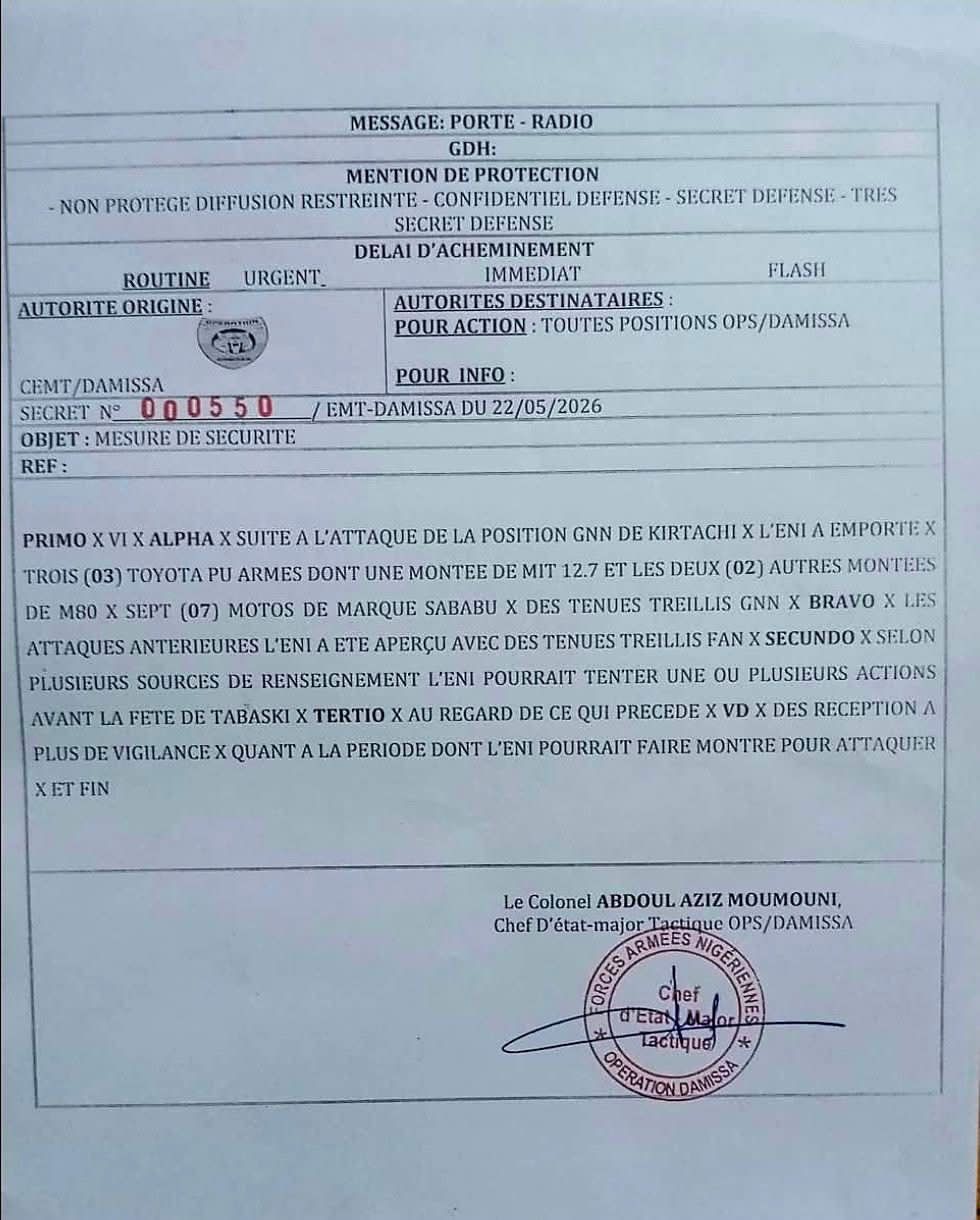
A classified internal military communication marked “Secret Defense” has confirmed significant losses of equipment following an attack on a Nigerien Gendarmerie Nationale (GNN) position in Kirtachi, in the Tillabéri Region in Niger Republic.
The internal radio message, dated May 22, 2026, indicated that the attack was carried out by suspected fighters of the Jama’at Nusrat al-Islam wal-Muslimin (JNIM), during which several military assets were reportedly seized.
According to the document, the attackers made away with three armed Toyota pickup vehicles. One of the vehicles was said to be mounted with a 12.7mm heavy machine gun, while the remaining two were fitted with M80-type weapons.
The report further stated that seven motorcycles, locally referred to as “Sababu,” were also taken, alongside GNN uniforms and related operational gear.
Preliminary figures contained in the same communication put the casualty toll at 12 security and defence force personnel killed, while four others were reported missing following the incident.
The document also reportedly urged heightened alertness across operational positions in the region, warning of possible further attacks ahead of the upcoming Tabaski celebrations.
Security sources have not yet issued an official public statement confirming the details contained in the leaked communication.
Niger Military Report Confirms Loss of Equipment After Attack on GNN Position
Senior Military Officer Dies in Road Traffic Accident Along Kaduna–Zaria Expressway
By: Zagazola Makama
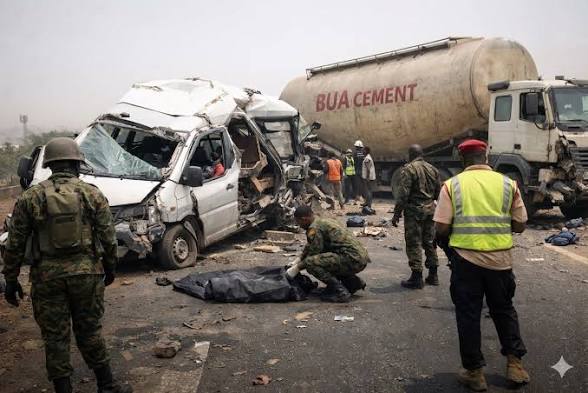
A senior military officer, Maj. S. Sayyadi of Headquarters Infantry Corps Command (ICC), has died in a road traffic accident along the Zaria–Kaduna Expressway near the Julius Berger gate, close to Jaji Military Cantonment.
Security sources disclosed that the incident occurred on May 21 when the officer’s vehicle reportedly collided with a Sino truck that had slowed down to access the China Civil Engineering Construction Corporation (CCECC) railway project site located at the New Barracks area in Jaji Military Cantonment.
Following the accident, medical teams from the Armed Forces Command and Staff College (AFCSC) and ICC were swiftly mobilised to the scene, where the officer was confirmed dead due to severe head injuries.
His remains were evacuated to a medical facility before being conveyed to Katsina State in a military ambulance for burial arrangements.
The late officer was laid to rest in Katsina State according to Islamic rites.
Sources said that Military authorities have expressed condolences to the family of the deceased, describing the incident as a tragic loss.
Senior Military Officer Dies in Road Traffic Accident Along Kaduna–Zaria Expressway
Uncategorized
Hidden Wounds Across Borders: Thousands of Women in Nigeria, Somalia Suffer in Silence as Obstetric Fistula Crisis Deepens

Hidden Wounds Across Borders: Thousands of Women in Nigeria, Somalia Suffer in Silence as Obstetric Fistula Crisis Deepens
By: Michael Mike
Thousands of women in Nigeria and Somalia are battling one of the world’s most devastating childbirth injuries — obstetric fistula — amid poverty, weak healthcare systems, insecurity and limited access to emergency maternal care, according to humanitarian medical workers.
A statement on Friday by Médecins Sans Frontières (MSF), stated that from northern Nigeria to southwestern Somalia, women who survived prolonged and obstructed labour are now living with chronic pain, incontinence, stigma and social isolation after losing control of their bladder or bowel following traumatic childbirth complications.
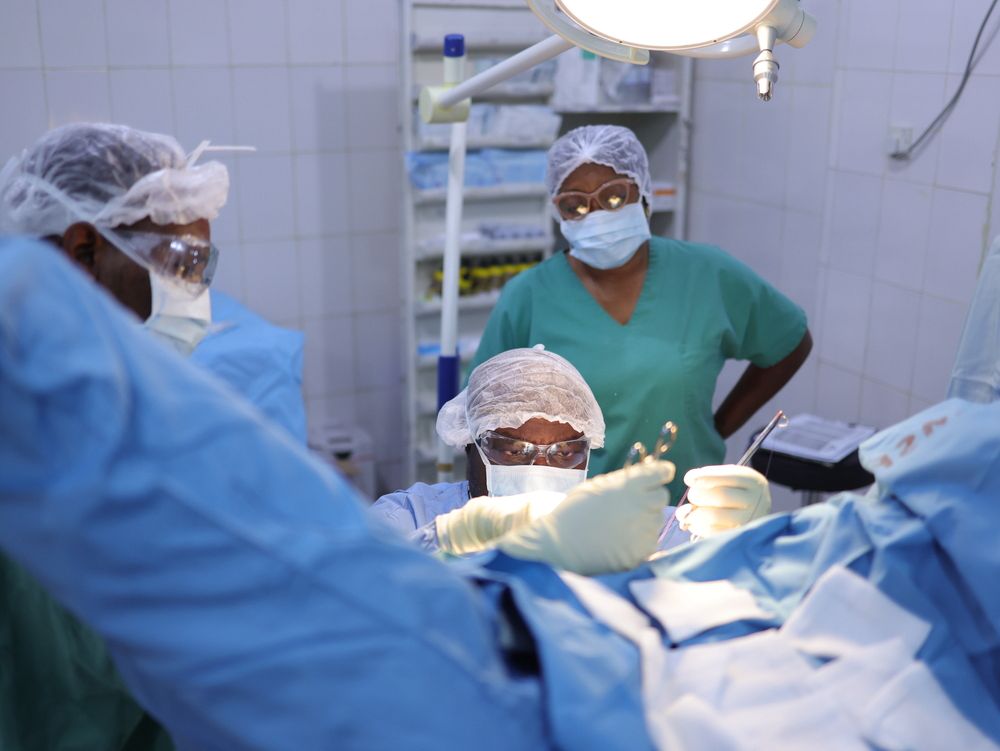
At Jahun General Hospital in northern Nigeria and Bay Regional Hospital in Somalia, according to the statement, teams from Médecins Sans Frontières (MSF) and local health authorities are struggling to provide life-changing reconstructive surgery and rehabilitation services to affected women whose lives have been shattered by the condition.
For many of the patients, the injury came after days of labour without access to emergency caesarean sections or skilled medical care — a reality that continues to endanger women in fragile and conflict-affected regions.
The statement said Aisha (not her real name), a young Nigerian woman from Yobe State, arrived at Jahun General Hospital emotionally broken after losing her baby during childbirth and suffering severe internal injuries that left her incontinent.
On the other side of the continent, Hodan (equally not her real name), a Somali woman married off as a teenager, endured eight years of silence and humiliation after a prolonged labour during her first pregnancy left her with the same condition.
“I did not know there was treatment,” Hodan said after finally reaching the fistula unit in Baidoa.
According to MSF, obstetric fistula occurs when prolonged obstructed labour damages tissues between the birth canal and the bladder or rectum, leaving women leaking urine or stool continuously. In about 90 per cent of cases, the baby does not survive.
Medical experts said the condition is closely linked to child marriage, teenage pregnancy, malnutrition, female genital mutilation and the collapse or absence of emergency obstetric services.
In both Nigeria and Somalia, those risk factors are compounded by insecurity, displacement, poor transportation and overstretched health systems, forcing many women to attempt childbirth at home or in poorly equipped facilities.
Dr. Raphael Kananga said many patients arrive at hospitals only after suffering irreversible injuries.
“Most of the women who reach us have already given birth somewhere else or tried to, often at home, and often after several days of labour,” he said.
“By the time they arrive at our hospital, they have already sustained an injury, often with additional infections and complications. Surgical repair is possible, but this should have been prevented from happening in the first place.”
The 55-bed fistula ward at Jahun General Hospital has become a critical lifeline for women across northern Nigeria. Since its establishment in 2008, more than 6,000 reconstructive surgeries have been carried out there.
In 2025 alone, 295 women were admitted, while 224 underwent surgery. Between January and March 2026, another 64 women were admitted, with 48 already receiving surgical treatment.
Care at the facility includes free surgery, physiotherapy, psychological counselling, nutrition support and long-term rehabilitation, with many patients spending up to three months recovering.
Aisha, who has already undergone two surgeries and is awaiting a third procedure, said meeting other survivors gave her hope.
“At first, I thought I would never be cured,” she said. “Then I came here and saw other women with the same condition. I realised I was not alone.”
In Somalia, the fistula unit at Bay Regional Hospital, opened in 2025 with support from MSF and Somalia’s Ministry of Health, remains one of the few specialised centres in the country capable of handling such cases.
Since its launch, only 38 women have received treatment there, even though several thousand more are estimated to require urgent care nationwide.
Frida Athanassiadis said many women live with fistula for years before learning that treatment exists.
“Fistula care is not only about surgery,” she said. “It is about listening, counselling, and helping women rebuild their confidence.”
Healthcare workers warn that demand for fistula care in both countries far exceeds available capacity.
Jahun General Hospital remains the only facility in Jigawa State capable of performing vesicovaginal fistula reconstructive surgery, while Bay Regional Hospital is the only specialised centre in Somalia’s Southwest State.
Humanitarian organisations said the persistence of obstetric fistula reflects deeper failures in maternal healthcare systems across parts of Africa, where preventable childbirth complications continue to claim lives and destroy futures.
Medical experts insisted that fistula is entirely preventable through proper antenatal care, access to trained midwives, timely referrals and emergency caesarean sections before prolonged labour causes permanent tissue damage.
MSF and health officials are now calling for urgent investments in maternal and newborn healthcare services, including skilled birth attendance, emergency obstetric care and expanded fistula treatment programmes for women already living with the condition.
For survivors like Aisha and Hodan, however, the struggle goes beyond physical healing — it is also about reclaiming dignity after years of pain, silence and exclusion.
Hidden Wounds Across Borders: Thousands of Women in Nigeria, Somalia Suffer in Silence as Obstetric Fistula Crisis Deepens

Zulum Flags off Distribution of Renewed Hope Sallah Palliative

2027: When Tinubu’s endorsement of Vice President Kashim Shettima’s unwavering support speaks volumes

Troops Arrest Suspected Security Impersonator In Plateau

Roger Federer’s Shock as DNA Results Reveal Myla and Charlene Are Not His Biological Children

THE PLIGHT OF FARIDA

FAILED COUP IN BURKINA FASO: HOW TRAORÉ NARROWLY ESCAPED ASSASSINATION PLOT AMID FOREIGN INTERFERENCE CLAIMS
-
 News2 years ago
Roger Federer’s Shock as DNA Results Reveal Myla and Charlene Are Not His Biological Children
-
Opinions4 years ago
THE PLIGHT OF FARIDA
-
 News1 year ago
FAILED COUP IN BURKINA FASO: HOW TRAORÉ NARROWLY ESCAPED ASSASSINATION PLOT AMID FOREIGN INTERFERENCE CLAIMS
-

 News2 years ago
EYN: Rev. Billi, Distortion of History, and The Living Tamarind Tree
-
 Opinions4 years ago
POLICE CHARGE ROOMS, A MINTING PRESS
-

 ACADEMICS2 years ago
A History of Biu” (2015) and The Lingering Bura-Pabir Question (1)
-

 Columns2 years ago
Army University Biu: There is certain interest, but certainly not from Borno.
-

 Politics12 months ago
2027: Why Hon. Midala Balami Must Go, as Youths in Hawul and Asikira/Uba Federal Constituency Reject ₦500,000 as Sallah Gift
