
News
A Bulwark for Borno’s Resilience: A Few Of Zulum’s Security Feats

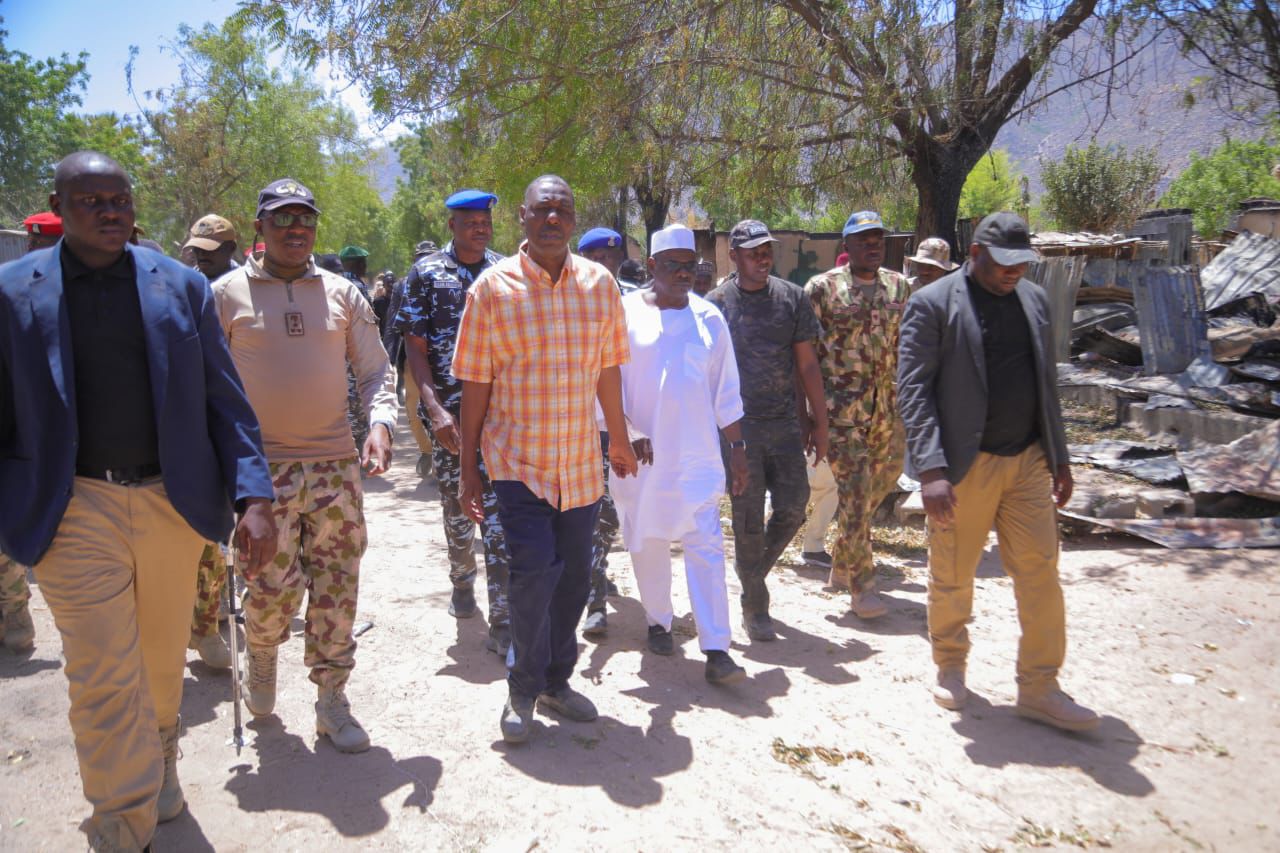
A Bulwark for Borno’s Resilience: A Few Of Zulum’s Security Feats
By Dauda Iliya
Weighed on the scale of the insecurity ravaging the entity he was entrusted with the responsibility of governing since May 29, 2019, the feats accomplished by Governor Babagana Umara Zulum of Borno State on the restoration of security as sine qua non for the recovery of the state from an appalling terror-orchestrated retrogression, and positioning it on the trajectory of prosperity have been exceptionally weighty.
With countless encomiums showered on the Professor of Agricultural Engineering-turned-governor from all nooks and crannies of the country and the globe over the last seven years of his governorship, even the most unapologetic critics of his administration would attest to this incontrovertible fact.
Prof. Zulum assumed the governorship of the state, smouldering with resilience, the passion to pilot the ship of the state to the shores of recovery and prosperity, and the unshakeable resolve to sustain the tempo of the search for lasting security for his dear, beleaguered state.
As the bulwark of Borno’s Resilience, Zulum has, for the past seven years, been unyielding in his strong commitment to the restoration of security and the recovery of the state. On countless instances, he mortgaged his safety and security as he trotted around the state, ministering to the numerous needs of the terror-traumatized population.
He was personally attacked several times when he was the Commissioner for Reconstruction, Rehabilitation, and Resettlement.

In 2020 alone, Governor Zulum was attacked four times in what seemed a coordinated scheme to frustrate his efforts at relocating over hundred of thousands of internally Displaced Persons (IDP) to their ancestral homes across the local government areas of the state,
most-notably during his visit to the fishing community of Baga in Kukawa LGA, where his convoy was ambushed in the year 2020. He survived the attack that could have frustrated the entire relocation and resettlement programme of the IDPs across the state.
On September 25 2020, the governor’s convoy was again attacked by suspected insurgents on its way to Baga, leaving several persons dead. Less than 48 hours later, on Sunday, September 27, another attack was launched on the governor’s motorcade in Monguno, on its way back to Maiduguri, the State capital, but no casualty was reported.
Governor Zulum was not only unruffled by such attacks but also unrelenting in his travels around the state to deliver services. The more the attacks on his convoy, the more he smouldered with the gusto and commitment to rebuild Borno from the rubble of insurgency and position it on the trajectory of prosperity in the class of its sister states of the federation.
In the face of such attacks, he stood face-to-face with the stark reality that daring all such frustrating challenges was the only way open to him to do his work. There was just no other way. He, therefore, resolved to dare all such challenges. He has, incontrovertibly, been daring the challenges most uncommonly.
Daredevil, absolutely incredibly, and prepared most particularly for sustainable recovery projects and programmes, he was fully aware that his administration had to contribute whatever was necessary, however many resources it could, to restore security.
Security is the duty and responsibility of the federal government, but its state and its people are the ones suffering and dying because of its lack. Therefore, while pleading passionately with the federal government and the military to please not allow the terrorists to retake his state from him, he promptly swung into action, contributing a huge quantum of resources that the security agencies need to fight terror.
He does this, while frontally tackling the massive humanitarian crisis ignited by the terror, simultaneously joining forces with the military to check or, at least, minimize the sudden terror resurgences before they reach an appalling state and rage that might take decades to subdue.
For Zulum and every stakeholder in the security of Nigeria, it would be most scary to witness any mass exodus of displaced communities, sacked once again by the resurgence, back to the already closed Maiduguri metropolis IDP camps, which were the most nauseating features of the 2014-2024 insurgency-precipitated humanitarian crisis.

In response to the series of resurging attacks, most scarily between the end of April and the middle of May 2025, most especially around Marte, Damboa, Gajiram, Chibok and the Mandara Hills of Gwoza, Zulum, therefore, hastened to Marte Local Government Area to assess the situation and provide support to the affected communities while deepening his pleas to the federal government and the military to hasten to his rescue before the terrorists retake Marte.
Between 2024 and 2025, Boko Haram/ISWAP tried several pranks to clip Zulum’s wings as he soared higher in his search for security for his state. The terrorists have been marauding into the Borno terrain from their border enclaves, tormenting resettled communities, killing scores, to, apparently, scare Zulum from going ahead with his UN-praised Borno Model of societal recovery.
Zulum, leveraging the fascinating successes of the security agencies – The North-East Operation Hadin Kai Theater Command in Maiduguri and the Multi-National Joint Task Force headquartered in Ndjamena, Chad Republic, seems solidly determined to ensure that Borno recovers from the terror-inflicted humanitarian crisis and, as a competent representative of the Nigerian authorities, squeezes terror out of the shores of Nigeria.
Excitingly, undeterred by the persistent resurgence of terror across the Northern, Central, and parts of the Southern zones of the state, Governor Zulum, smouldering with an uncommon determination and daredevil stance on recovery, still trotted around, resettling communities and instilling resilience to withstand the resurgence of terror.
Support to Military/Security Agencies and Volunteers
Governor Zulum has demonstrated exemplary leadership in addressing the state’s pressing security concerns through deploying both kinetic and non-kinetic measures.
In the last one year, Zulum has procured and distributed 481 operational vehicles to the military, Police, Nigerian Security and Civil Defence Corps, other law enforcement agencies, the Civilian JTF, hunters, and vigilantes.
Additionally, in November 2025, Borno State Governor Babagana Umara Zulum distributed 63 operational vehicles to security agencies in Maiduguri to enhance surveillance and combat emerging threats.
The beneficiaries include 30 vehicles for 10 sectors of the Civilian JTF, 16 for Rapid Response and Anti-Social Vices units, 10 for paramilitary organisations, six for local hunters, and one for the National Agency for the Prohibition of Trafficking in Persons (NAPTIP).
Zulum said the initiative aligns with his administration’s sustained efforts to strengthen security logistics across the state. “We will continue to support the security apparatus to ensure Borno is completely free from insurgency,” he stated.
Earlier in 2025, Governor Babagana Umara Zulum distributed 110 brand-new operational vehicles, 500 motorcycles, and 280 houses to the Nigeria Police Force and other security agencies.
According to the distribution formula, 60 vehicles will be allocated to the Nigerian Police and 50 vehicles and 500 motorcycles to the Nigerian military.
Zulum also approved an upward review of the monthly allowances to volunteers under the Borno Youth Empowerment Scheme, popularly known as the Civilian Joint Task Force (CJTF), Vigilantes Hunters, and Neighbourhood Watch.
Zulum approved an upward review of the monthly allowance for each volunteer from ₦30,000.00 to ₦50,000.00, while leaders of the volunteer groups will now receive ₦150,000.00 each.
The reviewed allowance has already started hitting their accounts, resulting in a revised monthly expenditure of ₦232.4 million.
“The Civilian Joint Task Force (CJTF), Vigilantes, Hunters, and Neighbourhood Watch have consistently demonstrated gallantry, resilience, and unwavering commitment in the fight against Boko Haram insurgents,” Zulum stated.
In recognition of these sacrifices and in appreciation of their steadfast dedication to peace and security, Zulum also approved an upward review of allowances for the
leaders of the volunteer groups to ₦150,000.00 each.
Zulum’s Tour to Pulka/Ngoshe
Over the last seven years, Zulum has maintained his routine of visiting communities affected by attacks to commiserate with them, build their resilience, and console them with humanitarian aid. Most recently, he paid a confidence- and resilience-building visit to the displaced persons in Ngoshe, who are currently taking refuge in Pulka.
Ngoshe, a community in Gwoza local government, was attacked on 4th March, forcing residents to flee their homes.
This was the second time Governor Babagana Zulum has visited victims of Ngoshe, in expression of grave concern about the security situation not only in Gwoza, but also in the entire State.
Addressing the displaced persons at the Pulka Central Primary School, Zulum said the visit was aimed at reinforcing government support, boosting public confidence, and engaging stakeholders on improved security strategies.
“The major reason why we are here is first and foremost to once again sympathize with them and to convey our deepest sympathy, and to assure them that the Federal Government of Nigeria and the Borno State Government will do everything possible to strengthen the security of the entire Gwoza community,” Zulum said.
He reassured residents of Gwoza and surrounding communities of strengthened security measures and sustained humanitarian support following recent attacks, stressing that all those in captivity will be rescued.
Governor Zulum spent the entire Saturday night coordinating security activities in Pulka following the recent attacks in Ngoshe, Pulka, and other communities in Gwoza. That was the first time a sitting Governor has slept in Pulka, a community 22 kilometers from Gwoza.
He noted to them that leadership is all about commitment and sacrifice, a hallmark of his administration since he assumed office.
“Leadership is not about living in your comfort zone and then addressing people and addressing their concerns, but coming directly to the doorsteps of the less privileged. This has been my tradition, this has been my culture since I assumed duty as the governor of the state,” Zulum said.
“I cannot remember when I lived consecutively for 10 days in my office or even one week since I assumed duty. I’m always in the remote areas attending to people, and I believe this is what we should do from now on to the end of my own administration,” he noted.
Governor Zulum, on Sunday, visited Ngoshe to see for himself the level of damage, which is about 40 kilometers away from Gwoza. He disbursed cash and relief items to over 30,000 people affected by the recent incident.
Speaking to newsmen shortly after inspecting the affected community, the Governor described the level of destruction as shocking and heartbreaking.
He assured residents of Ngoshe in Gwoza Local Government Area that the government will rebuild homes and public infrastructure destroyed by recent attacks, while intensifying security efforts to restore lasting peace in the area.
…Vows Ngoshe Will Not Fall Again
Governor Zulum reaffirmed the commitment of the Federal and the Borno State governments to decisively address the lingering security challenges in the state, assuring residents of Ngoshe that the town would not be allowed to fall back into the control of insurgents insha Allah.
Addressing troops of the 82 Division Task Force Battalion Ngoshe, Zulum said efforts are ongoing to strengthen the military’s capacity.
“I want to assure you that the Federal Government of Nigeria, and indeed the Government of Borno State, under the leadership of the Armed Forces, will do everything possible to contain the lingering security situation,” he said.
The governor emphasized the strategic importance of Ngoshe, warning that its fall could have wider security implications for surrounding communities.” Ngoshe is very important. The fall of Ngoshe would send a very bad signal to Pulka, Kirawa, Gwoza, and even Bama. We shall not allow this town to be taken over again by insurgents,” he assured.
These efforts at restoring security to Borno, exceptionally commendable as they may seem, constitute just a modicum of the vast array of accomplishments Governor Zulum has registered in this most critical requirement for the very existence and prosperity of every entity.
As the Agricultural Engineering-turned-governor winds up his two-tenure governorship stint, it is most-crucially imperative for Borno, its stakeholders and entire people to comb, with a fine tooth comb, the state’s political cum public servants class to sieve out a personality possessing the character, credibility and capacity of Zulum to sustain the tempo of search for lasting security and consolidate on Zulum’s accomplishments, but add value to those accomplishments.
Zulum’s successor should be a genius or, at least, exceptionally talented and committed to doing something strikingly new.
“Towering genius distains a beaten path; it seeks regions hitherto unexplored,” Abraham Lincoln would say.
Dauda Iliya is the Special Adviser on Media/Spokesperson to the Borno State Governor
A Bulwark for Borno’s Resilience: A Few Of Zulum’s Security Feats


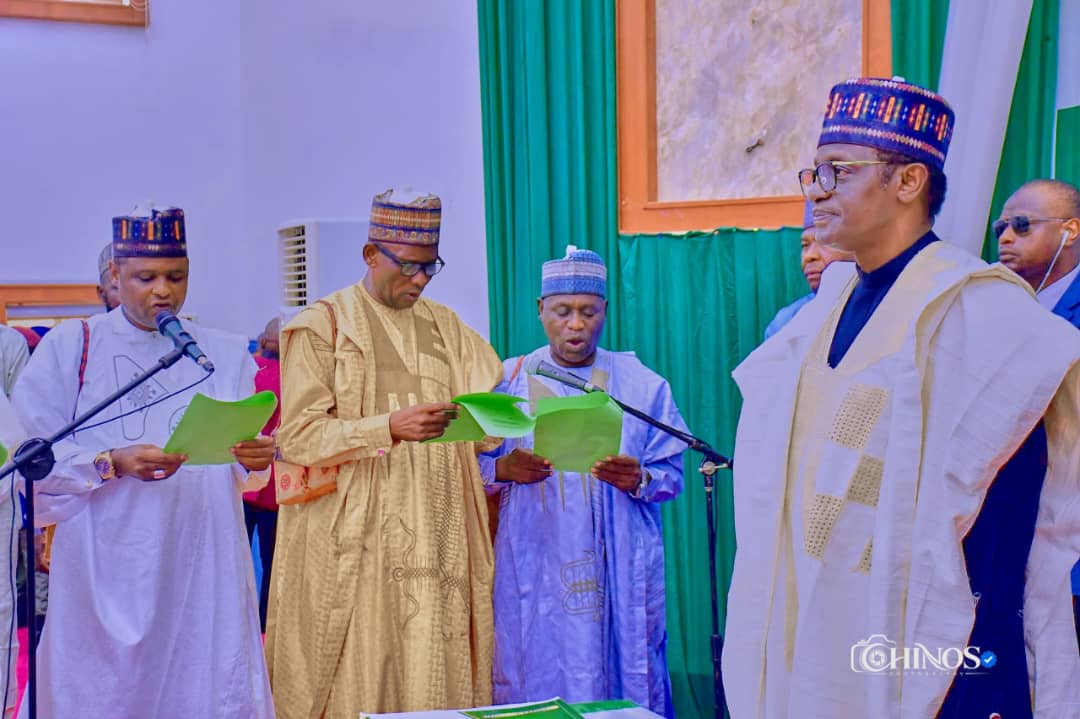
Gov. Buni swore in 2 commissioners and 7 local government chairmen in Yobe
By: Yahaya Wakili
Yobe state governor, Hon. Mai Mala Buni CON, COMN, has today sworn in two commissioners, the permanent secretary, and the 17 newly elected local government chairmen at the Banquet Hall, Government House, Damaturu.
Governor Buni said their appointment was based on merit, expertise, and individual commitment to serve and noted that, as the administration approaches its ends, there was still an opportunity for the new appointees to make a difference in their offices, assuring them of government support to discharge their duties efficiently and effectively.
According to Buni, the oath of office had provided the appointees with the legal framework to execute their duties fully, honestly, and diligently and filled the vacuum in the state executive council just as the election of council chairmen and councillors had delivered democracy to the grassroots.
He further said his administration had remained consistent in conducting local government elections to give grassroots people a sense of belonging and participation in governance through duly elected representatives.
“Yobe State was ranked second best performance” with a score of 64.3 percent, behind Oyo State’s 70 percent, in the latest assessment of the 36 states by the Kimpact Development Initiative.
Governor Mai Mala Buni tasked the chairmen of the local government to deliver their local government areas to the party in the forthcoming general elections.
“Those whose victory must be ensured to include President Bola Ahmed Tinubu GCFR for a second term in office, the state governorship candidate, Alhaji Baba Malam Wali mni, the three senatorial candidates, including Mai Mala Buni CON, six House of Representatives candidates, and the 24 state House of Assembly,” Buni listed.
Buni appealed to all political stakeholders and their supporters across all political parties to conduct their political activities peacefully and according to the rules of the game during and after the electioneering period.
“We remain a family, and Yobe State is a politically peaceful state; therefore, we must avoid and resist all activities capable of breaching peace in the state,” Governor Buni added.
Gov. Buni swore in 2 commissioners and 7 local government chairmen in Yobe

Kuje Prison Inmates Debate Education, Vocational Skills as Command Promises Jobs After Release
By: Michael Mike
The Nigerian Correctional Service (NCoS), Federal Capital Territory Command, has pledged to facilitate employment opportunities for inmates upon their release, as the Medium Security Custodial Centre, Kuje, held its maiden debate competition to promote rehabilitation and prepare inmates for reintegration into society.
The Controller of Corrections, FCT Command, Christopher Peter Jen, disclosed this on Thursday during the competition, which saw two teams of inmates argue the merits of formal education and vocational skills acquisition, with the vocational skills team emerging victorious.

Jen said the command was partnering with relevant stakeholders and support organisations to secure employment opportunities for discharged inmates, in a move aimed at improving their prospects of rebuilding their lives outside the custodial facility.
He expressed optimism that inmates could rise to positions of leadership and responsibility if given the necessary support, education and opportunities to reform.
“An inmate today can be a governor or any high-ranking individual in society tomorrow, if properly reformed,” he said.
The Controller also commended the Controller-General of Corrections, Sylvester Ndidi Nwakuche, for the opportunity to serve, saying it had strengthened his commitment to improving inmate rehabilitation and reformation across the FCT Command.
The Officer-in-Charge of the Kuje custodial centre, Assistant Controller of Corrections Adekunmi Sunday, said the debate was part of efforts to transform the facility into a centre for learning and reformation rather than one focused solely on confinement.
“Custody without training is punishment; custody with training is correction,” Sunday said.
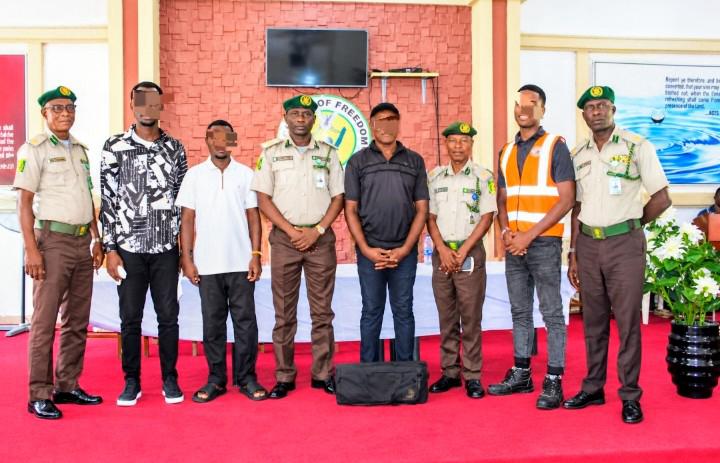
He stressed that education and vocational training were critical to preparing inmates for life after incarceration, adding that he expected every inmate under his supervision to acquire at least one of the two.
The maiden competition featured two teams of five speakers each. Team A argued in favour of education, while Team B defended vocational skills acquisition. Following the contest, the panel of judges declared Team B the winner.
The debate was organised to develop inmates’ intellectual abilities, improve their confidence and encourage constructive interaction, while providing a platform for them to express and defend their ideas.
Representatives of partner organisations and support groups also delivered goodwill messages, commending the service for its commitment to inmate education and rehabilitation.
In a vote of thanks delivered on behalf of the officer-in-charge by Superintendent of Corrections Yusuf Muye, the centre appreciated the FCT Controller, partners, staff and inmates for their contributions to the event’s success.
The centre said the debate would become a regular feature of its reformation calendar.
The employment pledge comes amid broader efforts by correctional institutions to equip inmates with practical skills and improve their chances of reintegration after serving their sentences. However, the command did not disclose the number of inmates expected to benefit from the proposed employment initiative or identify the organisations involved in the partnership.
Kuje Prison Inmates Debate Education, Vocational Skills as Command Promises Jobs After Release
Cuba Accuses US of Pressuring Nations Ahead of UN Vote on Blockade
By: Michael Mike
Cuba has accused the United States of mounting a campaign of diplomatic pressure against countries supporting calls for an end to its decades-long economic blockade, alleging that Washington is seeking to influence the outcome of an impending United Nations General Assembly vote.
Cuba’s Permanent Representative to the United Nations, Ernesto Soberón Guzmán, made the allegation on Friday while condemning a US-organised event scheduled for October 19 at the UN headquarters in New York, which he described as an attempt to divert international attention from the debate on the blockade.
The Cuban diplomat alleged that the event, titled “Cuba Libre”, was part of a broader effort to weaken support for a Cuban-sponsored resolution calling for an end to the economic, commercial and financial restrictions imposed by Washington. The resolution is scheduled for consideration by the General Assembly on October 27 and 28.
Speaking to UN-accredited journalists, Soberón accused the US of using political and diplomatic pressure to influence the positions of member states ahead of the vote, including alleged direct appeals by Secretary of State Marco Rubio to heads of state and government.
He described the reported contacts as an attempt to interfere with the sovereign decisions of UN member states, insisting that countries should be allowed to determine their voting positions without intimidation.
The diplomat also questioned the format of the October 19 event, citing restrictions on press access, the non-disclosure of panellists’ identities and a prohibition on attendees expressing their views.
He argued that the arrangements suggested an attempt to control the narrative rather than facilitate an open exchange of perspectives on Cuba.
Soberón said the Cuban delegation had obtained copies of the invitation and concept note despite not being invited to the event.
He further questioned the use of UN premises for an activity he alleged was designed to advance Washington’s political objectives against another member state, citing administrative instruction ST/AI/2019/4 on the use of UN premises and the need for activities to comply with the principles of the UN Charter.
The Cuban representative also accused Washington of applying a double standard by organising the event while having outstanding contributions to the UN’s regular budget.
Beyond the diplomatic dispute, Soberón drew attention to the economic consequences of US sanctions, particularly measures affecting Cuba’s fuel supplies and international trade.
He recalled that US President Donald Trump signed an executive order on January 29, 2026, introducing measures targeting countries supplying oil to Cuba, which he blamed for a sharp decline in fuel shipments to the island.
According to figures he presented, Cuba had received only one oil tanker from Russia in the preceding 10 months, describing the shipment as humanitarian assistance.
He also claimed that approximately 7,000 containers destined for Cuba remained at international ports because shipping companies were reluctant to transport them over fears of possible US sanctions.
Soberón linked the difficulties to further measures announced by Washington on May 1, 2026, which he said expanded the threat of sanctions against companies and countries maintaining commercial relations with Cuba.
He criticised the US-organised event for failing to address the reported impact of the restrictions on the Cuban economy and the living conditions of its population.
The Cuban government has consistently opposed the US embargo, which has remained a major point of contention between the two countries and has repeatedly featured in General Assembly debates.
Soberón maintained that the October 19 event should not distract the international community from the substantive question before the General Assembly: whether the United States should end its economic, commercial and financial blockade of Cuba.
He urged UN member states to uphold the principles of the UN Charter, resist political coercion and exercise their voting rights independently.
The United States has historically defended its Cuba policy on grounds including concerns over the island’s political system and human rights record, while Havana argues that the sanctions violate its sovereignty and impose severe economic hardship on its people.
The forthcoming General Assembly debate is expected to renew international scrutiny of the longstanding dispute.
Reaffirming Havana’s position, Soberón said Cuba would not change its stance because of external pressure, adding: “Cuba is not a threat. The blockade is.”
Cuba Accuses US of Pressuring Nations Ahead of UN Vote on Blockade

Gov. Buni swore in 2 commissioners and 7 local government chairmen in Yobe

SHOSA: Celebrating Excellence as Old Students Prepares to Rekindle Memories

Troops Rescue 27 Kidnap Victims, Including Six-Month-Old Baby, in Katsina

Roger Federer’s Shock as DNA Results Reveal Myla and Charlene Are Not His Biological Children

THE PLIGHT OF FARIDA

FAILED COUP IN BURKINA FASO: HOW TRAORÉ NARROWLY ESCAPED ASSASSINATION PLOT AMID FOREIGN INTERFERENCE CLAIMS
-
 News3 years ago
Roger Federer’s Shock as DNA Results Reveal Myla and Charlene Are Not His Biological Children
-
Opinions5 years ago
THE PLIGHT OF FARIDA
-
 News1 year ago
FAILED COUP IN BURKINA FASO: HOW TRAORÉ NARROWLY ESCAPED ASSASSINATION PLOT AMID FOREIGN INTERFERENCE CLAIMS
-
 Opinions5 years ago
POLICE CHARGE ROOMS, A MINTING PRESS
-

 News3 years ago
EYN: Rev. Billi, Distortion of History, and The Living Tamarind Tree
-

 ACADEMICS3 years ago
A History of Biu” (2015) and The Lingering Bura-Pabir Question (1)
-

 Columns3 years ago
Army University Biu: There is certain interest, but certainly not from Borno.
-

 Politics1 year ago
2027: Why Hon. Midala Balami Must Go, as Youths in Hawul and Asikira/Uba Federal Constituency Reject ₦500,000 as Sallah Gift
