
National News
ActionAid Nigeria Describes Tinubu’s Independence Day Speech, Echoes of Past Unfulfilled Promises and Reforms

ActionAid Nigeria Describes Tinubu’s Independence Day Speech, Echoes of Past Unfulfilled Promises and Reforms
By: Michael Mike
ActionAid Nigeria has described President Bola Tinubu’s Independence Day speech as echoes past promises and reforms that remain unfulfilled, stating that: “Despite the administration’s claims of economic progress, the reality is a worsening crisis for millions of Nigerians who cannot afford basic necessities.”
The Non-Governmental Organisation (NGO), in a statement on Tuesday by its Country Director, Andrew Mamedu, lamented that fuel subsidy removal, increasing cost of electricity, mounting inflation, heightened insecurity, inflation, and rising food prices have driven the poor into deeper poverty while unemployment soar.
The statement decried that the President’s reforms have only worsened the economic and social crisis, creating ripple effects that have deepened poverty and inequality.
Mamedu, said in the statement that the President has repeatedly asked Nigerians to “sacrifice” for the country, stressing that “but how long must this sacrifice last? The citizens are already bearing the brunt of devastating economic policies, with no respite in sight.
He said: “Meanwhile, corruption festers unchecked across all levels of government. What meaningful steps have been taken to address this systemic issue? In today’s speech, the president failed to address key issues, notably inflation and the rising exchange rate, which directly impact the purchasing power of ordinary citizens. These omissions leave us questioning the federal government’s understanding of the daily struggles Nigerians face.”
He insisted that: “The removal of the fuel subsidy on May 30, 2024, as pronounced by the president, triggered an unsustainable rise in fuel prices, making transportation, food production, and energy costs increasingly unbearable for ordinary Nigerians.
“Citizens are yet to recover from this shock, and instead, they face continuous suffering. The current reform by the President mirrors the devastating policies of past regimes, particularly those during the Abacha era, which left scars that we are still trying to heal from. President Tinubu’s purported “achievements” have not yet led to tangible improvements in the lives of Nigerians. On the contrary, there are growing concerns about threats to life, heightened insecurity, and rising inequality.”
He added that: “While ActionAid Nigeria acknowledges the military’s recent victories, issues surrounding the banditry in the Northwest remain largely unattended. Bandits continue to terrorise communities, displace families, and destroy livelihoods.
“These violent acts have left many Nigerians vulnerable and in constant fear. Shockingly, the President made no mention of this in his speech, ignoring the devastation that banditry has caused. The government must act swiftly to address the ongoing violence in the Northwest, providing security and protection for the citizens who have been left voiceless and unsupported.”
He noted that: “Nigerians have been speaking out, using various platforms to express their frustrations and concerns. Protests, public demonstrations, and widespread conversations on social media are clear indicators of the people’s dissatisfaction. Yet, the President and his administration remain distant and unresponsive to these cries for change. It is time for the government to truly listen to the people. Nigerians are tired of being told to “be patient” while their realities grow bleaker by the day.”
He said: “Nigerians need more than promises. We need tangible changes that will lead to affordable and improved living standards, security, and justice. Until then, ActionAid Nigeria stands in solidarity with the citizens, demanding that the government listen and act in the true interest of the people. We call for reforms that reflect the lived realities of everyday Nigerians and promote inclusivity, equity, and sustainability in governance.”
ActionAid Nigeria Describes Tinubu’s Independence Day Speech, Echoes of Past Unfulfilled Promises and Reforms


Tinubu commends Buni over successful primaries in Yobe
By: Yahaya Wakili
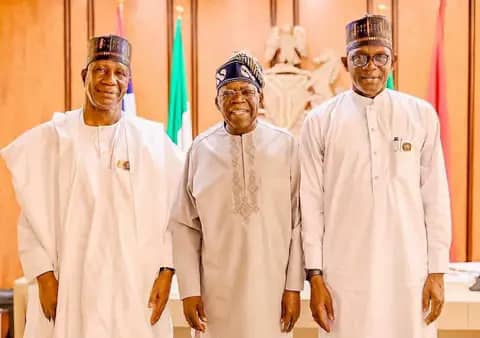
The President of the Federal Republic of Nigeria, President Ahmed Bola Tinubu GCFR, has commended Governor Mai Mala Buni CON of Yobe State and other stakeholders of the party for the successful primary election that produced Alhaji Baba Mallam Wali MNI as the party’s governorship candidate.
The President gave the commendation when he received Governor Buni and the APC gubernatorial candidate, Alhaji Baba Mallam Wali, MNI, at Aso Villa, Abuja.
President Tinubu expressed appreciation for the healthy political developments in Yobe State ahead of the forthcoming general elections.
The President described Governor Mai Mala Buni, CON, as a political strategist with invaluable strategies that have consistently contributed to the success of the All Progressives Congress (APC) and remain a worthy treasure for the party.
According to the president, “With Governor Buni at the helm of affairs, I have no doubt that Yobe State will always be delivered to the party.
“Yobe State is blessed to have a seasoned bureaucrat with a huge wealth of experience who has consistently been part of the system as the governorship candidate of the party,” President Tinubu said.
He said, “I am sure you will bring your wealth of experience to continue with the legacies of the Buni administration to add to the achievements in education, healthcare, road infrastructure, agriculture empowerment, and the rest,” President Tinubu told Baba Mallam Wali.
Governor Mai Mala Buni further described the candidate as fully prepared for the job and noted that he has been part of the system for a long time, and it will be continuity without wasting time.
He expressed the appreciation of the government and people of Yobe State for the support extended by the Tinubu-led federal government to the state to improve the lives of the people.
Tinubu commends Buni over successful primaries in Yobe
National News
Over 90% of Nigeria’s Inmates are State Offenders, Between 30-50% Shouldn’t Have Been Jailed – Tunji-Ojo
Over 90% of Nigeria’s Inmates are State Offenders, Between 30-50% Shouldn’t Have Been Jailed – Tunji-Ojo
Reveals How FG freed over 4,000 inmates in one day, cut recidivism from 13,000 to 1,000
By: Michael Mike
The Federal Government has disclosed that 93 per cent of inmates in Nigeria’s custodial facilities are being held for state offences, with only seven per cent facing federal offences, even as it revealed that between 30 and 50 per cent of inmates may be serving time for offences that do not warrant imprisonment.
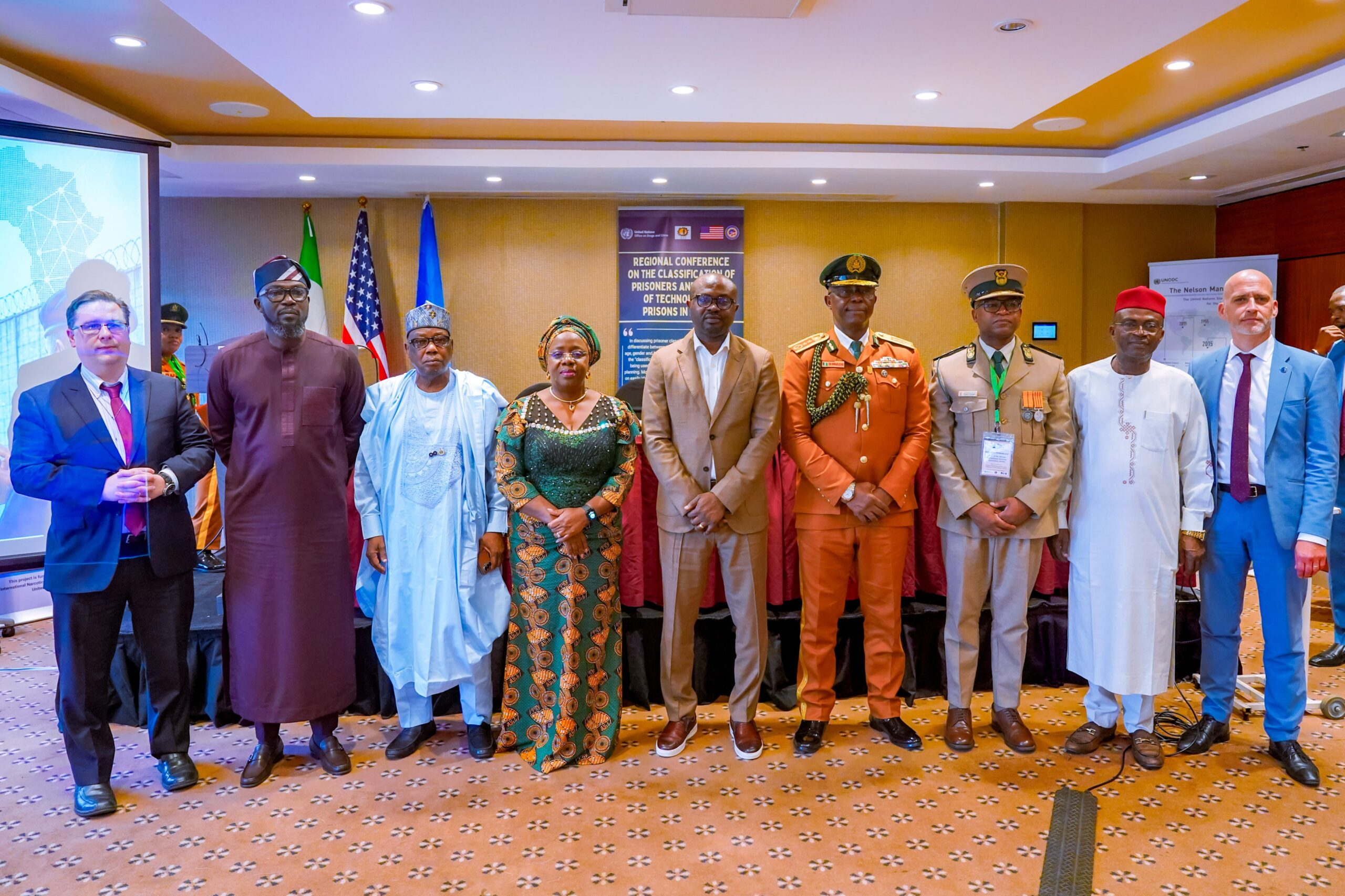
The Minister of Interior, Dr Olubunmi Tunji-Ojo, made the disclosure on Wednesday in Abuja at the Regional Conference on the Classification of Prisoners and the Use of Technology in Prisons in Africa.
The conference was jointly organised by the United Nations Office on Drugs and Crime (UNODC) and the African Correctional Services Association (ACSA).
Tunji-Ojo said the figures had exposed the need for a fundamental rethink of the way Nigeria and other African countries classify offenders and deploy imprisonment as a response to crime.
“93% of our inmates in Nigeria are state offenders. Only 7% are federal offenders. And of this 93%, I want to tell you before this president came on board, a lot of them were for minor offences that had no need for incarceration,” the minister said.
He said the Federal Government, upon his assumption of office, undertook an audit of inmates incarcerated over minor fines and compensation orders, a process that resulted in the release of more than 4,000 inmates.
“When I became minister, I called my permanent secretary, I called the Controller General of the Correctional Service, and I said, listen, give me the data, the record of people who are in correctional centres for fines and compensation of less than 500,000 or something. And guess what? Over 4,000 people,” he said.
According to the minister, the continued detention of such inmates was economically irrational, as the government spent far more feeding and maintaining them than the value of the fines or compensation involved.
“I said, what is the sense in this? Because I feed them in a year with more than 10 times of the fine. So how is the government benefiting?” he asked.
Tunji-Ojo said the government subsequently cleared the affected cases, resulting in the decongestion of correctional facilities by five per cent in a single day.
“And we were able to clear that, and in one day, we decongested our correctional centre by 5% in one day. In one day,” he said.
The minister said the experience raised a broader question about the rationale behind overcrowding in correctional facilities, insisting that the number of inmates alone should not be the only measure of the crisis.
“The question is this. Is your correctional centre rightfully overcrowded? That is the question. You have to look at those particular offences. You will realise that more than 30, 40, 50 percent are offences that do not warrant incarceration,” he said.
The disclosure comes against the background of Nigeria’s long-running prison congestion crisis. Correctional facilities across the country have for years struggled with overcrowding, placing enormous pressure on feeding, healthcare, security, rehabilitation and other essential services.
A significant proportion of the inmate population comprises persons awaiting trial. In many cases, detainees spend prolonged periods in custody before their cases are concluded, with some eventually discharged for lack of evidence or after spending periods in detention that exceed the sentences they might have received if convicted.
The situation has fuelled concerns over access to justice, the presumption of innocence and the impact of poverty on the criminal justice system, particularly where suspects are unable to meet bail conditions or secure effective legal representation.
The minister’s position suggests that the problem cannot be solved simply by constructing more prisons. Rather, it requires a more rigorous classification of inmates, faster trials and greater use of non-custodial measures for minor and non-violent offences.
Beyond decongestion, Tunji-Ojo said the Federal Government had also recorded significant progress in reducing recidivism through education, skills acquisition and rehabilitation.
He disclosed that the number of inmates returning to crime had fallen sharply from about 13,000 cases annually in 2023 to approximately 1,000 last year.
The minister attributed the improvement to increased access to education and vocational training within correctional facilities.
He said 62 inmates were currently pursuing postgraduate studies, while 261 were enrolled in undergraduate programmes. Another 1,125 inmates were participating in formal education.
He further disclosed that 18 National Open University of Nigeria centres had been established within correctional facilities, while 9,582 inmates were enrolled in vocational and non-formal rehabilitation programmes.
The figures, he said, reflected a deliberate shift in the philosophy of corrections from mere confinement to rehabilitation and reintegration.
Tunji-Ojo also said Nigeria had gone three consecutive years without recording a jailbreak or an attack on a correctional facility, attributing the achievement partly to improved data management and information sharing among security agencies.
He cited the case of an escaped inmate who was rearrested after attempting to obtain a Nigerian passport.
According to him, the inmate’s biometric information triggered an alert when he approached the Nigeria Immigration Service.
“Immediately he put his finger at the level of Nigeria Immigration Service to procure a passport. Immigration saw it immediately that he was an inmate. And immediately they reached out to Correctional Service and he was arrested right there,” the minister said.
He said the incident demonstrated the importance of integrating technology and biometric data across government agencies in strengthening national security and improving correctional administration.
The Controller-General of the Nigerian Correctional Service, Sylvester Nwakuche, said the country had continued to modernise its correctional system through reforms anchored on the Nigerian Correctional Service Act, 2019.
Nwakuche said the classification of inmates had become a strategic instrument for identifying risks, protecting vulnerable prisoners, deploying resources efficiently and delivering rehabilitation programmes tailored to the needs of individual inmates.
He said the proper classification of prisoners was essential to ensuring that inmates were not managed as a homogenous group, stressing that the risks, needs and rehabilitation requirements of a convicted violent offender could not be treated in the same manner as those of a low-risk or vulnerable inmate.
The Controller-General also said the integration of technology into correctional administration would improve record management, strengthen information sharing and enhance institutional accountability.
He noted that correctional institutions across Africa faced complex security and rehabilitation challenges that could not be solved by any single institution acting alone.
“No single correctional service possesses all the solutions to today’s security and rehabilitation challenges,” Nwakuche said.
He added: “We have a unique opportunity to exchange ideas, share practical experiences and collectively develop solutions that will strengthen correctional systems across Africa.”
The Abuja conference therefore provided a platform for African correctional authorities and international partners to examine how prisoner classification and technology could be deployed to improve prison management, enhance security and promote rehabilitation.
For Nigeria, the discussions are particularly significant as the country continues to confront the challenge of overcrowded custodial centres and a criminal justice system in which many suspects remain in detention for extended periods before trial.
The latest figures have also brought renewed attention to the relationship between federal and state justice systems. Although the Nigerian Correctional Service is a federal institution, the minister said 93 per cent of inmates were being held for state offences.
This means that the Federal Government is responsible for the custody, feeding, healthcare and rehabilitation of a large population of inmates whose alleged offences fall under state jurisdiction.
The revelation is likely to intensify calls for states to take greater responsibility for the administration of criminal justice, particularly by strengthening their courts, improving prosecution, expanding legal aid and ensuring that minor offenders are not unnecessarily committed to custodial facilities.
Legal and human rights advocates have long argued that the nation’s prison congestion crisis is not simply a problem of inadequate infrastructure. They maintain that unnecessary arrests, prolonged investigations, delayed trials, inability to meet bail conditions and the overuse of imprisonment for minor offences are major drivers of overcrowding.
The Federal Government’s experience of releasing more than 4,000 inmates in a single day over fines and compensation orders of less than about N500,000 has now provided a stark illustration of the problem.
The development also highlights the economic cost of unnecessary incarceration. As Tunji-Ojo pointed out, the cost of feeding and maintaining an inmate for a year could be many times higher than the fine or compensation that led to the person’s imprisonment in the first place.
The challenge before Nigeria, therefore, is to ensure that imprisonment is used for offenders whose incarceration is necessary to protect society, while non-custodial alternatives are deployed for minor offences and low-risk offenders.
The minister’s disclosure has consequently transformed the debate over prison congestion from a question of how many more custodial facilities Nigeria needs to a more fundamental question: how many people should be in prison in the first place?
With 93 per cent of inmates reportedly held for state offences, between 30 and 50 per cent allegedly serving sentences for offences that may not warrant incarceration, more than 4,000 inmates freed in one day and recidivism reportedly falling from about 13,000 to 1,000 cases annually, the Federal Government says the future of Nigeria’s correctional system must lie in smarter classification, technology-driven administration, rehabilitation and a justice system that reserves imprisonment for those who truly need to be behind bars.
Over 90% of Nigeria’s Inmates are State Offenders, Between 30-50% Shouldn’t Have Been Jailed – Tunji-Ojo

Judge Weighs Recusal in IGP Contempt Case Over Missing Man as Police Stay Away
By: Michael Mike
Justice Binta Nyako of the Federal High Court in Abuja has deferred a decision on whether to continue presiding over contempt proceedings against the Inspector-General of Police (IGP), saying she is considering stepping aside because of her deep involvement in the case.
The contempt proceedings arise from allegations that the IGP failed to obey subsisting court orders directing the police to produce officers implicated in the disappearance of John Anozie and to present several case files linked to the matter. The court had also awarded N2 million in damages to Mr. Anozie’s wife, Nnenna Anozie.
At Monday’s proceedings, the IGP was not represented in court.
When the matter was called, counsel to Mrs. Anozie, Vincent Adodo, told the court that the applicant was ready to proceed with the application seeking to commit the IGP for contempt over the alleged non-compliance with the court’s orders.
Before the application could be argued, Justice Nyako disclosed that she had reflected extensively on the case and was contemplating transferring the contempt proceedings to another judge.
“I have been thinking about this matter, and I am of the opinion that I should send this case to one of my brother judges to take the contempt proceedings,” the judge said.
“I feel I have been so involved in the matter.”
However, Adodo urged the court to retain the case, stating that his client had confidence in the judge’s continued handling of the proceedings.
“We are comfortable with you handling the case, My Lord,” he said.
Justice Nyako said she would take one week to decide whether to continue hearing the contempt application or assign it to another judge.
The proceedings also revealed what appears to be a breakthrough in efforts to recover one of the missing police case files central to the dispute.
Adodo informed the court that the file had been located and temporarily released to his legal team for photocopying before it was returned to the respondents over two weeks ago.
“They have found the case file,” he said, adding that the only outstanding step was for the authorities to certify the document.
“The only thing they need to do is just to certify it,” he told the court.
Reacting, Justice Nyako remarked: “At least something is happening.”
Background
The case stems from the alleged abduction of John Anozie by operatives of the now-disbanded Special Anti-Robbery Squad (SARS) in Lagos in June 2017. His whereabouts have remained unknown since the incident, making the case one of the unresolved allegations of enforced disappearance linked to the former police unit.
The suit has become a test of police accountability and compliance with judicial orders. The pending contempt proceedings seek to determine whether the IGP should be sanctioned for allegedly failing to obey the court’s directives, with Justice Nyako expected next week to decide whether she will continue hearing the matter or transfer it to another judge.
Judge Weighs Recusal in IGP Contempt Case Over Missing Man as Police Stay Away

FCT NUJ Chair Grace Ike Charges Graduands to Be Solution Providers, Choose Character Over Certificates

Borno: Emir, District Heads, Stakeholders Endorse Ali Isa Abdullahi as APC Deputy Governorship Candidate

Niger Launches AES Biometric Passport as Sahel Bloc Deepens Regional Integration

Roger Federer’s Shock as DNA Results Reveal Myla and Charlene Are Not His Biological Children

THE PLIGHT OF FARIDA

FAILED COUP IN BURKINA FASO: HOW TRAORÉ NARROWLY ESCAPED ASSASSINATION PLOT AMID FOREIGN INTERFERENCE CLAIMS
-
 News2 years ago
Roger Federer’s Shock as DNA Results Reveal Myla and Charlene Are Not His Biological Children
-
Opinions4 years ago
THE PLIGHT OF FARIDA
-
 News1 year ago
FAILED COUP IN BURKINA FASO: HOW TRAORÉ NARROWLY ESCAPED ASSASSINATION PLOT AMID FOREIGN INTERFERENCE CLAIMS
-

 News2 years ago
EYN: Rev. Billi, Distortion of History, and The Living Tamarind Tree
-
 Opinions5 years ago
POLICE CHARGE ROOMS, A MINTING PRESS
-

 ACADEMICS2 years ago
A History of Biu” (2015) and The Lingering Bura-Pabir Question (1)
-

 Columns2 years ago
Army University Biu: There is certain interest, but certainly not from Borno.
-

 Politics1 year ago
2027: Why Hon. Midala Balami Must Go, as Youths in Hawul and Asikira/Uba Federal Constituency Reject ₦500,000 as Sallah Gift
