
Uncategorized
AI Paris Summit: Nigeria, France, 56 others launch platform to bridge digital divides


AI Paris Summit: Nigeria, France, 56 others launch platform to bridge digital divides
By: Michael Mike
Participants at the just concluded Artificial Intelligence (AI) Paris Summit including Nigeria have launched a platform to promote AI accessibility, as part of its strategy to reduce the digital divide, and ensure AI is open, inclusive, and transparent.
This was disclosed in a press release from the French Government regarding the AI Summit, with details regarding the different steps taken so far. The details were contained in the statement on “Inclusive and Sustainable Artificial Intelligence for People and the Planet,’ signed by Nigeria, France, and 56 other countries including the European Union and African Union Commission at the summit.
Nigeria is among the eight founding members of the “Public Interest AI Platform and Incubator”. The purpose of this platform and incubator is to “support, amplify, decrease fragmentation between existing public and private initiatives on Public Interest AI and address digital divides. The Public interest AI Initiative will sustain and support digital public goods and technical assistance and capacity building projects in data, model development, openness and transparency, audit, compute, talent, financing and collaboration to support and co-create a trustworthy AI ecosystem advancing the public interest of all, for all and by all.”
The signatories of the Paris Statement agreed to encourage AI deployment that positively impacts the future of work, promotes sustainable growth, and supports both people and the planet.
The statement also seek global reflection on issues like security, human rights, gender equality, linguistic diversity and sustainable development.
The statement noted that, “In line with the Paris Pact for People and the Planet and the principle that countries should design their own transition strategies, we have identified priorities and launched concrete actions to serve the public interest and bridge the digital divide by accelerating the achievement of sustainable development goals.
“Enabling innovation in the field of AI by creating conditions conducive to its development and preventing market concentration, thereby supporting industrial recovery and development.
“Our actions follow three key principles: science, solutions (with an emphasis on open AI models that respect national frameworks) in accordance with international frameworks.”
The statement further stated, “We recognise the need to enhance our shared knowledge on the impacts of AI in the job market, though the creation of network of Observatories, to better anticipate AI implications for workplaces, training and education and to use AI to foster productivity, skill development, quality and working conditions and social dialogue.
“We underline the need for a global reflection integrating inter alia questions of safety, sustainable development, innovation, respect of international laws including humanitarian law and human rights law and the protection of human rights, gender equality, linguistic diversity, protection of consumers and of intellectual property rights. We take notes of efforts and discussions related to international fora where AI governance is examined.
“We look forward to next AI milestones such as the Kigali Summit, the 3rd Global Forum on the Ethics of AI hosted by Thailand and UNESCO, the 2025 World AI Conference and the AI for Good Global Summit 2025 to follow up on our commitments and continue to take concrete actions aligned with a sustainable and inclusive AI.”
AI Paris Summit: Nigeria, France, 56 others launch platform to bridge digital divides


Uncategorized
Ogwashi-Uku Palace: Izediunor Faction Has Lost At Every Court Level, Including Supreme Court

Ogwashi-Uku Palace: Izediunor Faction Has Lost At Every Court Level, Including Supreme Court
Ogwashi-Uku, Delta State — The Palace of the Obi of Ogwashi-Uku, HRM Obi (Dr.) Ifechukwude Aninshi Okonjo II, has dismissed as misleading a recent petition sent to Delta State Governor, Rt. Hon. Sheriff Oborevwori, by four individuals identified as Onyenor Ogwu, Pius Izediunor, Nodu Izediunor and PC Izediunor, describing it as an attempt to reopen a matter that has already been decided with finality by the Supreme Court of Nigeria.
The petitioners, who described themselves as representatives of an “Umu Obi Izediunor Royal Family” and an “Obi Dieyi Royal Family,” had alleged that buildings were demolished, fences erected and access to some properties restricted at Ogbenti-Obi Quarters in Ogwashi-Uku, and urged the Governor to intervene.
Responding on behalf of the Palace, Prince Onyema Okonjo, Chief of Staff to the Obi of Ogwashi-Uku, described the petitioners as recalcitrant serial losers who have refused to accept defeat despite losing the case at every level of the Nigerian judicial system, including twice at the Supreme Court. According to Prince Onyema Okonjo, “They are delusional and in denial and have refused the accept the reality of their situation.”
“This is not a fresh or unresolved dispute,” Prince Okonjo said. “The Delta State High Court ordered this same faction to vacate the Palace premises as far back as 2007. That judgment went to the Court of Appeal, which affirmed it. It went to the Supreme Court, which affirmed it. It went to the Supreme Court a second time, and was affirmed again. There is nothing left to litigate. What we are dealing with is a recalcitrant faction of serial litigants who have lost this case repeatedly and simply refuse to accept it.”
According to Prince Okonjo, rather than comply with the 2007 judgment, members and supporters of the Izediunor faction spent the years that followed selling portions of the ancestral Palace land to third parties and erecting structures on it, in defiance of the subsisting court order.
It was not until February 2021, he said, after all avenues of appeal had been exhausted, that court bailiffs, accompanied by police officers, moved in to execute the judgment and evict the occupants. A Certificate of Possession was subsequently issued to the Obi of Ogwashi-Uku, formally confirming legal title and possession of the premises.
“Even after the eviction and the issuance of the certificate of possession, some individuals refused to leave and continued to occupy parts of the grounds,” Prince Okonjo said. “What has now happened is that the Palace completed the fencing of its own premises and cleared illegal structures that had no business being there, on land it has held a valid court judgment and certificate over for years. That is not demolition in the sense the petition suggests. That is a property owner enforcing a Supreme Court judgment on his own land.”
The Palace also linked the recent petition to an ongoing criminal trial before the Federal High Court, Asaba Division, in Charge No. FHC/ASB/18C/2024, in which individuals connected to the Izediunor faction — including Mike Nwaukoni and Francis Okolie, also known as “Mayor” — are standing trial on charges of terrorism, attempted murder, attempting to force their way into the Palace which led to security official being attacked, waging communal war, and destruction of police vehicles. The prosecution has closed its case in that trial, and the defence is expected to open shortly. It is as a result of this incident that the Palace premises needed to be further secured and fortified.
Prince Okonjo further noted that the security works at the premises were carried out with police presence sanctioned by the Inspector-General of Police and the Commissioner of Police for Delta State, and questioned why a matter already settled by the Supreme Court, and enforced with the knowledge of the police high command, should require executive intervention.
“The Obi of Ogwashi-Uku recovered his ancestral Palace grounds through the courts, all the way to the Supreme Court, twice,” he said. “He showed patience by allowing some occupants time on the premises rather than enforcing his rights immediately and fully. That patience is now being repaid with a petition asking the Governor to look again at a case the highest court in the country has already closed.”
“We understand that some people find it difficult to move on after losing at the Supreme Court, but that difficulty cannot be turned into a licence to keep dragging a settled matter back to the public square. Furthermore, there is no Izediunor who was ever a legitimate Obi of Ogwashi-Uku. The courts have already made that clear. They are illegitimate usurpers and were illegal occupants of the Palace premises” Prince Okonjo said. “This case is closed. What remains is for the law to be respected.”
Efforts to reach the petitioners for further comment were not immediately successful as at the time of filing this report.
Ogwashi-Uku Palace: Izediunor Faction Has Lost At Every Court Level, Including Supreme Court

2027: Group Takes Tinubu Re-election Campaign to Abuja Streets
By: Michael Mike
The 2027 presidential election campaign took an early turn towards grassroots mobilisation in Abuja on Wednesday as the Hope Alive Initiative (HAI) deployed about 40 giant, colourful human mascots across strategic locations in the Federal Capital Territory to promote President Bola Ahmed Tinubu’s re-election bid.
The unusual street activation, which marked the opening phase of HAI’s multi-platform campaign, saw the mascots deployed around major roundabouts, markets, motor parks and other busy areas, drawing the attention of motorists, commuters and residents.
Carrying banners and campaign messages, the mascots moved through parts of the capital as HAI sought to take its pro-Tinubu message beyond conventional political gatherings and directly into public spaces.
The initiative is the first phase of a broader campaign that will combine physical mobilisation with digital and traditional media, including a city-wide SMS campaign, a weekly Pidgin-language radio programme and an original campaign jingle.

In a statement signed by its Director of Press and Communications, Ernest Omoarelojie, HAI said it decided to support Tinubu’s re-election based on what it described as the administration’s “bold reforms and initiatives” aimed at repositioning the Nigerian economy and strengthening national institutions.
The organisation listed reforms in the petroleum sector, developments in the foreign exchange market, increased government revenue and foreign reserves, moves towards greater Local Government autonomy, police and internal security reforms, the Nigerian Education Loan Fund (NELFUND), tax reforms and major road projects among the areas it believes should inform the 2027 electoral debate.
“While these reforms have come with short-term challenges, we believe they are difficult but necessary steps towards a more sustainable, prosperous and better governed Nigeria,” the organisation said.
Omoarelojie, who spoke during the street mobilisation, said the group was deliberately adopting a grassroots approach to ensure that its message reached Nigerians outside traditional political structures.
“We are asking Nigerians to look beyond sentiment. Let us look at the facts as they are,” he said.
According to him, citizens should assess the administration on the basis of its policies, programmes and measurable outcomes rather than political sentiments.
He cited the student loan scheme, economic reforms, foreign exchange management and infrastructure development as areas in which HAI believes the administration has made significant progress.
The organisation acknowledged that some of the government’s reforms had imposed short-term economic difficulties on citizens but argued that their long-term benefits would depend on sustained implementation.
HAI’s campaign will also deploy SMS messaging as a direct communication channel to residents across Abuja.
The organisation said the digital mobilisation would constitute the first stage of a wider communication strategy designed to expand as the 2027 election approaches.
Another major component of the campaign is a weekly Pidgin-language radio programme titled Wetin Tinubu Don Do Sef, designed to explain government policies and programmes in language accessible to a broad section of Nigerians.
According to HAI, each episode will concentrate on a specific policy area, examine its impact and explain how citizens could benefit from relevant government initiatives.
The programme is expected to feature a presenter alongside guests or co-hosts, with expert perspectives, citizen contributions and practical examples incorporated into discussions.
HAI said the programme would subsequently be syndicated on selected radio stations across the country as the campaign expands.
The organisation is also preparing an original campaign jingle intended to give the mobilisation effort a distinct identity and reinforce its political message across radio and other platforms.
HAI said the jingle draws inspiration from the tradition of memorable Nigerian political campaign songs, including the famous Hope ’93 campaign associated with the late businessman and politician, Chief M.K.O. Abiola.
The organisation said its August 19 street activation was only the beginning of a sustained campaign that would combine grassroots mobilisation, traditional broadcasting, digital communication and public engagement.
Subsequent phases will focus on explaining government policies and programmes in the economy, education, security and infrastructure sectors, with particular emphasis on NELFUND, economic reforms, security initiatives and road projects.
Omoarelojie said the 2027 election would offer Nigerians an opportunity to examine the country’s direction and decide whether the Tinubu administration had earned another mandate.
He urged voters to engage with the issues and judge the administration by its record, policies and their effects on citizens rather than political rhetoric.
With its deployment of human mascots, SMS mobilisation, Pidgin broadcasting and campaign music, HAI’s Abuja activation signals an effort to give the Tinubu re-election campaign a distinctly grassroots character long before the 2027 presidential contest reaches its peak.
2027: Group Takes Tinubu Re-election Campaign to Abuja Streets
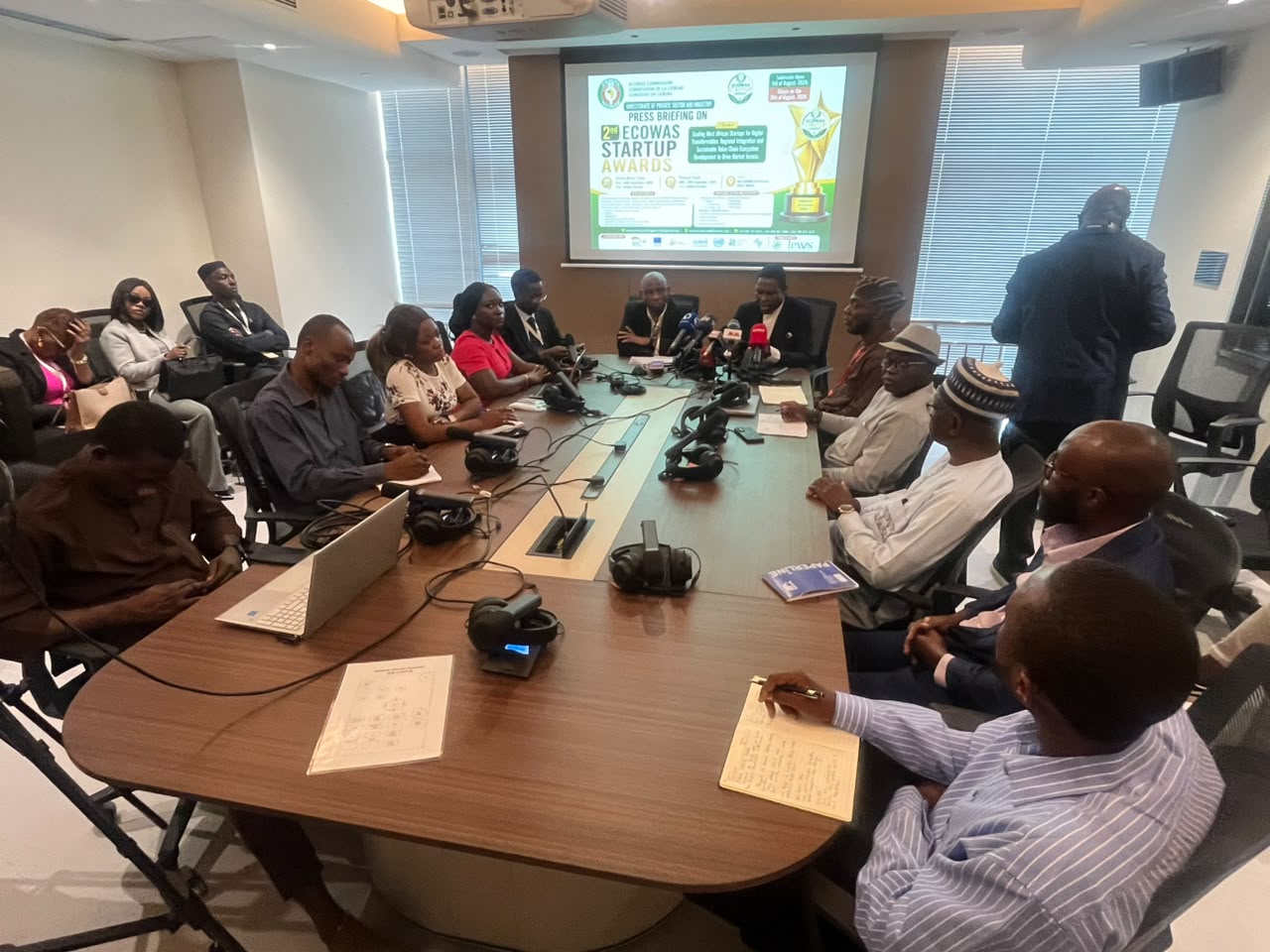
$65,000 Up for Grabs as ECOWAS
By: Michael Mike
The Economic Community of West African States (ECOWAS) has unveiled a $65,000 prize pool for the second edition of its Startup Awards, with about 60 entrepreneurs expected to compete for the top three positions.
The competition, scheduled for September 28, 2026, is coming five years after the inaugural edition held in Niamey, Niger Republic, in 2021.
The winner will receive $30,000, while the first and second runners-up will receive $20,000 and $15,000, respectively.
However, ECOWAS said the programme would go beyond cash prizes, as all 60 shortlisted participants will undergo a masterclass designed to strengthen their entrepreneurial and business management capacities before the final stage.
The Acting Director, Directorate of Private Sector and Industry, ECOWAS Commission, Peter Oluonye, disclosed this while announcing the programme, revealing that the Commission had received more than 6,000 applications since the application portal opened on August 3.
Oluonye said the applications would be screened by appointed assessors, with the pool eventually reduced to 60 participants.
He explained that the 60 shortlisted startups would first undergo the masterclass, after which the field would be further narrowed to 20 finalists who would compete for the three cash prizes.
He said the competition was designed to identify and showcase innovative, scalable businesses capable of addressing critical economic and social challenges across the West African sub-region.
“The ECOWAS Start-up Award is designed to showcase these innovations and multisectoral solutions and enabling policies,” Oluonye said.
The programme will focus on startups operating in areas including fintech; agri-tech and food systems; ed-tech and skills development; cleantech, climate and green innovation; tourism; hospitality; and travel technology.
According to Oluonye, the initiative was also conceived to address some of the major challenges confronting startups, including limited market penetration, inadequate financial models and policy-related constraints.
He said the Commission was particularly interested in startups with strong growth potential and the capacity to scale beyond their immediate markets.
“It is not just going to be just awarding cheques but to support them to the point that they become an inspiration for the youths,” he said.
Oluonye said the programme would deliberately promote inclusion by bringing together young people, women and persons with disabilities to showcase their innovations to potential partners and investors.
He added that ECOWAS would seek to facilitate digital adoption among micro, small and medium-sized enterprises and connect startups with venture capitalists, impact investors, development partners and financial institutions.
He said the broader objective was to build a stronger innovation ecosystem across the ECOWAS region and help startups navigate the difficult early stages of the business life cycle.
“By this programme we seek to support participating Start-ups to navigate these early stages of the business life cycle and help them to scale up into the growth stage,” he said.
Oluonye noted that startups that successfully transitioned into the growth stage would be better positioned to create jobs, add value to the economy and contribute to regional development.
The ECOWAS official also disclosed that the prize package had been increased from $40,000 in the inaugural edition to $65,000 in the second edition.
He stressed that the emphasis of the programme was not merely on identifying winners but on providing participants with the skills, networks and opportunities required to build sustainable businesses.
The first ECOWAS Startup Awards, held in 2021, featured 50 participants.
Meanwhile, the Director-General, Pan African Alliance of Small and Medium Industry, Dr. Henry Emejuo, said the 60 participants for the 2026 edition would be drawn through a combination of open applications and national startup programmes.
According to him, 50 per cent of the participants would be selected from applicants, while the remaining 50 per cent would be drawn from winners of various national startup programmes in ECOWAS member states based on recommendations from the ministers responsible for startups.
Emejuo called on financial institutions and private-sector organisations to provide the necessary support to the participating entrepreneurs, stressing that stronger private-sector involvement would be critical to ensuring the sustainability and growth of the startups.
ECOWAS also announced that subsequent editions of the Startup Awards would be held biennially, making the initiative a regular platform for identifying, nurturing and connecting innovative businesses across the region.
$65,000 Up for Grabs as ECOWAS

When Official Directives Become More Powerful Than the Law

DSS Trails, Nabs Man Impersonating Personnel in Abuja

Ogwashi-Uku Palace: Izediunor Faction Has Lost At Every Court Level, Including Supreme Court

Roger Federer’s Shock as DNA Results Reveal Myla and Charlene Are Not His Biological Children

THE PLIGHT OF FARIDA

FAILED COUP IN BURKINA FASO: HOW TRAORÉ NARROWLY ESCAPED ASSASSINATION PLOT AMID FOREIGN INTERFERENCE CLAIMS
-
 News2 years ago
Roger Federer’s Shock as DNA Results Reveal Myla and Charlene Are Not His Biological Children
-
Opinions5 years ago
THE PLIGHT OF FARIDA
-
 News1 year ago
FAILED COUP IN BURKINA FASO: HOW TRAORÉ NARROWLY ESCAPED ASSASSINATION PLOT AMID FOREIGN INTERFERENCE CLAIMS
-

 News2 years ago
EYN: Rev. Billi, Distortion of History, and The Living Tamarind Tree
-
 Opinions5 years ago
POLICE CHARGE ROOMS, A MINTING PRESS
-

 ACADEMICS2 years ago
A History of Biu” (2015) and The Lingering Bura-Pabir Question (1)
-

 Columns2 years ago
Army University Biu: There is certain interest, but certainly not from Borno.
-

 Politics1 year ago
2027: Why Hon. Midala Balami Must Go, as Youths in Hawul and Asikira/Uba Federal Constituency Reject ₦500,000 as Sallah Gift
