
News
AT UNGA80: VP Shettima Meets UN Secretary-General Over Nigeria’s Security Council Bid, UNDP Partnership, Others

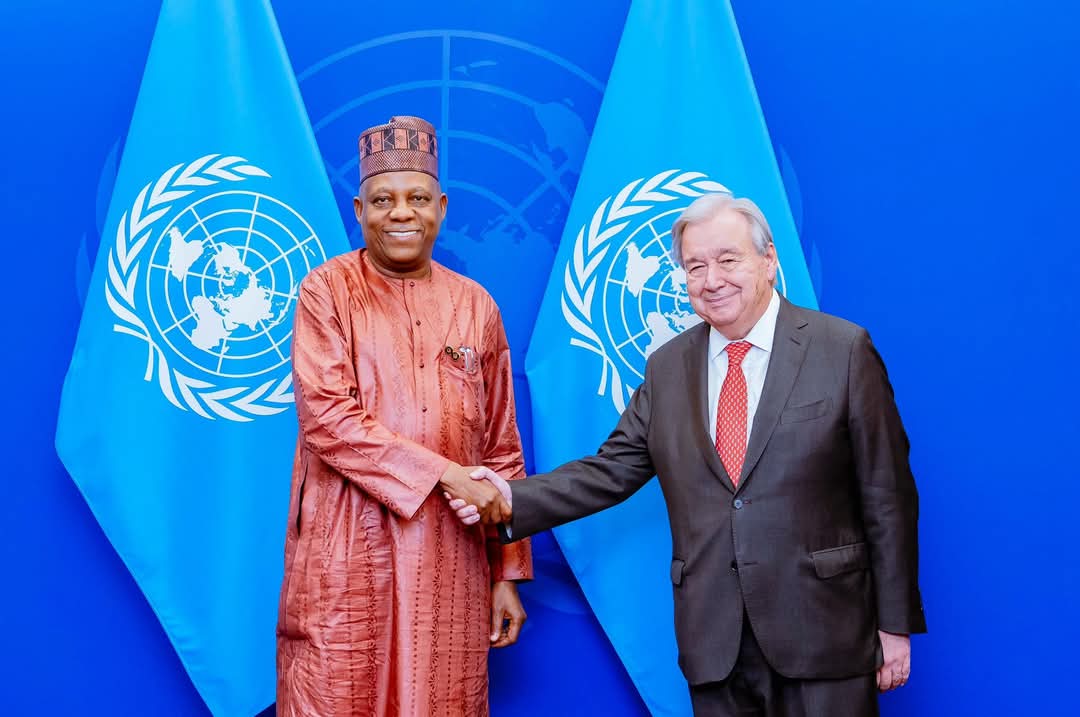
AT UNGA80: VP Shettima Meets UN Secretary-General Over Nigeria’s Security Council Bid, UNDP Partnership, Others
** Nigeria, UK forge strategic partnership on trade, defence, migration
** Says digital inclusion, youth empowerment backbone of President Tinubu’s agenda
By: Our Reporter
Vice President Kashim Shettima met with UN Secretary-General António Guterres at UN headquarters in the United States today to discuss key issues, including Nigeria’s quest for a permanent seat on the United Nations Security Council and other matters of mutual interest.
Vice President Shettima emphasised the need for the UN to “support Nigeria even more so that we achieve more,” highlighting that “we are aspiring to become a permanent member of the UN Security Council.”
The two leaders also held bilateral discussions focusing on achieving the Sustainable Development Goals (SDGs), climate change, collaboration on strengthening democracy in Nigeria and the African region, and partnership with the United Nations Development Programme (UNDP) on regional initiatives for democracy and security.
Speaking about the visit to the United Nations, Foreign Affairs Minister Ambassador Yusuf Tuggar disclosed that the UN has a very strong presence in Nigeria, with many of its agencies domiciled in the country.
The minister told the press after the Vice President met with Guterres that the UN Secretary-General commended the Vice President for emphasising Nigeria’s need for a permanent position on the UN Security Council.
Providing insight into the VP-UN Secretary-General meeting, Minister of Communications, Innovation & Digital Economy Dr ‘Bosun Tijani said the Nigerian delegation had a very cordial engagement with the UN Secretary-General.
He highlighted Guterres’ comments on artificial intelligence and his hope and expectation that Nigeria will continue to play a significant role in that field.
“He was extremely happy when we mentioned that Nigeria, just a few days ago, released our first multilingual and multimodal large language model—the first of its kind on the African continent, backed by any government.
“Even as we were leaving, he (Guterres) mentioned that he would love to see Nigeria support other African countries to ensure Africa is not left behind in artificial intelligence and that we can leverage it properly for development,” he disclosed.
Minister of State for Humanitarian Affairs and Poverty Reduction, Dr Yusuf Tanko Sununu, stressed that the Nigerian government had fruitful discussions with the United Nations Secretary-General, highlighting President Bola Ahmed Tinubu’s administration’s efforts in addressing humanitarian crises and poverty reduction.
“We highlighted that we have one of the largest national social registers containing almost 18.9 million households, and we have reached over 8.1 million Nigerians through conditional cash transfers.
“We also highlighted the government’s efforts to promote inclusivity for people with disabilities,” the minister added.
Furthermore, he stated that both parties shared ideas on durable solutions to address ongoing challenges.
Sununu added that the humanitarian ministry is affected by funding reductions to UN organisations, noting that the World Food Programme (WFP) currently supports about 1.3 million Nigerians receiving emergency food transfers.
The minister stressed that the federal government is working earnestly to “fill the gap.”
He disclosed that the UN Secretary-General assured Nigeria of continued support to improve the ministry’s capacity, authenticate its national social register, and secure more funding for intervention and poverty reduction activities.
“Generally, the Secretary-General thanked the Nigerian government, especially the President, for ongoing support to the United Nations and assured us that the UN will continue to support Nigeria’s wishes and aspirations.”
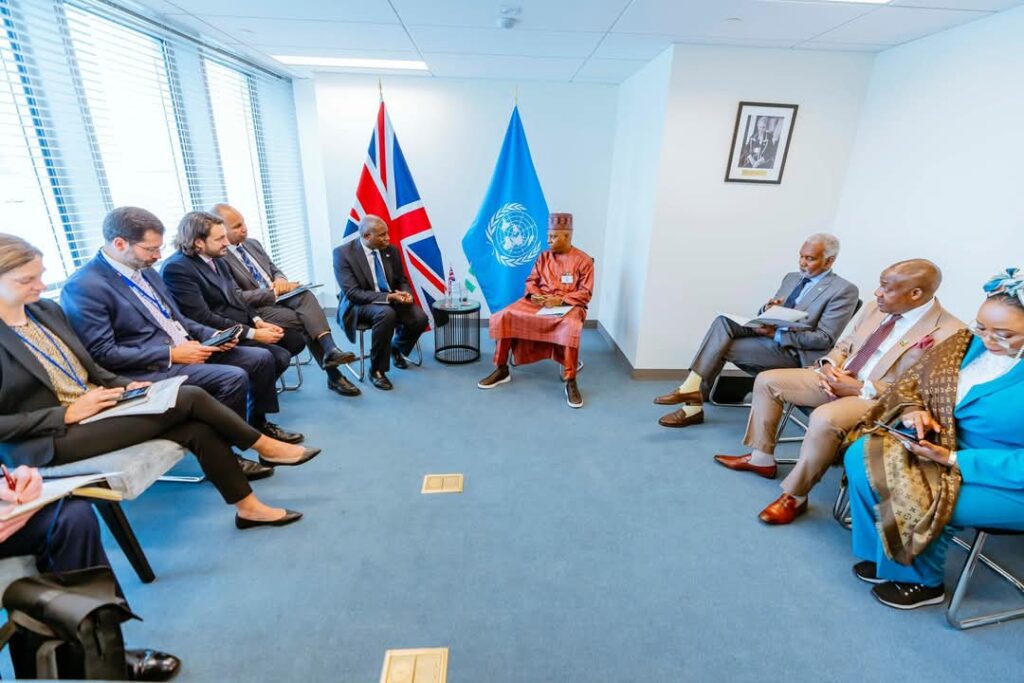
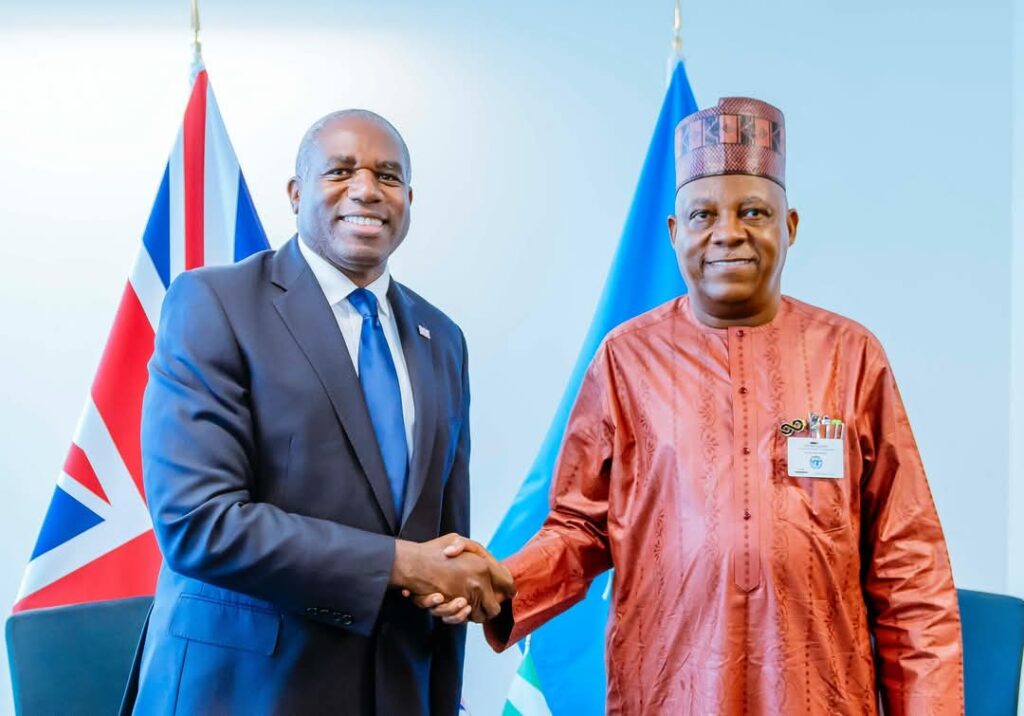
Earlier in the day, the Vice President held a bilateral meeting with the Deputy Prime Minister of the United Kingdom, David Lammy MP.
The UK and Nigerian leaders pledged to deepen cooperation in trade, economy, defence, and migration.
On the same day, Vice President Kashim Shettima attended the Global Leadership Council Meeting, assuring that Nigeria is poised to leverage opportunities in the digital space to engage youths and empower women and girls.
The Global Leadership Council Meeting, held at UNICEF Headquarters, Henry Labouisse Hall, 3 United Nations Plaza, United States, brought together Heads of State, CEOs, heads of UN agencies, civil society champions, and young people to analyse how to co-create and deliver innovative solutions on a global scale.
“Be assured that we are poised to take opportunities in the digital space to engage our youth and, most importantly, to empower our women because they are the backbone of our society,” the Vice President said, adding that inclusivity, which is very crucial, is one of the backbones of President Bola Ahmed Tinubu’s administration, exemplified by young people occupying key positions in Nigeria’s government.
AT UNGA80: VP Shettima Meets UN Secretary-General Over Nigeria’s Security Council Bid, UNDP Partnership, Others



EU Releases €225,000 Humanitarian Aid for Conflict-Displaced Persons in Kebbi
By: Michael Mike
The European Union (EU) has released €225,000, equivalent to about N340 million, in humanitarian assistance to support communities displaced by conflict in Kebbi State.
The intervention, announced on Wednesday, will enable the Nigerian Red Cross to provide emergency assistance to conflict-displaced persons in the state over a six-month period.
The assistance comes amid worsening insecurity in Kebbi, where armed attacks and communal violence across seven Local Government Areas have displaced thousands of residents and left affected communities in urgent need of humanitarian support.
According to the EU, the funding will prioritise multipurpose cash assistance, allowing displaced families to meet their most immediate needs, while protection services will be provided for vulnerable individuals.
The response is expected to reach approximately 7,700 conflict-displaced people living in settlements and host communities across the state.
The EU said particular attention would be given to female-headed households, persons with disabilities, elderly people and individuals facing acute protection risks.
The intervention will also include continuous monitoring of population movements and the mobilisation of local volunteers, with the EU saying the effort would help lay the groundwork for longer-term recovery interventions by other humanitarian actors.
The latest intervention is part of the EU’s contribution to the Disaster Response Emergency Fund (DREF) of the International Federation of Red Cross and Red Crescent Societies (IFRC).
The EU said insecurity in Kebbi State had deteriorated significantly following an escalation of armed attacks and communal violence.
While displacement had been ongoing since mid-August, it said a sharp escalation in violence around August 31 triggered the humanitarian response.
The violence has reportedly affected more than 16,600 people across the state, including 7,706 people who have been displaced and 108 others who sustained injuries.
The EU said the affected population was confronting a complex security environment characterised by organised banditry, armed group activity and communal violence.
It added that displaced families living in temporary settlements and host communities were in urgent need of shelter, food, clean water, healthcare and protection.
The humanitarian funding is being channelled through the IFRC’s DREF, a mechanism established to provide immediate financial support to National Red Cross and Red Crescent Societies responding to disasters and other emergencies.
The EU said the intervention reflected its broader commitment to humanitarian assistance for populations affected by conflicts and disasters.
Through its Civil Protection and Humanitarian Aid department, the bloc provides emergency assistance to vulnerable populations affected by natural disasters and man-made crises around the world.
The European Commission has also signed a €16 million humanitarian delegation agreement with the IFRC to support the Federation’s DREF.
Established in 1979, the DREF is funded through contributions from donors and provides National Red Cross and Red Crescent Societies with rapid access to emergency financing.
For smaller-scale disasters, the IFRC allocates grants from the fund, which can subsequently be replenished through donor contributions.
EU Releases €225,000 Humanitarian Aid for Conflict-Displaced Persons in Kebbi

N101m defamation judgment debt: A/Court begins hearing SERAP’s appeal Friday
The Court of Appeal in Abuja has scheduled hearing for Friday in the appeal filed by the Incorporated Trustees of the Socio-economic Rights and Accountability Project (SERAP) in relation to the May 5 judgment given against the group by a High Court of the Federal Capital Territory (FCT).
Information about the planned hearing date is contained in a notice sent on Wednesday by the appellate court’s Registry to parties in the appeal marked: CA/ABJ/CV/1114/2026.
Justice Halilu Yusuf of the High Court of the FCT had, in the May 5 judgment, awarded N101million in damages and cost against SERAP and its Deputy Director, Kolawole Oluwadare upon holding that they defamed two officials of the Department of State Services (DSS) through a false publication it made on September 10, 2024.
The judgment was on the suit marked: CV/4547/2024 filed by the DSS officials – Sarah John and Gabriel Ogundele – who accused SERAP and Oluwadare of making false claims in publications on the group’s website and social media platforms that the claimants invaded their Abuja office on September 9, 2024 and subjected them to harassment.
Justice Halilu Yusuf held among others that claimants led sufficient evidence that effectively established all the ingredients of defamation.
Justice Yusuf rejected that defence of justification raised by SERAP and Oluwadare on the grounds that they failed to provide evidence that their publications were not based on falsehood.
The judge noted that the words like invasion, forceful entry and harassment were used inaccurately, the defendants having admitted at trial that the DSS officials did not forcefully enter into SERAP’s premises and did not brandish any weapon
He held that the publications made by the defendants injured the reputation of the claimants in their professional capacity and standing in the society.
Justice Yusuf said: “Having been unable to establish invasion and harassment, the defence of justification fails. There is no doubt that the publication affected the claimants mentally and psychologically.”
The judge said, going forward, it was necessary for care and due diligence on the part of SERAP and its officials before releasing information to the public.
He added that in the exercise of their right to tweet and send information out, the defendants should be aware of the rights of others, particularly as it relates to government agencies and their officials.
The judge dismissed the objection raised by the defendants against the competence of the suit and held that the claimants possessed the requisite locus standi to file the suit over which the court has the jurisdiction to entertain.
He held that as against the defendants’ argument, the claimants must not be named in the publication complained about for defamation to be established.
Justice Yusuf noted that from when the claimants complained about the inaccuracy of the publications, the defendants failed to take any steps to pull down the injurious publication.
He proceeded to adjudge the publications as defamatory and awarded damages of N100million against the defendants in addition to N1m as cost of prosecuting the suit.
The judge also ordered the defendants to publish a public apology on SERAP’s website, X handle, two national daily newspapers and two television stations.
He held that the judgment sum shall attract 10 percent interest per annum from the date of the judgment until the sum is fully paid by the defendants.
N101m defamation judgment debt: A/Court begins hearing SERAP’s appeal Friday

NCYP Backs Tinubu’s 2027 Bid, Says Economic Reforms Must Translate Into Jobs
By: Michael Mike
The Northern Christian Youth Professionals (NCYP) has thrown its weight behind President Bola Ahmed Tinubu’s re-election bid in 2027, arguing that continuity in economic policy is necessary to consolidate ongoing reforms and translate Nigeria’s improving macroeconomic performance into jobs, investment and higher living standards.
The group’s position came as the World Bank reported that economic growth in sub-Saharan Africa is gaining momentum, with Nigeria among the countries whose growth forecasts have been upgraded, while warning that the next challenge is to convert growth into more jobs and better opportunities.
In a statement signed by its National Chairman, Isaac Abrak, on Tuesday, NCYP said Nigeria had reached a critical stage in its economic reform journey where the emphasis should shift from stabilisation to inclusive prosperity.
The group was reacting to President Tinubu’s Independence Day address on October 1, in which the President declared: “The emergency treatment is over. The foundation has been repaired,” and said the government’s economic priority had moved from correcting the country’s economic course to achieving “shared and widespread prosperity.”
According to NCYP, the latest World Bank assessment reinforces the argument that Nigeria must sustain the reforms rather than reverse course.
The World Bank said on October 6 that growth in sub-Saharan Africa was being supported by improved macroeconomic resilience, stronger domestic demand and investment, while noting that years of reforms and improved economic management had contributed to improved forecasts for countries including Nigeria. It nevertheless warned that growth remained insufficient to substantially reduce extreme poverty or create enough jobs for the region’s rapidly expanding labour force.
The World Bank’s latest country assessment similarly said Nigeria’s macroeconomic performance had improved further in 2026, with real GDP growth of 4.2 per cent in the first half of the year, compared with 3.9 per cent a year earlier.
It, however, cautioned that growth was still insufficient to generate enough productive jobs and materially reduce poverty, stressing the need for greater private investment, productivity, human capital development and job creation.
NCYP said this was precisely the challenge facing the Tinubu administration in the next phase of its economic programme.
“Nigeria must now move from reform to prosperity, from growth to jobs, and from jobs to poverty reduction,” the group said.
It noted that the country’s real GDP grew by 4.43 per cent in the second quarter of 2026, compared with 3.89 per cent in the first quarter, citing the National Bureau of Statistics’ latest GDP report. The NBS has published its Q2 2026 GDP report dated August 31, 2026.
While describing the improving growth trajectory as encouraging, NCYP maintained that headline economic figures would only become meaningful when ordinary Nigerians experienced improvements in employment, income and living conditions.
The group said youth development should therefore remain central to the next phase of the economic programme, particularly given Nigeria’s large young population.
It cited the Nigeria Education Loan Fund (NELFUND), saying more than 1.1 million students had gained access to tertiary education financing.
NELFUND’s current data shows that more than 1.08 million students have been supported across 37 states, with over ₦191 billion in loans disbursed, while its broader student-loan platform records more than 1.4 million registered students.
NCYP also backed proposed reforms to the National Youth Service Corps, saying a more productive national service scheme could equip graduates with specialised skills in agriculture, medicine, education, technology, digital innovation, infrastructure, the green economy, enterprise and the creative sector.
The organisation argued that Nigeria’s youthful population should be treated as an economic asset rather than merely a demographic challenge.
“With education, skills, financing and the right economic environment, our young people can become entrepreneurs, skilled professionals, job creators and drivers of industrialisation,” it said.
The group outlined what it described as the economic pathway to prosperity: reforms should create stability; stability should encourage investment; education and skills should create opportunities; enterprise should create businesses and jobs; while industrialisation should deliver sustainable prosperity.
It said the agenda was particularly important for Northern Nigeria, where it called for an economy capable of converting skills into enterprise, enterprise into jobs and jobs into sustainable livelihoods.
The World Bank has similarly identified the creation of more and better private-sector jobs as central to Nigeria’s long-term prosperity, with its 2026–2032 Country Partnership Framework focusing on competitiveness, private capital, human capital and resilience.
The Bank has also acknowledged that Nigeria’s recent reforms have strengthened macroeconomic stability, but warned that household incomes have not fully recovered and poverty remains high. It has called for the stabilisation gains to be consolidated while accelerating inclusive growth.
Against this backdrop, NCYP said it had decided to support President Tinubu’s re-election in 2027, framing the decision around continuity of economic policy.
“It is against this background that NCYP supports the re-election of President Bola Ahmed Tinubu in 2027, with our position anchored on policy continuity and the need to consolidate the economic reforms while moving decisively into the next phase of job creation, human-capital development and industrialisation,” Abrak said.
NCYP Backs Tinubu’s 2027 Bid, Says Economic Reforms Must Translate Into Jobs

In Ethiopia, VP Shettima moves to strengthen Nigeria’s nutrition future through agricultural value-chain transformation.

EU Releases €225,000 Humanitarian Aid for Conflict-Displaced Persons in Kebbi

UNESCO, FG Seek Ethical Framework for Neurotechnology in Nigeria

Roger Federer’s Shock as DNA Results Reveal Myla and Charlene Are Not His Biological Children

THE PLIGHT OF FARIDA

FAILED COUP IN BURKINA FASO: HOW TRAORÉ NARROWLY ESCAPED ASSASSINATION PLOT AMID FOREIGN INTERFERENCE CLAIMS
-
 News3 years ago
Roger Federer’s Shock as DNA Results Reveal Myla and Charlene Are Not His Biological Children
-
Opinions5 years ago
THE PLIGHT OF FARIDA
-
 News1 year ago
FAILED COUP IN BURKINA FASO: HOW TRAORÉ NARROWLY ESCAPED ASSASSINATION PLOT AMID FOREIGN INTERFERENCE CLAIMS
-

 News3 years ago
EYN: Rev. Billi, Distortion of History, and The Living Tamarind Tree
-
 Opinions5 years ago
POLICE CHARGE ROOMS, A MINTING PRESS
-

 ACADEMICS3 years ago
A History of Biu” (2015) and The Lingering Bura-Pabir Question (1)
-

 Columns3 years ago
Army University Biu: There is certain interest, but certainly not from Borno.
-

 Politics1 year ago
2027: Why Hon. Midala Balami Must Go, as Youths in Hawul and Asikira/Uba Federal Constituency Reject ₦500,000 as Sallah Gift
