News
Bangladesh Envoy Seeks Stronger Nigeria Ties, Laments Low Bilateral Trade
By: Michael Mike
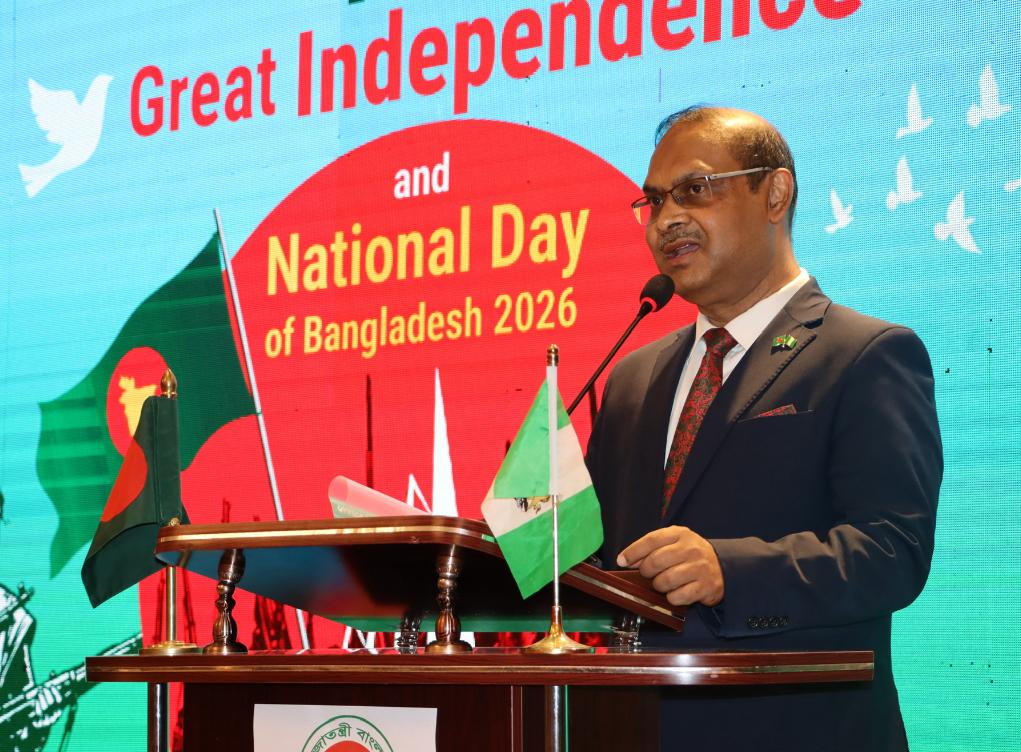
The High Commissioner of Bangladesh to Nigeria, Miah Md. Mainul Kabir, has expressed concern over the relatively low volume of trade between the two countries, describing it as far below its actual potential despite the strong diplomatic ties that have existed for decades.
Kabir made the remarks in Abuja while addressing guests at the celebration of the 55th anniversary of Bangladesh’s Independence and National Day. He stressed that expanding economic cooperation between both countries would remain a key focus of his diplomatic mission.
According to him, although trade between Nigeria and Bangladesh has recorded gradual growth over the years, the level of commercial exchange does not reflect the enormous opportunities available to both nations.
“Bilateral trade between our two countries has grown steadily yet remains well below its true potential,” he said. “Bangladesh offers competitively priced, high-quality products in textiles and garments, pharmaceuticals, ceramics, jute goods, processed foods and ICT services, while Nigeria, with its vast market, energy resources and agricultural depth, presents significant opportunities for stronger trade relations.”
The envoy highlighted agriculture as one of the most promising areas for collaboration, pointing particularly to contract farming as a new pathway for expanding bilateral economic engagement.
He explained that Bangladesh’s experience in high-yield and climate-adaptive agricultural production could be combined with Nigeria’s vast arable land and growing agro-processing industry to boost productivity and food security in both countries.
To unlock these opportunities, Kabir said Bangladesh is now intensifying its diplomatic and economic engagement with African nations, with Nigeria occupying a strategic position in that effort.
“Bangladesh is placing renewed focus on strengthening our partnerships in Africa, particularly with Nigeria — a country of immense dynamism, influence and opportunity,” he said.
The High Commissioner noted that the two countries share long-standing cordial relations rooted in similar historical experiences, youthful populations and shared democratic aspirations.
He added that both nations have consistently worked together within major international organisations such as the United Nations, the Non-Aligned Movement, the Organisation of Islamic Cooperation, the D-8 Organization for Economic Cooperation and the Commonwealth of Nations.
According to him, the partnership between the two countries reflects a broader commitment to South–South cooperation and collective efforts by developing nations to promote shared prosperity and global development.
Beyond trade, Kabir identified several other sectors where Nigeria and Bangladesh could deepen collaboration, including education, skills development, digital innovation, technical training and defence cooperation, particularly in professional military training and peacekeeping operations.
He also emphasised the importance of people-to-people engagement, noting that stronger cultural exchanges, academic partnerships and youth cooperation would further strengthen the bond between both nations.
The envoy used the occasion to commend Bangladeshi nationals living and working in Nigeria, describing them as responsible representatives of their country abroad.
“You are exemplary ambassadors of our nation,” he said. “Your hard work and integrity contribute significantly to the economies of Bangladesh and Nigeria and strengthen the bond between our peoples.”
Kabir also reflected on Bangladesh’s development journey over the past five and a half decades, noting that the country has emerged as a significant economic force among developing nations.
According to him, Bangladesh’s nominal gross domestic product is approaching half a trillion dollars, placing the country among the 35 largest economies in the world and making it a leading example of socio-economic progress in the Global South.
In his remarks, Director of Regions at Nigeria’s Ministry of Foreign Affairs, Bukar Hamman, reaffirmed Nigeria’s commitment to strengthening bilateral relations with Bangladesh.
Hamman said both countries share a strong belief in multilateral cooperation, peacebuilding and inclusive development.
“Both our nations have contributed significantly to United Nations peace operations, demonstrating mutual dedication to global peace and security,” he said.
He noted that bilateral engagement between Nigeria and Bangladesh has continued to expand in recent years, particularly in trade, agriculture, education and defence cooperation.
Hamman also welcomed the growing presence of Bangladeshi businesses in Nigeria and encouraged deeper collaboration between private sector actors from both countries.
“There is vast potential for collaboration in textiles, pharmaceuticals, ICT and renewable energy sectors where Bangladesh has developed notable expertise,” he said.
“As we look to the future, Nigeria remains committed to strengthening our ties with Bangladesh. Enhanced cooperation between our two countries will not only benefit our peoples but also contribute to stronger South–South cooperation and global development efforts.”
He added that the celebration of Bangladesh’s independence anniversary was not only an opportunity to reflect on the country’s historical journey but also a moment to recognise its aspirations for continued peace, innovation and progress.
Hamman stressed that Nigeria values Bangladesh as a trusted partner and friend, expressing confidence that the relationship between the two nations would continue to grow stronger in the years ahead.
Bangladesh Envoy Seeks Stronger Nigeria Ties, Laments Low Bilateral Trade
News
Alex Birbir’s Plateau False Narrative Collapses Under the Weight of Facts
By: Zagazola Makama
Once again, Mr. Alex Birbir, speaking comfortably from outside Nigeria and relying heavily on emotionally charged propaganda supplied by local conflict entrepreneurs, has attempted to distort the realities of the Plateau crisis into a simplistic and dangerous narratives designed for foreign audiences unfamiliar with the actual situation on ground.
His latest podcast is not only riddled with exaggerations, contradictions and outright falsehoods, but also dangerously seeks to demonize Nigerian security forces while justifying armed Berom militia mobilisation under the deceptive banner of “self-defense.”
At the fore of Birbir’s claim is the allegation that Nigerian troops “fought alongside Fulani terrorists” against Berom youths who, according to him, merely wanted to defend their communities after attacks in Barkin Ladi.
But the actual sequence of events completely destroys this narrative. What truly happened on Wednesday, May 6, 2026, was that a large group of armed Berom youths mobilized toward the predominantly Fulani settlement of Jong following the killing of seven locals at Nding Sesut community the previous day.
Security sources confirmed that before the mobilisation, some of the youths allegedly contacted the Army commander in the area and demanded that troops “step aside” so they could carry out a retaliatory raid on Jong community.
That request was refused. Instead of abandoning their constitutional responsibility, troops of Operation Enduring Peace (OPEP) deployed to prevent the reprisal attack and stop what could have turned into a mass casualty event against innocent civilians.
That singular action is now being twisted by Birbir into “the military fighting alongside Fulani terrorists.” Think carefully about the absurdity of that argument. Since when did preventing a retaliatory raid on an entire civilian settlement become “supporting terrorists”?
If armed youths from any ethnic group mobilize toward another community carrying weapons and threatening reprisals, is the military supposed to simply fold its arms and allow bloodshed because activists overseas have already chosen their preferred victims and villains? The troops prevented a revenge attack.
And because they refused to allow armed youths to storm Jong community, propaganda merchants like Birbir became angry.
What Birbir deliberately refuses to mention is that when the armed youths arrived near Jong, shooting started from their own side and a firefight followed involving armed Fulani elements in the area. Troops were immediately alerted and swiftly intervened, dominating the general area and preventing total escalation.
Troops Operation Enduring Peace also deployed Quick Response Forces which helped stabilize the situation and prevent further reprisals. That is what professional soldiers are supposed to do. Yet in Birbir’s fictional version, stopping armed youths from invading another community somehow translates into “fighting Christians.” Even more reckless is his repeated attempt to frame the Plateau crisis as some grand “Islamic jihad” to establish a caliphate in Nigeria.
There is absolutely no evidence that Boko Haram, ISWAP or any international jihadist organization is operating inside Barkin Ladi, Riyom, Bassa or Mangu as part of a coordinated Islamic conquest.
What Plateau is suffering from is a brutal cycle of communal reprisals involving armed groups from multiple sides, fueled by cattle rustling, land disputes, attacks on herders, revenge killings, illegal mining disputes and long-standing ethnic grievances which we have consistently documented.
The violence is tragic.But it is not the Hollywood-style “Christianity versus Islam” fantasy Birbir and his cohort are selling online. In fact, many of the incidents he ignores completely expose how selective and dishonest the propaganda has become.
For example, on May 10, 2026, troops of Sector 6 Operation Enduring Peace came under direct ambush from armed Berom militia while responding to reports of attacks on cattle around Gero area in Jos South LGA. The attackers reportedly attempted to encircle troops from surrounding hills before soldiers responded with superior firepower, forcing them to retreat toward Nyango and Daron communities.
During the attack, nine cows were killed, five injured and a Fulani herder identified as Aliyu Yusuf sustained gunshot wounds. Hours later, another soldier, Warrant Officer Rex Okang, was brutally attacked and badly injured by armed youths in Dorowa Tsoho, Barkin Ladi.
So the same military Birbir accuses of “supporting Fulani terrorists” is now also being attacked by the very armed groups he portrays as helpless victims. This is now becoming a very consistent and dangerous pattern of insurrection.
Whenever troops refuse to permit retaliatory attacks, attempt arrests, recover illegal weapons or block armed mobilisations, they are immediately blackmailed with accusations of “supporting Fulani terrorists.” When checkpoints are maintained, troops are accused of bias.
When checkpoints are withdrawn after attacks on soldiers, troops are accused of abandonment. When troops stop reprisals, they are accused of supporting one side.
When they arrest armed suspects, activists suddenly scream “targeting indigenous people.”
It is a propaganda carefully designed to delegitimize security operations anytime armed militias fail to get what they want. The reality on ground is that Nigerian troops have repeatedly risked their lives protecting communities across Plateau regardless of ethnicity. Troops have responded to attacks on Berom communities. Troops have also responded to attacks on Fulani settlements. Troops have recovered rustled cattle. Troops have evacuated wounded civilians from both sides.
Troops have prevented reprisals. Troops have died trying to restore peace. In the same plateau troops under attack of bandits and lost many officers and men.
Only recently in Mangu, a senior Nigerian Army officer was brutally killed after they came under heavy fire by the local Militia in Plateau. At different times, they have been attacked by Berom youths. But none of these matter to some propagandists whose primary interest is sustaining outrage and exporting a false genocide narrative abroad.
Perhaps the most dramatic chapter in Alex Birbir’s latest online fiction series was his now-famous “Burial Attack” story, where he attempted to convince international audiences that heavily armed Fulani jihadists surrounded a Christian burial ground in Barkin Ladi, launched a coordinated massacre operation, exchanged gunfire for “four to five hours,” while the Nigerian military conveniently disappeared into thin air.
During the tense atmosphere surrounding the burial, armed local youths were already positioned around the area and gunfire was reportedly initiated from within the local militia side toward surrounding hills after rumors spread about possible movements nearby.
According to Birbir, mourners were abandoned, Christians were left “with sticks and machetes,” machine guns echoed everywhere, terrorists almost overran the burial ground, and only brave local youths prevented “dozens and dozens” from being massacred. Even more revealing was Birbir’s own statement where he proudly declared that local youths “took up arms” to defend the area. In the aftermath, not one casualty, not one corpse, not one verified gunshot victim. No hospital admission. No medical evacuation. No emergency death report, was recorded.
Mr Birbir should therefore tell us how does a supposed four-to-five-hour terrorist assault involving machine guns and sniper rifles end without a single confirmed casualty? Did the terrorists suddenly forget how to shoot? Or perhaps, just perhaps, the entire event was massively exaggerated and manipulated for propaganda purposes.
Birbir also made another astonishing claim, insisting that “Christians defended themselves with sticks and stones against machine guns and AK-47s.” Again, facts expose the dishonesty. Security operations in Plateau have repeatedly uncovered Ak47 riffles, pistols, locally fabricated rifles, illegal arms factories, ammunition components and armed Berom militia networks linked to criminal elements operating in the state.
Several suspects involved in illegal weapons fabrication, robbery, and targeted attacks have already been arrested by troops while credible information has uncovered more arms factories. Only recently, troops recovered another fabricated rifle from a Berom militia member during operations in Barkin Ladi. If people are only carrying “sticks and stones,” where are these rifles, ammunition and fabricated weapons suddenly coming from?
Do illegal assault rifles or Ak47 now grow naturally inside Plateau or Berom farmlands? Even more revealing was Birbir’s own statement where he admitted that local youths “took up arms” to defend themselves. That statement alone destroys the entire “helpless civilians” narrative being marketed internationally. Mention a single scenario where they have defended their communities, instead those arms were used to perpetuate targeted attacks, armed robbery and cattle rustling. This year alone, the Berom militia have rustled or killed more than 400 cattle belonging to the fulani. None of these reports was acknowledge by Me Birbir.
Nobody denies that communities have suffered terrible losses in Plateau as a result of the attacks by Fulani bandits. Both Berom and Fulani communities have buried victims. Both sides have suffered same level of attacks. Both sides have experienced reprisals.
But what Birbir and similar propagandists are doing is dangerously reframing a complex communal conflict into a false one-directional religious extermination narrative. And that distortion is extremely dangerous because it radicalizes youths, fuels retaliation and undermines peace efforts.
Perhaps the greatest irony of all is this,
the same armed groups now attacking soldiers are often from the same communities loudly accusing the military of not protecting them enough. Troops are insulted when they intervene. Troops are attacked when they maintain neutrality. Troops are blackmailed when they stop reprisals. Troops are demonized when they arrest suspects. Naked women run to the street to protest. In one instant, they attacked troops, dismantled their check point and burnt some of their equipment.
Yet if the military withdraws completely and violence escalates uncontrollably, the same voices will again blame the military for “abandoning Christians.” This endless contradiction exposes the real problem:
Some actors no longer want peace.
They want validation for retaliation.
The unfortunate truth is that Plateau’s violence will never end if every attempt to enforce neutrality is interpreted as “supporting the enemy.” No military operation can succeed where armed militias are defended, illegal weapons are normalized and propaganda rewards revenge narratives over accountability.
Accusing troops of “aiding terrorists” simply because they prevented armed youths from attacking another civilian settlement is not only dishonest, it is reckless and inflammatory.
Peace in Plateau will only come through truth, accountability, disarmament and honest dialogue, not through emotional podcasts designed to inflame international outrage while ignoring the full complexity of the conflict.
Alex Birbir’s Plateau False Narrative Collapses Under the Weight of Facts
News
Zulum Appoints Prof. Bukar Usman as Pioneer Chairman of Zakkat, Waqf Commission, Names New Secondary Education Board Member
By: Our Reporter
Borno State Governor, Professor Babagana Umara Zulum, has approved the appointment of Prof. Bukar Muhammad Usman as the pioneer Executive Chairman of the newly established Zakkat and Waqf Collection and Distribution Commission.
The Commission, which became operational in 2025 following the passage of its enabling law by the State Assembly and the Governor’s subsequent assent, is mandated to oversee the collection, administration, and equitable distribution of Zakkat and Waqf across the state.
The appointment of the Executive Chairman is in accordance with the powers conferred on the Governor under Section 4 (1) and (2) of the Commission’s Law, 2025.
Prof. Bukar Muhammad Usman, a Professor of Arabic Literature and a distinguished Islamic scholar, brings to the role expertise in Islamic jurisprudence and academic leadership.
He began his academic career at the Nigerian Arabic Language Village, Gamboru Ngala, where he served as a lecturer from 2006 to 2018. Following the completion of his Ph.D., he joined the Department of Arabic at Yobe State University, where he currently holds the rank of professor.
Before his appointment, Prof. Bukar served as Head of the Department of Arabic at Yobe State University and was a member of both the university’s Senate and Council. He also served on the editorial board of Al-Nur Journal, a scholarly publication of the Department of Arabic.
He participated in numerous seminars, workshops, and conferences both nationally and internationally. He has published several scholarly papers in reputable local and international journals and also supervised many Master’s and Ph.D. theses across various institutions.
In a related development, Governor Zulum has also approved the appointment of Malam Muhammad Ibrahim Muhammad as a member of Borno State Senior Secondary Education Board, representing Southern Borno.
The appointment follows the demise of Alhaji Ibrahim Sarki in January 2026 and is in line with the provisions of Section 4 (1)(a) of the Borno State Senior Secondary Education Board (Amendment) Law, 2024.
Until his appointment, Malam Muhammad Ibrahim Muhammad was a lecturer at the College of Education, Gashua, and holds a Master’s degree in Fundamentals of Religion.
Governor Zulum congratulated the appointees and urged them to deploy their experience, integrity, and commitment toward strengthening their respective institutions.
Both appointments are for an initial term of four years and are subject to confirmation by the Borno State House of Assembly.
Zulum Appoints Prof. Bukar Usman as Pioneer Chairman of Zakkat, Waqf Commission, Names New Secondary Education Board Member
News
Zulum elated by Tinubu’s approval of 3 federal institutions for Borno in 3 years
.. Says Borno will reciprocate the gesture in 2027
By: Our Reporter
Borno State Governor, Professor Babagana Umara Zulum, has commended President Bola Ahmed Tinubu for approving three major federal institutions for the state within three years of assuming office.
Zulum made the commendation on Sunday in Bama, shortly after a sympathy visit to residents affected by a devastating windstorm that struck part of the town last week.
Zulum specifically noted that since President Tinubu took office, he has approved the take-off of three vital federal institutions, including the Federal College of Education, Gwoza; the National Orthopaedic Hospital, Azare; and the Federal University of Agriculture and Entrepreneurship, Bama.
He expressed delight that the institutions would directly transform the lives of the people of Borno through job creation, improved access to quality education, and specialised healthcare delivery.
Zulum commended President Tinubu for his sustained attention to Borno’s recovery and development needs, noting that the three federal institutions would significantly accelerate post-insurgency reconstruction and economic revitalisation.
“I want to draw your attention to the establishment of the Federal University of Agriculture and Entrepreneurship, Bama, by the President of the Federal Republic of Nigeria, Bola Ahmed Tinubu, just two days ago.
“The pioneer principal officers were appointed. This is a remarkable achievement, and we want to hail the President for what he has done.”
“The take-off of the Federal College of Education, Gwoza, and the National Orthopaedic Hospital, Azare, was achieved under the administration of President Tinubu; therefore, I want to commend him and assure him that the people of Borno State will reciprocate the kind gesture at the appropriate time.”
Zulum had last year announced the handover of Umar Ibn Ibrahim El-Kanemi College of Education, Science, and Technology, Bama, for the immediate commencement of academic activities at the newly established Federal University of Agriculture and Entrepreneurship, Bama. The Governor also approved one billion naira for the immediate take-off of the University.
The Governor has consistently offered similar support to the Federal Polytechnic, Monguno; Federal College of Education, Gwoza; and National Orthopaedic Hospital, Azare, approving over N5 billion to facilitate a seamless take-off.
The Governor also inspected ongoing construction work for the 19 Brigade headquarters in Bama, underscoring his administration’s determination to consolidate security gains and restore full civil authority around the Bama general area.
Zulum elated by Tinubu’s approval of 3 federal institutions for Borno in 3 years
-
News2 years agoRoger Federer’s Shock as DNA Results Reveal Myla and Charlene Are Not His Biological Children

-
Opinions4 years agoTHE PLIGHT OF FARIDA
-
News1 year agoFAILED COUP IN BURKINA FASO: HOW TRAORÉ NARROWLY ESCAPED ASSASSINATION PLOT AMID FOREIGN INTERFERENCE CLAIMS
-

News2 years agoEYN: Rev. Billi, Distortion of History, and The Living Tamarind Tree
-

Opinions4 years agoPOLICE CHARGE ROOMS, A MINTING PRESS
-

ACADEMICS2 years agoA History of Biu” (2015) and The Lingering Bura-Pabir Question (1)
-

Columns2 years agoArmy University Biu: There is certain interest, but certainly not from Borno.
-

Opinions2 years agoTinubu,Shettima: The epidemic of economic, insecurity in Nigeria