
News
Behold! Wind Of Change In Borno’s Third-tier Governance


Behold! Wind Of Change In Borno’s Third-tier Governance
By Dauda Iliya
A phenomenal wind of change is blowing across third-tier governance in Borno State, with the inauguration of the state’s 27 newly elected local government council chairmen, Thursday, January 29, as launchpad.
In a strategic shift in grassroots governance, named: Zulum’s New Formula, about sixty percent of the council chiefs are all under the age fifty, a historic departure from the dominant paradigm of majority above-sixty, and already aging-out, politicians holding the third-tier governance fort.
Most striking, however, is the fact that Governor Zulum has ensured fifteen percent of the chairmen are in their thirties—a novel and unprecedented development.
Moreover, over sixty percent of them hold bachelor’s or postgraduate degrees, combining knowledge, education and leadership, a pacesetting accomplishment in the annals of local government administration, at least in Northern Nigeria.
This novel grassroots governance approach has already produced results: several chairmen have prepared strategic blueprints aligned with the Governor’s 25-year development framework and 10-year strategic transformation plan.
The new chairmen were elected on 13th December 2025, in the third local government poll conducted under Governor Babagana Umara Zulum’s administration within six and a half years.
The election fulfilled the provision of the 1999 Constitution (as amended), which mandates that local government areas be governed by elected officials—a principle recently reaffirmed by the Supreme Court.
Apart from the striking age shift, majority of these grassroots-governance new breeds were sieved from backgrounds in administration, political appointment, academia, business and, most-strikingly, practical farming.
Zulum’s New Formula is advised by the fact that the youth form the largest demographic group in Borno State, as is incontrovertibly the case in all states of the country, and have played a significant role in promoting the state’s peace and stability.
To, therefore, integrate them into governance, Governor Zulum has entrenched the trend of appointing many young people to political and public offices.
The newly inaugurated local council leadership is also gender-inclusive, with a considerable number of women elected as councillors and further opportunities emerging for women in both elective and appointive roles.
Prior to the inauguration, Governor Zulum submitted an executive communication to the House of Assembly seeking to amend the Local Government Administration Law 2000, extending chairmen’s tenure from two to three years. This responds to popular demand and allows greater time to initiate and deliver development projects.
As he administered the oath of office on them, that historic Thursday, Zulum whose massage was delivered by the acting Governor, Hon. Umar Usman Kadafur, charged them to be above board in the conduct of local governance and develop their local government areas in fulfillment of their respective realities and according to existing and emerging imperatives.
His aim is to put to shame, all doubting Thomases and pessimists about his pacesetting novel grassroots governance formula.
“As you take your oaths of Allegiance and Office, you have not just won an election, but you have accepted a covenant with the people of Borno State,” Zulum. He pointed out to the local council helmsmen, “You have volunteered to bear the weight of their hopes, their struggles and their aspirations for a better life at the grassroots, the very foundation of our society.”
The governor emphasized that their stewardship comes at a pivotal moment in the history of the state, and described them as the primary engines for the implementation of his 25-Year Development Plan and the immediate drivers of his 10-Year Strategic Transformation Initiative.
“Your success at the local level is the critical foundation for the Borno of our collective vision, a State of sustained peace, shared prosperity and renewed hope,” he charged.
Zulum underscored to them his profound passion for, and commitment to, his novel grassroots governance formula.
The resources you steward are the lifeline of our communities. You must be guardians of every Naira, aligning every project and programme with the pillars of our 10-Year Strategy. Focus on essentials that directly improve lives, security and dignity of our people. No vanity projects. Furthermore, I direct your immediate attention to the welfare of Local Government staff. Timely payment of salaries and entitlements is non-negotiable. In the same vein, all workers must report to their duty posts promptly. Productivity and discipline must be restored.
As he bade them farewell in their tortures grassroots governance voyage, he charged:
“The path ahead is steep, but the destination is worth the climb. You are the critical keystone for our long-term plan to transform Borno state. The legacy you leave begins today, with your integrity, your humility and your unwavering commitment to service. I have faith that you will be the leaders Borno State needs.”
Zulum, on one hand, and the massive assemblage of well-wishers, Doubting Thomases and pessimists, all on the other, watched the newly inaugurated local council helmsmen as they set their respective ships sailing across the turbulent sea of grassroots governance on a voyage to justify, or otherwise, the governor’s novel grassroots governance formula.
Whatever happens, a desirable wind of change is blowing across Borno State’s grassroots governance, purposefully for the lasting good of a state rising from the ruins of terror.
Dauda Iliya is the Special Adviser on Media/Spokesperson to the Borno State Governor
Behold! Wind Of Change In Borno’s Third-tier Governance



Troops arrest suspected foreign national along Azir–Damboa road in Borno
By Zagazola Makama
Troops of 25 Brigade, in collaboration with the Civilian Joint Task Force (CJTF), have arrested a suspected foreign national along the Azir–Damboa road in Borno State.
Military sources told Zagazola Makama that the suspect was apprehended at about 5:55 p.m. on Sept. 5 following a tip-off from local residents about the movement of a suspected foreigner along the route.
During preliminary questioning, the suspect reportedly identified himself as a national of the Republic of Cameroon.
He told the troops that he entered Nigeria through Taraba State and was travelling towards Niger State in search of artisanal work but lost his way.
The suspect remains in military custody for further investigation and necessary action, while authorities work to establish his identity, travel history and circumstances surrounding his presence in the area.
Troops arrest suspected foreign national along Azir–Damboa road in Borno

Troops arrest suspected ISWAP member with gunshot wound in Borno
By Zagazola Makama
Troops of 82 Division Task Force Battalion have arrested a suspected ISWAP member who was found loitering around Papa 7 location in Borno State.
Military sources told Zagazola Makama that the suspect was apprehended at about 9:35 a.m. on Sept. 6 while troops were conducting picketing duties in the area.
The suspect was found with a gunshot wound and was taken into custody for questioning.
Preliminary interrogation reportedly indicated that the suspect had descended from Gava in the Mandara Mountains in search of medical attention.
Sources attributed his movement to the effects of sustained military pressure and psychological operations targeting terrorist enclaves in the area.
The suspect remains in military custody for further investigation, while security forces continue operations aimed at degrading terrorist groups and disrupting their activities in the Mandara Mountains.
Troops arrest suspected ISWAP member with gunshot wound in Borno
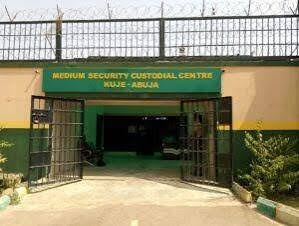
Investigation begins as SNCO dies after shooting incident at Kuje custodial centre
By Zagazola Makama
Authorities have commenced an investigation into a shooting incident involving a senior non-commissioned officer at the Kuje Medium Security Custodial Centre in the Federal Capital Territory.
Sources told Zagazola Makama that the incident occurred at about 9:37 a.m. on Sept. 7 while the personnel was on duty at the facility.
According to the sources, the SNCO fired at his commanding officer, but the shot missed after the officer moved away.
The SNCO subsequently died from a self-inflicted gunshot wound.
The circumstances surrounding the incident remain unclear, and an investigation has been launched to establish what led to the shooting.
The remains of the deceased personnel were evacuated to the University of Abuja Teaching Hospital (UATH) for further action.
Authorities are expected to provide additional details as the investigation progresses.
Investigation begins as SNCO dies after shooting incident at Kuje custodial centre

Troops arrest suspected foreign national along Azir–Damboa road in Borno

Troops arrest suspected ISWAP member with gunshot wound in Borno

Investigation begins as SNCO dies after shooting incident at Kuje custodial centre

Roger Federer’s Shock as DNA Results Reveal Myla and Charlene Are Not His Biological Children

THE PLIGHT OF FARIDA

FAILED COUP IN BURKINA FASO: HOW TRAORÉ NARROWLY ESCAPED ASSASSINATION PLOT AMID FOREIGN INTERFERENCE CLAIMS
-
 News2 years ago
Roger Federer’s Shock as DNA Results Reveal Myla and Charlene Are Not His Biological Children
-
Opinions5 years ago
THE PLIGHT OF FARIDA
-
 News1 year ago
FAILED COUP IN BURKINA FASO: HOW TRAORÉ NARROWLY ESCAPED ASSASSINATION PLOT AMID FOREIGN INTERFERENCE CLAIMS
-

 News2 years ago
EYN: Rev. Billi, Distortion of History, and The Living Tamarind Tree
-
 Opinions5 years ago
POLICE CHARGE ROOMS, A MINTING PRESS
-

 ACADEMICS3 years ago
A History of Biu” (2015) and The Lingering Bura-Pabir Question (1)
-

 Columns3 years ago
Army University Biu: There is certain interest, but certainly not from Borno.
-

 Politics1 year ago
2027: Why Hon. Midala Balami Must Go, as Youths in Hawul and Asikira/Uba Federal Constituency Reject ₦500,000 as Sallah Gift
