
News
Borno Denies Spending ₦4bn on Non-Existent Rail Project, Blames Budget Report Error

Borno Denies Spending ₦4bn on Non-Existent Rail Project, Blames Budget Report Error
By: Michael Mike
The Borno State Government has denied reports that it spent ₦4 billion on rail construction projects in Maiduguri Metropolitan Council and Jere Local Government Area, insisting that no such project was awarded, funded or executed in the state during the 2025 fiscal year.
The government described the reports as misleading and clarified that the inclusion of a rail project in the 2025 Budget Implementation Report, with an indication that it was 100 per cent completed, was merely an administrative error.
In a statement issued by the Commissioner for Information and Internal Security, Prof. Usman Tar, the government said an internal review involving the Ministries of Budget and Transport and Energy, alongside other relevant agencies, confirmed that no rail project passed through the state’s official procurement process.
According to the statement, no Executive Council approval was sought or obtained for any rail project, no budgetary clearance was requested, no contract was awarded and no funds were released for such a project during the period under review.
The government stressed that projects of such magnitude are subject to laid-down procedures, including formal proposals, Executive Council approvals, budgetary clearances, contract awards and subsequent release of funds.
It maintained that none of these processes were initiated or concluded in relation to any rail line project in the 2025 fiscal year.
“It was however noted that the inclusion of a rail project entry in the 2025 Budget Implementation Report, indicating 100 per cent completion, was an administrative error and does not reflect the true position of the matter as the said project was neither executed nor paid for,” the statement said.
The government disclosed that relevant stakeholders had already been engaged to correct the records and put in place measures to prevent a recurrence of such an administrative lapse.
Reaffirming its commitment to transparency, due process and accountability in public finance management, the government also commended citizens, civil society organisations and other stakeholders for their vigilance in promoting good governance and public accountability.
The clarification followed public scrutiny over entries in the state’s budget implementation documents, which suggested that ₦4 billion had been expended on rail projects despite the absence of any visible rail infrastructure in the affected areas.
Borno Denies Spending ₦4bn on Non-Existent Rail Project, Blames Budget Report Error


News
Stakeholders advocate stronger govt synergy to tackle poverty, insecurity, environmental challenges

Stakeholders advocate stronger govt synergy to tackle poverty, insecurity, environmental challenges
Some stakeholders in academia have called for stronger government synergy to tackle poverty, insecurity and environmental challenges in the country.
They made the call in Kashere community in Akko Local Government Area of Gombe State on Monday while speaking at a national conference organised by the Faculty of Social Sciences, Federal University of Kashere, (FUK).
Prof Mohammed Ja’afar, the Vice Chancellor of FUK represented by Prof Umar Gurama, the Deputy Vice-Chancellor Administration said that the conference was key to bridging gaps between researchers and policy makers.
Ja’afar commended the organisers while urging that recommendations from the two-day conference be made available to relevant stakeholders towards achieving sustainable development in the country.
Prof Bibi Muhammad, Dean Faculty of Social Sciences, FUK said that such synergy was essential for sustainable development of the country, stressing that poverty, insecurity and environmental challenges were major issues hindering Nigeria’s development.
Muhammad said if the country were to fast track its development, there must be a holistic approach by all stakeholders in the country.
He said that the interconnected nature of poverty, insecurity and environmental challenges in Nigeria underscores the need for a holistic approach to addressing these challenges.
“There is a disconnect between the policy formulators, policy implementers at all levels of governments and research institutions such as the university systems.
“Governments at all levels must synergise and also work with researchers with a view to bridging the gap and providing sustainable solutions to these issues,” he said.
On his part, Prof Mohammed Baba, from the Faculty of Technology Education, Department of Educational Psychology and Counseling, Abubakar Tafawa Balewa University, Bauchi who was the keynote speaker urged collective efforts to tackle the challenges.
Baba said that with the multidimensional and multifaceted nature of the challenges, “we cannot adopt a single approach to finding solutions and achieving sustainable development.”
Prof Abbas Bashir, one of the lead paper presenters, from the Department of Geography, Modibbo Adama University, Yola, Adamawa State said that the government and other stakeholders have done a lot in addressing poverty and environmental challenges.
Bashir said: “what we haven’t done right is to harmonise the interlinks between these dimensions of our developmental trajectory so that we can bring them together in an interactive sense.
“Duplication of authorities by government must be avoided and all functions harmonised from Federal, state and LG levels so that the culture of doing things differently without synergy can be avoided.”
The theme of the conference is: “Poverty, Insecurity and Environmental Challenges in Nigeria.”
Stakeholders advocate stronger govt synergy to tackle poverty, insecurity, environmental challenges
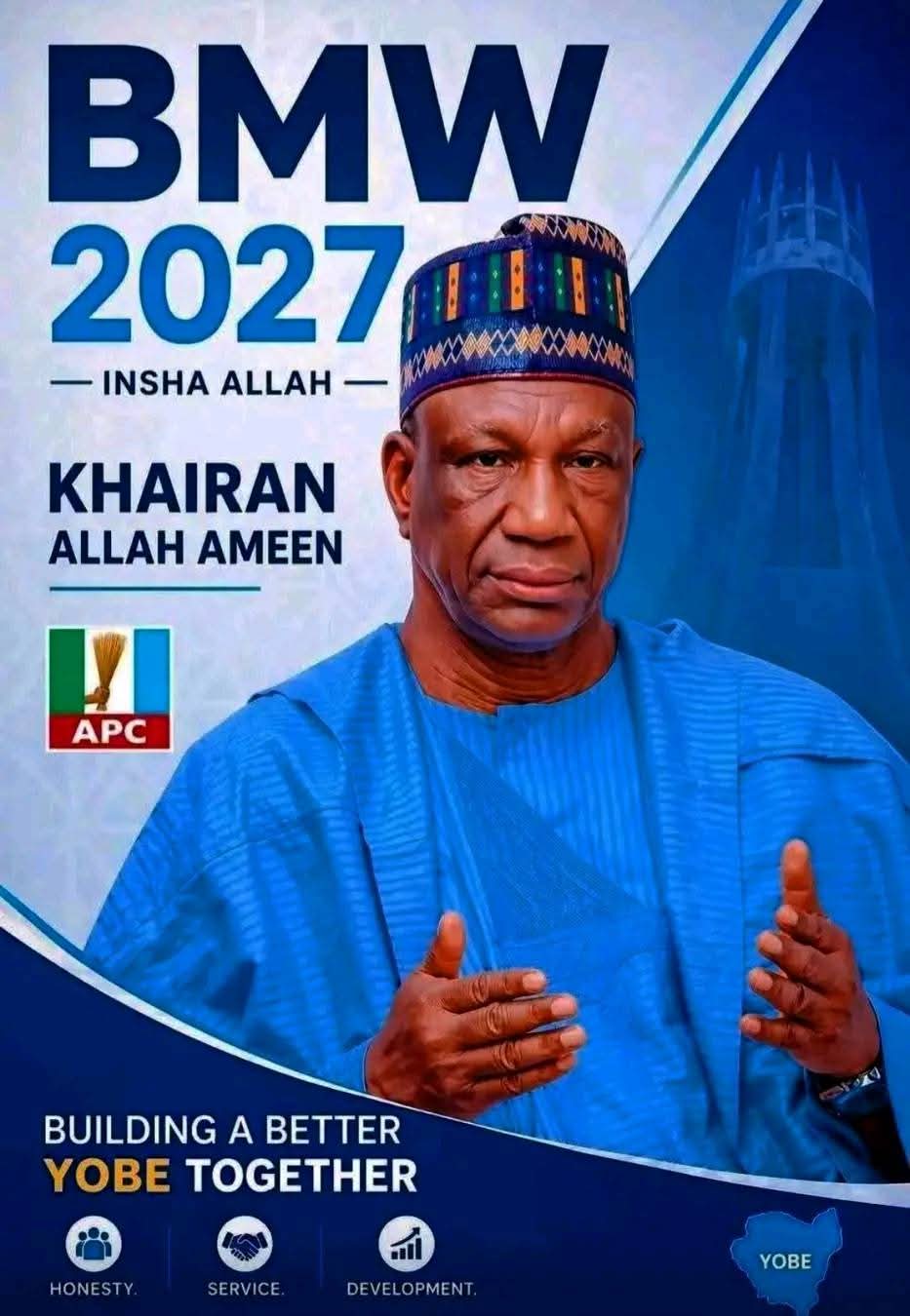
Yobe: Baba Mallam Wali will step up development if elected in 2027
By: Yahaya Wakili
Muhammad Yahaya, a political observer in Yobe State, on Saturday said that he remains optimistic that after the 2027 general elections, the citizens of Yobe State will witness massive developmental projects under the leadership and administration of the incoming APC governor, Alhaji Baba Mallam Wali.
According to Home, Wali will continue from where his predecessor, Mai Mala Buni CON, stopped, stressing that Governor Buni has already put Yobe State on the list of developing states in Nigeria.
Baba Mallam Wali is a well-known, seasoned administrator who is committed to the ideals of service; he has the capacity and the experience in administration, being the longest-serving secretary to the state government in the northeastern region. Baba Mallam Wali carries the competence and temperament required to build on the legacies of governance of Governor Mai Mala Buni in the state. impact, Yobe State will witness a rapid development within the shortest time, and Yobeans will have known that the leaders of Yobe State, His Excellency Senator Ibrahim Geidam FCAE and His Excellency Governor Mai Mala Buni CON, COMN, have made them a good choice.
“Yobe State deserved a kind of leader like Senator Ibrahim Geidam, Governor Mai Mala Buni, and Alhaji Baba Mallam Wali, and therefore, what remains from the people of Yobe State is to give Baba Mallam Wali support and cooperation in order to move Yobe State forward beyond expectations. Alhaji Umar Idris, a political analyst in the state, said now the APC has done a good thing and made an excellent choice since it’s adopting a rotation formula by shifting to the Yobe North Senatorial District. “He observed
Muhammad added, “This is a welcome development, and it will unite the party members and the people of Yobe State as a whole, and definitely APC will continue ruling the state forever. According to the political analysis, the former secretary to the state government, Alhaji Baba Mallam Wali, brings to the ticket a strong record across Yobe State politics and will strengthen the state to achieve its noble goals.
He also said that Baba Mallam Wali Fcan, MNI, was chosen because of his political experience, state reach, Yobe North influence, and record in public office.
“His performance showed his acceptance among members of the public across the state. He said the wealth experience of Baba Mallam Wali qualifies him to govern the state for four to eight years, Inshallah; therefore, his emergence as an All Progressives Congress (APC) candidate was a well-deserved recognition. Baba Mallam Wali will perform better and be committed to the development of Yobe State.” He added
Yobe: Baba Mallam Wali will step up development if elected in 2027
News
Plastic Crisis: NESREA Rejects Manufacturers’ Pushback, Insists New Regulations Will Transform Nigeria’s Economy
Plastic Crisis: NESREA Rejects Manufacturers’ Pushback, Insists New Regulations Will Transform Nigeria’s Economy
By: Michael Mike
The National Environmental Standards and Regulations Enforcement Agency (NESREA) has firmly rejected calls to suspend Nigeria’s newly introduced National Environmental (Plastic Waste Control) Regulations, 2026, insisting that the country can no longer afford a plastics economy that allows products to flood the market without responsibility for their recovery and disposal.
In what could trigger a major policy and industry showdown, the environmental regulator defended the controversial regulations against criticisms by the Manufacturers Association of Nigeria (MAN), arguing that the new framework is not anti-industry but a necessary response to an escalating environmental crisis that has clogged waterways, worsened flooding, polluted ecosystems and created mounting public health and economic costs.
The agency said suspending the regulations would amount to delaying urgently needed reforms and would send the wrong signal to investors, recyclers, development partners and businesses already preparing for a transition to a circular economy.
Director-General and Chief Executive Officer of NESREA, Prof. Innocent Barikor, said the regulations were designed to reduce plastic pollution, promote resource efficiency, encourage recycling and create a sustainable plastics economy capable of generating jobs and attracting investment.
Barikor dismissed claims that the regulations would impose an outright ban on single-use plastics, disrupt manufacturing operations and increase dependence on imports.
According to him, the much-debated 80-micron provision under Regulation 26 applies only to specific categories of plastic bags and does not constitute a blanket prohibition on plastic packaging across sectors such as food and beverages, pharmaceuticals, agriculture and logistics.
“It is misleading to present the regulations as a wholesale ban on all plastic packaging or all single-use plastics,” the agency stated.
Rather than shutting industries down, NESREA said the regulations provide a phased implementation framework that gives manufacturers sufficient time to adapt.
The agency noted that the minimum recycled polyethylene terephthalate (PET) content requirement would not take effect immediately, beginning with a threshold of 25 per cent on January 1, 2028, and increasing to 50 per cent from January 1, 2030.
The timelines, it said, would enable manufacturers, recyclers and brand owners to make investments, strengthen supply chains and build local recycling capacity.
NESREA warned that the bigger threat to Nigeria’s economy lies in the continued mismanagement of plastic waste.
According to the agency, unchecked plastic pollution has contributed to blocked drainage systems, flooding, environmental degradation, marine litter, public health concerns and the loss of valuable recyclable materials that could otherwise support domestic industries.
The regulator maintained that the new policy framework could unlock significant economic opportunities in waste collection, sorting, recycling, packaging innovation, logistics and environmental compliance services.
It further argued that a properly implemented circular plastics economy could create thousands of green jobs across both the formal and informal sectors while stimulating investment in local recycling infrastructure and secondary raw-material production.
On concerns that compliance costs could increase the prices of consumer goods, NESREA said the country is already paying heavily for inaction through environmental remediation costs, sanitation burdens and damage caused by flooding and pollution.
The agency explained that the regulations are founded on the internationally recognised polluter-pays principle, which places responsibility on producers to participate in the recovery and environmentally sound management of products introduced into the market.
It also rejected claims that the regulations would encourage import dependence, saying they specifically promote the use of locally sourced food-grade recycled PET and are intended to boost Nigeria’s domestic recycling industry, conserve foreign exchange and strengthen local value chains.
NESREA argued that plastic pollution is not merely a waste management issue but one that must be addressed throughout the entire value chain—from product design and production to consumption, collection, recycling and final disposal.
The agency disclosed that the regulations establish mechanisms for generating reliable national data on plastic production, recovery and environmental leakage through a Central Data Collection Platform, producer reporting systems and compliance monitoring frameworks.
It maintained that the regulations are consistent with Nigeria’s existing plastic waste policies and roadmaps and provide the legal framework required to translate policy aspirations into enforceable obligations.
Significantly, NESREA declared that the country has reached a defining moment in its environmental governance journey.
“Nigeria cannot continue with a plastics system in which products are placed on the market without adequate responsibility for their recovery, recycling or environmentally sound management,” the agency stated.
It nonetheless extended an olive branch to manufacturers and other stakeholders, proposing structured engagement on implementation guidelines, compliance timelines, producer responsibility schemes and support mechanisms for industrial transition.
The regulator insisted that the objective is not to weaken manufacturing but to reposition Nigeria’s plastics sector for competitiveness in a world increasingly driven by sustainability, traceability, recycled content and producer accountability.
The emerging standoff between environmental regulators and manufacturers is expected to shape the future of Nigeria’s plastics industry and test the country’s resolve to balance industrial growth with environmental sustainability.
Plastic Crisis: NESREA Rejects Manufacturers’ Pushback, Insists New Regulations Will Transform Nigeria’s Economy

Stakeholders advocate stronger govt synergy to tackle poverty, insecurity, environmental challenges

Borno Denies Spending ₦4bn on Non-Existent Rail Project, Blames Budget Report Error

Yobe: Baba Mallam Wali will step up development if elected in 2027

Roger Federer’s Shock as DNA Results Reveal Myla and Charlene Are Not His Biological Children

THE PLIGHT OF FARIDA

FAILED COUP IN BURKINA FASO: HOW TRAORÉ NARROWLY ESCAPED ASSASSINATION PLOT AMID FOREIGN INTERFERENCE CLAIMS
-
 News2 years ago
Roger Federer’s Shock as DNA Results Reveal Myla and Charlene Are Not His Biological Children
-
Opinions4 years ago
THE PLIGHT OF FARIDA
-
 News1 year ago
FAILED COUP IN BURKINA FASO: HOW TRAORÉ NARROWLY ESCAPED ASSASSINATION PLOT AMID FOREIGN INTERFERENCE CLAIMS
-

 News2 years ago
EYN: Rev. Billi, Distortion of History, and The Living Tamarind Tree
-
 Opinions5 years ago
POLICE CHARGE ROOMS, A MINTING PRESS
-

 ACADEMICS2 years ago
A History of Biu” (2015) and The Lingering Bura-Pabir Question (1)
-

 Columns2 years ago
Army University Biu: There is certain interest, but certainly not from Borno.
-

 Politics1 year ago
2027: Why Hon. Midala Balami Must Go, as Youths in Hawul and Asikira/Uba Federal Constituency Reject ₦500,000 as Sallah Gift
