
News
Calls for the Repositioning of PDSS made

Calls for the Repositioning of PDSS made
By: Michael Mike
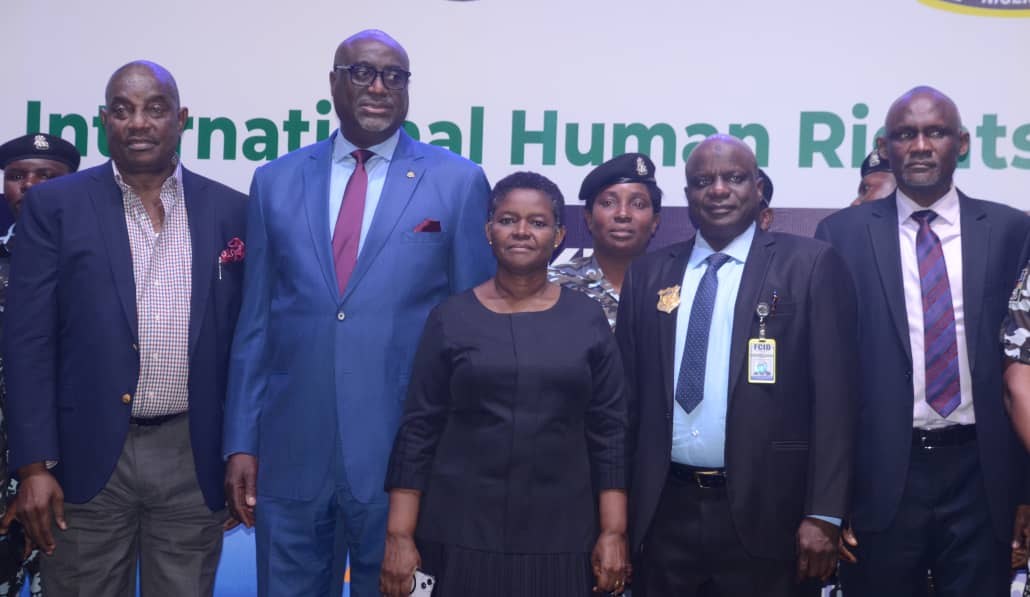
The Police Duty Solicitor Scheme (PDSS) has been asked to be repositioned so that Nigerians everywhere in the country can effective access justice.
The call was made at a stakeholders meeting at the weekend in Abuja to commemorate the International Human Rights Day.
Experts at the occasion called for renewed understanding among police officers on how the PDSS supports the Police Force from investigation to court appearance.
Among those who spoke at the event include the former Inspector General of Police and Chairman, Police Service Commission, Solomon Arase; Attorney General of the Federation and Minister of Justice,, Lateef Fagbemi SAN; Director General, Legal Aid Council of Nigeria, Aliyu Abubakar; Project Manager, Criminal Justice Reform, Rule of Law and Anti-Corruption (RoLAC Phase II) Programme, Dr. Oluwatoyin Badejogbin among others.
The event which marked the end of the 16 Days of Activism against Sexual and Gender Based Violence 2023, was organised by the European Union-funded Rule of Law and Anti-Corruption Programme (RoLAC II) of International Institute for Democracy and Electoral Assistance (International IDEA) in collaboration with the Legal Aid Council of Nigeria (LACON).
In his opening remarks, the Director General, Legal Aid Council of Nigeria, Aliyu Abubakar highlighted the benefits of the Scheme to include: fosterimg community policing and strengthening service delivery by the Police; increase protection and promotion of the legal and human rights of suspects and detainees; improve accountability and transparency in the Police Force; promote access to justice for the poor; vulnerable and marginalized persons; improve the quality of legal assistance and justice delivery in Nigeria and increase Nigeria’s compliance with her international human rights obligations.
He asked for cooperation from the Police hierarchy ahead of rolling out of the Scheme nationwide.
Delivering his keynote address, Arase noted that the introduction of the PDSS, in response to the imperative outlined in the Administration of Criminal Justice Act (ACJA), was a watershed moment in our commitment to safeguarding the rights of individuals in police custody.
According to the Police Service Commission boss, the gains achieved through the PDSS have been transformative, not only in principle but in tangible, life-changing ways.
He however called for a more comprehensive and integrated approach that addresses systemic issues within the country’s criminal justice system.
He said: “Historically, detainees faced prolonged periods in police facilities without access to legal representation, leading to routine violations of their rights. The PDSS, driven by a commitment to justice, has become a mechanism through which lawyers provide free legal services to detainees across Nigeria, ensuring that their rights are not only protected on paper but upheld in practice.
“While the success of the PDSS is evident in specific regions, there is a need for widespread replication and adoption. The lessons learned in Anambra, Edo, FCT, and Lagos should serve as a blueprint for other states, fostering a culture of legal responsibility and collaboration that transcends regional boundaries”.
On his part, the Attorney General of the Federation and Minister of Justice,, Lateef Fagbemi, represented by Gladys Odigbaro, Director of Solicitor Department, Federal Ministry of Justice pointed out that the enforcement of Force Order 20 and other relevant provisions of Administration and Criminal Justice Act (ACJA) are commendable milestones in the concerted efforts to address the crisis of arbitrary, irrational and interminable pretrial (awaiting trial) detentions in the country.
He noted that the Scheme also comes with the advantage of preventing undue congestion of inmates in correctional facilities with the consequential benefit of saving government the resources required to maintain a large population of inmates or detainees.
The Inspector General of Police, Kayode Egbetokun, who was represented by AIG Shehu Gwarzo, said the Police Duty Solicitor Scheme as captured by Force Order 20, aims to contribute to the realization of the ongoing reform programme of his administration.
He said: “Force Order 20 addresses ‘free legal services for arrested and/or detained persons in police formations’ and institutes the PDSS as a country-wide mechanism for its delivery. It expands the provision of legal services in police stations by ensuring prompt access to Duty Solicitors for suspects. It implements the constitutional promise of access to counsel in police stations in Nigeria.”
On what informed the event, Dr. Oluwatoyin Badejogbin, Project Manager, Criminal Justice Reform, Rule of Law and Anti-Corruption (Phase II) Programme of International IDEA said it was aimed at establishing renewed commitment of the IGP to grant duty solicitors access to police detention centres as well as initiate renewed understanding among Police on how the PDSS supports the Police Force from investigation to court appearance.
Police spokespersons from the 36 states and the Federal Capital Territory (FCT) were among participants at the event.
Calls for the Repositioning of PDSS made


Troops, Police Recover Suspected IED, Reopen Road in Zamfara
By Zagazola Makama
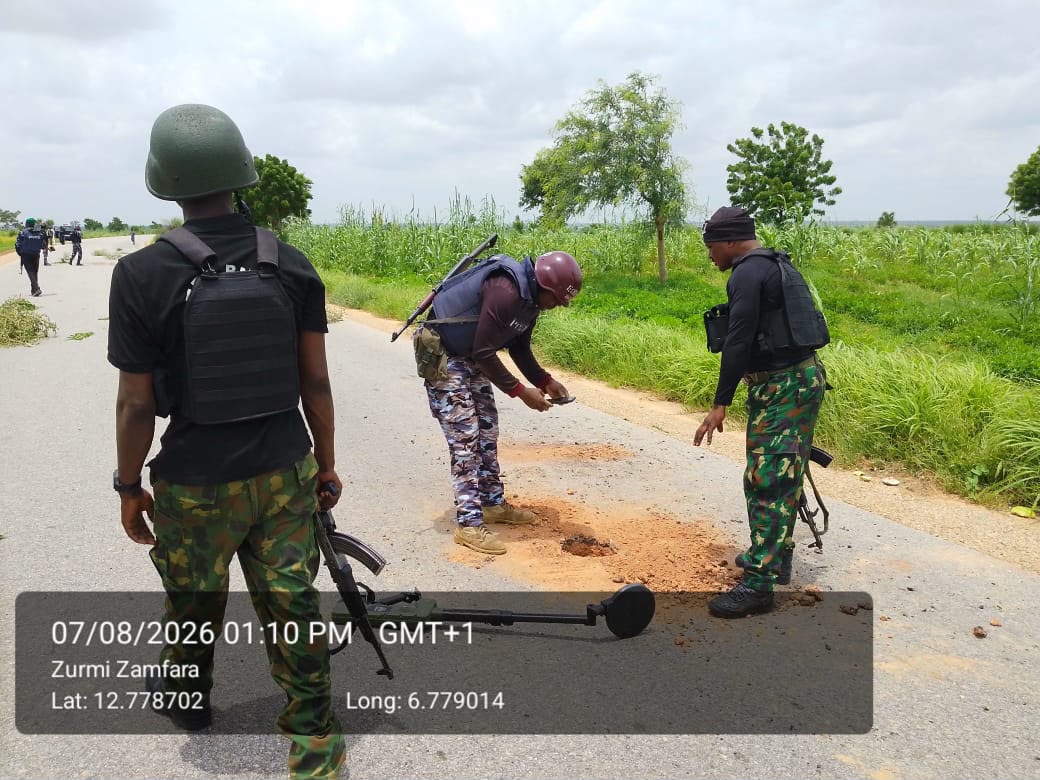
Troops of Operation FANSAN YANMA and the Nigerian Police Force have safely recovered a suspected improvised explosive device (IED) planted along a road in Zurmi Local Government Area of Zamfara State.
The operation was conducted at about 1:55 p.m. on Aug. 7 by troops of CSI Battalion VI/CT 2, Joint Task Force North West Operation FANSAN YAMMA, deployed at Forward Operating Base Kaura Namoda, in conjunction with a Nigeria Police Force Explosive Ordnance Disposal (EOD) team and troops of the 1 Brigade Quick Reaction Force.

The team mobilised to Jabanda village, following a report of a suspected IED planted along the road.
According to military sources, the team located and successfully cleared the suspected explosive device.
Following the successful operation, the road was declared safe and reopened to motorists, restoring normal vehicular movement along the route.
The security forces subsequently continued their operations to ensure the safety of commuters and residents in the area.
Troops, Police Recover Suspected IED, Reopen Road in Zamfara

Law School Student Dies in Suspected Suicide at Lagos Hostel
By Zagazola Makama
A 23-year-old student of the Nigerian Law School has died in a suspected suicide incident at the school’s hostel in Victoria Island, Lagos.
The incident occurred in the early hours of Friday, Aug. 7, 2026, when the deceased, identified as Alayande Faith Ajoke, was found dead within the hostel premises.
According to sources, the Chief Matron of the Law School, Mrs. Igbokwe Juliana, reported the incident at the Victoria Island Police Division at about 6:30 a.m.
The report stated that at about 4:30 a.m., a student who had just completed her internship, Ojo Abisoye Tinuola, informed the matron about a suspected suicide involving her roommate, Alayande.
The matron subsequently proceeded to the scene, where the deceased was found lying on the ground within the hostel premises.
Preliminary observations indicated that the deceased may have jumped from the rooftop of the four-storey hostel building.
Police sources said preliminary investigation further revealed that the deceased allegedly left behind two notes addressed to her stepfather and roommate.
Following the report, a team of police detectives visited the scene, documented the area and took photographs of the scene and the body.
The remains were subsequently evacuated to the Mainland General Hospital Mortuary, Yaba, for preservation and autopsy.
The police said investigation into the circumstances surrounding the death is ongoing.
Law School Student Dies in Suspected Suicide at Lagos Hostel
News
Gov Abiodun Commends Army, Police, DSS, Others for Intelligence-led Rescue of 5 Kidnapped Poly Students, 2 Others

Breaking…
Gov Abiodun Commends Army, Police, DSS, Others for Intelligence-led Rescue of 5 Kidnapped Poly Students, 2 Others
- 5 Suspects Arrested
Governor Dapo Abiodun of Ogun State has lauded the Department of State Services (DSS), the Nigerian Army, the Nigerian Police, as well as Civil Defence Corps (NSCDC), for rescuing five kidnapped students of Gateway ICT Polytechnic, Saapade, in Remo North Local Government Area of the state.
The students, who were abducted by suspected kidnappers earlier this week, were rescued in the early hours of Friday, in an intelligence-led operation around Alamala community, off Ayetoro Road Roundabout, of the state capital. Also rescued were two non-students.
The governor described the rescue as a major breakthrough in its fight against kidnapping, even as he reaffirmed his administration’s unwavering commitment to ensuring that kidnappers and other criminal elements have no hiding place in the state.
He described the operation, which included members of the State Security Network Agency (Amotekun Corps), local vigilantes and hunters, as a demonstration of the success that can be achieved when security agencies work together.
“One of the victims sustained a gunshot injury during the incident and was immediately evacuated for medical attention. The student has since been stabilised.
“This operation is still ongoing, and I wish to assure the good people of Ogun State that our security agencies remain on the trail of every individual connected with this criminal enterprise,” said the governor.
“Our resolve is very clear. Ogun State will remain hostile to criminality and safe for every law-abiding citizen, resident and investor,” the Governor declared, stressing that
According to him, recent joint security initiatives, particularly Operation Kò S’Áyé, have demonstrated the effectiveness of intelligence sharing, inter-agency collaboration and sustained operational pressure against criminal elements.
The governor also commended President Bola Ahmed Tinubu for his administration’s commitment to combating banditry, terrorism and kidnapping across the country, noting that the recent rescue of 308 abducted victims by Nigerian security forces underscores the growing effectiveness of coordinated security operations nationwide. (Reuters)
“At this juncture, I must acknowledge the purposeful leadership of President Bola Ahmed Tinubu, whose administration has placed the restoration of peace and security at the centre of Nigeria’s development agenda through sustained investment in the operational capacity of the Armed Forces and other security agencies.
“The strengthening of intelligence coordination, the acquisition of modern security assets and his deliberate reforms have continued to deepen inter-agency collaboration,” he said.
The governor further noted that the Federal Government has continued to strengthen the nation’s security architecture, adding that the recent approval of a substantial salary increase for officers and men of the Armed Forces would further boost personnel welfare and morale.
“One of the kidnapped victims sustained a gunshot injuries during the operation and was immediately evacuated for medical attention and has since been stabilised.” disclosed a security source.
Gov Abiodun Commends Army, Police, DSS, Others for Intelligence-led Rescue of 5 Kidnapped Poly Students, 2 Others

Troops Arrest Four Armed Militia, Recover Two Pistols in Jos

Four Houses Set Ablaze in Jos Community Amid Dispute

Troops, Police Recover Suspected IED, Reopen Road in Zamfara

Roger Federer’s Shock as DNA Results Reveal Myla and Charlene Are Not His Biological Children

THE PLIGHT OF FARIDA

FAILED COUP IN BURKINA FASO: HOW TRAORÉ NARROWLY ESCAPED ASSASSINATION PLOT AMID FOREIGN INTERFERENCE CLAIMS
-
 News2 years ago
Roger Federer’s Shock as DNA Results Reveal Myla and Charlene Are Not His Biological Children
-
Opinions4 years ago
THE PLIGHT OF FARIDA
-
 News1 year ago
FAILED COUP IN BURKINA FASO: HOW TRAORÉ NARROWLY ESCAPED ASSASSINATION PLOT AMID FOREIGN INTERFERENCE CLAIMS
-

 News2 years ago
EYN: Rev. Billi, Distortion of History, and The Living Tamarind Tree
-
 Opinions5 years ago
POLICE CHARGE ROOMS, A MINTING PRESS
-

 ACADEMICS2 years ago
A History of Biu” (2015) and The Lingering Bura-Pabir Question (1)
-

 Columns2 years ago
Army University Biu: There is certain interest, but certainly not from Borno.
-

 Politics1 year ago
2027: Why Hon. Midala Balami Must Go, as Youths in Hawul and Asikira/Uba Federal Constituency Reject ₦500,000 as Sallah Gift
