
News
COAS commissions AHOOAS estate, shopping complex in Ibadan, reaffirms soldier-first welfare policy

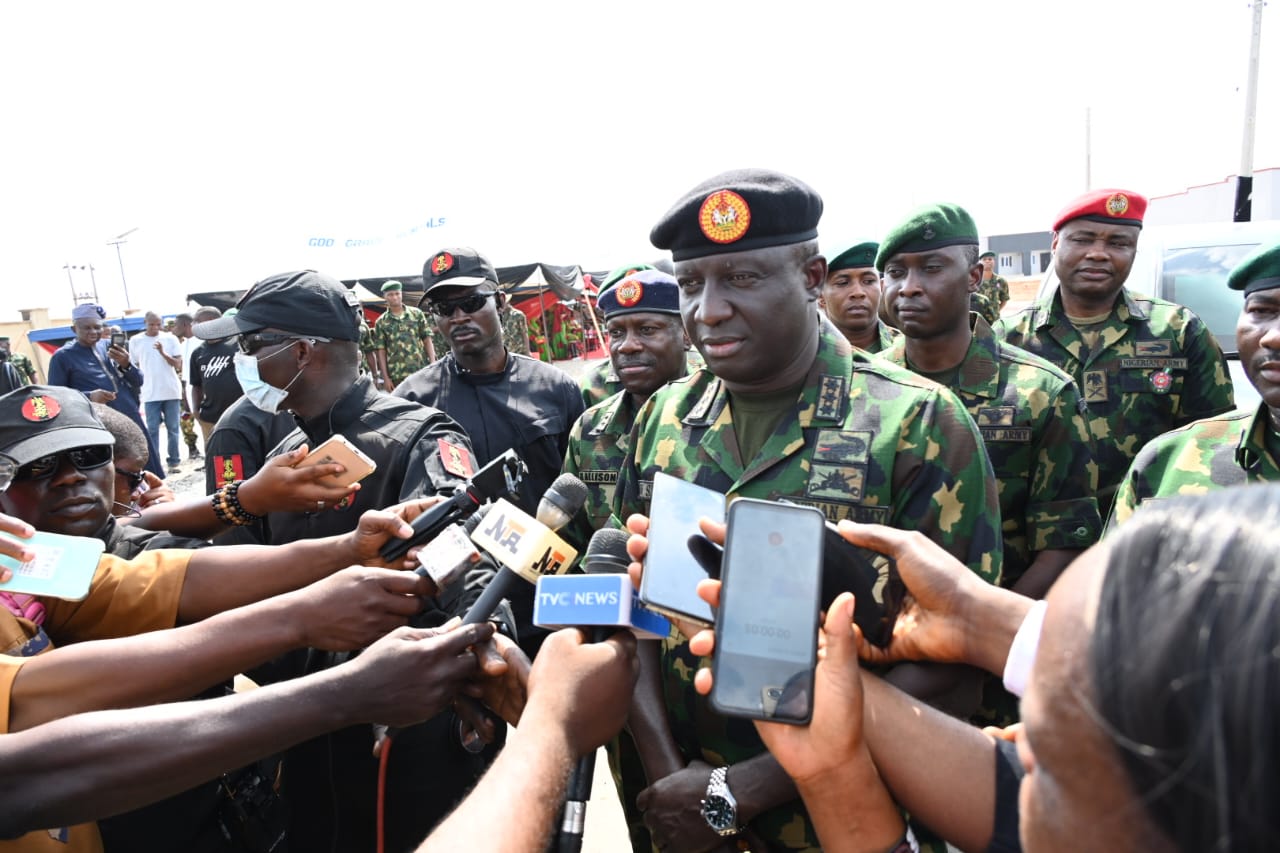
COAS commissions AHOOAS estate, shopping complex in Ibadan, reaffirms soldier-first welfare policy
By: Zagazola Makama
The Chief of Army Staff (COAS), Lt.-Gen. Waidi Shaibu, on Friday commissioned the Affordable Home Ownership Option for All Soldiers (AHOOAS) estate and a Post-Service Housing Development Limited (PHDL) shopping complex in Ibadan, Oyo State, reaffirming the Nigerian Army’s commitment to a soldier-first welfare policy.
Shaibu said the projects were part of deliberate efforts to address the post-service housing needs of personnel and improve their overall quality of life, describing access to decent housing as a critical component of troop welfare.
The event was attended by the Special Guest of Honour, the Executive Governor of Oyo State, represented by the Commissioner for Lands and Urban Development, Mr William Akinfumilayo; the Royal Father of the Day, Oba Rashidi Adeolu Ladoja; Principal Staff Officers from Army Headquarters; senior serving and retired officers; partners of the project; members of the Nigerian Army Officers’ Wives Association and the Soldiers’ Wives Association, as well as members of the press.
The COAS said the AHOOAS scheme was conceived to enable serving soldiers to acquire affordable and decent homes in locations of their choice, which they could comfortably retire into after years of service to the nation.
“This project is a clear demonstration of our resolve to place the welfare of the Nigerian soldier at the centre of our policies and actions. A soldier who is assured of his future is better motivated to give his best in the defence of the nation,” he said.
He recalled that the pilot phase of the AHOOAS project in Idu, Abuja, delivered over 400 housing units now fully occupied by soldiers and their families, adding that the Ibadan project was part of the expansion of the scheme to other parts of the country.
Shaibu disclosed that similar projects were at various stages of completion in Benin, Jos and Abuja, while plans were also underway to fast-track home ownership for the Warrant Officers’ cadre of the Nigerian Army.
He paid tribute to the late former Chief of Army Staff, Lt.-Gen. Taoreed Lagbaja, for initiating the housing scheme, and assured that the current leadership would continue to build on the foundation he laid.
The COAS also commended the Oyo State Government for its support to military formations in the state and urged other state governments to key into the initiative by allocating land for the scheme in their respective states.
According to him, the commissioning of the PHDL shopping complex in Eleyele, Ibadan, would complement the housing estate by providing essential services, supporting small businesses and contributing to the local economy.
Shaibu expressed appreciation to the management of PHDL and partner organisations for their professionalism in delivering the projects, noting that the Nigerian Army remained open to credible public-private partnerships that would enhance personnel welfare.
He further thanked President Bola Ahmed Tinubu, GCFR, for his continued support to the Armed Forces, reaffirming the Army’s commitment to actualising the President’s vision of a secure and prosperous Nigeria.
The COAS assured residents of Oyo State of the Nigerian Army’s sustained cooperation with civil authorities in promoting peace and security across the state and the country at large.
Earlier speaking at the ceremony, the Managing Director of PHDL, Maj.-Gen. I.A. Allison, said the philosophy of the COAS was firmly anchored on welfare, noting that home ownership remained one of the most critical assurances a soldier could have after years of service to the nation.
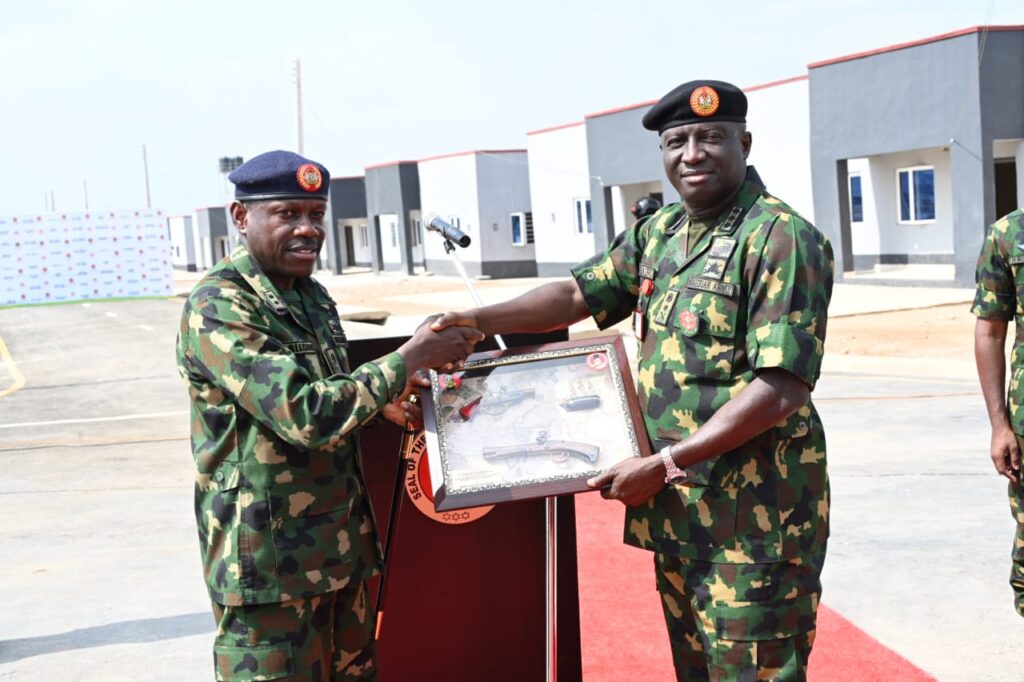
“There cannot be a better welfare than a house a home into which a soldier is sure he will retire,” he said.
He recalled that the first phase of the AHOOAS project was commissioned at Idu, Abuja, on Dec. 18, 2024, with 400 housing units, describing the Akobo project as a continuation of that vision exactly one year later.
The Post-Service Housing Development Limited (PHDL) managing director acknowledged the contributions of his predecessors, Maj.-Gen. Titus Umeri (rtd) and Maj.-Gen. J.T. Omali (rtd), saying he had built on their achievements since assuming office.
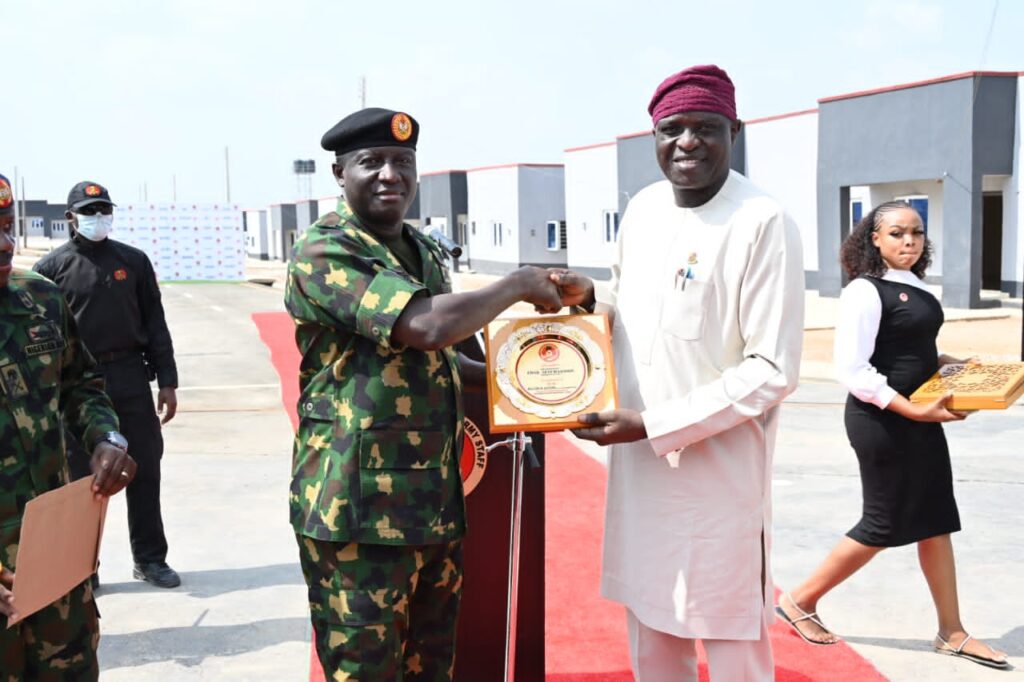
He disclosed that following his initial briefing of the COAS, approvals were granted for concurrent construction across multiple locations nationwide. “As I speak, aside from Akobo, we have 80 housing units under construction in Jos, 60 completed here, 40 completed in Benin, and 120 units nearing completion at Idu as Phase Two,” Allison said.
He added that the Akobo estate comprised 30 units of two-bedroom apartments for junior non-commissioned officers and 30 units of three-bedroom apartments for senior non-commissioned officers.
According to him, five per cent of the houses would be allocated free of charge to soldiers who were badly wounded in battle or suffered severe trauma during operations.
To ensure balanced communities, Allison said 25 per cent of the houses would be allocated to civilians at discounted rates, while 70 per cent would be reserved for soldiers at highly subsidised prices. “When a house built at N30 million is sold for N7.5 million, or one built at N50 million is sold for N8.5 million, then it is clear that this is a genuine welfare programme,” he said.
He further disclosed that commercial developments were being undertaken alongside the housing scheme, including 22 shops in Ibadan, a completed shopping complex with over 120 shops in Abuja awaiting commissioning, and another complex of over 50 shops under construction in Warri, expected to be completed in the first quarter of 2026. Allison also commended partners supporting the initiative.
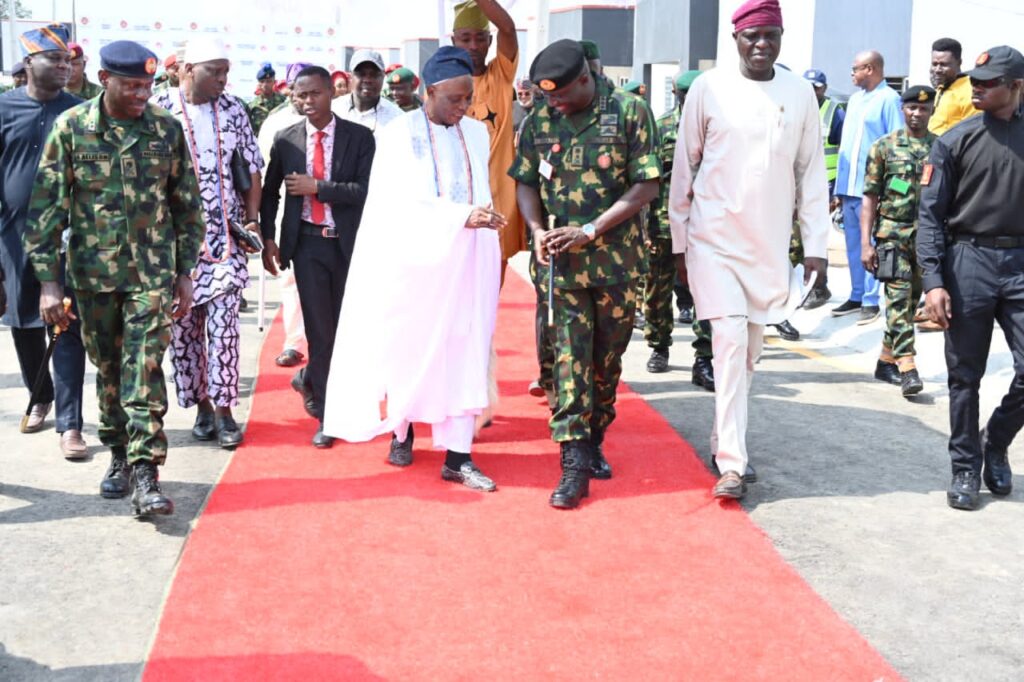
He said Family Homes Funds Limited had constructed 50 two-bedroom houses to be donated to widows of fallen soldiers, adding that the formal handover would take place before Jan. 15, 2026, to coincide with activities marking Armed Forces Remembrance Day.
The PHDL MD expressed appreciation to the Chief of Army Staff, the Oyo State Government, the Royal Father of the Day and all guests for witnessing the commissioning of the AHOOAS project, describing it as another milestone in the Nigerian Army’s welfare drive.
COAS commissions AHOOAS estate, shopping complex in Ibadan, reaffirms soldier-first welfare policy



Suspected militia kill motorcyclist along Nyong-Bodel road in Plateau
By Zagazola Makama
An unidentified person was killed by suspected militias along the Nyong-Bodel road in Bokkos Local Government Area of Plateau State.
Security sources told Zagazola Makama that the incident occurred at about 3:50 p.m. on Sept. 4, 2026.
According to the sources, troops of Sector 5, Operation Enduring Peace, deployed at Bodel, responded to a report of an attack and killing of the victim along the road.
The troops arrived at the scene and discovered the victim’s corpse alongside his motorcycle, while the suspected attackers fled after sighting the troops.
The corpse was evacuated to a mortuary, while efforts are ongoing to establish the identity of the victim and apprehend the assailants.
Security agencies are also intensifying patrols and surveillance along the route to prevent further attacks and restore confidence among residents and road users.
Suspected militia kill motorcyclist along Nyong-Bodel road in Plateau

Troops launch rescue operation after hospital matron kidnapped in Plateau
By Zagazola Makama
Troops of Sector 5, Operation Enduring Peace, have launched a rescue operation following the abduction of Mrs Sarah Dalang, a matron at Cottage Hospital, Bokkos, Plateau State.
Security sources told Zagazola Makama that the incident occurred at about 2:20 p.m. on Sept. 4, 2026.
According to the sources, the troops responded to a report of the kidnapping and mobilised alongside other security agencies to commence search and rescue operations.
The security personnel conducted operations around suspected hideouts of the kidnappers but no contact was established with the criminals.
Efforts are ongoing to track the kidnappers, locate the victim and secure her safe release.
Security agencies have continued to intensify operations across Bokkos and adjoining areas to disrupt criminal activities and protect residents.
Troops launch rescue operation after hospital matron kidnapped in Plateau
Troops neutralise terrorist, recover four motorcycles in Katsina
By Zagazola Makama
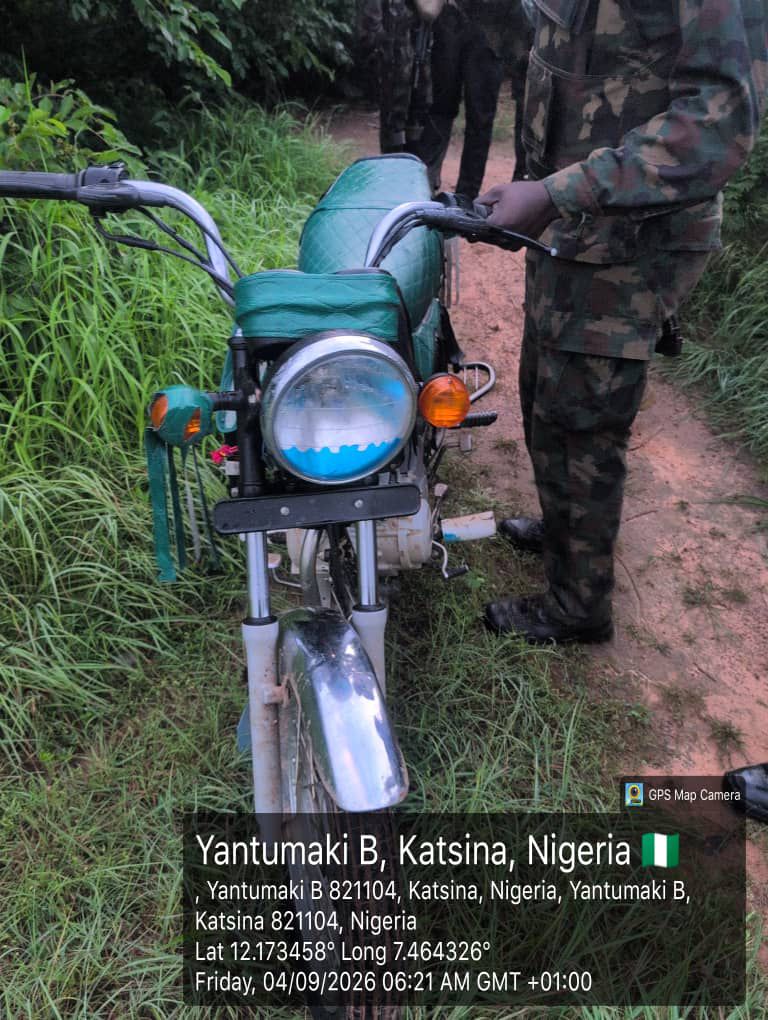
Troops of Sector 1, Joint Task Force North West, Operation Fansan Yamma, have neutralised a terrorist and recovered four motorcycles and other items during a dawn offensive operation in Dan Musa Local Government Area of Katsina State.
The operation was conducted on Sept. 4, 2026, following credible intelligence on the presence of terrorists around the Yantumaki Forest area.
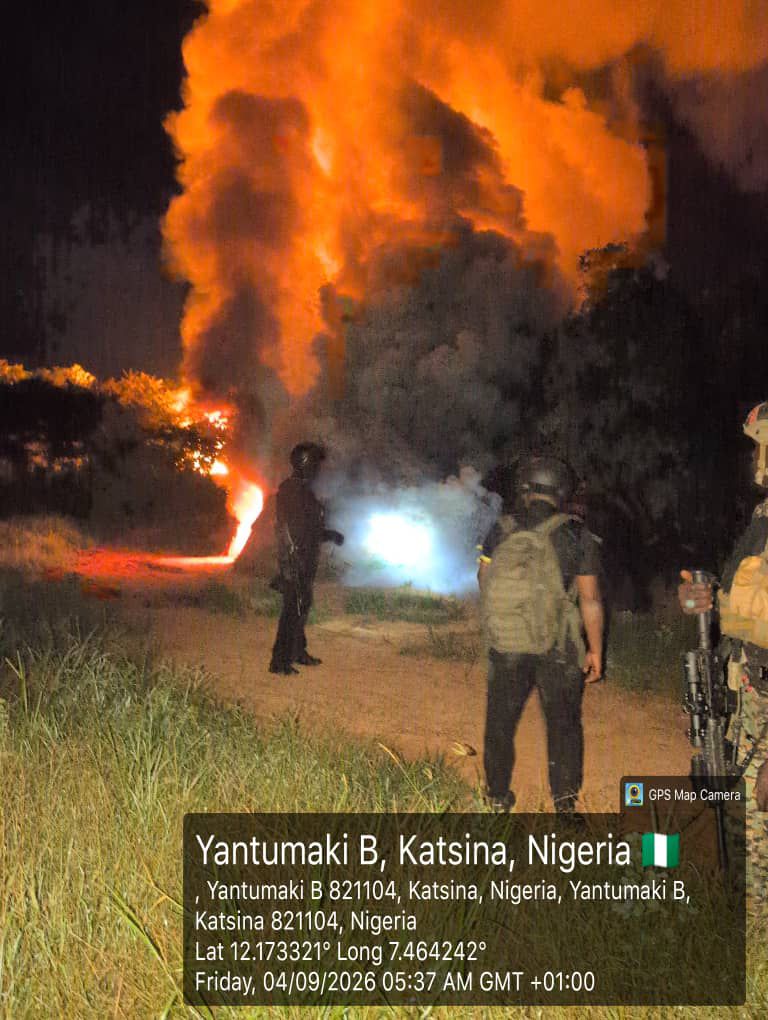
According to security sources, the troops launched a coordinated offensive against the terrorists and engaged them with superior firepower, forcing the surviving elements to flee into the surrounding bushes.
During the subsequent exploitation of the area, the troops confirmed the neutralisation of one terrorist and recovered four motorcycles, one mobile phone and five empty intravenous drip containers.
The recovered medical containers were suspected to have been used in treating wounded terrorists operating in the area.
The operation is part of ongoing efforts by Operation Fansan Yamma to sustain pressure on terrorist networks, degrade their operational capabilities and deny them freedom of movement within the Joint Operations Area.

The theatre has also urged members of the public to continue providing credible and timely information to security agencies to support ongoing operations and facilitate the eradication of terrorist elements across the Joint Operations Area.
Troops neutralise terrorist, recover four motorcycles in Katsina

Suspected militia kill motorcyclist along Nyong-Bodel road in Plateau

Troops launch rescue operation after hospital matron kidnapped in Plateau

Troops neutralise terrorist, recover four motorcycles in Katsina

Roger Federer’s Shock as DNA Results Reveal Myla and Charlene Are Not His Biological Children

THE PLIGHT OF FARIDA

FAILED COUP IN BURKINA FASO: HOW TRAORÉ NARROWLY ESCAPED ASSASSINATION PLOT AMID FOREIGN INTERFERENCE CLAIMS
-
 News2 years ago
Roger Federer’s Shock as DNA Results Reveal Myla and Charlene Are Not His Biological Children
-
Opinions5 years ago
THE PLIGHT OF FARIDA
-
 News1 year ago
FAILED COUP IN BURKINA FASO: HOW TRAORÉ NARROWLY ESCAPED ASSASSINATION PLOT AMID FOREIGN INTERFERENCE CLAIMS
-

 News2 years ago
EYN: Rev. Billi, Distortion of History, and The Living Tamarind Tree
-
 Opinions5 years ago
POLICE CHARGE ROOMS, A MINTING PRESS
-

 ACADEMICS3 years ago
A History of Biu” (2015) and The Lingering Bura-Pabir Question (1)
-

 Columns3 years ago
Army University Biu: There is certain interest, but certainly not from Borno.
-

 Politics1 year ago
2027: Why Hon. Midala Balami Must Go, as Youths in Hawul and Asikira/Uba Federal Constituency Reject ₦500,000 as Sallah Gift
