
Crime
Cocaine trafficking: Two notorious drug kingpins sentenced to life imprisonment

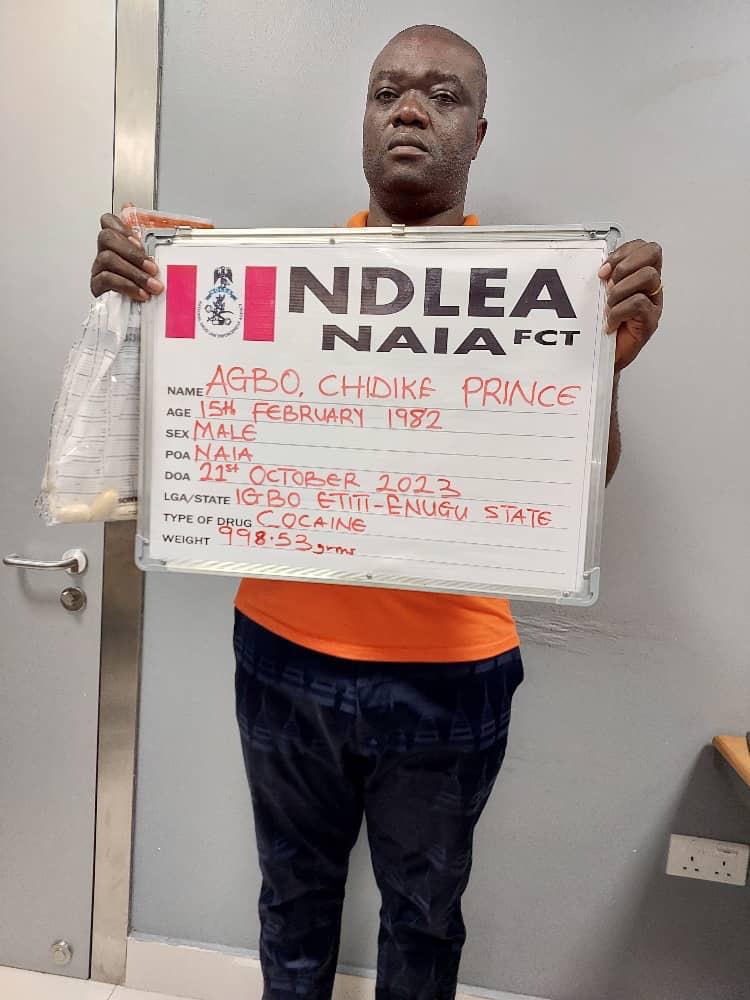
Cocaine trafficking: Two notorious drug kingpins sentenced to life imprisonment
By: Michael Mike
Two notorious drug kingpins: Uwaezuoke Ikenna and Agbo Chidike have been sentenced to life imprisonments for drug trafficking offenses.
According to a statement by the spokesman of the National Drug Law Enforcement Agency (NDLEA), Femi Babafemi the two criminals would now spend the rest of their lives in jail, “bringing an end to their years of criminal enterprise of exporting cocaine across continents following their arrest and diligent prosecution by NDLEA.”
Babafemi said for 43-year-old businessman Uwaezuoke, his journey to a lifetime in jail began when he was first arrested by NDLEA operatives on 19th March 2022 at the Nnamdi Azikiwe International Airport, Abuja during the inward clearance of Ethiopian Airlines flight from Addis Ababa, Ethiopia after he was found to have ingested 100 big wraps of cocaine weighing 2.243 kilogrammes.
Uwaezuoke was subsequently arraigned at the Federal High Court, Abuja Division in charge number FHC/ABJ/CR/438/2022 and was granted bail on certain conditions after he pleaded not guilty. He thereafter absconded, leading the court to revoke his bail and issue an arrest warrant against him.
“In a curious twist, Uwaezuoke was again arrested by NDLEA operatives on 1st August 2023, at the Murtala Mohammed International Airport, Lagos while attempting to export 1.822 kilogrammes of cocaine to India through ingestion using a different passport and under a different name, Ilonzeh Onyebuchi.
“He was again arraigned before Justice Nicholas Oweibo of the Federal High Court, Lagos Division in charge number FHC/L/554C/2023. He pleaded guilty to the two counts charge and was convicted and sentenced on 18th October 2023 to a total term of seven years of imprisonment or a fine of ₦1, 500,000.00. He paid the fine and was transferred to Abuja to face the importation case pending against him.
“He was re-arraigned on 20th March 2024 at the Abuja Division of the Federal High Court in charge number FHC/ABJ/CR/438/2022 before Justice Joyce Obehi Abdulmalik, where he pleaded guilty again. Despite his plea, the court, noting his lack of remorse, the seriousness of drug-related offences and the fact that he is a repeated offender, convicted and sentenced him to life imprisonment.
In the case of 42-year-old Agbo Chidike Prince, he was arrested at the Nnamdi Azikiwe International Airport, Abuja during the outward clearance of Ethiopian Airlines flight to Hong Kong on 21st October 2023 for ingesting 49 wraps of cocaine weighing 998.73 grammes.
“Upon his arraignment before Justice Joyce Obehi Abdulmalik of the Federal High Court, Abuja Division, the defendant pleaded guilty to the one count charge, prompting the prosecution to present evidence and review the facts of the case.
Despite the plea of allocutus by the defendant’s counsel, the court, noting the nature of the case and the commercial quantity of the drug, emphasized the seriousness of drug-related offences, convicted and sentenced the defendant on 15th April, 2024 to life imprisonment.”
Meanwhile, NDLEA officers at the Gate C Departure Hall of the Lagos airport last Friday arrested a passenger, Yahaya Oturah, while attempting to export 4,000 pills of tramadol 225mg to Malpensa, Italy on an Ethiopian Airline flight.
The psychoactive substance was found concealed in women wears and granulated melon packed in the suspect’s backpack and another bag containing food items. In his statement, Oturah who is a frequent flyer confessed he was hired to courier the drug for 700 Euros on successful delivery of the consignment in Italy.
In Bayelsa, NDLEA operatives last Wednesday arrested 28-year-old Jennifer Iliya at Amarata area of Yenagoa for producing and distributing cakes laced with illicit drugs especially cannabis sativa. At the time of her arrest, substantial number of the drugged cakes weighing 1.5 kilogrammes were recovered from her. A 20-year-old hair stylist, Josephine Odunu and a dispatch rider, Edesemi Ikporo, 30, had been arrested on Sunday 10th March by NDLEA operatives for in Yenagoa for a similar offence.
Two suspects: Joseph Dadik, 47, and Bensha Yari, 32, were arrested with 24,180 ampoules of pentazocine injection weighing 135.5 kilogrammes at Sabon Tasha, Kaduna, while Adamu Umar, 18, was nabbed with 20.7 kilogrammes cannabis when his house in Shuware area of Mubi, Adamawa state was raided on Friday 26th April.
In another incident, no less than 310.7 kilogrammes cannabis was recovered last Thursday when NDLEA operatives raided parts of Mushin in Lagos state. While 300 kilogrammes was seized at Olatunji Street, Mushin, 10.7 kilogrammes of same substance was retrieved from two suspects: Tijani Wasiu and Suleiman Aisha
at Anifowose, Mushin.
A suspect, Stanley Chukwudi, 43, was arrested with 5,900 ampoules of pentazocine injection at Sabon Gari area of Kano State last Thursday and a couple, Fredrick Odion, 53, and Gladys Odion, 52, were nabbed with 50 kilogrammes cannabis at Iruekpen, Esan West local government area, Edo state by NDLEA officers last Wednesday.
Babafemi said with the same zeal, the various commands of the agency across the country continued with the War Against Drug Abuse (WADA) advocacy campaign in the past week.
The Chairman/Chief Executive Officer of NDLEA, Brig. Gen. Buba Marwa (Retd), while commending the officers and men of the Directorate of Prosecution and Legal Services of the Agency for the diligent prosecution of Uwazuoke and Agbo cases, said the success rate of cases prosecuted by the agency has shown that there’s no escape route for those involved in the illicit trade of drug trafficking.
He equally applauded those of MMIA, Lagos, Kaduna, Kano, Edo, Adamawa and Bayelsa Commands as well as their counterparts in all the commands across the country for intensifying their drug supply and drug demand reduction activities.
Cocaine trafficking: Two notorious drug kingpins sentenced to life imprisonment


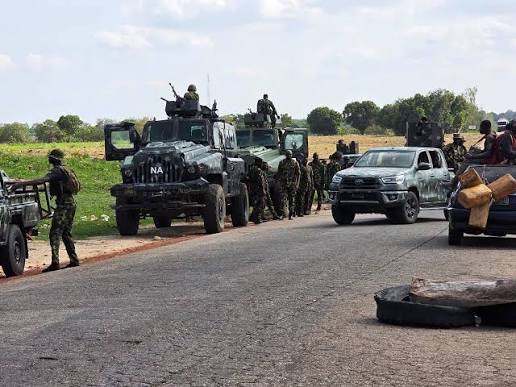
Troops Recover AK-47 Rifle, Ammunition in Failed ISWAP Reconnaissance Operation in Borno
By: Zagazola Makama
Troops of 68 Battalion, Mallam Fatori, have recovered one AK-47 rifle and 31 rounds of ammunition during an operation against suspected ISWAP elements in Abadam Local Government Area of Borno State.
Security sources said the incident occurred at about 9:07 a.m. on June 11 when troops observed the movement of two ISWAP reconnaissance teams ahead of their defensive area of responsibility.
According to the sources, an ambush team was immediately deployed to flank the suspected terrorists, but the insurgents fled upon sighting the troops and opened fire while escaping.
Following an exploitation of the area, troops recovered one AK-47 rifle and 31 rounds of 7.62mm special ammunition.
The sources added that follow-up operations were ongoing to track the fleeing terrorists and deny them freedom of movement within the general area.
Military authorities said the operation was part of sustained efforts to disrupt terrorist reconnaissance activities and strengthen security across the Lake Chad axis.
They reaffirmed commitment to maintaining pressure on insurgent groups until they are fully degraded.
Troops Recover AK-47 Rifle, Ammunition in Failed ISWAP Reconnaissance Operation in Borno
Troops Arrest Suspect Over Killing of More Than 50 Cattle in Edo
By: Zagazola Makama
Troops of Operation MESA have arrested a suspected criminal linked to the killing of more than 50 cattle belonging to Fulani herders in Esan South-East Local Government Area of Edo State.
Security sources said that the suspect was arrested at about 4:30 a.m. on Thursday following credible intelligence on his whereabouts.
According to the sources, troops of 4 Brigade operating from the Forward Operating Base (FOB) in Uromi apprehended the suspect at his residence in Oloshi Main Town.
The suspect had reportedly been on the run since May 31, when he allegedly led an attack that resulted in the killing of over 50 cattle in the Oloshi general area.
The sources said the arrest was made after sustained efforts by security agencies to track down those involved in the incident.
Following his arrest, the suspect was handed over to the Nigeria Police Force for further investigation and possible prosecution.
Security agencies have assured residents that efforts are ongoing to apprehend other individuals connected to the attack.
Troops Arrest Suspect Over Killing of More Than 50 Cattle in Edo
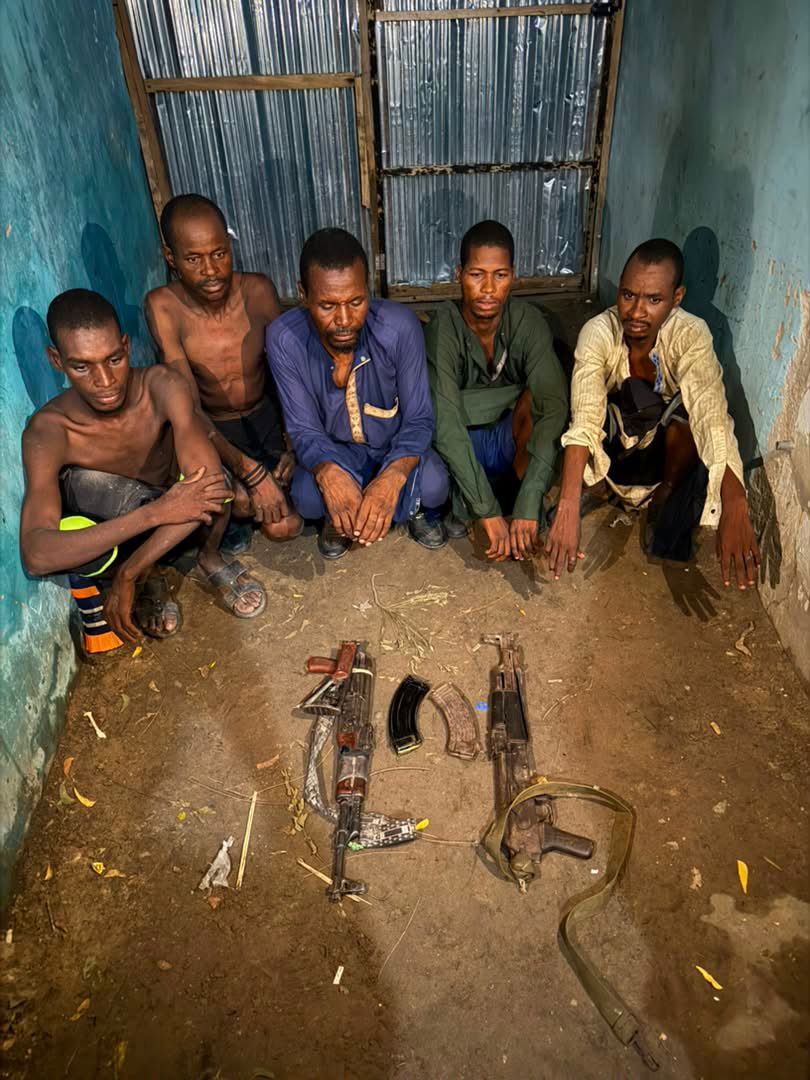
Troops Arrest Suspected Kidnappers, Recover Two AK-47 Rifles in Magumeri Borno
By: Zagazola Makama
Troops of Operation HADIN KAI conducting an ongoing operation in Magumeri Local Government Area of Borno have arrested suspected kidnappers and recovered two AK-47 rifles from them.
Sources involved in the operation disclosed on Friday that the suspects were apprehended during a targeted security operation ahead of Magumeri town.
According to the sources, the operation led to the recovery of two AK-47 assault rifles believed to have been used by the suspects in criminal activities within the area.
The sources further revealed that preliminary interrogation of the suspects had yielded valuable intelligence that could assist security agencies in tracking and arresting other members of the kidnapping network.
“The suspects have provided useful information that can aid further operations and lead to the arrest of additional members of the criminal syndicate,” the source said.
The arrests are part of ongoing efforts by security forces to dismantle kidnapping and other criminal networks operating in parts of Borno State.
Security authorities have yet to issue an official statement on the operation, while investigations and follow-up actions are continuing.
Troops Arrest Suspected Kidnappers, Recover Two AK-47 Rifles in Magumeri Borno

Police Foil IED Attack, Destroy Explosive Device in Zamfara

WHEN TERRORISTS MOCK THE STATE

Russia’s Role in the Widening Insecurity in Africa

Roger Federer’s Shock as DNA Results Reveal Myla and Charlene Are Not His Biological Children

THE PLIGHT OF FARIDA

FAILED COUP IN BURKINA FASO: HOW TRAORÉ NARROWLY ESCAPED ASSASSINATION PLOT AMID FOREIGN INTERFERENCE CLAIMS
-
 News2 years ago
Roger Federer’s Shock as DNA Results Reveal Myla and Charlene Are Not His Biological Children
-
Opinions4 years ago
THE PLIGHT OF FARIDA
-
 News1 year ago
FAILED COUP IN BURKINA FASO: HOW TRAORÉ NARROWLY ESCAPED ASSASSINATION PLOT AMID FOREIGN INTERFERENCE CLAIMS
-

 News2 years ago
EYN: Rev. Billi, Distortion of History, and The Living Tamarind Tree
-
 Opinions4 years ago
POLICE CHARGE ROOMS, A MINTING PRESS
-

 ACADEMICS2 years ago
A History of Biu” (2015) and The Lingering Bura-Pabir Question (1)
-

 Columns2 years ago
Army University Biu: There is certain interest, but certainly not from Borno.
-

 Politics1 year ago
2027: Why Hon. Midala Balami Must Go, as Youths in Hawul and Asikira/Uba Federal Constituency Reject ₦500,000 as Sallah Gift
