
News
Court of appeal frees jailed orphanage owner Solomon Tarfa in Kano


Court of appeal frees jailed orphanage owner Solomon Tarfa in Kano
By Bodunrin Kayode
On Friday, the Court of appeal discharged and acquitted Prof Solomon Tarfa, who had been imprisoned on charges of forgery by a Kano High Court.
Tarfa’s incarceration and vindication on appeal was the second time in 22 years of persecution by Kano state government for running a Christian orphanage in the state.
Tarfa had similarly been charged with running a fake orphanage in year 2000 by a mobile magistrate court which conviction was overturned on appeal to the high court.
Almost 20 years later on Christmas Day, 2019 Kano state again arrested him and charged him for the same offense contrary to the law against double jeopardy.
According to the Presiding Justice of the court of appeal Kano, Justice Mbaba the evidence of a grown former orphan at DuMerci was helpful to the appeal.
“I believe that was the evidence that formed the basis on which the charges of abduction and kidnaping against Appellant were dismissed, as the evidence of the Prosecution, rather presented Appellant as a man on the role of honour and fame, instead of infamy, in my opinion.”
His Lordship concluded that,
“I set aside the conviction of the Appellant, and hold that this case was very unfortunate, going by the evidence of PW1, I cannot understand why it was taken out, in the first place, against the Appellant. Appellant is hereby discharged and acquitted of the said charge.”
According to International human rights lawyer Emmanuel Ogebe who was part of a global advocacy effort for Prof Tarfa, “this was an outstanding verdict from the court of appeal. The court rightly noted that this was an honorable man conducting humanitarian deeds and this case should never have been brought against him as I stated previously.
“At a time when paid professors were on strike for better conditions, Prof Tarfa had committed his life to catering for unwanted babies. Rather than receive a national honor, he was imprisoned on fake charges.
“What a country! Kano state is an embarrassment to religious freedom in Nigeria.
“I commend my learned colleague Sunny Akanni and his team for a successful outing and urge Kano state to release the Christian orphans they took and islamized since 2019.”
Ogebe added, “I want to alert my Lords Justices in Nigeria that they too and not just politicians are subject to scrutiny and visa bans by the United States government for anti-democratic and unjust rulings.
“That notwithstanding I want to be clear that the US failed by not designating Nigeria a country of particular concern (CPC) for religious persecution when Kano state’s actions against prof Tarfa amongst others prove that terrorists are not Nigeria’s only problem.
“It’s unfortunate that Prof Tarfa missed the wedding of one of the orphans he raised during his time in prison. I hope Kano state will stop the persecution.”
Court of appeal frees jailed orphanage owner Solomon Tarfa in Kano




NiDCOM Audit: NIDO Demands Answers, Board Constitution Over 13 Queries
By: Michael Mike
The Nigerians in Diaspora Organisation (NIDO) Worldwide has demanded full accountability from the Nigerians in Diaspora Commission (NiDCOM) over 13 audit observations contained in the Auditor-General for the Federation’s report on non-compliance and internal control weaknesses in federal government agencies.
NIDO Worldwide also called for the immediate constitution and effective operation of NiDCOM’s statutory Governing Board, saying the absence of the board raises broader concerns about institutional oversight of an agency established to manage Nigeria’s engagement with its citizens abroad.
The organisation made the demands in a statement on Saturday following its review of the Auditor-General for the Federation’s Annual Report on Non-Compliance/Internal Control Weaknesses in Ministries, Departments and Agencies of the Federal Government for the year ended December 31, 2024.
According to NIDO Worldwide, the audit observations concerning NiDCOM are contained in Volume I of the report, under the International Audit and Liaison Department, covering transactions and activities for the 2023 financial year.
The organisation stressed that the audit report should neither be treated as a criminal conviction nor dismissed as a social media allegation, but as an official document requiring a formal response from the institution concerned.
It said the issues raised by the Auditor-General cut across financial reporting, procurement, contract execution, payments and asset management.
Among the observations highlighted by NIDO are the alleged non-submission of NiDCOM’s 2023 audited financial statements; procurement through emergency procedures without the required certification; alleged splitting of contracts to avoid approval thresholds; and contracts awarded to companies whose statutory or prequalification documents were reportedly invalid or expired.
The audit observations also reportedly included concerns over the financial capacity of some contractors, payments relating to diaspora events for which evidence of execution was not produced for audit, alleged overpayments to contractors, breaches of tax deduction and federal e-payment requirements, movement of funds between expenditure heads, cash advances above statutory limits and five vehicles listed in the Commission’s records that were reportedly not sighted during physical verification.
NIDO Worldwide said one aspect of the report was particularly significant: the Auditor-General recorded “No response” from NiDCOM management against each of the 13 observations.
The organisation said the audit report consequently maintained the findings pending implementation of the recommendations and called for the Commission’s leadership to account before the Public Accounts Committees of the National Assembly where required.
NIDO, however, stressed that the audit findings should not be interpreted as proof of personal dishonesty or criminal liability by any individual.
“An audit observation is not a criminal conviction, and non-compliance recorded by an auditor is not, without more, proof of personal dishonesty by any individual,” it said, adding that it would not prejudge anyone or support trial by social media.
The group said its central demand was therefore straightforward: that the Commission provide documentary answers to the observations.
It noted that NiDCOM had, in a public statement issued on September 5, 2026, indicated that relevant documentation remained intact and would be made available to the Auditor-General and the appropriate committees of the National Assembly when required.
NIDO said it expected the undertaking to be honoured fully.
It also rejected the idea that the audit observations were questioning whether diaspora events took place, arguing that the central issues raised by the Auditor-General concern whether the contracts underpinning such activities were properly procured and whether sufficient documentary evidence of execution was available for audit.
“The answer to that query therefore lies in the vouchers, contracts, approvals and delivery records, not in the guest lists,” the organisation said.
Those that signed the statement are: Dr Fatoye Olufemi, Chairman, NIDO Africa; Barr. Chibuzo Ubochi, Chairman, NIDO Europe Coordinating Chairman, NIDO Worldwide; Dr Chris Juwon Fayomi, Coordinator, NIDO Oceania; Dr Victor Ubani, Chairman, NIDO Americas; Dr Franca Adanne Akinola, Chairman, NIDO Asia
The organisation’s intervention also brought renewed attention to the governance structure of NiDCOM.
NIDO said the Nigerians in Diaspora Commission (Establishment) Act 2017 provides for a Governing Board with responsibility for the general administration of the Commission, including functions relating to policy and its audited and management accounts.
It said it was not aware, as of the date of its statement, that the Governing Board contemplated by the Act had been constituted and operationalised.
According to the organisation, the prolonged absence of the board represents a gap in the governance framework established by law for NiDCOM, particularly because of the board’s oversight responsibilities.
NIDO was careful to distinguish its governance concerns from any suggestion that a Governing Board would necessarily have prevented the matters raised in the audit.
It said the point was that statutory oversight structures should be operational in a public institution.
“This is not about weakening NiDCOM. It is about strengthening the institution and completing its governance architecture,” it said.
NIDO Worldwide subsequently called for full cooperation with the Office of the Auditor-General for the Federation and the Public Accounts Committees of the National Assembly, including the production of all documents required to address the audit observations.
It also demanded the prompt submission of outstanding audited financial statements and continued compliance with public finance, procurement and audit requirements.
Where the Auditor-General recommends recovery and remittance of public funds, NIDO called for the recommendations to be implemented, while prescribed sanctions should be applied where competent authorities establish that they are warranted.
Beyond the immediate audit issues, the organisation called for stronger diaspora participation in the governance and consultative structures responsible for diaspora affairs.
It also renewed its demand for the creation of dedicated Diaspora Desks in the Federal Ministry of Foreign Affairs and in Nigerian embassies, high commissions and missions abroad.
According to NIDO, such desks would provide Nigerians living outside the country with identifiable institutional channels for issues involving consular services, investment, welfare and repatriation.
The organisation further renewed its call for diaspora voting rights, saying Nigerians living abroad should be enabled to participate in Nigeria’s electoral process through appropriate constitutional and legislative measures.
NIDO also proposed that a federal institution should be designated to be led and managed by Nigerians in the Diaspora, arguing that diaspora professionals could contribute their experience of governance and institutional practices acquired abroad.
It recommended the National Orientation Agency for that purpose.
The organisation nevertheless cautioned against allowing the audit controversy to degenerate into a contest between individuals, organisations or political interests.
“NIDO Worldwide is non-partisan and takes no part in any partisan contest,” it said.
It maintained that legitimate scrutiny of public expenditure should not depend on who raises the issue, stressing that the substantive response should be directed to the Auditor-General’s report and the constitutional institutions responsible for acting on it.
The organisation also said accountability should apply across the diaspora engagement ecosystem, including NIDO itself.
It stressed that where expenditure was properly documented, authorised and justified, this should be established, while any funds determined by competent authorities to be recoverable should be returned and any wrongdoing established through due process should be dealt with according to law.
NIDO urged the Auditor-General and the National Assembly to discharge their oversight responsibilities without intimidation or politicisation, while urging NiDCOM to provide comprehensive answers to the audit observations.
“Produce the records. Answer the observations. Implement the recommendations. Constitute the Board. Strengthen the institution,” the organisation said.
“That is how public accountability works. That is how confidence is restored.”
NiDCOM Audit: NIDO Demands Answers, Board Constitution Over 13 Queries
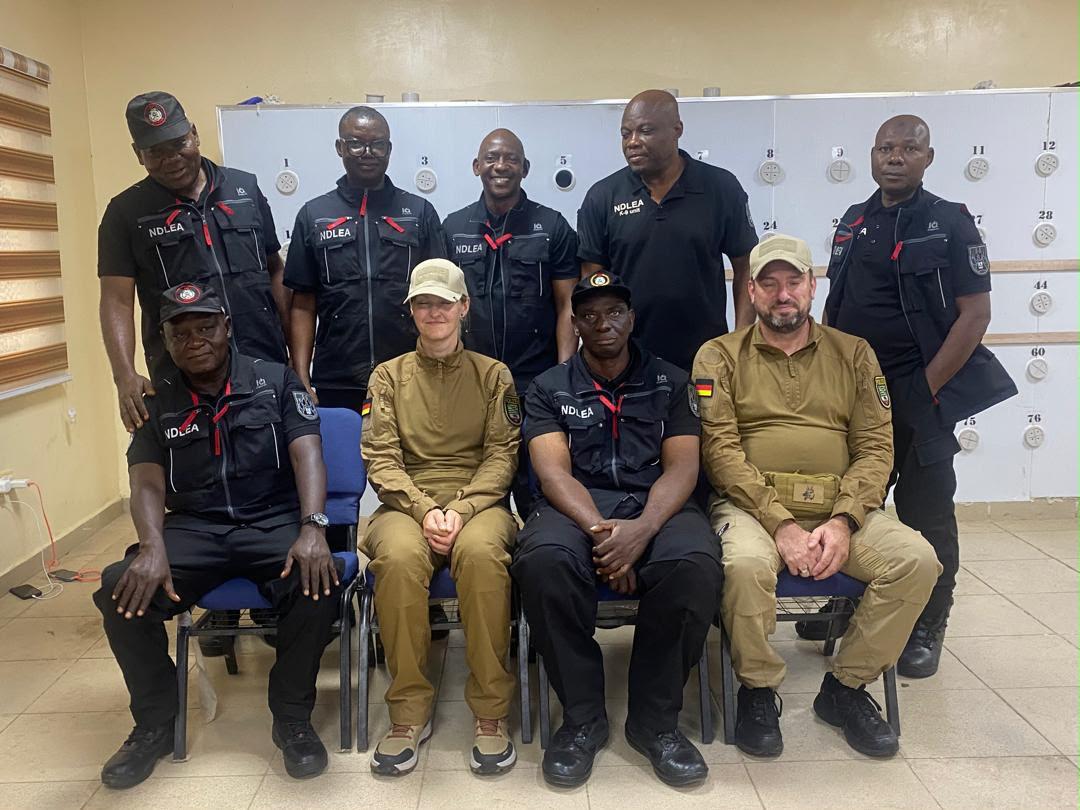
NDLEA Dogs Get German Upgrade for Drug Detection Operations
By: Michael Mike
The National Drug Law Enforcement Agency (NDLEA) has intensified efforts to strengthen its ability to detect concealed narcotics at Nigeria’s entry points, putting its canine handlers through specialised retraining by German technical experts.
The refresher course, organised in collaboration with Germany’s Bundeskriminalamt (BKA), focused on improving the ability of NDLEA handlers and their service dogs to detect narcotics and respond effectively to increasingly sophisticated methods employed by drug traffickers.
The training was conducted at the NDLEA Canine Unit Facility in Lagos by two German technical dog-handling experts, Andreas Roscher and Jacqueline Shüler.
According to a press statement by the spokesman of the anti-narcotics agency, Femi Babafemi, 11 personnel from the Canine Unit, comprising the unit commander, two veterinary doctors and eight dog handlers, participated in the exercise alongside their service dogs. Five additional NDLEA officers from commands in Lagos who had expressed interest in joining the Canine Unit also participated.
He noted that rather than being limited to classroom instruction, the exercise included practical simulations at some of the country’s busiest aviation and maritime facilities, including the Murtala Muhammed International Airport (MMIA) baggage hall, APM Terminals Apapa and the MMIA NAHCO export shed.
The participants were trained in advanced obedience and control, narcotics detection, scent imprinting and search patterns, as well as the safe deployment of canine assets during high-risk operations.
The exercise is significant to the agency’s interdiction efforts as traffickers increasingly resort to sophisticated concealment methods to move illicit drugs through airports, seaports and land borders.
Chairman/Chief Executive Officer of the NDLEA, Brig. Gen. Buba Marwa (rtd.), said the training underscored the agency’s determination to maintain a highly skilled workforce capable of responding to evolving drug-trafficking techniques.
“Our canine teams remain one of the most potent assets in our detection and interdiction efforts, and this is why we will continue to invest in their retraining and welfare,” Marwa said.
He noted that the agency’s interceptions of concealed narcotics at airports, seaports and border posts had benefited significantly from the capabilities of its sniffer dogs and handlers.
“The successes we have recorded at our airports, seaports and border points in intercepting concealed narcotics are in no small measure due to the dedication and sharpened instincts of our dogs and their handlers,” he said.
According to him, the collaboration with the German authorities would further strengthen the agency’s operational capacity while bringing its canine operations closer to international standards.
The NDLEA chief, however, acknowledged manpower and logistical gaps confronting the Canine Unit, particularly the need for additional service dogs, trained personnel and boarding facilities.
He said the agency needed to expand the unit’s capacity to provide adequate canine coverage across Nigeria’s seaports, international airports and land borders.
Marwa disclosed that steps were being taken to address the identified gaps, while supporting the recommendation that the specialised refresher training should become an annual exercise.
The training therefore goes beyond improving the skills of existing handlers, with the participation of prospective recruits indicating an effort by the agency to expand the pool of personnel capable of working with its narcotics detection dogs.
The NDLEA’s Canine Unit has become an important component of the agency’s interdiction operations, particularly in environments where traffickers attempt to conceal narcotics in baggage, cargo and other consignments.
With the latest training, the agency is seeking to strengthen both the technical skills of its handlers and the reliability of its canine teams as they operate across the country’s major gateways for international and domestic movement.
NDLEA Dogs Get German Upgrade for Drug Detection Operations

IGP Disu meets Niger governor over deaths of 37 suspected illegal miners
By: Our Reporter
The Inspector-General of Police, IGP Olatunji Rilwan Disu, psc (+), NPM, has arrived at the Niger State Government House in Minna over the deaths of 37 suspected illegal miners who reportedly died while in the custody of the Nigeria Security and Civil Defence Corps (NSCDC).
The IGP was received by Niger State Governor, Mohammed Umaru Bago, during the visit, where he commiserated with the state government and the families affected by the incident.
Disu assured the governor of a thorough, transparent and comprehensive investigation to establish the circumstances surrounding the deaths and determine what led to the loss of lives while the suspects were in government custody.
The visit comes amid growing concern over the incident, with President Bola Tinubu ordering a full and transparent investigation and warning that the Federal Government would not tolerate deaths resulting from official negligence, abuse, inhumane treatment or dereliction of duty.
The Niger State Government has also constituted a Committee of Inquiry, while the NSCDC Commandant General has suspended the Niger State Commandant, Suberu Siyaka Aniviye, and members of his team pending investigations.
IGP Disu meets Niger governor over deaths of 37 suspected illegal miners

The Persistent Political Scar on Nigeria: Fulani Ethnic Groups as the New Target of Demonization
NiDCOM Audit: NIDO Demands Answers, Board Constitution Over 13 Queries

NDLEA Dogs Get German Upgrade for Drug Detection Operations

Roger Federer’s Shock as DNA Results Reveal Myla and Charlene Are Not His Biological Children

THE PLIGHT OF FARIDA

FAILED COUP IN BURKINA FASO: HOW TRAORÉ NARROWLY ESCAPED ASSASSINATION PLOT AMID FOREIGN INTERFERENCE CLAIMS
-
 News3 years ago
Roger Federer’s Shock as DNA Results Reveal Myla and Charlene Are Not His Biological Children
-
Opinions5 years ago
THE PLIGHT OF FARIDA
-
 News1 year ago
FAILED COUP IN BURKINA FASO: HOW TRAORÉ NARROWLY ESCAPED ASSASSINATION PLOT AMID FOREIGN INTERFERENCE CLAIMS
-

 News3 years ago
EYN: Rev. Billi, Distortion of History, and The Living Tamarind Tree
-
 Opinions5 years ago
POLICE CHARGE ROOMS, A MINTING PRESS
-

 ACADEMICS3 years ago
A History of Biu” (2015) and The Lingering Bura-Pabir Question (1)
-

 Columns3 years ago
Army University Biu: There is certain interest, but certainly not from Borno.
-

 Politics1 year ago
2027: Why Hon. Midala Balami Must Go, as Youths in Hawul and Asikira/Uba Federal Constituency Reject ₦500,000 as Sallah Gift
