
Uncategorized
Days of Truancy Are Over, Chairman EHCON Board Tells Staff

Days of Truancy Are Over, Chairman EHCON Board Tells Staff
By: Michael Mike
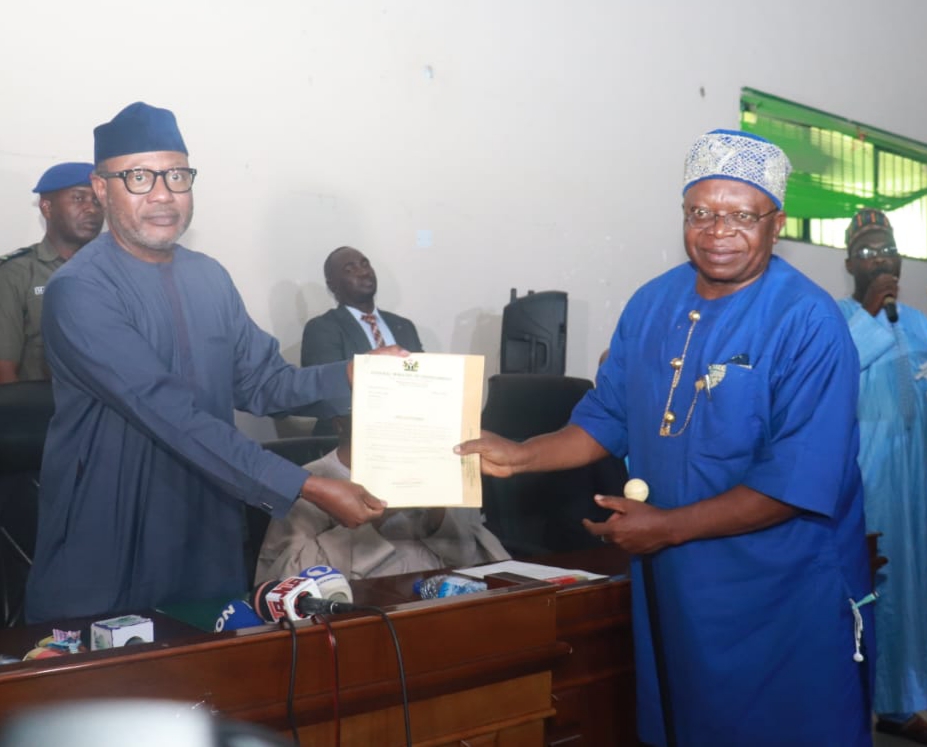
The newly inaugurated Environmental Health Council’s (EHCON) Chairman Honorable Tonye Longjohn has advised the management and staff of the Council to be more dedicated to their duty, insisting that the days of truancy by staff are over.
Longjohn made this assertion in his first address with the top management and staff of the Council after the inauguration of the board of agencies under the Ministry of Environment by the Minister, Mohammed Abdullahi. Also in attendance were the other members of the Board at the Council’s office in Abuja.
According to the Chairman, “Mr. President would not be happy with us if he finds out that we are defaulting on discharging our duties, that would not be nice,” adding that “there would not be room for truancy, please , if you have subordinates that are truants, please tell them that the days of truancy are gone.”
The EHCON Chairman, however assured the staff that they were not there to disturb anyone from carrying out his/her work because, they are all brothers and sisters. He informed the staff that whatever benefit is due to them, shall be made available to them as at when due, either promotion or welfare.
On his part, the Registrar EHCON, Dr. Yakubu Mohammed Baba who was represented by his Senior Technical Adviser (STA) and a Director, Registration, Ethics and Standard in the agency Dr. Isah Adamu praised President Muhammadu Buhari for appointing a board for the Council after many years, he however, went back to memory lane on numerous achievements the Council had recorded since the appointment of the Registrar, Dr. Yakubu Mohammed Baba two years ago.
Speaking further, Adamu said that the Council was established in 2002 by an Act of Parliament and was known and called Environmental Health Officers Registration Council of Nigeria (EHORECON) but now that the Act has been amended by Mr. President, the Council is now known and addressed as the Environmental Health Council of Nigeria (EHCON).
He explained that the practice of EHCON is segmented into two, one is for individual practitioners and the other is the companies’ service providers, adding that, the sanitary inspection of Premises, Cleaning Services, Public health officers and sewage collection, the Council ensures Registration and Regulations are done in administrative way at the headquarters.
Adamu however, on behalf of the Council promised the Chairman and other members of the Board that the Council is ready to give full support and maximum cooperation to the Board in order to discharge their duties creditably.
Days of Truancy Are Over, Chairman EHCON Board Tells Staff



Nigeria Moves to Strengthen Climate Accountability with New Transparency Committee
By: Michael Mike
The Federal Government has inaugurated a Project Steering Committee (PSC) to drive the implementation of the Global Environment Facility-backed Capacity Building Initiative for Transparency (CBIT), in a move aimed at improving Nigeria’s climate data systems and environmental accountability.
The initiative, coordinated by the Federal Ministry of Environment, is designed to enhance the country’s ability to track, report and verify climate actions, particularly in line with its obligations under the Paris Agreement.
Speaking during the inauguration in Abuja, the Director of Forestry at the ministry, Halima Bawa-Bwari, described the committee as a strategic mechanism to strengthen coordination and oversight of the project. Represented by Deputy Director Aiwuyo Christopher, she noted that the PSC would provide policy direction, ensure institutional alignment and address implementation challenges.
According to her, the CBIT programme—established under the Global Environment Facility following decisions reached at COP21 in Paris—supports countries in meeting enhanced transparency requirements under the Paris Agreement.
For Nigeria, she said, the project is critical to improving the generation, management and reporting of greenhouse gas emissions data across major sectors of the economy.
She explained that the initiative would reinforce institutional frameworks for data management, build technical capacity among stakeholders and support the development of a digital platform to promote transparent and accessible climate data.
Bawa-Bwari stressed that the success of the project would significantly improve Nigeria’s ability to meet its international reporting obligations with greater accuracy, consistency and credibility.
She also underscored the importance of collaboration, noting that effective implementation would depend on strong cooperation across sectors such as Agriculture, Forestry and Other Land Use (AFOLU), Energy, Transport, Industrial Processes and Product Use (IPPU), and Waste.
“The role of the committee is central to ensuring that the project achieves its objectives and contributes meaningfully to Nigeria’s climate commitments,” she said, urging members to demonstrate commitment and provide strategic leadership.
Also speaking, the Director of Planning, Research and Statistics at the ministry and GEF Operational Focal Point for Nigeria, Babagana Bukar, said the committee would play a key role in guiding implementation, resolving bottlenecks and aligning the project with national priorities, including the Energy Transition Plan and Nigeria’s Nationally Determined Contributions (NDCs).
He emphasised that transparency remains fundamental to credible climate action, describing it as the backbone of effective environmental governance rather than a mere procedural requirement.
In his remarks, the representative of the Food and Agriculture Organisation (FAO) in Nigeria and ECOWAS, Hussein Gadain—represented by Adesoji Adeyemi—reaffirmed the organisation’s commitment to supporting countries in meeting transparency requirements through improved data systems and stronger partnerships.
He noted that the CBIT initiative is specifically designed to help countries enhance their capacity to monitor emissions and track climate actions across key sectors.
Similarly, the Director-General of the Nigeria Conservation Foundation (NCF), Joseph Onoja, highlighted the importance of collaboration in achieving sustainable outcomes. He said the partnership reflects a shared commitment among stakeholders to ensure effective implementation and measurable impact.
Onoja stressed the need for coordinated efforts to avoid duplication and promote synergy, noting that unified approaches would deliver more sustainable and impactful results.
Also contributing, a representative of the National Council on Climate Change (NCCC), Ann Umas, said the initiative is aimed at building a strong, data-driven foundation for climate governance, enabling informed decision-making and long-term sustainability.
The inauguration event was organised by the Department of Forestry of the Federal Ministry of Environment in collaboration with FAO and the Nigeria Conservation Foundation.
With the establishment of the steering committee, Nigeria is taking a significant step toward strengthening its climate transparency framework, improving data integrity and positioning itself for greater credibility in the global climate space.
Nigeria Moves to Strengthen Climate Accountability with New Transparency Committee
Uncategorized
Nigeria Moves to Transform Career Guidance System as Ministries, UNESCO, GIZ Push New National Policy Framework
Nigeria Moves to Transform Career Guidance System as Ministries, UNESCO, GIZ Push New National Policy Framework
By: Michael Mike
Nigeria has taken a decisive step toward overhauling its career guidance and counselling system with the launch of a high-level policy dialogue aimed at developing a National Career Guidance and Counselling (CGC) Policy Framework.
The initiative, convened at the United Nations House in Abuja, brought together key stakeholders from the Federal Ministry of Education, Federal Ministry of Labour and Employment, Federal Ministry of Youth Development, United Nations Educational, Scientific and Cultural Organisation (UNESCO), Deutsche Gesellschaft für Internationale Zusammenarbeit (GIZ), and other development and technical partners.
Speaking at the opening session, the Permanent Secretary, Federal Ministry of Education, Mr. Abel Enitan, described the workshop as a milestone in ongoing education reform efforts, emphasizing that career guidance must be repositioned as a strategic pillar rather than a peripheral service in Nigeria’s education system.
He noted that the changing global economy—driven by automation, digital transformation, and industrial shifts—demands that students are equipped not only with academic knowledge but with structured guidance that connects learning to real labour market opportunities.
According to him, the proposed framework will help align individual aspirations with national economic needs, particularly in priority sectors such as agriculture value chains, construction, and digital skills.
“Counselling in our institutions has been treated as a secondary service rather than a strategic necessity,” he said. “In today’s world, students need more than a syllabus; they need a compass.”
He further stressed that institutionalizing a national policy would ensure integration of labour market intelligence into school counselling systems, elevate Technical and Vocational Education and Training (TVET) as a first-choice pathway, and improve employment outcomes as a measurable result of education investments.
Also speaking, the Acting Head of Education Sector at UNESCO Abuja, Mr. Oladeji Adeyemi, reaffirmed that career guidance and counselling is the critical bridge between education and employment, warning that even strong education systems cannot achieve their full impact without a coordinated CGC structure.
He explained that the new framework is designed to move Nigeria from fragmented interventions to a fully integrated system that connects education, labour, and youth development sectors.
“Career Guidance and Counselling is not an add-on — it is the bridge that connects learning to livelihoods,” he said.
Adeyemi emphasized the need for stronger institutional collaboration and shared ownership, noting that no single institution can effectively deliver career guidance in isolation. He called for a system where roles are clearly defined and stakeholders are fully accountable for implementation.
He also stressed the importance of alignment among stakeholders, describing the workshop as a platform to harmonize perspectives, validate earlier technical work, and agree on a coherent implementation pathway for the policy.
Over the next two days, participants are expected to engage in technical discussions, review international best practices, and jointly define the structure and pillars of the proposed national framework.
Both speakers underscored the urgency of moving from a system of “career by chance” to one of “career by choice,” where young Nigerians are equipped with structured pathways to education, skills development, and sustainable employment.
Development partners, including UNESCO under its Better Education for Africa’s Rise (BEAR III) initiative and GIZ, reaffirmed their continued support for Nigeria’s education and skills reform agenda.
The workshop is expected to produce a consolidated draft framework that will guide the future of career guidance and counselling in Nigeria’s education and labour systems.
Nigeria Moves to Transform Career Guidance System as Ministries, UNESCO, GIZ Push New National Policy Framework
Uncategorized
Air Strikes Eliminate ISWAP Shura Council Members, Foreign fighter wounded in Major Blow to Insurgent Leadership

Air Strikes Eliminate ISWAP Shura Council Members, Foreign fighter wounded in Major Blow to Insurgent Leadership
By Zagazola Makama
Recent air strikes by security forces in Borno State have eliminated key members of an insurgent Shura council, in what sources describe as a significant blow to the group’s leadership structure.
Security sources said the strikes, carried out about three to four days ago at a location west of Dogon Chukun, targeted a of senior insurgent figures.
The sources disclosed that three Shura council members were among those neutralised, alongside two senior field commanders known as “Munzirs” and several fighters believed to be serving as bodyguards.
According to the sources, the operation has disrupted the command hierarchy of the group, as the Shura council plays a central role in strategic decision-making and operational coordination.
According to the sources, another top figure identified as Yaa Bashir, also a senior member of the Shura council, sustained a serious thigh fracture in the strikes.
They further revealed that a foreign fighter identified as Abu Khalid, believed to be an Arab national, also suffered severe injuries during the same operation.
The sources added that efforts are ongoing to ascertain the identities of others affected while assessment of the full impact of the strikes continues.
They noted that the operation forms part of sustained efforts by Operation Hadin Kai to degrade insurgent leadership and disrupt their operational capabilities in the North-East.
Air Strikes Eliminate ISWAP Shura Council Members, Foreign fighter wounded in Major Blow to Insurgent Leadership

APC Backs Tegbe for Power Reforms, Cites Proven Expertise, Strategic Leadership

Nigeria Convenes African Leaders on Climate-Conflict Nexus, Pushes Peace-Centred Adaptation Strategy

Nigeria, Ghana Close Ranks Against Drug Cartels, Sign Landmark Anti-Trafficking Pact

Roger Federer’s Shock as DNA Results Reveal Myla and Charlene Are Not His Biological Children

THE PLIGHT OF FARIDA

FAILED COUP IN BURKINA FASO: HOW TRAORÉ NARROWLY ESCAPED ASSASSINATION PLOT AMID FOREIGN INTERFERENCE CLAIMS
-
 News2 years ago
Roger Federer’s Shock as DNA Results Reveal Myla and Charlene Are Not His Biological Children
-
Opinions4 years ago
THE PLIGHT OF FARIDA
-
 News1 year ago
FAILED COUP IN BURKINA FASO: HOW TRAORÉ NARROWLY ESCAPED ASSASSINATION PLOT AMID FOREIGN INTERFERENCE CLAIMS
-

 News2 years ago
EYN: Rev. Billi, Distortion of History, and The Living Tamarind Tree
-
 Opinions4 years ago
POLICE CHARGE ROOMS, A MINTING PRESS
-

 ACADEMICS2 years ago
A History of Biu” (2015) and The Lingering Bura-Pabir Question (1)
-

 Columns2 years ago
Army University Biu: There is certain interest, but certainly not from Borno.
-

 Opinions2 years ago
Tinubu,Shettima: The epidemic of economic, insecurity in Nigeria
