
News
ECOWAS parliamentarian calls for direct election of members

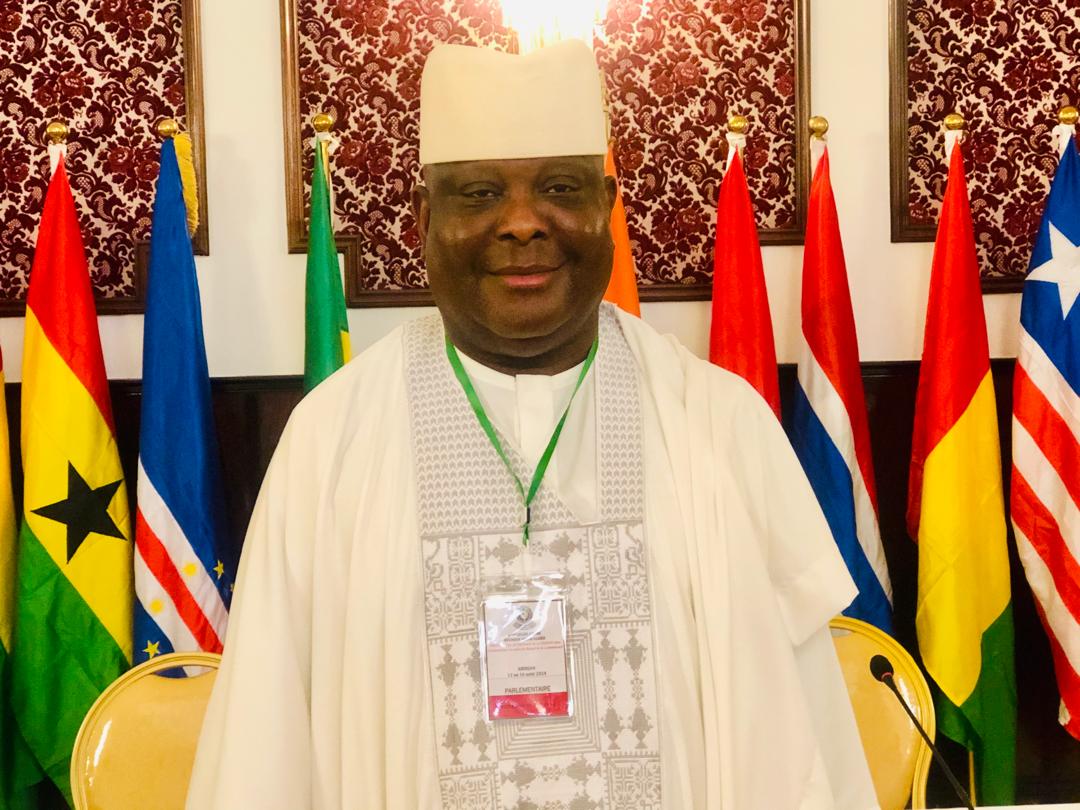
ECOWAS parliamentarian calls for direct election of members
By: Michael Mike
A member of the 6th ECOWAS Parliament, Sen. Osita Izunaso has called for election of members directly by their constituents into the regional legislative body, rather than through nomination by their countries as it is today.
Izunaso, the First Rapporteur of the parliament’s Joint Committee on Public Accounts, made the call in an interview with journalists in Abidjan on Tuesday.
Izunaso (APC-Imo West) is a fourth-term senator, and longest serving lawmaker from the South-East and South-South geopolitical zones in the Nigerian senate.
Speaking on the sidelines of the parliament’s joint committee on administration, budget, finance, public account, macroeconomic policy, and economic research meeting, he suggested the amendment of the Supplementary Act for that purpose.
“The direct election of members to the ECOWAS Parliament is long overdue.
“We must borrow a leaf from the European Parliament, where members are elected directly by their constituents.
“I think we have to work out a framework for the direct election of members to the ECOWAS Parliament.
“That will go a long way in solving most of the problems of the parliament, and I strongly believe in it.
“I spoke about it when I was making my contributions and I believe that is the best way to go.
“The modalities have to be worked out, and it is one of the issues we are going to agree on in this conference.
“The committee that is in charge will be given that responsibility to work out a framework on how to hold direct elections to ECOWAS Parliament.
“When that happens, I’m sure more powers will be given to the Parliament,” he said.
Izunaso noted that through direct elections, the people’s representatives to the parliament will be elected directly, whether they have been parliamentarians or not.
According to him, it has to be open for people who want to contest to do so because it is not only parliamentarians who have repository of knowledge.
The lawmaker said there were non-parliamentarians that are more knowledge, who might even make better contributions if they were elected into the Parliament.
“The benefit of electing ECOWAS parliamentarians directly is that it will give them more authority, they’ll have more powers, they’ll have more checks and balances.
“This is as enshrined in the principles of Separation of Powers, because when you hold direct elections, you give more powers to the legislature.
“So, it will be more beneficial to the ECOWAS sub-region than it is today,” the senator said.
Izunaso also called for the amendment of the Supplementary Act to give total legislative authority to the ECOWAS Parliament, stressing that there were a lot of gaps that needed to be closed.
He observed that a situation where the ECOWAS Parliament does not have legislative powers with regards to budgeting, it would not augur well for the community.
“So, we are proposing that the Supplementary Act be amended to give more powers to the ECOWAS Parliament, in terms of budgeting and also auditing.
“This is because if you have a parliament that does not exercise legislative duties, then there’s a gap, something is missing somewhere,” he said.
The parliamentarian also proposed that the amendments should include mandating that some key appointments in the ECOWAS parliament be subjected to parliamentary confirmation.
He suggested that the appointment of the President of the ECOWAS Commission, the commissioners, and other top management staff should be subjected to parliamentary confirmation.
On the threat of Mali, Burkina Faso, and Niger to exit ECOWAS, the lawmaker said their exit would bring about the dual challenges of funding and exclusion.
“So, it’s not only about the need for more funding, but it’s more of inclusivity; If we say we are ECOWAS, every part of ECOWAS should be together.
“We’re not happy that any one of our member countries would want to pull out, because the more we are, the merrier, so we want them back.
“But I believe that the Authority of ECOWAS Heads of Government are working towards resolving the issues,” Izunaso added.
ECOWAS parliamentarian calls for direct election of members


News
CCS Supports Objective Security Reporting, Rejects Ethnic Double Standards in Addressing Criminality
PRESS STATEMENT
CCS Supports Objective Security Reporting, Rejects Ethnic Double Standards in Addressing Criminality
July 8, 2026
The Centre for Contemporary Studies (CCS), Abuja, expresses its support for the position articulated by security analyst and conflict reporter Zagazola Makama on the imperative of objective, fact-based reporting of criminal activities, irrespective of the ethnic, religious, or political identity of those involved.
CCS believes that the fight against insecurity in Nigeria can only succeed when the same standards of accountability are applied to all offenders without exception. Criminality does not become acceptable because it is committed by a member of one’s ethnic group, nor does violence become justifiable because it is wrapped in the language of communal defence.
The controversy generated by the identification of a suspected attacker involved in the attempted assault on the National Institute for Policy and Strategic Studies (NIPSS), Kuru, highlights a deeper national challenge: the tendency of some individuals and groups to support transparency only when it exposes those they consider opponents, while resisting the same transparency when facts implicate members of their own communities.
CCS maintains that objective reporting is not ethnic profiling. Where credible facts establish the identity, affiliation, or operational background of criminal actors, journalists and security analysts should not be intimidated into suppressing such information merely because it is politically inconvenient or socially uncomfortable. Selective outrage and selective accountability only deepen mistrust and prolong conflict.
For years, Nigerians have demanded that security reports accurately identify perpetrators of violence. That demand must remain consistent. Whether the perpetrators are Fulani bandits, Berom militias, Irigwe militias, Mwaghavul militias, or any other armed criminal group, the truth must be reported and the law must take its course.
The Centre also commends the professionalism and courage of security personnel who successfully repelled the attempted attack on NIPSS and continue to defend strategic national institutions under difficult circumstances. Their sacrifices deserve public recognition and support.
CCS wishes to emphasize that no community in Nigeria possesses a monopoly on either victimhood or criminality. Across the country, millions of law-abiding citizens from every ethnic and religious background desire peace, security, and justice. Equally, criminal elements exist across communities and must be confronted without bias or sentiment.
Nigeria cannot defeat insecurity if citizens judge crimes based on the identity of the perpetrator rather than the nature of the offence. A criminal remains a criminal regardless of ethnicity. An armed attacker remains an armed attacker regardless of religion. A murderer does not become a hero because he belongs to a particular community.
The Centre therefore calls on the media, civil society organisations, community leaders, and the general public to uphold a single standard of justice and accountability. The protection of criminals through ethnic, religious, or political narratives undermines national security and weakens efforts to build lasting peace.
CCS stands firmly for truth, accountability, and equal justice under the law. We support all responsible efforts to expose criminality wherever it exists and reject every attempt to shield offenders from scrutiny because of their identity.
There must be no sacred cows in the fight against insecurity. There must be no shielding of criminals. Justice must remain blind to ethnicity, religion, and politics.
Yusuf Musa
Chief Executive Officer (CEO)
Centre for Contemporary Studies (CCS), Abuja &
Capt. Kabir Aminu (Rtd.)
Director, Security and Strategic Studies
Centre for Contemporary Studies (CCS), Abuja
CCS Supports Objective Security Reporting, Rejects Ethnic Double Standards in Addressing Criminality
The Kano Model Comes of Age: Faith Leaders Become Africa’s Firewall Against Disinformation
By Senator Iroegbu
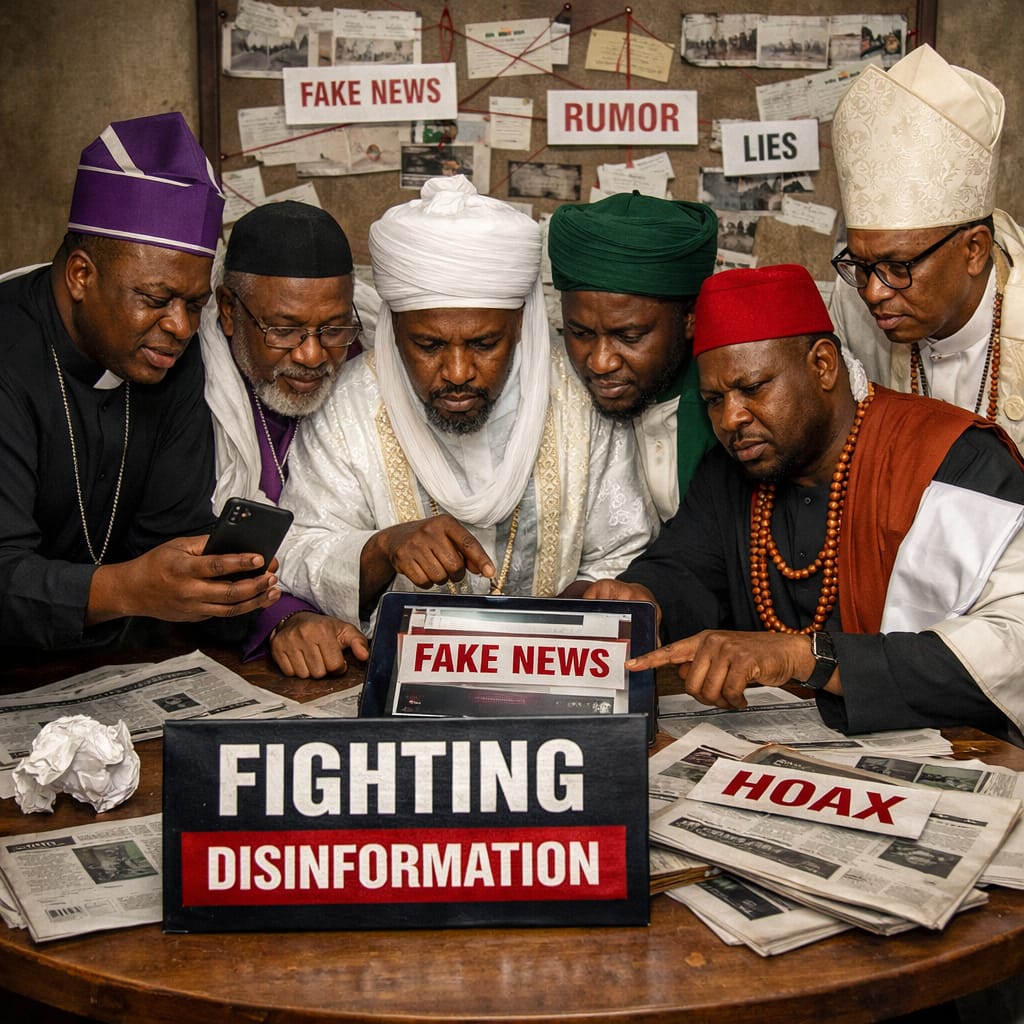
Months ago, these pages made an argument that ran counter to conventional wisdom. Nigeria’s most effective answer to disinformation may not be found inside government ministries or technology companies, but in an unlikely place: the mosque, the church and the traditional palace. That idea was named the Kano Model, a simple but powerful proposition that places religious and traditional leaders at the centre of the fight to build public resilience against misinformation, disinformation and information manipulation.
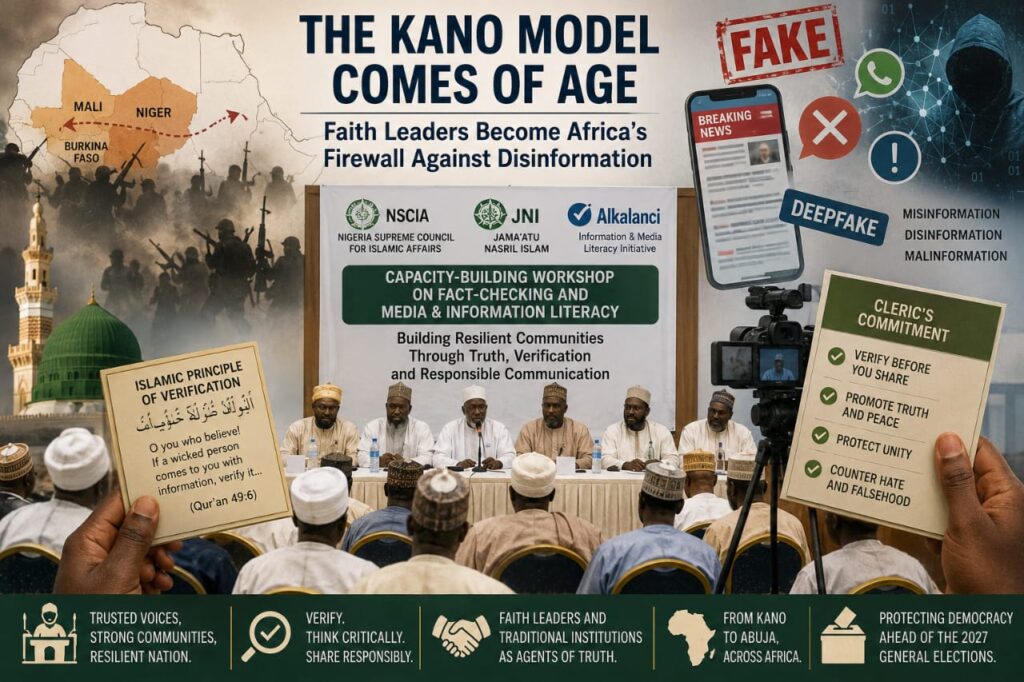
Today, that idea has taken a decisive step forward. In Abuja, between 24 and 25 June 2026, Alkalanci, the Hausa language verification platform, convened the largest edition yet of its fact-checking and media literacy training. Supported by the MacArthur Foundation and in collaboration with the Centre for Democracy and Development, the workshop gathered Islamic clerics and scholars from across Northern Nigeria under a single roof for the first time. It followed earlier sessions in Kano, Sokoto, Gombe, Kaduna and Maradi in neighbouring Niger Republic. More than 120 clerics and teachers have now passed through the programme, across six cities and two countries. What began as a modest experiment in one emirate has matured into a movement.
The timing could hardly be more consequential. Nigeria is moving steadily towards the 2027 general elections, a season when domestic misinformation predictably surges. Across the Sahel, military governments battle violent extremism while geopolitical rivalries intensify and foreign powers compete for influence through information operations as much as through diplomacy or arms. Artificial intelligence now allows fabricated videos, cloned voices and manipulated images to circulate at alarming speed. This is no longer merely a media challenge. It is a national security challenge.
The significance of Abuja lies not only in scale but in institutional weight. The two most authoritative bodies in Nigerian Islam lent their voices to the cause. The Nigerian Supreme Council for Islamic Affairs (NSCIA), led by the Sultan of Sokoto, and Jama’atu Nasril Islam (JNI) both charged clerics with becoming guardians of truth. Speaking through its Secretary-General, Professor Is-haq Oloyede, the NSCIA grounded the appeal in scripture, recalling that Surah Al-Hujurat instructs believers to verify information before acting upon it. Verification, the Council argued, is not an import but a divine injunction.
That moral framing changes the conversation entirely. For decades, governments have tried to combat disinformation through regulation, censorship and technology. Each has a role, yet none reaches the deeper question of trust. People do not always believe institutions. They believe people they know. Across Northern Nigeria and much of Africa, few voices command greater trust than religious leaders and traditional rulers. Every Friday, every Sunday, and at countless community gatherings, millions receive guidance from imams, pastors, scholars, and emirs. When those trusted voices urge citizens to pause before forwarding a message, verify a viral clip or question an inflammatory rumour, they build a social firewall no algorithm can match.
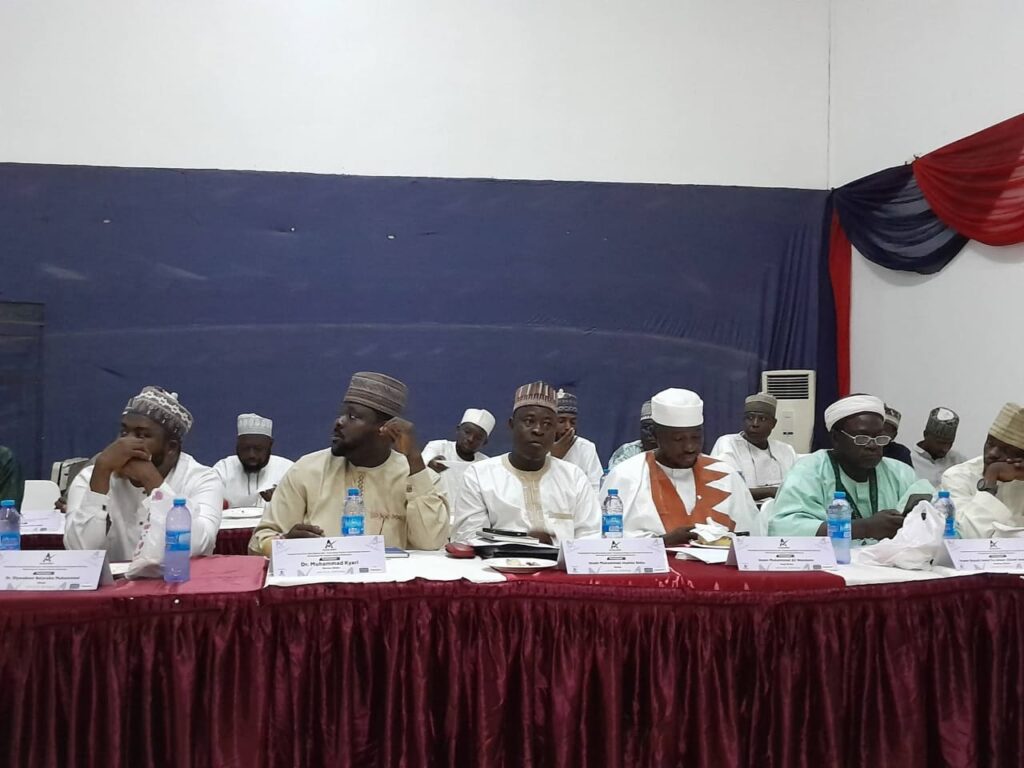
This is precisely where traditional institutions become decisive. The programme has drawn consistent endorsement from the emirates. The Emir of Kano was represented at the pioneering session, the Sultan of Sokoto at another, the Emirate of Gombe at a third. When a Sarkin Alkali speaks for the Sultan, or a royal envoy addresses assembled imams, the message carries an authority no government circular can rival. As the Emir of Gombe’s representative reminded an earlier gathering, truthfulness is not merely an ethical duty. It is an act of faith.
The threats, meanwhile, are evolving. Alkalanci’s Editor, Alhassan Bala, warned that the coming election season will bring a surge of misinformation from domestic actors, alongside foreign information manipulation and interference. Deepfakes, the synthetic speeches, videos and audio, are now cheap enough to flood any campaign, adding a dangerous new layer. The JNI’s Secretary-General, Professor Khalid Abubakar Aliyu, went further still, urging clerics to remain resolutely apolitical, to verify before they speak, and cautioning politicians against enticing religious leaders into partisan corners. In a country where a single doctored clip can inflame a community overnight, a clergy trained to pause and verify is a national security asset.
The Sahel makes the stakes plainer. In Mali, Burkina Faso and Niger, disinformation has become an instrument of war, deployed to justify coups, discredit democratic institutions and turn populations against their neighbours and regional bodies. Much of it is amplified by networks tied to external powers seeking leverage on African soil. That the Alkalanci training has already crossed into Maradi is therefore no small detail. It carries the model into the very theatre where information warfare is fiercest, and through the one channel foreign propagandists struggle to capture: the trusted local voice speaking a local language.
Equally telling is what this reveals about civil society. The programme is not a state project. It is a local organisation building long-term societal resilience, empowering trusted leaders to become educators, validators and defenders of truth. Every such effort is, in plain terms, an investment in peace.
The lesson from Kano and now Abuja is remarkably simple. The fight against disinformation cannot be won by governments alone, nor outsourced entirely to journalists, fact-checkers or technology companies. It must become a societal responsibility, one that reaches beyond the North and beyond a single faith, drawing in Christian clergy, women and youth networks and traditional rulers nationwide.
At a time when falsehood travels faster than truth, Africa’s greatest advantage may not lie in more sophisticated technology, but in its enduring institutions of faith and tradition. The warriors for truth are multiplying. The task before Nigeria, the Sahel and Africa is to keep their ranks growing.
Senator Iroegbu is a security, geopolitics and development analyst. Email: senator.iroegbu@yahoo.co.uk
The Kano Model Comes of Age: Faith Leaders Become Africa’s Firewall Against Disinformation
Military
Residents Cheer Troops as Operation FANSAN YAMMA Returns with Captured Terrorists’ Logistics in Zamfara
Residents Cheer Troops as Operation FANSAN YAMMA Returns with Captured Terrorists’ Logistics in Zamfara
By Zagazola Makama
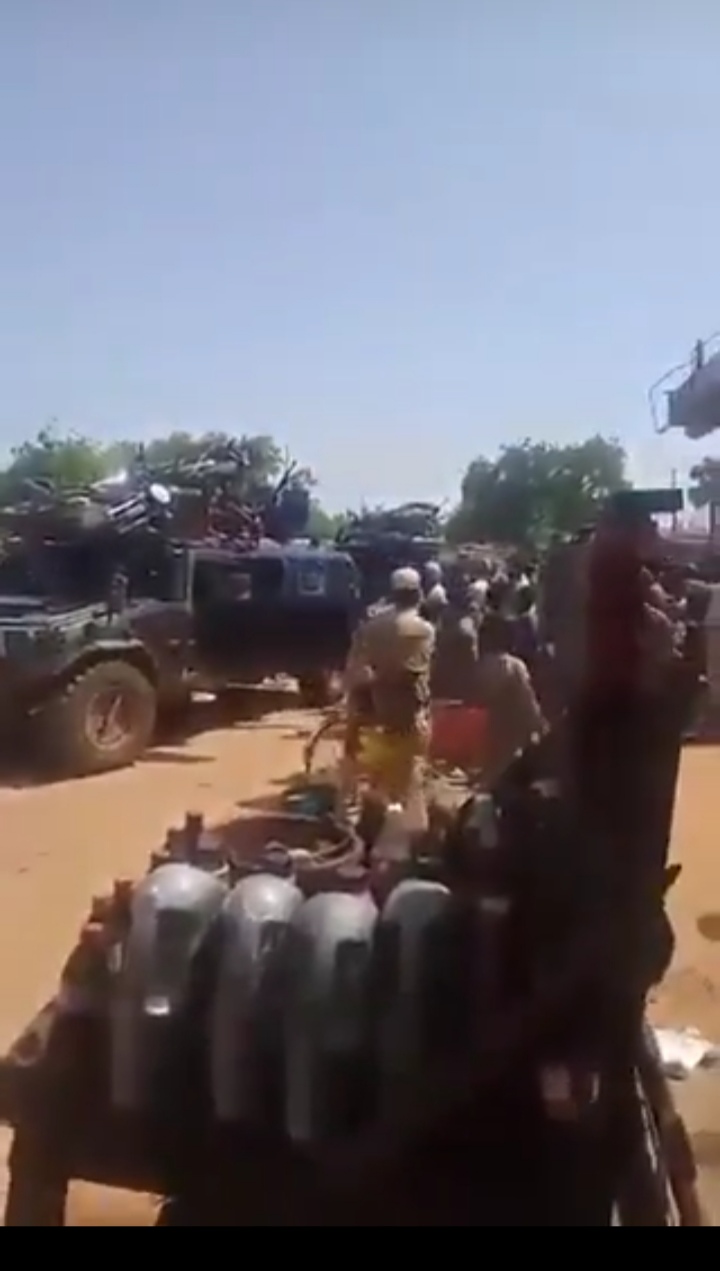
Residents of Gummi town in Zamfara State on Thursday poured into the streets to celebrate troops of the Joint Task Force North West, Operation FANSAN YAMMA, following a major operational success against terrorists in the area.
Eyewitnesses said the jubilant crowd gathered as soldiers arrived in town with logistics recovered from terrorists after a successful counter-ambush operation that reportedly left more than 100 terrorists neutralised.
The recovered items, including eight motorcycles used by the armed groups for movement during attacks on communities, were transported on an Armoured Personnel Carrier (APC) to the Headquarters of Operation FANSAN YAMMA in Gummi.
Residents were seen cheering, waving at the troops and applauding their efforts as the convoy entered the military base, with many expressing appreciation for the soldiers’ courage and sacrifices in the ongoing fight against banditry in the North West.
Security sources told Zagazola Makama that the successful operation dealt a significant blow to the criminal networks operating in the area, disrupting their mobility and logistical capabilities.
The spontaneous celebration by residents is seen as a reflection of growing public confidence in the military’s sustained offensive against terrorists and bandits across Zamfara and neighbouring states.
Military authorities reaffirmed that Operation FANSAN YAMMA remains committed to sustaining offensive operations aimed at dismantling terrorist enclaves, denying criminal elements freedom of movement, and restoring lasting peace across the North West.
The Joint Task Force also acknowledged the continued support and actionable intelligence provided by residents, describing community cooperation as critical to the success of ongoing operations.
Residents Cheer Troops as Operation FANSAN YAMMA Returns with Captured Terrorists’ Logistics in Zamfara

CCS Supports Objective Security Reporting, Rejects Ethnic Double Standards in Addressing Criminality

The Kano Model Comes of Age: Faith Leaders Become Africa’s Firewall Against Disinformation

Residents Cheer Troops as Operation FANSAN YAMMA Returns with Captured Terrorists’ Logistics in Zamfara

Roger Federer’s Shock as DNA Results Reveal Myla and Charlene Are Not His Biological Children

THE PLIGHT OF FARIDA

FAILED COUP IN BURKINA FASO: HOW TRAORÉ NARROWLY ESCAPED ASSASSINATION PLOT AMID FOREIGN INTERFERENCE CLAIMS
-
 News2 years ago
Roger Federer’s Shock as DNA Results Reveal Myla and Charlene Are Not His Biological Children
-
Opinions4 years ago
THE PLIGHT OF FARIDA
-
 News1 year ago
FAILED COUP IN BURKINA FASO: HOW TRAORÉ NARROWLY ESCAPED ASSASSINATION PLOT AMID FOREIGN INTERFERENCE CLAIMS
-

 News2 years ago
EYN: Rev. Billi, Distortion of History, and The Living Tamarind Tree
-
 Opinions5 years ago
POLICE CHARGE ROOMS, A MINTING PRESS
-

 ACADEMICS2 years ago
A History of Biu” (2015) and The Lingering Bura-Pabir Question (1)
-

 Columns2 years ago
Army University Biu: There is certain interest, but certainly not from Borno.
-

 Politics1 year ago
2027: Why Hon. Midala Balami Must Go, as Youths in Hawul and Asikira/Uba Federal Constituency Reject ₦500,000 as Sallah Gift
