
News
ECOWAS Takes Steps to Remove Bottlenecks in Palm Oil Industry in West Afric


ECOWAS Takes Steps to Remove Bottlenecks in Palm Oil Industry in West Africa
By: Michael Mike
Economic Community of West African States (ECOWAS) has taken a step to boost the production of palm oil and its sales in the subregion with a convocation of the meeting of stakeholders to evolve strategies to end the bottlenecks of the industry.
Speaking at the Meeting of the Free Movement of Palm Oil under the ECOWAS Preferential Tariff Regime (ECOWAS Trade Liberalization Scheme, ETLS) in Abuja, the ECOWAS Commission’s Commissioner of Economic Affairs and Agriculture, Massandje Toure-Litse said the meeting has become inevitable to work out modalities for tackling challenges faced by stakeholders in palm oil industry in the subregion.
Toure-Litse said one of the challenges in palm oil trading in the region was taxation, adding that ECOWAS ETLS had eradicated tariffs in business transactions within the region.
She said: “Some products will go to some countries and the countries will ask them to pay tariffs when we know that under ECOWAS law, goods produced in our region should be free of tax.
“We have invited all the countries to come and have a discussion to solve the issues in the commercialisation of palm oil in the region. The countries invited are Ivory Coast, Togo, Benin, Nigeria, Ghana and Liberia.”
On his part, the ECOWAS Commission’s Director of Customs, Union and Taxation, Salifou Tiemtore, while lamenting that West African countries are not producing enough palm oil to meet members’ needs, said there is urgent need to increase production and ensure that bottlenecks affecting the industry are removed.
Tiemtore said: “Let me tell you the truth, till now, with the statistics we have, we still need to import palm oil. What we are producing is not enough for our own consumption.
“If you take a country like Nigeria, it has the capacity to double its production in terms of palm oil but we need to put in place some incentives so that through ECOWAS ETLS Nigeria can cover the Nigerian market and also go beyond the Nigerian market.”
He said the region has the potential to meet the needs of member states if support were given to entrepreneurs to expand production and take advantage of the ECOWAS ETLS.
In his address of welcome, the Head of the ECOWAS National Unit at the Ministry of Foreign Affairs, Ambassador Yakubu Dadu, said despite the remarkable success of the ETLS, “we find ourselves facing challenges within the pivotal palm oil sector.
“The cross-border movement of palm oil has encountered origin-related disagreements among Member States, posing a threat to the sector’s stability and growth potential.
“It is in recognition of these challenges that we have gathered here today, united by a shared commitment to have frank discussions that would strengthen and protect the palm oil sector, ensuring its resilience against external competition.”
The meeting is a platform for conversation with palm oil-producing countries and industry stakeholders to establish measurable metric thresholds based on the production capacity of palm oil, taking into account the economic conditions of ECOWAS Member States.
“We will delve into discussions on palm oil production capacity in the region, analyze import and export data, identify and understand the challenges faced by the sector under the ETLS, and collectively propose lasting solutions to address these challenges,” he said.
ECOWAS Takes Steps to Remove Bottlenecks in Palm Oil Industry in West Africa


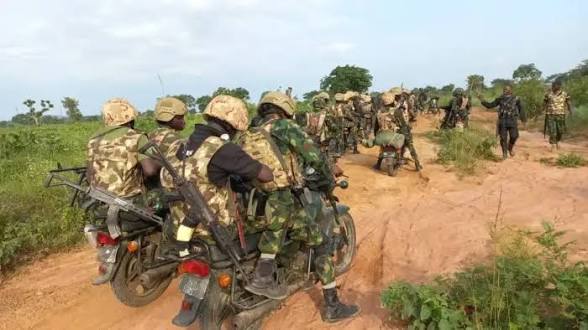
Troops rescue three abducted victims, recover ammunition in Borno
By: Zagazola Makama
Troops of Operation Hadin Kai have rescued three abducted civilians and recovered ammunition during an operation in Bama Local Government Area of Borno State.
Security sources said the operation was carried out at about 10:00 a.m. on March 30 by troops of 202 Battalion in collaboration with volunteer forces at BOCOBS.
According to the sources, the troops responded to credible intelligence indicating that suspected members of the Islamic State West Africa Province and Boko Haram had abducted three locals in the area.
The sources said the troops made contact with the insurgents and successfully rescued all three victims during the operation.
Items recovered from the scene include one AK-47 rifle magazine loaded with 30 rounds of 7.62mm special ammunition.
The sources added that the rescued victims are safe, while troops have continued to dominate the general area to prevent further incidents.
They said the operation is part of sustained efforts to protect civilians and dismantle terrorist activities across the North-East theatre.
Troops rescue three abducted victims, recover ammunition in Borno
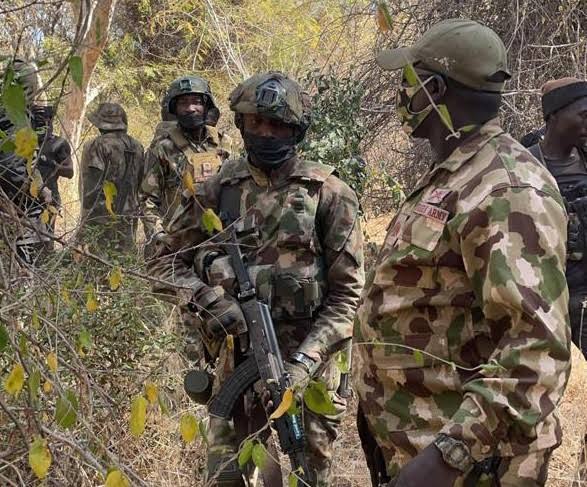
Troops repel terrorist attack in Yobe
By: Zagazola Makama
Troops of Operation Hadin Kai have repelled an attack by suspected members of the Islamic State West Africa Province and Boko Haram on a Forward Operating Base in Yunusari Local Government Area of Yobe State.
Security sources said the incident occurred at about 10:05 p.m. on March 30 at Forward Operating Base Bukarti.
According to the sources, the terrorists launched an attack on the troops’ position, prompting a fierce engagement during which the troops successfully repelled the assailants.
During the encounter, one soldier sustained injuries and has since been stabilised and is responding to treatment.
The sources added that the attackers carted away a gun truck mounted with a QJC gun, a Civilian Joint Task Force vehicle, two motorcycles, a PKT machine gun and a Baofeng radio.
They said troops have continued to maintain operational presence in the area, while efforts are ongoing to recover the stolen equipment and further degrade the capabilities of the insurgents.
Troops repel terrorist attack in Yobe
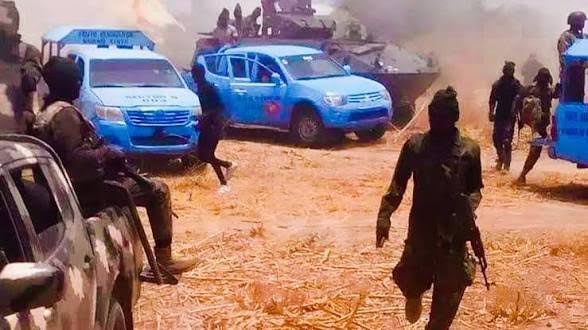
CJTF member accidentally shot by colleague in Borno
By: Zagazola Makama
A member of the Civilian Joint Task Force (CJTF) has been injured in an accidental shooting incident in Biu Local Government Area of Borno State.
Security sources said the incident occurred at about 3:50 a.m. on March 31 at the location of 162 Amphibious Battalion in Mandara-Girau.
According to the sources, the CJTF member was on duty when he was mistakenly shot in the left leg by a colleague.
The victim was immediately evacuated to the battalion’s medical facility, where he is currently receiving treatment.
Sources said the injured personnel are responding to treatment, while further details surrounding the incident are being awaited.
CJTF member accidentally shot by colleague in Borno

Troops arrest two suspected terrorist collaborators in Pulka

Troops rescue three abducted victims, recover ammunition in Borno

Troops repel terrorist attack in Yobe

Roger Federer’s Shock as DNA Results Reveal Myla and Charlene Are Not His Biological Children

THE PLIGHT OF FARIDA

FAILED COUP IN BURKINA FASO: HOW TRAORÉ NARROWLY ESCAPED ASSASSINATION PLOT AMID FOREIGN INTERFERENCE CLAIMS
-
 News2 years ago
Roger Federer’s Shock as DNA Results Reveal Myla and Charlene Are Not His Biological Children
-
Opinions4 years ago
THE PLIGHT OF FARIDA
-
 News12 months ago
FAILED COUP IN BURKINA FASO: HOW TRAORÉ NARROWLY ESCAPED ASSASSINATION PLOT AMID FOREIGN INTERFERENCE CLAIMS
-

 News2 years ago
EYN: Rev. Billi, Distortion of History, and The Living Tamarind Tree
-
 Opinions4 years ago
POLICE CHARGE ROOMS, A MINTING PRESS
-

 ACADEMICS2 years ago
A History of Biu” (2015) and The Lingering Bura-Pabir Question (1)
-

 Columns2 years ago
Army University Biu: There is certain interest, but certainly not from Borno.
-

 Opinions2 years ago
Tinubu,Shettima: The epidemic of economic, insecurity in Nigeria
