
News
EFFECTIVE COLLABORATION, CRITICAL TO SECURITY AGENCIES

EFFECTIVE COLLABORATION, CRITICAL TO SECURITY AGENCIES
…GOC 6 Division Re-Echoes, As Commissioner of Police Visits
By: Jonah Danjuma
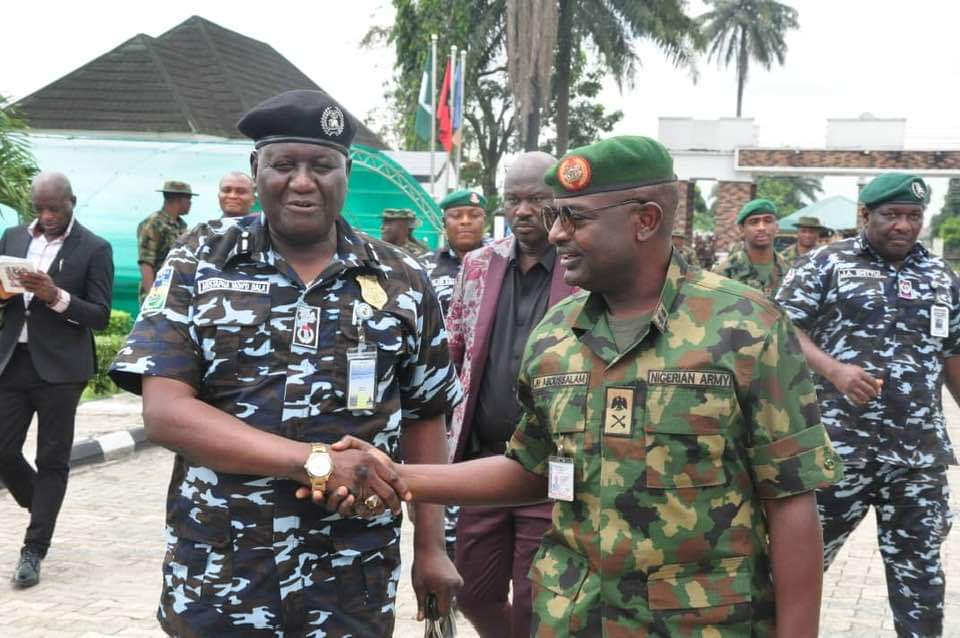
The criticality of effective collaboration among security agencies has been emphasized, particularly in a joint and complex operating environment that the security agencies navigate in the Niger Delta Region (NDR). The General Officer Commanding (GOC ), 6 Division, Nigerian Army (NA), Major General Jamal Abdussalam has today 22 October 2024, emphasized this when the newly posted Commissioner of Police, Rivers State Police Command, CP Mustapha Mohammed Bala paid him a courtesy call at Headquarters, 6 Division, Port Harcourt Barracks.
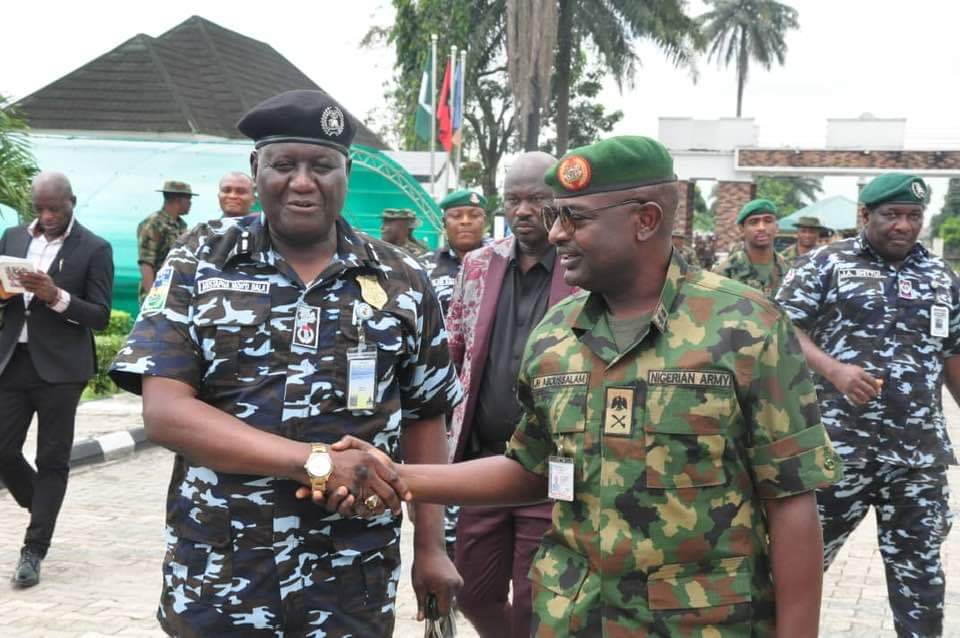
Major General Abdussalam disclosed that Nigeria Police Force (NPF) is a key partner to the NA, adding that if NPF couldn’t contain a situation, that’s when the NA would be called upon to deploy men and equipment. He further stressed that if the NPF didn’t succeed, it means all other security agencies have failed, maintaining that all the agencies are working for a common goal. The failure of one is the failure of all, stressing that if there is crisis in Rivers State, all the security agencies would be blamed, when there is peace, all will take the credit. He called on all security agencies to continue to synergise and cooperate with the NPF in discharging their responsibilities in the NDR.
The GOC stated that collaboration with other security agencies is part of the Chief of Army Staff, Lieutenant General Taoreed Lagbaja command philosophy, which placed emphasis on joint environment. This, he said is a mandate from COAS to collaborate with other security agencies, while assuring the newly posted Commissioner of Police that 6 Division under his watch will continue on the trajectory of collaboration with the NPF to effectively secure Rivers State. He urged commanders of various formations and units to continue to synergise and collaborate with the NPF.
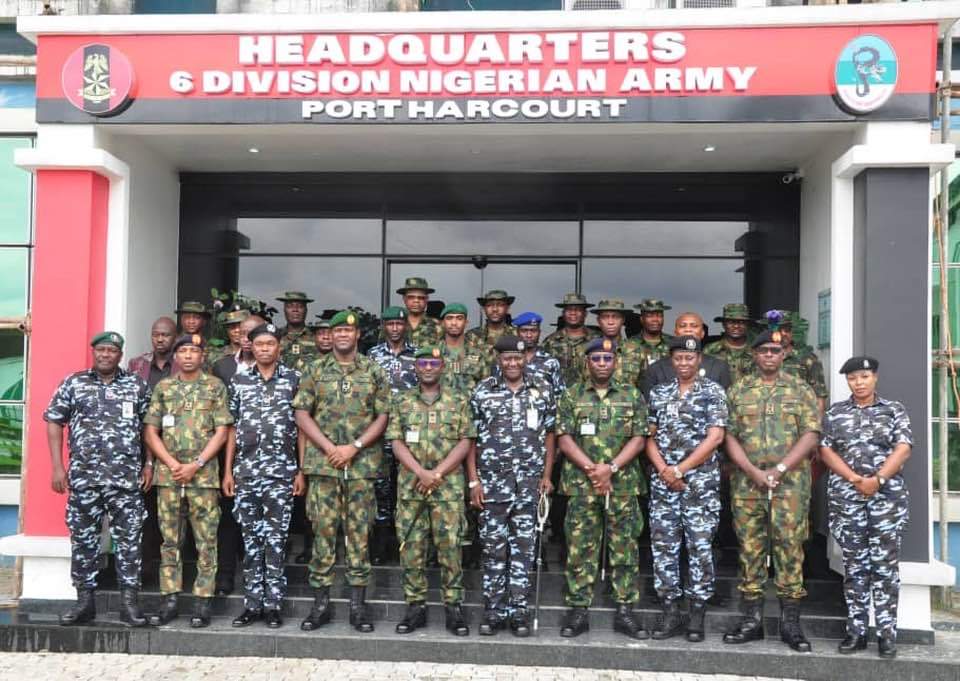
Earlier, while marking his remarks, the Commissioner of Police, Rivers State Police Command, CP Mustapha Mohammed Bala thanked the GOC for his support to the command. He added that the visit to Headquarters 6 Division was basically to seek for more collaboration and support from the GOC and also tap from his wealth of experience as one of the senior military commanders in the State.
CP Mustapha disclosed that he was posted to the Rivers State at trying time and without the cooperation of other security agencies, most especially the NA, it will be difficult to achieve parity in the operating environment. He also expressed his appreciation to the GOC, and pledged effective collaboration with the NA in the State.
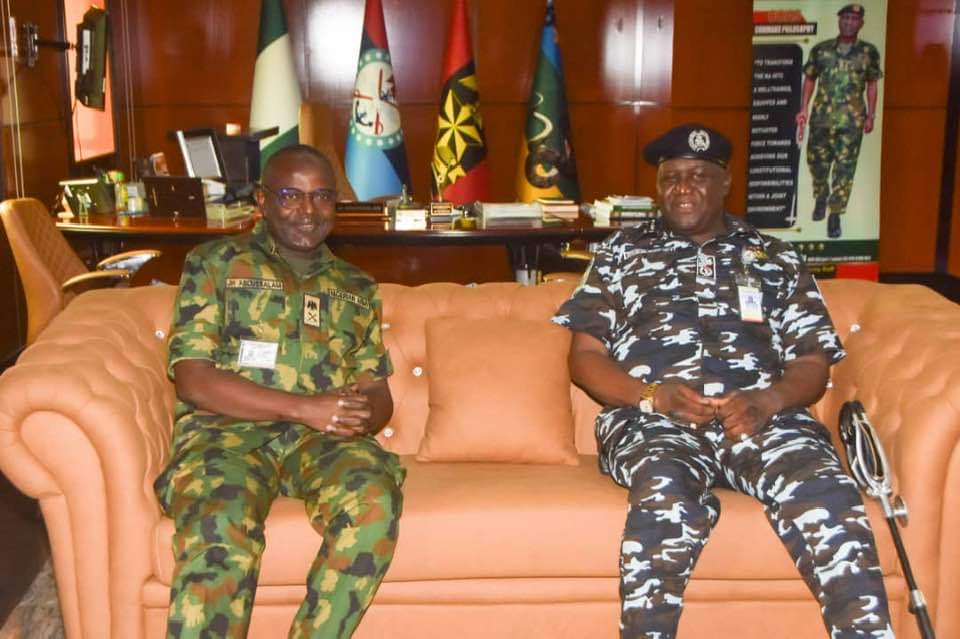
CP Bala reiterated his commitment to work with the NA under the leadership of the GOC, urging that he should considered as one of NA officers posted to work under the GOC. He reassured the GOC of maximum support and cooperation to enable security agencies effectively navigate the complex operating environment in Rivers State.
EFFECTIVE COLLABORATION, CRITICAL TO SECURITY AGENCIES



UBEC, ADSUBEB distribute learning materials to support out-of-school children in Adamawa
Universal Basic Education Commission (UBEC) in collaboration with the Adamawa State Universal Basic Education Board (ADSUBEB) on Friday inaugurated the distribution of learning materials targeting out-of-school children across the state.
Speaking at the event in Yola, Dr Murtala Babayi, Executive Chairman, ADSUBEB appreciated President Bola Tinubu for his administration’s commitment to repositioning the education sector.
According to Babayi, no child should be left behind is not just a policy direction by the Tinubu administration but also a powerful national promise that we are proud to uphold today.
Babayi also commended the efforts of the first lady, Oluremi Tinubu for her advocacy for the welfare, dignity, and education of children especially the most vulnerable.
He said the commitment has become a beacon of hope and a source of inspiration to many across the country.
The Chairman said that the challenge of out-of-school children is not merely an educational issue but a social, economic, and moral concern that demands urgent and collective action.
“Every child out of school represents a dream deferred, a potential untapped, and a future at risk.
“Today, through this initiative, we are taking a bold and practical step to change that narrative”, he said.
According to him, the learning materials being distributed are more than just books and supplies but tools of transformation, instruments of empowerment, and symbols of renewed hope.
Babayi urged parents, guardians, and community leaders to ensure the children remain in school as a collective responsibility to secure their future.
Hajiya Amina Tafida, Zonal Coordinator UBEC in Adamawa, said the distribution of the materials is a collective effort to improve the quality of teaching and learning in public basic education schools across the state.
She said learning materials remain one of the most essential learning resources in any education system.
“When placed in the hands of learners and teachers at the right time and in the right quantity, they improve learners’ understanding, and support better academic performance.
“Today’s distribution is therefore a direct investment in the future of our children and the development of our state”, she said.
Tafida urged education secretaries across the state to ensure that the materials were distributed judiciously and strictly according to the enrollment figures of each school within their local government areas.
Mr Rimoh Jeremiah, Education Secretary of Demsa Local Government who spoke on behalf of his colleagues, assured judicious distribution of the materials and usage for maximum results.
The learning materials includes books, pencils, bags and Sandals among others.
UBEC, ADSUBEB distribute learning materials to support out-of-school children in Adamawa

ITF, NECA Train 30 Entrepreneurs to Turn Business Stories into Economic Value
…Eight-week programme targets weak business positioning, funding challenges
By: Michael Mike

The Industrial Training Fund (ITF) and the Nigeria Employers’ Consultative Association (NECA) have trained 30 entrepreneurs to overcome one of the major obstacles to business growth— the inability to communicate their value, attract customers and position their ventures for funding.
The intervention, delivered through an eight-week skills and storytelling programme, was designed to help business owners move beyond possessing technical or creative abilities to effectively presenting their products, services and economic contributions.
At the graduation ceremony in Abuja, the Executive Director of M-Search Creative Hub and M-Search Media, Zainab Salami, said the programme was conceived after the organisers identified storytelling and business positioning as persistent challenges among entrepreneurs.
She said many business owners had viable products and services but struggled to explain their value to customers, clients and potential investors, limiting their ability to grow and secure funding.
“When we were picking the participants, we wanted to make sure that we picked business owners. And we know that one issue they had was telling their stories and positioning themselves for customers, for clients and also for funding,” Salami said.
She explained that the training was intended to equip participants with practical tools to articulate their business journeys, demonstrate their impact and communicate the value they create for the economy.
“We wanted to make sure that they were able to position themselves, also talk about their value, talk about how they are also creating impact for the economy and make sure that they are able to tell their stories and become better storytellers that can improve Nigerian economic value basically,” she said.
The programme’s focus on storytelling reflects a growing recognition that business survival depends not only on the quality of a product or service but also on the ability of entrepreneurs to make their ventures visible, credible and attractive to the market.
Salami disclosed that the training featured mentors from Nigeria, the United Kingdom and South Africa, who provided practical frameworks on storytelling and business development.
She added that finance experts, including PhD holders in the field, also helped participants understand how businesses could combine profitability with value creation and economic impact.
“We had mentors across board. We had mentors from United Kingdom, we had from South Africa that were experts in storytelling and they were able to give them practical frameworks for them to be able to properly articulate what they were doing, their businesses,” she said.
Salami further explained that the financial component was designed to help participants appreciate the relationship between sustainable business growth, profit and wider economic contributions.
“We even had people from finance, PhD holders from finance that they were able to let them understand how your business can create impact, make profits and also provide value,” she added.
According to her, the organisers received 100 applications but selected only 30 participants to preserve the specialised nature of the programme and ensure that beneficiaries received adequate attention and practical guidance.
“We had 100 people, we had 100 applications but because we wanted to make it niche, we picked 30 participants for this cohort,” Salami said.
Representing the ITF-NECA Technical Skills Development Programme (TSDP), the Training Manager, ITF Modern Skills Training Centre, Abuja, Hayatu Abubakar Tamgol, said the initiative formed part of efforts to build a pool of skilled Nigerians capable of contributing meaningfully to the economy.
Tamgol said the ITF’s mandate was to encourage skills acquisition within Nigeria’s industrial and commercial sectors and develop indigenous manpower capable of meeting the changing needs of the economy.
“The Industrial Training Fund is a human resource development organisation that is empowered to encourage the acquisition of skills within the nation’s industry and commerce with a view to generate a pool of indigenous manpower sufficient to meet the needs of the economy,” he said.
He added that the organisation was committed to developing the competencies and capabilities of Nigerians to ensure that the country had sufficient skilled manpower to manage its economy.
“And in order to do that, the ITF needs to develop competencies and capabilities of Nigerians so as to have an adequate pool of Nigerians that are capable to manage the nation’s economy,” Tamgol said.
The ITF official said the organisation’s participation in the programme was aimed at ensuring that the skills acquired by youths and entrepreneurs could translate into employment, self-reliance and economic development.
Expressing satisfaction with the outcome of the training, Tamgol said the participants had demonstrated that the programme achieved its learning objectives.
“I’m coming in at the graduation time, and from what I have seen, and from the success stories that these trainees were able to share, I’m very satisfied that learning has taken place here,” he said.
He said both the ITF and NECA were satisfied with the results recorded during the programme, adding that skills development remained essential to tackling youth unemployment and promoting self-employment.
Tamgol also disclosed that the ITF, under the leadership of its Director-General, was implementing its flagship Skills of Artisans programme, which provides Nigerians across the country with opportunities to acquire practical skills.
He said the initiative was designed to enable beneficiaries to become self-employed, earn a livelihood and contribute to a stronger economy.
“The ITF presently, under the leadership of our Director General, is implementing her flagship programme, which is the Skills of Artisans programme. And this programme is giving Nigerians the opportunity, all over the country, for them to acquire skills, so as to be able to be self-employed, for them to be able to take care of themselves, so that Nigeria will be better off,” he said.
For one of the beneficiaries, the training offered a new understanding of the importance of deliberately communicating her personal and business journey.
She said the programme taught her that entrepreneurs risk losing control of their narratives when they fail to explain their experiences, vision and value effectively.
“Because one of the things we learn in class is, if you don’t tell your story, somebody will tell it for you and they will tell it wrongly,” she said.
The participant added that technical or creative ability alone was insufficient if customers, partners and investors remained unaware of the person behind the work or the value being created.
“One thing that I’ve learned is that no matter how good you are as a creative, if nobody knows you, it’s like a waste,” she said.
She said the training had equipped her to communicate her work more effectively, explain her vision and position her creative enterprise for greater visibility.
“For me now, learning the story now, I’m not just being a creative, I’m able to let people know what I do and my vision as a whole,” she added.
ITF, NECA Train 30 Entrepreneurs to Turn Business Stories into Economic Value

Airstrikes destroy terrorist logistics hubs, neutralise 18 in Tumbunma Baba
By Zagazola Makama

Nigerian military aircraft under Operation Hadin Kai have destroyed several terrorist structures and logistics hubs, neutralising about 18 terrorists in an air interdiction operation at Tumbunma Baba in the Tumbuns general area.
The operation, conducted at about 6:05 a.m. on Sept. 11, followed intelligence reports of a high-profile terrorist meeting taking place on the islands.
According to military sources, the formation, conducted the air interdiction after confirmatory intelligence, surveillance and reconnaissance (ISR) missions on Sept. 9 identified several terrorist structures and logistics hubs in the area.
The aircraft reportedly acquired and engaged the identified targets with onboard munitions, resulting in the destruction of several structures and logistics facilities.
The strikes also neutralised approximately 18 terrorists believed to be operating from the enclave.
Military sources assessed the operation as having achieved an estimated 85 per cent success rate, with further air interdiction recommended to consolidate the gains and disrupt surviving elements in the area.
The operation is part of sustained efforts by the military to degrade terrorist networks, destroy their logistics infrastructure and deny them freedom of movement and coordination within the Tumbuns.
Airstrikes destroy terrorist logistics hubs, neutralise 18 in Tumbunma Baba

Troops recover cattle after suspected crop destruction in Jos East

UBEC, ADSUBEB distribute learning materials to support out-of-school children in Adamawa

ITF, NECA Train 30 Entrepreneurs to Turn Business Stories into Economic Value

Roger Federer’s Shock as DNA Results Reveal Myla and Charlene Are Not His Biological Children

THE PLIGHT OF FARIDA

FAILED COUP IN BURKINA FASO: HOW TRAORÉ NARROWLY ESCAPED ASSASSINATION PLOT AMID FOREIGN INTERFERENCE CLAIMS
-
 News2 years ago
Roger Federer’s Shock as DNA Results Reveal Myla and Charlene Are Not His Biological Children
-
Opinions5 years ago
THE PLIGHT OF FARIDA
-
 News1 year ago
FAILED COUP IN BURKINA FASO: HOW TRAORÉ NARROWLY ESCAPED ASSASSINATION PLOT AMID FOREIGN INTERFERENCE CLAIMS
-

 News2 years ago
EYN: Rev. Billi, Distortion of History, and The Living Tamarind Tree
-
 Opinions5 years ago
POLICE CHARGE ROOMS, A MINTING PRESS
-

 ACADEMICS3 years ago
A History of Biu” (2015) and The Lingering Bura-Pabir Question (1)
-

 Columns3 years ago
Army University Biu: There is certain interest, but certainly not from Borno.
-

 Politics1 year ago
2027: Why Hon. Midala Balami Must Go, as Youths in Hawul and Asikira/Uba Federal Constituency Reject ₦500,000 as Sallah Gift
